

In this guide
A prepayment customer who owes money is not locked in. Ofgem guidance states that a household can switch supplier where it has a prepayment meter and owes the current supplier up to £5001. Independent guidance puts the same threshold in slightly different words: on a prepayment meter, a switch is possible as long as the debt to the current provider is less than £5002. That £500 per fuel figure is the practical boundary of the Debt Assignment Protocol, the industry arrangement that lets the debt travel with the customer to a new supplier instead of pinning them to the old one.
The mechanism matters because prepayment debt is otherwise a trap. A household that cannot clear a balance cannot move to a cheaper tariff, and the meter keeps taking a share of every top-up. The protocol breaks that by having the old and new supplier agree an assignment of the debt, after which the new supplier collects it through the meter on repayment terms that Ofgem expects to be aligned with the customer's ability to pay3. Once the assignment is agreed, the transfer has a statutory deadline: within 15 working days of the assignment being agreed, and no later than 32 working days from receipt of the required information4.
Above £500 per fuel the protection falls away. Ofgem's own consultation describes the position bluntly: except for prepayment customers protected by the protocol, meaning those with less than £500 debt per fuel, suppliers can block a switch5. The rest of this page sets out who qualifies, how the debt moves, how it is repaid, and what happens at the edges.
What the Debt Assignment Protocol is
The Debt Assignment Protocol is the route by which a prepayment customer's outstanding balance is handed from one supplier to another as part of a switch. It is not a debt write-off and it is not a grant. It is an assignment: the new supplier takes on the right to collect the balance, and the customer keeps paying it, through the meter, at the new address on the new tariff.
The word "assignment" carries a specific legal meaning, and it is worth being precise about it because the same term appears in unrelated energy schemes. In the Domestic Renewable Heat Incentive, Assignment of Rights allows an investor to help fund the purchase or installation of a renewable heating system and in return receive the rights to RHI payments9. That is a financing arrangement between a household and an investor. The Debt Assignment Protocol is a different thing entirely: a transfer of a debt claim between two licensed suppliers, governed by the supply licence conditions and the standards of performance regulations.
The protocol sits inside a wider body of debt rules. Ofgem's consultation on improving debt standards in the domestic retail market describes the protection as applying to prepayment customers with less than £500 debt per fuel, and contrasts it with the position for other customers, who can be blocked from switching5. The licence conditions behind it are enforced through the guaranteed standards regime, where a supplier that fails to meet a standard can be required to make a payment of £40 for each failure4.
For a household, the significance is straightforward. The protocol is what converts a debt from a barrier into a condition of the switch. It does not reduce what is owed, and it does not remove the repayment deduction from the meter. What it does is preserve the household's ability to change supplier, which is the main lever a prepayment customer has over price.
Eligibility: debts between £10 and £500 per fuel
The headline eligibility rule is the £500 per fuel ceiling. Ofgem's switching guidance states it as a condition of the switch: a prepayment meter and up to £500 owed to the supplier1. Independent guidance repeats the same figure as a "less than £500" test2. The two formulations differ only at the boundary, and the practical reading is that a balance at or approaching £500 needs to be discussed with the supplier before a switch is attempted.
The £500 figure is per fuel, so a dual fuel customer with a gas balance and an electricity balance is assessed on each separately. That is a meaningful distinction in a household where one fuel has run up arrears and the other has not.
There is no lower bound in the switching rules themselves. A small balance does not need the protocol at all if it can be cleared, and Ofgem guidance deals with very recent arrears separately: where a customer owes money to the old supplier and has been in debt for less than 28 days, the money owed should be added to the final bill rather than treated as a transferable debt1. Independent guidance describes the same 28 day rule, with the debt added to the final bill2.
The £100 figure that appears in current consultations belongs to a different mechanism. Ofgem's Debt Relief Scheme working paper sets out that households would need to hold eligible debt of £100 or more10, and the statutory consultation states that a floor of £100 on the level of eligible debt is considered appropriate7. That is the entry point for a proposed write-down scheme, not for switching. A household with £150 of prepayment debt is inside the switching threshold and outside the Debt Relief Scheme floor only if the scheme's other criteria are met.
| Rule | Figure | What it governs |
|---|---|---|
| Switching threshold | Up to £500 per fuel1 | Whether the protocol protects the switch |
| Recent arrears | Less than 28 days1 | Whether the debt goes on the final bill instead |
| Debt Relief Scheme floor | £100 minimum eligible debt7 | Entry to the proposed write-down scheme |
| Guaranteed standard payment | £40 per failure4 | Compensation when a standard is missed |
How a debt is transferred when you switch
The transfer is an agreement between two suppliers, and the customer's role is to start the switch and then keep to the repayment arrangement. The sequence has a statutory clock attached to it.
Once the old and new supplier agree the assignment, the transfer must be completed within 15 working days of that agreement, and in any event no later than 32 working days from receipt of the information the regulations require4. Those two deadlines operate together: the 15 working day clock starts when the suppliers agree, and the 32 working day clock starts earlier, when the information arrives. A switch that stalls because one supplier is slow is therefore caught by the outer limit.
The new supplier's consent is the pivot. The protocol protects a customer only where the new supplier agrees to be assigned the debt. Where it does not, the customer is in the same position as any other debtor: the old supplier can require the balance to be settled or reduced before the account is released, and the switch does not proceed on protected terms.
Suppliers also have discretion to write off debt outside the scheme. Ofgem's statutory consultation on the Debt Relief Scheme records that suppliers may continue to write off the debt of customers they are unable to engage with where they deem this appropriate, and that this sits outside the scope of the scheme7. That is a commercial decision, not an entitlement, and it is not something a household can rely on.
The wider debt landscape is being reshaped. Ofgem has consulted on a Debt Relief Scheme intended to reduce the debt stock by up to £500 million under phase 18, funded through network distribution charges10, with supplier claims paid on a "pay when paid" basis and the option of third party assignment10. Under the delivery guidance, suppliers can access third party funding and receive payment for claims prior to May 202711. None of that changes the £500 switching threshold today.
How the debt is repaid on the meter: percentage, fixed weekly or both
Repayment happens through the prepayment meter, and the meter can be configured in more than one way. The two standard methods are a percentage deduction from each top-up and a fixed weekly amount, and a meter can apply both. The choice affects how quickly the balance falls and how much of a top-up reaches the supply.
There is no single national percentage. The nearest published figure is a modelling assumption rather than a rule: Ofgem's Debt Relief Scheme working paper states that its modelling assumed a value for customer contributions and debt repayment displacement of 5%10. That is an assumption about how much of an eligible debt would be recovered from customers in a scheme design, not a cap or a default on any individual meter.
The cost of debt sits behind every bill as well. Ofgem's decision on the price cap operating cost and debt allowances set the debt allowance at 3.6% of bills on average, equating to approximately £71 in the April 2025 cap12. The allowance is built from a weighted average benchmark of total costs, set at an aggregate level across all components of debt-related costs12, based on observed debt costs over 2023 and 202412. The same decision retains the current differences between direct debit and standard credit customers12, and the standard credit allowance is given as £166 per customer on a dual fuel basis12.
For a household, the practical point is that the deduction is negotiable in its structure even where the balance is not. A meter set to take a large fixed weekly sum will clear the debt faster and leave less for heating. A meter set to take a smaller percentage will clear it more slowly. Ofgem's expectations on repayment terms, set out in its guidance on Additional Support Credit, are that repayment terms are aligned with the customer's ability to pay3.
Negotiating an affordable repayment rate

Repayment terms are the part of the arrangement a household has the most room to influence. Ofgem's Additional Support Credit guidance is explicit that repayment terms should be aligned with the customer's ability to pay3, and the same principle runs through the involuntary installation rules.
Where a supplier installs a prepayment meter without permission, it must first make reasonable efforts to agree another way for the customer to repay the debt and offer support if the customer is struggling to pay6. That obligation is a precondition, not an afterthought: the supplier has to try to reach an agreement before the meter goes in.
The wider debt standards work points the same way. Ofgem's consultation on improving debt standards in the domestic retail market is the vehicle for tightening what suppliers must do when a customer falls behind5, and the Debt Relief Scheme consultation describes eligibility as turning on a combination of the level of debt built up during the crisis and the ability of the customer to afford repayments13. Ability to pay is therefore the organising principle in both the switching rules and the scheme design.
The funding options considered for a one-off debt relief scheme include recovery through network charges, cost recovery through a price cap allowance, supplier voluntary contributions, and debt matching through customer contributions13. Ofgem's expectation is that the scheme will be cost neutral against a counterfactual of continuing to use the debt allowance through the price cap to fund bad debt costs13. That matters to a household because it indicates the direction of policy: debt is being treated as a system cost to be managed, not purely as an individual failure.
In practice, a household negotiating a rate is negotiating within a framework where the supplier has published expectations to meet. The rate agreed should be recorded, and it should be revisited if circumstances change. The protocol does not set the rate; the supplier and customer do, subject to Ofgem's expectations.
When the protocol does not apply: debts over £500 and supplier refusal
Two situations take a household outside the protocol. The first is a balance above £500 per fuel, where the protection does not apply and the switch can be blocked5. The second is a refusal by the new supplier to accept the assignment, which removes the mechanism even where the balance is within the threshold.
Where the protocol does not apply, the old supplier can pursue the balance through its ordinary debt processes. Those processes are constrained. A supplier can move a customer to a prepayment meter without permission if the customer is building up an energy debt and other ways of recovering the debt have not worked14, and the same condition appears across Ofgem's consumer guidance: suppliers can move a customer to a prepayment meter without permission if the customer is building up debt and has not responded to the supplier's attempts to help15.
The involuntary installation rules were introduced in 20238, and enforcement has followed. Ofgem's market compliance review of prepayment meter installations sets out a compensation framework, including a £500 level where vulnerability was not considered18, and Ofgem has published on compensation for installing prepayment meters without permission19.
There is also a separate statutory cap on spending in this area. The legislation governing compulsory scheme electricity suppliers provides that spending must not exceed the supplier's obligation percentage of £300,000 in respect of customers who are supplied with neither gas nor electricity, with £600,000 in total20. The two figures describe different scopes within the same provision.
Moving into a property with debt already on the meter
Debt follows the account, not the building. A new occupier does not inherit liability for a previous occupant's arrears, but the meter may still be carrying a repayment arrangement, and until the supplier is told the account has changed hands, top-ups will be reduced by a deduction that belongs to someone else.
The practical steps are to take a meter reading at the point of moving in, register with a supplier, and tell the supplier that the account has changed hands so any repayment arrangement attached to the previous account is removed. Where the property has been empty, the supplier may treat the supply as a deemed contract, and the charges under a deemed contract must be no higher than those payable under the supplier's applicable standard variable supply contract21.
The wider point is that prepayment meters are a payment method, not a status. Ofgem's consumer guidance describes a prepayment meter as a way to pay for electricity or gas in advance rather than after use15. A meter carrying a debt arrangement is doing two jobs at once: collecting payment for current use and recovering an old balance. Separating those two jobs is what the conversation with the supplier is for.
Households moving into a property with an existing prepayment meter should also check whether the meter is a smart meter in prepayment mode, because the rules on remote switching and credit differ from those for a traditional key or card meter. Ofgem's guidance on getting help with a prepayment meter covers the support available where a meter is causing difficulty15.
Getting off prepayment: switching to a credit meter
There is no general right to a credit meter, and suppliers commonly expect a debt to be cleared or substantially reduced before moving a customer off prepayment. The protocol is about switching supplier while keeping a prepayment meter, not about changing the payment method.
Where a supplier has installed a prepayment meter without permission, a specific obligation applies: the supplier must give £30 credit once it has installed the meter or remotely switched the existing meter to prepayment mode6. That credit is a cushion against the immediate loss of supply, not a debt reduction.
The route off prepayment generally runs through the debt. A household that clears the balance, or reduces it to a level the supplier accepts, is in a position to ask for a credit meter. Where the balance is being managed under an arrangement, the supplier's willingness to change the payment method depends on its own credit policy and on the customer's payment record.
The guaranteed standards regime provides a backstop where suppliers fail to meet their obligations. The regulations require an extra £40 to be paid if the original compensation is not issued within 10 working days, or if the supplier fails to forward a payment due from a gas transporter or electricity distributor22. The underlying additional standard payment is £40 for each failure4, and Ofgem has proposed no immediate increase to that £40 level23.
For a household, the sequence that matters is: reduce the balance, keep the arrangement, then ask. The protocol keeps the supplier switch open in the meantime, which is the lever that makes the rest possible.
Protections against forced prepayment installation
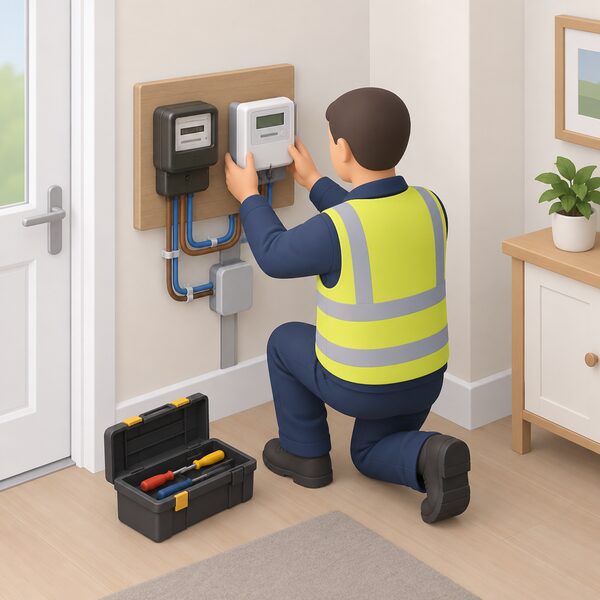
The rules on installing a prepayment meter without permission are the strongest protection in this area, and they operate before any debt assignment question arises.
A supplier may install a prepayment meter without permission only where the customer is building up an energy debt and other ways of recovering the debt have not worked14. Before doing so, the supplier must make reasonable efforts to agree another way for the customer to repay the debt and offer support if the customer is struggling to pay6. The same conditions appear in Ofgem's consumer-facing guidance: suppliers can move a customer to a prepayment meter without permission if the customer is building up debt and has not responded to the supplier's attempts to help15.
The involuntary prepayment rules came into force in 20238. Enforcement since then has produced a compensation framework. Ofgem's market compliance review of prepayment meter installations sets a £500 compensation level where vulnerability was not considered18, and Ofgem has published separately on compensation for installing prepayment meters without permission19.
The guaranteed standards regime also applies to smart meter installation appointments. Ofgem's final decision on smart meter guaranteed standards of performance records that an exemption was updated so that it applies only to refusals from when the legislation comes into effect, and that historical refusals before 23 February 2026 are not captured24. The underlying standards sit in the 2015 regulations4 and in the 2025 statutory instrument21.
For a household carrying prepayment debt, the protections and the protocol work in opposite directions but towards the same end. The protocol keeps the switch open. The installation rules constrain what a supplier can do when a customer falls behind. Together they define the space in which a repayment arrangement is negotiated.
Sources24 cited
- Switching your home energy supplier, Ofgem, 2026
- Gas and electricity switching guidance, Uswitch, 2026
- Additional Support Credit: our expectations, Ofgem, 2025
- The Electricity and Gas (Standards of Performance) (Suppliers) Regulations 2015, legislation.gov.uk, 2015
- Improving debt standards in the domestic retail market, Ofgem, 2024
- Installing a prepayment meter without your permission, Ofgem, 2026
- Debt Relief Scheme statutory consultation, Ofgem, 2025
- Debt strategy update: supporting reduction of energy debt, Ofgem, 2025
- Domestic RHI guide to assignment rights, Ofgem, 2022
- Debt Relief Scheme working paper, Ofgem, 2025
- Debt Relief Scheme delivery guidance, Ofgem, 2025
- Energy price cap operating cost and debt allowances decision, Ofgem, 2025
- Resetting the energy debt landscape, Ofgem, 2024
- Check if energy suppliers can install prepayment meters without permission, Ofgem, 2026
- Get help with your prepayment meter, Ofgem, 2026
- Get help with your prepayment meter, Ofgem, 2026
- Prepayment meters: consumer guidance, Ofgem, 2026
- Market compliance review: prepayment meter installations, Ofgem, 2026
- Compensation for installing prepayment meters without permission, Ofgem, 2025
- The Electricity and Gas (Standards of Performance) (Suppliers) (Amendment) Regulations 2026, legislation.gov.uk, 2026
- The Electricity and Gas (Standards of Performance) (Suppliers) (Amendment) Regulations 2025, legislation.gov.uk, 2025
- Smart meter guaranteed standards of performance, Ofgem, 2025
- Energy consumer outcomes: proposed implementation, Ofgem, 2026
- Final decision: smart meter guaranteed standards of performance, Ofgem, 2026
 Prepayment Meter DebtHow debt repayment is set on a prepayment meter, the limits on the share of a top-up that can be taken, and how to have a rate reviewed.
 Prepayment Meters and DebtCan your energy supplier force you onto a prepayment meter because you owe them money?
 Disconnection and WarrantsCan your energy supplier force you onto prepayment or cut you off for debt?
 Prepayment and Vulnerable RulesThe licence obligations on energy suppliers when a household falls into debt: when a prepayment meter may be installed without consent, the warrant process, the ban covering highly vulnerable households, remote switching of smart meters, and the free help available.
 Switching SupplierHow long does switching energy supplier actually take, and what happens if you owe money?
 Prepayment MetersHow do you top up a prepayment meter for gas or electricity, and what happens when the credit runs out?