In this guide
A comparison site or a broker sits between a household and the supplier, and that position is the whole subject. The site or broker does not generate electricity, does not own the wires and does not carry the supply obligation. It earns money by being the route a household takes to a tariff, and the terms on which it does that determine how much of the market a household actually sees.
The protections that apply depend on which kind of intermediary is involved. Ofgem's own complaints guidance directs households with a problem about an energy supplier to the supplier first, and the Energy Ombudsman describes itself as an independent service, separate to Ofgem, for problems with an energy supplier, an energy broker, a network operator or a heat network supplier1. That single sentence is the clearest statement in the official material that brokers are inside the redress system rather than outside it.
For a household pursuing energy independence, the intermediary layer is a dependency in its own right. A household that generates its own power still buys gas, still imports from the grid at times, and still relies on a supplier's billing systems. The comparison site or broker adds one more party between the household and the meter, and one more set of commercial interests to understand.
What comparison sites and brokers do, and how they differ
A comparison site presents tariffs from a set of suppliers and takes a payment, usually commission, when a household switches through it. A broker does something narrower and more personal: it negotiates or arranges a contract, often for a business or a site with multiple meters, and is paid by the supplier or by the customer. Both are third party intermediaries in the sense that neither is the supplier of last resort, neither owns the network, and neither carries the statutory duties that fall on a licensed supplier.
The distinction matters because the routes to redress differ. The Energy Ombudsman's remit covers problems with an energy supplier, an energy broker, a network operator or a heat network supplier2. Where a household has a dispute with a named comparison business, the Ombudsman's own dispute pages identify the company by the name that appears on the account holder's bill, which is the test it applies to confirm it has the right entity7.
There is a longer-standing concern about how intermediary models affect standards. Written evidence to a parliamentary committee described how the brokerage model through which energy suppliers tender out their installation obligations to individual installers removed the traditional close oversight suppliers have over the standard of installations, with suppliers often not aware who will actually be delivering the work until after the event8. That evidence concerns installation work rather than tariff comparison, but the structural point transfers: when a supplier delegates a customer-facing function to an intermediary, the supplier's direct knowledge of what the customer experiences weakens.
For a household, the practical difference is who holds the contract. If the household contracts with a supplier and the comparison site merely introduced it, the supplier is the counterparty. If a broker arranged the contract, the broker's conduct is itself within the Ombudsman's scope2.
How comparison sites make money, and what that means for the results you see

Commission is the standard model, and commission creates a structural bias that no amount of good faith removes entirely. A site paid by suppliers has an interest in the tariffs those suppliers want sold. The published evidence on supplier profitability gives a sense of the sums moving through the market: independent analysis reports that energy firms banked £6bn in profits in the first six months of 2026, with UK returns worth over £200 of profit for every household in the country, and that a tracker covering 30 energy companies records around £125 billion in profits made on UK operations since 20209.
Those figures describe suppliers rather than comparison sites, and they do not establish that any particular site is biased. What they establish is the scale of the commercial interest on the other side of the introduction. A household reading a comparison result is looking at a market in which the parties paying for the introduction have substantial margins at stake.
Government has acknowledged the comparison problem directly. The 2024 consumer paper included investigating how to make it easier for consumers to compare energy prices between different offerings and tariffs10. That is an official statement that comparison is not yet working as well as it should, which is a more useful thing for a household to know than any claim a site makes about itself.
The honest position for a household is this: a comparison site is a commercial introducer, not an adviser. It can save time. It cannot be assumed to show the whole market, and the tariffs it does show are the ones its commercial arrangements support.
Third party intermediaries: who they act for
The term third party intermediary covers a wide range, and the obligations attached to it vary. The clearest statutory statement concerns pass-through. Legislation introduced in October 2022 included powers to oblige intermediaries, such as private landlords, to pass through the benefit they receive from energy price support to end users12. The Energy Ombudsman's guidance on the Energy Prices Act 2022 sets out the same principle: intermediaries in receipt of support from the Energy Price Guarantee, the Energy Bills Support Scheme, the Energy Bills Rebate Scheme or the Energy Bills Discount Scheme must pass the benefit obtained to consumers, as the intended beneficiaries of the relevant schemes12.
That is a meaningful protection for households whose energy arrives through someone else, whether a landlord, a site owner or a heat network. It establishes that the intermediary is not entitled to keep support intended for the end user.
Where a household pays a site owner or landlord for energy and has a problem, Ofgem's guidance is that the household should contact them first13. Where the household has its own contract with a supplier, it follows that supplier's complaints procedure, with details on the bill or the supplier's website13.
Heat networks sit at the edge of this. Consumer protection regulation for heat networks, including pricing, transparency and quality of service, is reserved, with the UK Parliament retaining the power to make these laws14. The Energy Ombudsman provides an independent service, separate to Ofgem, for problems with an energy supplier, an energy broker, a network operator or a heat network supplier2. The practical consequence is that a household on a heat network deals with a supplier that is not a licensed electricity or gas supplier, and the protections arrive through a different route.
"This means that intermediaries, in receipt of support from the Energy Price Guarantee, Energy Bills Support Scheme, the Energy Bills Rebate Scheme or the Energy Bills Discount Scheme, must pass the benefit obtained to consumers, as the intended beneficiaries of the relevant schemes."
Consumer protection: the banned practices and your rights of redress

The Consumer Protection from Unfair Trading Regulations 2008 provided the core framework, and its status has changed. Regulation 15, which dealt with offences committed by bodies of persons, no longer has effect, and the Regulations were revoked on 6 April 2025 by the Digital Markets, Competition and Consumers Act 202415. There are currently no known outstanding effects recorded for that section15.
What survives in practice is the substance of the consumer rights. Guidance published by a local authority trading standards service sets out that where a supplier misled you or used an aggressive commercial practice, the rights of redress are the right to unwind the contract, the right to a discount and the right to damages3. Those three remedies are the practical core of what a household can ask for when an intermediary's conduct induced a switch.
The government's own consumer guide on buying green heating and insulation products summarises key consumer rights as reflected in consumer protection law, alongside product-specific considerations16. That guide exists because the green heating market attracted selling practices that needed addressing, and the same principles apply to any intermediary selling an energy-adjacent product or service.
Redress in the energy market is under active review. A consultation published in October 2025 on fairer, faster redress covers complaints against domestic energy suppliers, complaints by small enterprises against non-domestic energy suppliers, and complaints against heat networks, and applies to England, Scotland and Wales6. The direction of travel is towards wider coverage, which matters for households whose complaint currently falls outside an ombudsman's remit.
The Energy Ombudsman's own submission to Ofgem's forward work programme consultation set out three priorities: ensuring consumers can access the service in a simple and timely way, having the right powers to enforce signposting and implementation of remedies, and covering significant gaps in consumer redress within the wider energy market11.
Your rights of redress: unwind, discount and damages
The three remedies are distinct and a household should understand which it is asking for. Unwinding means the contract is treated as if it had not been made, which is the strongest outcome and the hardest to obtain. A discount reduces what the household pays. Damages compensate for loss caused by the conduct3.
The Energy Ombudsman's service is free to the consumer, and a dispute can be registered via the website, post, email or telephone4. Once a complaint is escalated, the Ombudsman asks the consumer to send information and evidence, reviews the evidence provided by both the consumer and the energy company, informs both parties of its decision within 6 weeks, and gives the energy company a set of actions to resolve the problem1.
That six-week decision window is the figure a household should hold on to when deciding whether to escalate. It is a defined period, not an open-ended process.
Evidence is the practical constraint. The Ombudsman's dispute pages state that a complainant must have sufficient evidence to support the case, including the date the complaint was raised with the supplier17. A household that cannot show when it first complained may find the escalation blocked before the merits are considered.
For households in Northern Ireland, the redress landscape is separate. The Consumer Council for Northern Ireland is the contact for problems dealing with a fuel supplier18, and it gives free advice and can investigate complaints about natural gas and electricity5.
Checking a comparison site is independent and accredited
Accreditation under the Confidence Code is the recognised marker, and it carries obligations about how results are presented and how the site is paid. The check a household can actually perform is narrower than the marketing suggests: does the site state which suppliers it covers, does it explain its remuneration, and does it present the whole market or a panel.
The Energy Ombudsman's dispute records show how a comparison business is identified when a complaint reaches it. In one published case, the entity was confirmed because the company name matched the name written on the account holder's bill7. That is the test that matters if a household ever needs to name the business it dealt with.
Independent advice is available separately from the comparison market. The Energy Savings Advice Service can give free impartial advice on energy and renewables in England and Wales19. That is a different function from comparison: advice rather than introduction, and free rather than commission-funded.
For households in Northern Ireland, the Consumer Council offers an energy price comparison tool to compare electricity and gas tariffs for all suppliers in Northern Ireland5. The phrase "all suppliers" is the Council's own, and it is the standard a household should expect from a publicly accountable tool.

Northern Ireland: the Consumer Council's comparison tool and free advice
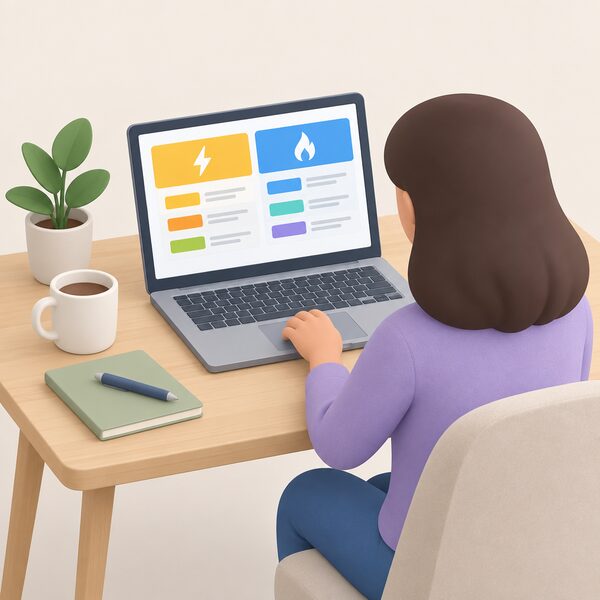
Northern Ireland has a separate market and a separate consumer body, and the arrangements differ from Great Britain in ways that matter to a household. The Consumer Council offers an energy price comparison tool to compare electricity and gas tariffs for all suppliers in Northern Ireland, and it gives free advice and can investigate complaints about natural gas and electricity5. Its service is free to use5.
Alongside the Council, NI Energy Advice offers free independent and impartial energy advice to domestic householders in Northern Ireland, including referrals to energy grants and other sources of help20. The Consumer Council NI and Northern Ireland Energy Advice together provide free, independent and impartial energy advice to all domestic householders in Northern Ireland20.
The Consumer Council's remit is wider than energy. It covers energy, water, transport and postal services, and it may be able to help with an unresolved complaint in any of them5. Its energy complaints scope covers electricity and gas companies, for example billing issues, customer service failings or problems with your meter5. Its water remit covers billing issues or problems with water pressure or quality, its transport remit covers problems with airlines, ferry travel or public transport, and its postal remit covers problems receiving compensation for items being lost or damaged5.
There is a territorial limit. The Consumer Council cannot help consumers who live outside Northern Ireland, unless the complaint is about a flight that departed from or arrived into Northern Ireland5.
For households struggling with bills, the Northern Ireland guidance points to the Consumer Council for Northern Ireland as the contact for problems dealing with a fuel supplier18, and separate advice is published for those struggling to pay energy bills19. Energy efficiency guidance and information on heating technologies suited to a home are also published for Northern Ireland households21.
Complaining about a broker or comparison site: the steps that get results
The sequence is fixed and starting in the wrong place costs time. First, the trader. Where a household pays a site owner or landlord for its energy and has a problem or complaint, the first contact is that trader13. Where the household holds its own contract with an energy supplier, the supplier's complaints procedure applies, with details on the bill or on the supplier's website13.
Second, the ombudsman. The Energy Ombudsman provides an independent service, separate to Ofgem, for problems with an energy supplier, an energy broker, a network operator or a heat network supplier2. Where the problem concerns a network operator, the Energy Networks Association website can identify who the network provider is24.
Third, evidence. The Ombudsman asks the consumer to send information and evidence, reviews the evidence from both sides, informs both parties of its decision within 6 weeks, and gives the energy company a set of actions to resolve the problem1. The dispute can be registered for free via the website, post, email or telephone4.
For households in England or Wales, Citizens Advice's free consumer service can help with problems with energy bills or supply13. It may refer a household to the Extra Help Unit if support is needed with a difficult or urgent complaint, if the household cannot deal with its supplier alone due to personal circumstances, if it is considered vulnerable, or if it is at risk of being disconnected from an energy supply13.
For households in Northern Ireland, the Consumer Council is the route, and it can investigate complaints about natural gas and electricity5.
Where the intermediary layer leaves a household dependent
The comparison site and the broker are dependencies, and they are worth naming as such. A household that switches through an intermediary still depends on the grid, still depends on a licensed supplier for billing and for the supply obligation, and still depends on gas or electricity arriving through infrastructure it does not own. The intermediary adds a commercial party between the household and the meter, and that party's interests are not identical to the household's.
The protections are real but bounded. The Ombudsman covers brokers as well as suppliers2. The pass-through obligation means an intermediary receiving energy price support must pass the benefit to the end user12. The three redress remedies, unwind, discount and damages, exist where a trader misled a household or used an aggressive commercial practice3. Redress is being reviewed to close gaps, with a consultation covering domestic suppliers, small enterprises and heat networks across England, Scotland and Wales6.
What remains outside is the choice architecture itself. A household cannot verify from the outside that a comparison site shows every tariff, and the government's own work on making comparison easier is a recognition that the current arrangement falls short10. The most durable position for a household is to treat the intermediary as an introducer, keep the evidence, and know which body to escalate to when the introduction goes wrong.
Sources24 cited
- Complain about your energy supplier or network operator, Ofgem, 2026
- Network operators, Energy Ombudsman, 2026
- Problems with services, Isle of Anglesey County Council, 2025
- Information for disputes with flexibility service providers, Energy Ombudsman, 2026
- Complaints, Consumer Council for Northern Ireland, 2026
- Fairer, faster redress in the energy market, GOV.UK, 2025
- Go Compare Energy Ltd, Energy Ombudsman, 2026
- Written evidence, UK Parliament, 2015
- News, End Fuel Poverty Coalition, 2026
- Putting consumers first: empowering and protecting energy consumers, GOV.UK, 2024
- Ofgem forward work programme 2025-6 consultation, Energy Ombudsman, 2025
- Heat networks affected by the Energy Prices Act 2022, Energy Ombudsman, 2026
- Alternative homes energy guidance, Ofgem, 2026
- Heat networks, Scottish Government, 2026
- The Consumer Protection from Unfair Trading Regulations 2008, Regulation 15, legislation.gov.uk, 2025
- Buying green heating and insulation products: consumer guide, GOV.UK, 2023
- Theodore Stevenage Limited, Energy Ombudsman, 2026
- Overdue utility bills, nidirect, 2026
- Who to contact, Ofgem, 2026
- Low carbon heating, nidirect, 2026
- Energy efficiency tips, nidirect, 2026
- Heating technologies to suit your home, nidirect, 2026
- Energy saving grants in your area, nidirect, 2026
- Energy terms explained, Ofgem, 2026
 Utility Regulator NIWho sets your energy prices in Northern Ireland and who can you complain to?
 Energy Supply in NICan you get gas where you live in Northern Ireland, and what happens if your power goes off?
 Switch Energy SupplierThe practical sequence of a domestic energy switch: the details and readings needed, the five working day transfer, cooling-off periods, exit fees and the final bill.
 The Full Installers GuideHow do you find an installer you can trust, and what should you check before signing anything?
 Suppliers in Northern IrelandNorthern Ireland runs its own energy market, with its own regulator, its own suppliers and no price cap.
 Who Supplies Your Energy?Not sure who bills you for gas or electricity?