In this guide
Six large companies dominate domestic supply in Great Britain with 91% market share, and Octopus is now the largest electricity supplier and second largest gas supplier in Great Britain, according to Ofgem1. British Gas is described as the largest gas supplier as of March 2026 and the second-largest electricity supplier2. Those two positions, held by different companies in different fuels, are why there is no single uncontested answer to the question of who is Britain's biggest energy supplier: gas and electricity accounts are counted separately, and a household with dual fuel appears twice.
The scale behind those percentages is large. There are approximately 53.7 million domestic customer accounts in Great Britain3. Energy UK, the industry trade association, states that its members deliver over 95% of the energy supply for 28 million UK homes and nearly 80% of the UK's power generation4. Around 20 energy firms are currently available to choose from, down from more than 50 at the end of 20205; a separate count puts the figure at 17 suppliers operating in the UK as of April 20262.
Market share is not a vanity statistic. It is a working number in regulation. Obligations under the Energy Company Obligation and the Great British Insulation Scheme are apportioned using a calculation based on each supplier's share of the gas and electricity supply market6, and Feed-in Tariff costs are spread across all licensed electricity suppliers in Great Britain through the levelisation process, based on their share of the electricity supply market7. Share determines who pays for what, and therefore which customers carry which costs.
What market share means, and why the figure moves
Ofgem classifies suppliers by the share of each fuel they hold rather than by customer numbers alone. Its published definitions set out four categories. Small suppliers "hold less than 1% of the market in both fuels (gas and electricity)". Medium suppliers "hold less than 5% of the market in both fuels (gas and electricity) and 1% or more in a single fuel". Large legacy suppliers "have held at least 5% of the market in either fuel since the government transferred the ownership of gas and electricity from public to private ownership in the 1980s"10.
The underlying measurement for electricity is volumetric, not per household. Ofgem's Feed-in Tariff guidance defines a licensed electricity supplier's market share as the amount of electricity supplied to customers in Great Britain less the exempt amount supplied to qualifying Energy Intensive Industries, expressed as a percentage of the total relevant electricity supplied by all licensed electricity suppliers in Great Britain7. A share measured in kilowatt hours can differ from a share measured in meter points, because customer mixes differ: a supplier with many low-use flats and a supplier with many large houses do not rank the same on both measures.
Shares move for three reasons: households switching, suppliers failing, and companies buying each other. The first has become the least important of the three. In 2015, approximately 3.3 million domestic consumers switched their electricity supplier and 2.6 million their gas supplier11. By the second quarter of 2021, 20% of bill-payers said they were thinking of switching, down from a peak of 23% in the first quarter of that year, and 44% of those who did switch did so exclusively due to cost or tariff12. Acquisitions and failures have since done far more to redraw the map than consumer choice has. Further detail sits on who owns which energy supplier.
The big six and beyond: who supplies British homes
The original grouping was defined by Ofgem as Centrica plc (parent company of British Gas), E.ON UK, Scottish and Southern Energy (SSE), RWE npower, EDF Energy and ScottishPower10. At their height, these companies supplied seven out of 10 British households with gas and electricity2. Four of the original six still supply more than half of energy customers today: British Gas, EDF Energy, E.ON Next and ScottishPower13.
The concentration figure has moved in an arc rather than a straight line. Between March 2015 and March 2016 the six large suppliers' share of domestic meter points fell from 90% to 87% for electricity and from 90% to 86% for gas11. By September 2016, 14% of domestic consumers received their electricity from suppliers other than the six large energy companies, and the number of active domestic gas or electricity suppliers had more than doubled between December 2012 and September 2016, reaching 4814. The Scottish Government recorded the big six share of the Great Britain market at around 80% in 201715. It has since climbed back: 91% by Ofgem's reckoning1, and 91.2% of the domestic electricity market for the six biggest companies in the first quarter of 2025 on an independent count16.
| Measure | Figure | Period | Source |
|---|---|---|---|
| Six large suppliers, domestic electricity meter points | 87% | March 2016 | 11 |
| Six large suppliers, domestic gas meter points | 86% | March 2016 | 11 |
| Big six, Great Britain market | around 80% | 2017 | 15 |
| Six large companies, domestic market | 91% | 2025 | 1 |
| Big six, domestic electricity | 91.2% | Q1 2025 | 16 |
The names inside the 91% are not the names of 2010. Octopus holds the largest electricity position and the second largest in gas1; British Gas is first in gas and second in electricity2; E.ON Next is described as the UK's third largest energy supplier as of March 2026 and EDF as the fifth-largest2. The smaller end has also changed character: in March 2016, 55% of customers of other domestic suppliers with market share above 1% were on fixed-term tariffs, compared to 32% for the six large suppliers11. See also challenger energy suppliers and the big six energy suppliers.
Energy UK: the trade association behind 28 million households
Energy UK is the trade association for the energy industry with over 100 members4. Its members deliver nearly 80% of the UK's power generation and over 95% of the energy supply for 28 million UK homes4. That reach is roughly the size of the whole domestic electricity market as Ofgem measured it in March 2016, when there were around 28 million domestic electricity and 21 million domestic gas customers in Great Britain11.
Energy UK is not a regulator. It has no licensing power and cannot fine a supplier. What it does is coordinate voluntary commitments that, because of its members' coverage, apply across almost the entire market. Thirteen energy suppliers covering more than 95% of homes are signed up to Energy UK's Vulnerability Commitment, and fifteen suppliers covering almost the entire market signed the Winter 2024 Commitment17. The association also serves as a collective vehicle in regulatory processes: in Ofgem's review of price cap wholesale costs, five suppliers worked with Energy UK to commission a consultancy to collectively quality assure their submissions18.
For a household, the practical consequence of near-universal membership is that a voluntary commitment behaves a little like a rule, without the enforcement that a rule carries. If a supplier falls short of a Vulnerability Commitment promise, the remedy lies with the supplier's own complaints process and then the ombudsman, not with the trade body. The obligations that are genuinely enforceable, on vulnerable customers and on prepayment and debt conduct, come from licence conditions set by the regulator. Around 30% of bill-payers contacted their supplier in the past three months as of the second quarter of 202112, so the quality of that relationship is not a marginal matter.
The price cap: how Ofgem limits what suppliers charge
Ofgem first introduced the price cap in 2019 because of concerns that customers who never switched were paying more than those who did19. Its purpose is described plainly by the Welsh Government: Ofgem "sets the price cap to protect people from a 'loyalty penalty'"20. The cap sets a limit to the unit rate of gas and electricity a supplier can charge, and also caps standing charges on standard variable tariffs21.
The legal basis is statutory. Under the Domestic Gas and Electricity (Tariff Cap) Act 2018, the Gas and Electricity Markets Authority "must modify the standard supply licence conditions so that they include conditions ('tariff cap conditions') that impose a cap on all standard variable and default rates that may be charged by the holders of supply licences for the supply of gas or electricity under domestic supply contracts"22.
Coverage and frequency both matter. The default tariff cap protects 22 million default tariff and standard variable tariff customers8. It applies where a customer has not signed up for a fixed-term contract with their supplier23, and does not apply to a household that has signed up to a fixed-term tariff. Ofgem revises the cap each quarter23. That has been the position since August 2022, when Ofgem announced it would update the cap every quarter rather than every six months9; before that it was reviewed twice a year. Suppliers update standard variable tariffs on a regular basis, usually in line with Ofgem's three-monthly changes5.
How the level is built
The cap sets maximum prices for a unit of energy and daily standing charges for customers in each energy supply region of Great Britain23, and varies by payment method as well as region. The headline annual figure is a typical-consumption illustration, not a maximum bill. Regional levels for 1 October to 31 December 2025 show the spread: the table below gives annual electricity figures at nil consumption and at 3,100 kWh single-rate, and at nil consumption and 4,200 kWh multi-register24.
| Region and payment method | Nil consumption | 3,100 kWh single-rate | Nil consumption (multi-register) | 4,200 kWh multi-register |
|---|---|---|---|---|
| South East, Other Payment Method | £165.45 | £960.22 | £166.99 | £1,194.07 |
| Southern, Standard Credit | £183.50 | £1,008.32 | £183.36 | £1,252.38 |
| Eastern, Prepayment | £167.73 | £926.96 | £169.16 | £1,152.98 |
| Southern Western, Other Payment Method | £187.83 | £979.78 | £190.02 | £1,213.43 |
Headline levels have moved sharply. The cap fell to £1,834 in the fourth quarter of 2023 with a planned increase to £1,92825, and for 1 April to 30 June 2026 it was set at £1,64126. During the crisis a separate mechanism, the Energy Price Guarantee, was extended at the £2,500 level18. Northern Ireland sits outside all of this: energy prices were not capped there, and suppliers "have the flexibility to set their tariffs independently to reflect their costs of operating"27. That difference is covered further on energy suppliers in Northern Ireland.
Bills today, and what is driving the difference
The composition of the increase since before the energy crisis is better evidenced than the total. Wholesale prices account for 54% of the rise since pre-crisis levels, network charges for 20% and green levies for 6%28. The same breakdown is reported independently: green levies and network charges account for just 6% and 20% of the rise in bills since before the energy crisis29.
The reason wholesale dominates is structural rather than commercial. Gas sets the wholesale price of electricity in the UK 98% of the time, according to academic research published in 202329. A supplier's tariff, whoever the supplier is, is therefore largely an expression of the international gas price, which is why comparisons between suppliers rarely open up the gaps that comparisons between years do. The UK is described in government material as "a net energy importer with a high dependence on gas and oil", with the price cap protecting consumers from the rapid changes observed in the wholesale energy market in the short term30.
Household experience has eased somewhat from the worst of it. In Ofgem's Financial Vulnerability Classification, the share of consumers classified as "doing well" rose from 46% in January 2025 to 53% in the July to August 2025 wave31. That still leaves close to half of consumers outside that category. During the crisis, direct support flowed through suppliers rather than around them: the Energy Bills Support Scheme provided a £400 energy discount for electricity customers32, an earlier proposal offered "an up-front discount on their bills worth £200" repayable through bills in later years33, and over 900,000 households without a direct supplier relationship had to be reached through local authorities in Great Britain instead34.
Supplier profits: the disputed middle of the bill
Margins on supply are thin relative to the totals that pass through suppliers' hands, but the absolute sums are large. In 2023, suppliers were likely to earn 2.4% profit on every average customer's bill from 1 October, up from 1.9% at the time35. On the same analysis, customers would only pay less profit to energy firms than before if their bill was above £4,000 a year35.
More recent campaign-group tracking puts current figures higher in cash terms. Suppliers are expected to make an additional £140m in profit on the nation's energy bills over the next 12 months following price cap changes, and could take £1.74bn in profits over the next 12 months from customers' energy bills36. Across the wider industry, around £125 billion in profits has been made on UK operations by 30 energy companies since 2020, and energy firms banked £6bn in profits in the first six months of 2026, with UK returns worth over £200 of profit for every household in the country37.
These figures measure different things and should not be added together: a supply margin per bill is not the same as group profit across generation, networks and supply. Ofgem's own review of cap wholesale costs found evidence of recovery beyond allowances in some periods: six suppliers with 65% market share experienced an over-recovery with a range of +£10 to +£77 per standard variable tariff electricity customer across the cap periods examined18. Concentration matters here, because when six firms hold 91% of the domestic market1, an allowance set slightly loose or slightly tight is felt by nearly every household at once. Supplier profits and margins sets out the accounting in more detail.
How the market is regulated
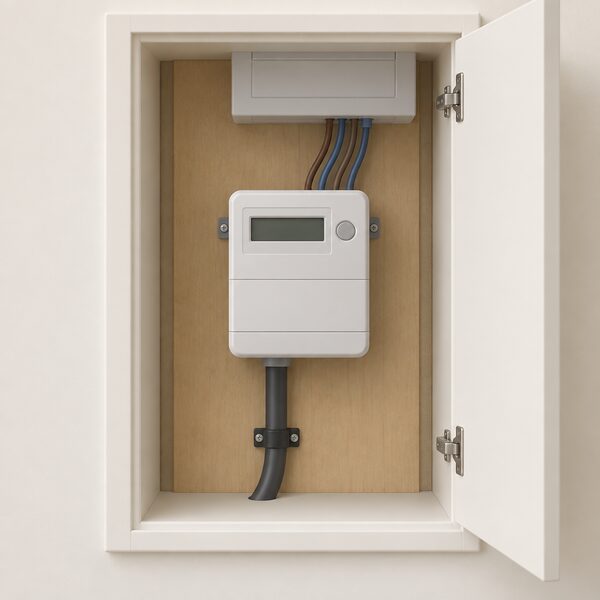
The regulator is the Gas and Electricity Markets Authority, referred to for ease as Ofgem38. Its cap duty is statutory22, and market share is the arithmetic on which several of its schemes turn. Environmental and social obligations are set "using a calculation based on their share of the gas and electricity supply market"6, and under the Energy Company Obligation a household can contact any of the obligated energy suppliers to find out how they may be able to help, even if they are not that household's energy provider39.
Exits are handled explicitly in that arithmetic. Where a licensed electricity supplier has its licence revoked before levelisation, that supplier "will not form part of the market share calculation"7. The consequence is that when a supplier fails, its share of scheme costs does not vanish; it is redistributed across those still trading. The cost of failure on this scale is well documented: between July 2021 and May 2022, 29 energy suppliers failed, affecting nearly four million households in the UK9. See energy supplier failures and supplier of last resort.
One further regulatory feature shapes the cost of getting off gas. The Scottish Government's Heat Pump Sector Deal Expert Advisory Group recorded that most of the regulated social and environmental levies are made on electricity rather than gas, increasing electricity's relative price, and that a rebalancing through action of the UK Government and Ofgem is urgently needed40. Renewable electricity sources now make up 43% of the UK supply21, and emissions in the electricity supply sector are 82% lower than 2008 levels31, yet the levy structure still weighs on the fuel that electrified homes depend on.
What concentration means for household energy independence
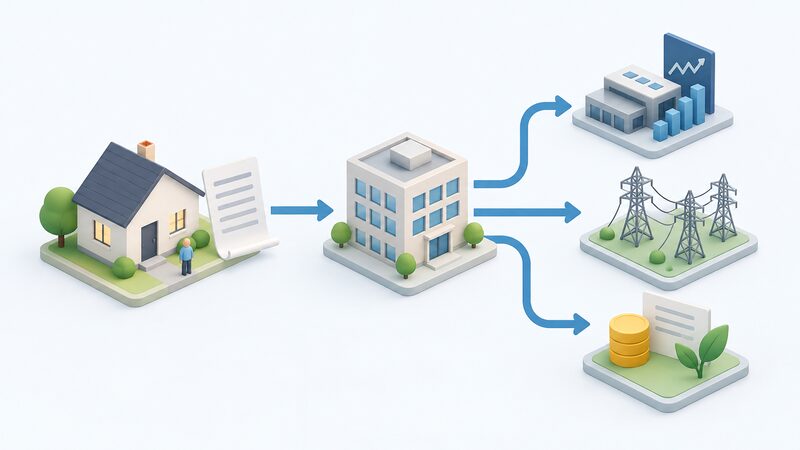
The market was designed with suppliers as the primary interface between energy consumers and the energy system41. That design is the root of the dependence. Whoever bills a household, the supplier sits between that home and the wholesale market, administers the cap, delivers government support, and carries scheme obligations set by its market share. A 91% share held by six companies1 means most households experience the energy system through one of six commercial relationships.
Switching does not change that structure, and the evidence suggests it no longer changes much else either. Ofgem's supplier-level survey for July to August 2025 found that no suppliers saw a statistically significant increase in the proportion of customers who said they were satisfied, or a decrease in dissatisfaction, compared with the January 2025 wave42. Satisfaction among those who had switched had fallen to 67% by December 202243. Earlier work described a market in which "two-thirds of households disengaged and paying more for their energy than customers who have switched suppliers"44; the cap now blunts that penalty for the 22 million accounts it covers8, but it does so by regulating the supplier, not by removing the household's reliance on one.
Genuine reduction in dependence comes from consuming less bought energy or generating some at home. At the start of 2026, domestic solar comprised 30% of UK solar capacity and 84% of total UK solar installations45, so the household sector is already the bulk of installations by count if not by capacity. Even then, the supplier relationship persists: export payments, Feed-in Tariff levelisation, standing charges and metering all run through a licensed supplier. A home with panels and a battery reduces its import volumes and its exposure to the unit rate; it does not leave the market, and it does not escape the standing charge, which the cap sets by region and payment method24. The realistic goal is a smaller, less painful dependence rather than none, and suppliers and energy independence develops that point. The pillar overview sits at /suppliers/.
Sources45 cited
- State of the energy market: retail, Ofgem, 2025-04-15
- Big six energy suppliers guide, Uswitch, 2026-07-17
- Debt Relief Scheme impact assessment, Ofgem, 2025-11-06
- Energy UK explains the Clean Heat Market Mechanism, Energy UK, 2024-01-23
- How to choose an energy company, Which?, 2026-01-19
- Great British Insulation Scheme: energy suppliers, Ofgem, 2026-09-17
- Feed-in Tariff guidance for licensed electricity suppliers, Ofgem, 2024-09-06
- Price cap operating cost and debt allowances decision, Ofgem, 2025-05-23
- Energy supply market report, Public Accounts Committee, 2022-11-13
- Energy terms explained, Ofgem, 2026
- Retail energy markets in 2016, Ofgem, 2016
- Consumer perceptions of the energy market, Q2 2021, Ofgem, 2021
- Which? energy survey results, Which?, 2026-01-19
- Future Insights Series: the future of retail market regulation, Ofgem, 2017
- Scottish Energy Strategy, Scottish Government, 2017
- UK energy statistics, Uswitch, 2025-12-17
- Energy UK's Winter 2024 Commitment, Energy UK, 2024-11-20
- Energy price cap wholesale costs review, Ofgem, 2023-12-15
- What is the energy price cap, Energy Saving Trust, 2026-09-07
- Energy price cap explained, Welsh Government, 2026-03-04
- Heating fuel guide, Uswitch, 2026-01-27
- Domestic Gas and Electricity (Tariff Cap) Act 2018, legislation.gov.uk, 2018-07-19
- Domestic energy prices, House of Commons Library, 2026
- Energy price cap levels, 1 October to 31 December 2025, Ofgem, 2025
- Domestic energy prices briefing, House of Commons Library, 2026-08-28
- Written statement: fuel poverty, Welsh Government, 2026-02-26
- Energy Price Guarantee up until 30 June 2023, GOV.UK, 2026-09-17
- Electricity prices in Great Britain, House of Lords Library, 2026-06
- Factcheck: why expensive gas is keeping UK electricity prices high, Carbon Brief, 2025-05-20
- Spring Statement 2022, HM Treasury, 2022-03
- Energy Consumer Satisfaction Survey, July to August 2025, Ofgem, 2025
- Everything you need to know about government energy support, Which?, 2023-11-02
- Domestic energy prices research briefing, House of Commons Library, 2022-02-03
- Vital help with energy bills on the way for millions more homes, GOV.UK, 2022-12-19
- Ofgem price cap change sets sky-high energy bills for winter, End Fuel Poverty Coalition, 2023-09-26
- Tariff watch, End Fuel Poverty Coalition, 2026-09-20
- News: energy firm profits tracker, End Fuel Poverty Coalition, 2026-09-16
- Improving debt standards in the domestic retail market, Ofgem, 2024-12-12
- Energy Company Obligation: homeowners and tenants, Ofgem, 2026-09-17
- Heat Pump Sector Deal Expert Advisory Group interim report, Scottish Government, 2021-06-14
- Future supply market arrangements: call for evidence, Ofgem, 2017-11-14
- Customers' satisfaction with their supplier: supplier-level findings, Ofgem, 2025
- Energy Consumer Satisfaction Survey, August to September 2023, Ofgem, 2022-12
- A Scotland without fuel poverty is a fairer Scotland, Scottish Government, 2016-10-24
- Domestic solar power, POST, 2026
 Who Owns Which Energy SupplierWho is actually behind the company that sends your energy bill?
 The Full Energy Suppliers GuideWho the UK's domestic gas and electricity suppliers are, how the market is structured across Great Britain and Northern Ireland, what a supplier is licensed and obliged to do, how the price cap limits bills, what happens when a supplier fails, and who regulates it all.
 The Full Where Our Energy Comes From GuideWhere does the gas in your boiler and the electricity in your sockets actually come from?
 Energy Debt and ArrearsHow much do households in the UK owe their energy supplier, and how many people are behind on their bills?
 The Full Statistics GuideHow many homes in the UK have solar panels, heat pumps or batteries?
 Boiler Manufacturers in the UKCovers the manufacturers supplying gas, oil, LPG and electric boilers to UK homes, their main ranges and where they are made.