In this guide
Energy theft is the taking of electricity or gas without paying for it, and it most often takes the form of a meter that has been bypassed, damaged or interfered with. The network operator SSE states that this can range from bypassing the electricity meter, stealing electricity directly from the network, or knowingly using electricity without being registered to an electricity supplier1. A tampered meter is not a private arrangement between a household and a supplier: it is a criminal matter, a safety matter, and a matter that affects every other billpayer on the same network.
Reporting is straightforward and can be done anonymously. Electricity theft can be raised by phone call, through the StayEnergySafe website, or by Facebook Messenger1. The safety instruction that accompanies every reporting route is blunt: do not attempt to touch any of the equipment if you spot something unusual, instead report it anonymously1. The reason is that interference with a meter carries a risk of fatality in the worst cases1.
The legal position is set out in the Electricity Safety, Quality and Continuity Regulations 2002, under which a person failing to comply with applicable provisions is liable on summary conviction to a fine not exceeding level 5 on the standard scale2. Ofgem, for its part, does not investigate individual disputes and does not directly get involved with complaints about energy suppliers or network operators3. Reports of suspected theft go to the network, and disputes that follow go to the Energy Ombudsman, an independent service separate to Ofgem3.
What counts as energy theft and meter tampering
The network operator's definition is broad, and it is worth reading carefully because it covers conduct that a householder might not think of as theft at all. It ranges from bypassing the electricity meter, to stealing electricity directly from the network, to knowingly using electricity without being registered to an electricity supplier1. The third of those is the one that catches people out: a property that is occupied and drawing power with no registered supply is, on this definition, being supplied unlawfully, whether or not anyone has physically touched the meter.
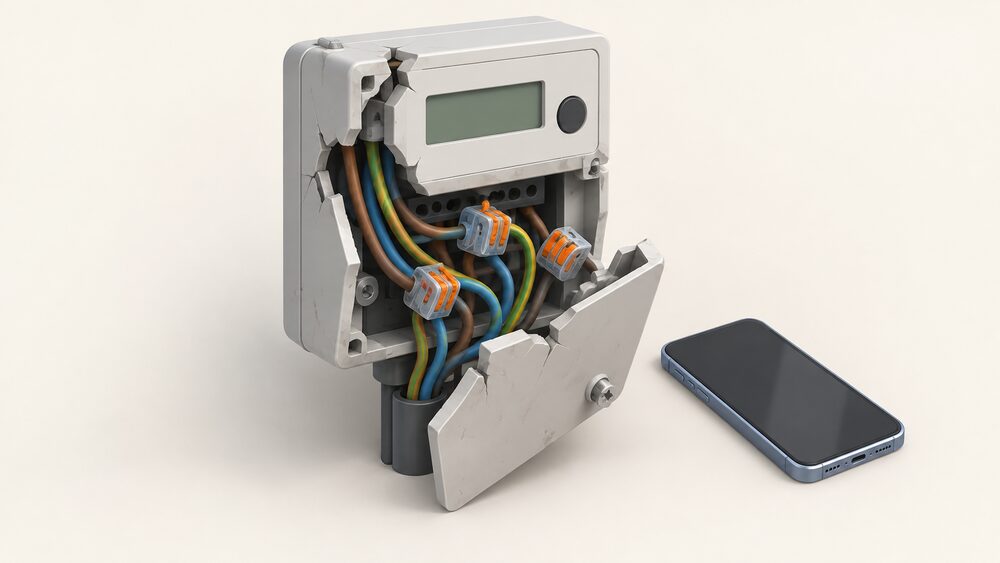
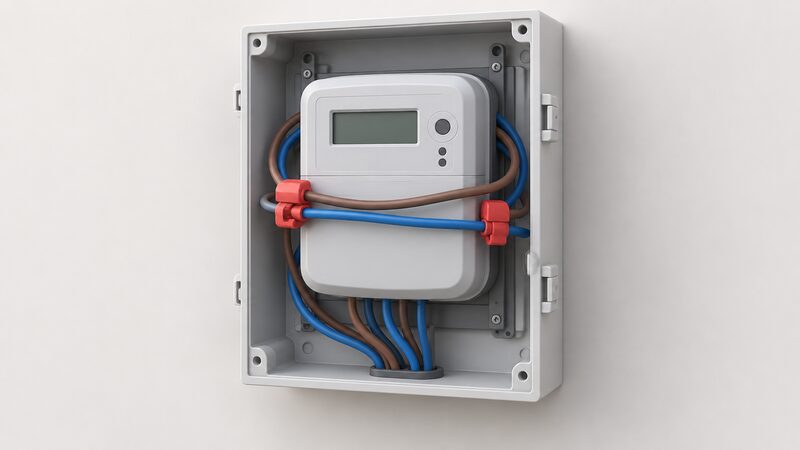
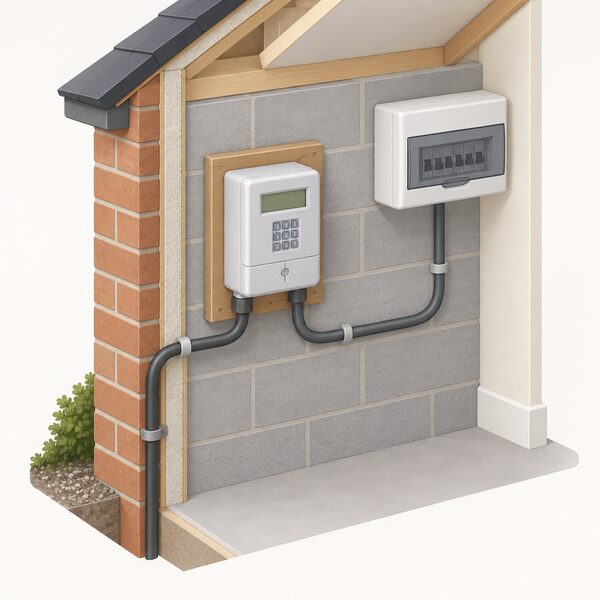
Meter tampering is the physical end of the same problem. The signs the network operator lists are specific and observable from outside the meter box in many cases. Wires sticking out or wrapped around and connector clips attaching them to the meter can be a sign of a potential bypass1. So can a casing that has been smashed, broken, or removed completely with the cables disconnected1. A smell of something burning, or smoke or sparks near the meter box, is listed as a further sign of a potential bypass1.
It is worth separating suspicion from certainty. A meter box that smells of burning may be a bypass, or it may be an ordinary electrical fault, and the Met Office advises that if neighbours still have power but your home does not, it is likely there is a problem with the fuses or trip switches in your home4. That distinction matters for what a householder does next: an internal fault is a call to an electrician, while a suspected bypass is a report to the network.
Smart meters change the picture on detection rather than on legality. Only your supplier, or third parties given explicit permission from the consumer, can see how much energy you are using and when5. That means an unmetered or bypassed supply is not hidden from the supplier in the way a purely mechanical meter might once have been, and consumption data sits with the supplier rather than being openly visible to neighbours or to other parties.
Meter tampering is a criminal offence: fines and prison sentences
The core offence provision sits in the Electricity Safety, Quality and Continuity Regulations 2002. A person who fails to comply with applicable provisions shall be liable on summary conviction to a fine not exceeding level 5 on the standard scale2. The regulations apply to duty holders and consumers, so the exposure is not confined to whoever physically carried out the work2.
Alongside the criminal route, there is a regulatory route that bites on companies rather than householders. Ofgem has stated that failure to comply with smart meter repair rules could result in the energy regulator putting companies on notice or enforcing fines, and that suppliers could face action from the regulator, which could include fines or legal action6. That is a separate track from the criminal offence, and it is aimed at suppliers' conduct rather than at a household's meter.
There is also a data offence that sits alongside energy performance and metering rules. Unauthorised disclosure of data is a criminal offence7, and the Energy Performance of Buildings Regulations 2012 create three criminal offences: inappropriate disclosure of data, obstructing an enforcement official, and impersonating an enforcement official8. These are not theft offences, but they show how far the statutory protection around metering and energy data now reaches.
For a householder, the practical point is that a tampered meter is not a way of reducing a bill that carries only a civil risk. It carries a criminal one, and the fine is set by statute rather than by the supplier. Where a meter has been interfered with by a previous occupant, the person now responsible for the property can find themselves dealing with the consequences of work they did not commission.
How to report energy theft: phone, StayEnergySafe and Facebook Messenger
There are three routes, and they are deliberately low-friction. Electricity theft can be reported by phone call, through the StayEnergySafe website, or by Facebook Messenger1. All three are described as ways to raise a report, and the network operator states that reports can be made anonymously1. A householder does not need to give a name, an address, or a reason for suspicion.
The anonymity is the point of the design. The instruction that accompanies the reporting routes is to report anonymously rather than to intervene: do not attempt to touch any of the equipment if you spot something unusual, instead report it anonymously1. That applies whether the suspicion concerns a neighbouring property, a shared meter cupboard in a block of flats, or a meter in a property the reporter has some connection to.

The channels are for electricity theft specifically. Gas theft and interference with gas meters sit under a different safety regime, and the risks are different in kind. The Health and Safety Executive states that poorly maintained, badly installed or faulty gas appliances can cause gas leaks, fire, explosions and carbon monoxide poisoning9. In Northern Ireland, gas work is regulated through the Gas Safe Register, which nidirect describes as the official list of gas businesses registered to work safely and legally on boilers, cookers, fires and all other gas appliances10. A suspected gas meter interference is a safety report to the network or to the gas emergency service, not a StayEnergySafe report.
"Do not attempt to touch any of the equipment if you spot something unusual, instead report it anonymously."
What happens after you report
The report goes to the network operator, which is the body that owns and maintains the wires and meters and which investigates suspected bypassing or direct theft1. The reporter's involvement normally ends there. Anonymity means there is no follow-up to the person who raised it, and no obligation to provide evidence or to be contacted again.
Where the matter becomes a dispute between a household and its supplier, a different process applies. The Energy Ombudsman is an independent service, separate to Ofgem, for problems with an energy supplier, an energy broker, a network operator or a heat network supplier3. A complaint can be escalated if a problem reported is not fixed within 8 weeks, if the household and the energy company cannot agree on a fix, if a deadlock letter is received, or if the household is not happy with the decision received3.
Once a complaint is escalated, the Ombudsman will ask for information and evidence, review the evidence provided by the household and the energy company, inform the household of its decision within 6 weeks, and give the energy company a set of actions to resolve the problem3. For heat networks, the period after which a complaint can be escalated to the Energy Ombudsman remains eight weeks11.
There is a separate route where a supplier has failed. If a household has a case open with the Energy Ombudsman when a supplier goes out of business, the Ombudsman will contact them to discuss next steps12. That matters in theft cases because a supplier under investigation may also be a supplier in difficulty, and the two processes can run at once.
Billing errors are a common companion to meter problems, and they have their own evidence trail. In one Ombudsman case study, a meter reader had taken a reading of 34518 from the meter eight months before the complaint, and a missed meter exchange led to incorrect estimated billing13. The lesson for a household facing a disputed meter is that dated readings and records are what a case turns on.
Why tampering is dangerous beyond the legal risk
The safety case is the strongest argument against interference, and it does not depend on the law at all. Stealing electricity is highly dangerous and in the worst cases it can result in a fatality1. That is the network operator's own assessment, and it is stated without qualification.
The mechanism is straightforward. A bypass carries current around the protective devices that a properly installed supply relies on, and the connections are made outside the design of the installation. The visible signs the network operator lists, wires wrapped around with connector clips, a casing smashed or removed with cables disconnected, and a smell of burning or smoke or sparks near the meter box, are all descriptions of an installation that has been taken outside its safe operating envelope1.
Gas carries a comparable and in some ways sharper risk. Poorly maintained, badly installed or faulty gas appliances can cause gas leaks, fire, explosions and carbon monoxide poisoning9. Where a gas engineer finds an appliance or installation to be either at risk or immediately dangerous, both carry the same message on the warning label: Danger Do Not Use14. The Gas Industry Unsafe Situations Procedure therefore treats the two categories as equally requiring the supply to be left alone.
There is a wider safety principle that applies to any alteration of a building's services. The Scottish Building Standards Technical Handbook states that care should be exercised, particularly with withdrawn standards, in relation to wind and snow loadings where the effects of climate change may render these unsafe15. The point is not about meters directly, but about the general rule that work done to an older standard, or outside a standard, is not automatically safe because it was once accepted.
For a household, the safety consequence of a tampered meter is that the risk is not confined to the property where the interference happened. A bypass on a shared supply, in a block or a terrace, puts current outside the protection of the installation that serves neighbouring homes as well.
How suppliers and Ofgem handle theft and licence obligations
Ofgem's role in this area is as a monitor and an administrator rather than as an investigator of individual cases. Ofgem monitors energy suppliers and network operators closely to make sure they meet the rules set out in licences, regulations and law, provide good customer service, and reply quickly to customers3. It does not directly get involved with complaints about energy suppliers or network operators, and it does not investigate individual disputes3.
Where Ofgem does act is on supplier conduct and on scheme compliance. As scheme administrator for the Energy Company Obligation, Ofgem is responsible for setting energy suppliers' obligations, calculating suppliers' obligations and tracking performance against them, processing notifications, auditing suppliers, counter fraud, and reporting to the Secretary of State at DESNZ16. Obligated energy suppliers notify Ofgem of the measures they have delivered17. For the Warm Home Discount, Ofgem's role is to administer the industry initiatives and facilitate suppliers' compliance with the scheme18.
The enforcement posture is stated plainly. On the price cap, Ofgem will be closely monitoring supplier compliance and will continue to take firm action against suppliers who fall short of their requirements19. On smart meter repair rules, failure to comply could result in the energy regulator putting companies on notice or enforcing fines6.
Suppliers also carry guaranteed standards with compensation attached. Ofgem requires energy suppliers to meet Guaranteed Standards and sets the level of compensation payable if they breach a standard20. That is the mechanism a household can point to when a supplier's handling of a meter problem has caused a delay or an error, and it sits alongside the Ombudsman route rather than replacing it.
The prepayment meter rules show how far supplier conduct obligations now reach. Suppliers installing prepayment meters without permission must make at least 10 attempts to contact the household using different methods, for example phone calls, letters or text messages21. In a market compliance review, at least 40,000 customers were affected, and energy suppliers will also write off a further £13 million debt from customers who had a prepayment meter installed without permission during the assessment period22. Those figures are about forced installation rather than theft, but they illustrate the same principle: where a supplier's conduct around metering falls short, the remedy is regulatory and financial.
Energy theft and your household energy independence
A household's energy independence rests on a supply it controls, a meter it can read, and a relationship with a supplier it can hold to account. Meter tampering attacks all three at once. A bypassed meter removes the household's own visibility of what it is using, because only the supplier, or third parties given explicit permission from the consumer, can see how much energy is being used and when5. The household loses the record on which a dispute would be built.
The dependence that remains after a report is real and worth stating. The network operator owns the meter and the wires, and it investigates1. The supplier holds the consumption data5. Ofgem monitors and administers but does not investigate individual disputes3. The Energy Ombudsman can decide a dispute and set actions for the company, but only after the escalation thresholds are met3. A household that reports a suspected theft is therefore handing the matter to bodies it does not control, and its own role ends at the report.
There is a second dependence, on the integrity of the meter itself. A meter that has been interfered with is a meter whose readings cannot be relied on, and the consequences of that run into billing. The Ombudsman case study on a missed meter exchange shows how a single dated reading, 34518 taken eight months before the complaint, became the anchor for a dispute about estimated billing13. Where a meter has been tampered with, that anchor is missing.
For a household thinking about independence in the round, the practical position is that a lawful, working meter is the foundation of every other step. Smart metering, accurate readings and a clear account history are what make it possible to challenge a bill, to switch supplier, and to plan consumption. Theft, whether by a previous occupant or by a neighbour on a shared supply, undermines that foundation for everyone connected to it, and the reporting routes exist precisely so that a suspicion can be passed to the network without the reporter taking on any risk themselves1.
Sources22 cited
- Electricity theft, SSE, 2026-09-19
- The Electricity Safety, Quality and Continuity Regulations 2002, legislation.gov.uk, 2002-10-24
- Complain about your energy supplier or network operator, Ofgem, 2026
- What to do in a power cut, Met Office, 2026-09-20
- Protecting data on the smart meter network, Smart DCC, 2026
- Tough new rules force suppliers to fix faulty smart meters, GOV.UK, 2026-03-10
- The Energy Performance of Buildings (Scotland) Regulations 2008, legislation.gov.uk, 2008-09-16
- Energy Performance of Buildings Regulations 2012 guidance, legislation.gov.uk, 2023-09-26
- Gas Safe Register, nidirect, 2025-10-29
- Building Standards Technical Handbook - Domestic (April 2026), Scottish Government, 2026-03
- Energy Prices (Domestic Supply) (Northern Ireland) Regulations 2022(NorthernIreland)Regulations2022), Hansard, 2022-11-16
- What happens if your energy supplier goes out of business, Ofgem, 2026
- Guidance on scam emails claiming to be from Energy Ombudsman, Energy Ombudsman, 2026-02-09
- Gas safety in the home: frequently asked questions, Health and Safety Executive, 2026
- Domestic RHI: Guide to metering, Ofgem, 2026
- Energy Company Obligation (ECO), Ofgem, 2026-09-17
- Great British Insulation Scheme: energy suppliers, Ofgem, 2026-09-17
- Warm Home Discount (WHD), Ofgem, 2026-09-17
- Summary of changes to energy price cap 1 October to 31 December 2025, Ofgem, 2025-08-27
- Problems with services, Isle of Anglesey County Council, 2025-10
- Check energy suppliers can install prepayment meters without household permission, Ofgem, 2026
- Compensation for installing prepayment meters without permission, Ofgem, 2025-05-28
 Scams and Mis-SellingHow energy supplier scams present, what the doorstep and phone selling rules require, the redress available when a contract was mis-sold, and how the Energy Ombudsman handles a dispute.
 Spot and Report an Energy ScamThe common approaches used in rebate texts, grant cold calls, doorstep sales and fake supplier emails, and the checks that confirm whether contact is genuine.
 Report a Faulty MeterWhat to do when a meter over-records, stops recording or produces impossible readings: the evidence to gather, how to raise it with the supplier, the 5 working day and 8 week deadlines, and how the Energy Ombudsman handles meter disputes.
 Prepayment Meter DebtHow debt repayment is set on a prepayment meter, the limits on the share of a top-up that can be taken, and how to have a rate reviewed.
 Smart Meter Data and Who Sees ItWhat does your smart meter actually record, and who gets to see it?
 Submit Meter ReadingsThe routes for sending readings, by app, online account, phone and automated line, and the timing that gets them onto the right bill.