

In this answer
Short answer
A tenant's electrical safety checklist starts with two documents: the current Electrical Installation Condition Report (EICR) and the annual Gas Safety Record. The law places the duty on the landlord. Under the Electrical Safety Standards in the Private Rented Sector (England) Regulations 2020, a landlord must "ensure that the electrical safety standards are met during any period when the residential premises are occupied under a specified tenancy"1. Landlords must supply new tenants with a copy of the current EICR at the start of their tenancies2.
The gas side runs on a fixed annual cycle. The landlord is responsible for servicing boilers and appliances annually and must provide an up-to-date gas safety record, which is a legal requirement3. A record of the safety check must be kept for two years, with a copy issued to each existing tenant within 28 days of the check and to any new tenants before they move in4.
What a tenant can change is narrower than what a tenant can ask about. If the energy bills are in your name, the choice of supplier and of meter sits with you; if the landlord pays the supplier, it does not. The sections below set out the documents, the permissions and the limits.
What the law requires of your landlord
Two separate legal strands cover a rented home. The first is the electrical installation. The Electrical Safety Standards in the Private Rented Sector (England) Regulations 2020 require the landlord to ensure the electrical safety standards are met during any period when the residential premises are occupied under a specified tenancy1. That is a continuing duty, not a one-off inspection at the start of the tenancy.
The second strand is older and covers the wiring itself. The Landlords and Tenant Act 1985 requires landlords of properties with short leases to keep the electrical wiring in repair and in proper working order2. This is a repairing obligation rather than a testing one, and it applies alongside the periodic inspection regime.
The practical instrument for the first duty is the EICR. An EICR will cost a landlord approximately £150 to £300, depending on the size and location of the property, on the basis that no further work is needed2. Where remedial work is required, that figure does not cover it. Landlords must supply new tenants with a copy of the current EICR at the start of their tenancies2.
Government guidance on these standards is written for landlords, tenants and local councils, which matters because it confirms that tenants are an intended audience for the rules rather than bystanders to them7. Local authorities enforce the regime, and the guidance is the reference point for what compliance looks like.
For a household's energy independence, this is the least negotiable layer. A tenant cannot rewire a property, cannot replace a consumer unit, and cannot commission an EICR. The safety of the fixed installation is entirely the landlord's responsibility, and the tenant's lever is the paperwork: asking for the report, checking its date, and raising concerns with the council where it is missing.
Certificates and records to ask for

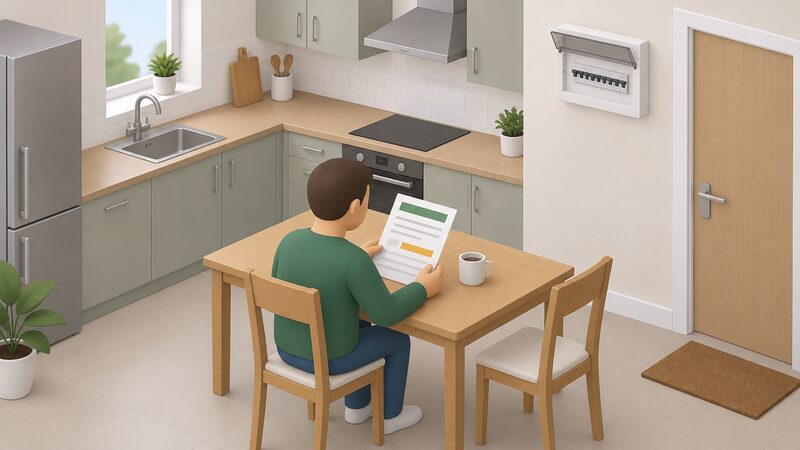
The two documents worth requesting in writing are the EICR and the Gas Safety Record. Tenants should ask for a Gas Safety Record, and should ensure their landlord provides a current one8. The Gas Safety Record is the tenant-facing summary of the annual check on each appliance and flue.
An electronic copy is acceptable. The record must be capable of being reproduced in hard copy format when required, for example for the tenant, the Health and Safety Executive or the housing department; it must be secure from loss and interference; and it must uniquely identify the gas operative who carried out the safety check4. A photograph of a certificate on a phone is not automatically sufficient if it fails those tests.
Tenants should also check that any engineer who visits to carry out work is Gas Safe registered9. Registration is the individual engineer's, not the firm's, and it can be checked directly.
"Ask for a copy of the annual gas safety record."
Where a gas appliance needs attention, the route runs through the landlord. If you rent your home, you will need to contact your landlord to arrange a safety check for all gas appliances and flues by a Gas Safe registered engineer11.
In Northern Ireland the same annual servicing expectation applies: the landlord is responsible for servicing boilers and appliances annually, and an annual safety check must be carried out on each appliance or flue provided for tenants' use3. The enforcement bodies differ from those in Great Britain, but the duty on the landlord does not.
| Document | Who holds it | Tenant's route to it | Timescale |
|---|---|---|---|
| EICR | Landlord | Copy at start of tenancy2 | At start of tenancy |
| Gas Safety Record | Landlord | Copy within 28 days of check; before move-in for new tenants4 | Annual cycle |
| Engineer registration | Gas Safe register | Check the visiting engineer9 | On each visit |
Smart meters in a rented home: who decides and who pays
The dividing line is the bill payer. If you rent your home and the energy bill is in your name, it is your choice to have a smart meter installed5. The same rule is stated by the energy advice body: if your energy bill is in your name, it is your choice to have a smart meter installed13. Private renters can choose a smart meter if the energy bills are in their name or they prepay for energy, after checking the tenancy agreement and letting the landlord know14.
Where the landlord pays the supplier, the position reverses. Any household that pays for energy, whether owning or renting, should be able to book a smart meter installation where it is expected to work in the property15. That is a statement about suppliers' obligations to bill payers, not a right that overrides a landlord who holds the account.
Two conditions sit on top of the choice. First, there might be rules in your contract about how energy is supplied, including the type of meter that can be installed16. Second, it is recommended that you let your landlord know before you make the change13. Neither removes the choice where the bill is in your name, but both shape how it is exercised.
The consumer body's position is that renters with bills in their name hold the choice, whether renting a flat or a home17. The energy ombudsman handles complaints about smart meter installation and operation where a supplier has not resolved them14.
For energy independence, a smart meter changes information rather than supply. It gives a household half-hourly visibility of its own consumption and, with an in-home display, the ability to act on it. It does not reduce dependence on the grid, the supplier or the standing charge, and in a rented home it may have to be removed or reconfigured if the tenancy ends and the next occupier's supplier cannot use it.
Switching supplier when you pay the bills
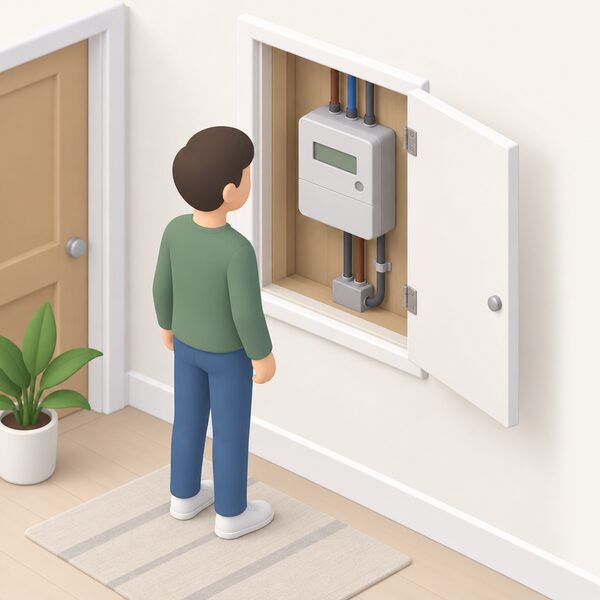
If you pay a supplier directly for the electricity or gas you use at home, you can choose to switch to a different supplier or tariff at any time19. Ofgem states the same rule in tenant-facing terms: if you have to pay your energy bills, you can choose to switch your supplier or tariff at any time19. Consumer protection law gives tenants who pay their energy company directly the right to choose their supplier18.
The tenancy agreement can still shape the practical outcome. It is worth checking the agreement to see if the landlord has listed a preferred supplier; a tenant can still switch, but may need to switch back when leaving20. That is a contractual term about the end of the tenancy rather than a bar on switching during it.
Where the landlord pays the energy company, they choose the supplier, and a tenant can ask them to change but they are not obliged to18. Residents on a landlord's business contract may not have the right to choose their own energy supplier or switch suppliers themselves21. Residents who hold their own contract with a supplier may be able to switch their business energy supplier7.
If arrears have built up, the supplier should review current payments and debt repayments before any switch proceeds22. A prepayment meter can be changed to a credit meter in some circumstances: some suppliers install a new meter for free, but in most cases a credit check must be passed or a refundable deposit paid, and private tenants who are the bill payer have the right to change payment method23.
Switching is the clearest lever a renting household holds over its own energy costs, and it is also the most limited. It changes who bills you, not how the home performs. The fabric, the heating system and the meter type all remain the landlord's property.
Warmth, insulation and the £350 premium
A rented home's thermal performance is set by the landlord, and the grant system reflects that. The Warm Homes: Local Grant covers privately rented properties with an EPC rating of Band F or G which have a registered exemption under the Energy Efficiency (Private Rented Property) (England and Wales) Regulations 201524. Owner occupied properties at Band D, E, F or G are covered on a different footing24.
For domestic private rented property, the legal baseline is the 2018 Minimum Level of Energy Efficiency standard, EPC band E6. A home below that band needs either improvement or a registered exemption, and the exemption is what unlocks the grant route for the worst-performing rented stock.
In Scotland, Home Energy Scotland administers grant and loan funding, including a Private Rented Sector Landlord Loan25. For heating systems such as warm air units or high heat retention electric storage heaters, that loan covers up to £5,00026. For heat pump replacement applications, the applicant must provide a letter from an installer detailing why a replacement is the most suitable option for the home26.
Secondary improvements under the Scottish scheme are funded per measure: £375 each for a cylinder thermostat, draught proofing, a wastewater heat recovery system or a hot water tank jacket25.
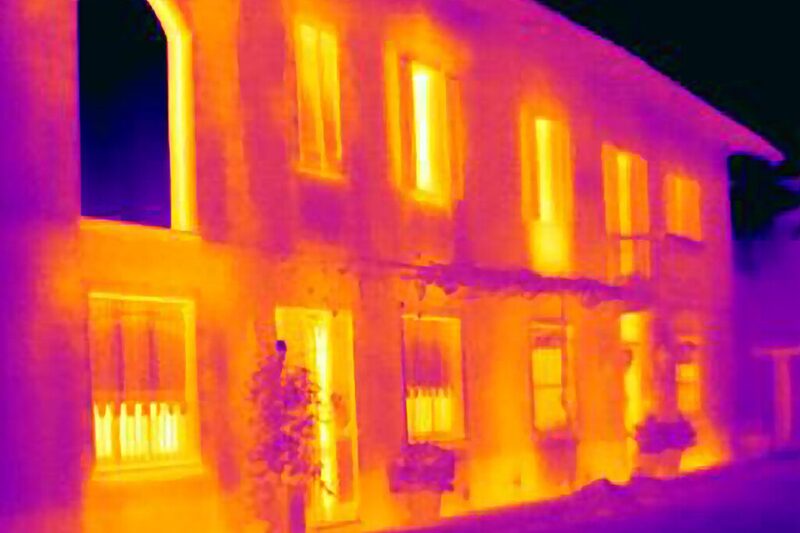
Tenants can gather evidence without touching the fabric. Tool hire shops rent out thermal cameras, usually by the week, at rates from around £100 to £200, though a household may also have access to one through a library or community scheme27. A thermal survey produces photographs of cold bridges and draughts that a landlord can act on, and it is the kind of evidence that supports a request rather than a complaint.
The £350 figure in the section title is the sum of two £375 secondary improvement measures under the Scottish scheme, and it illustrates the scale of what is available per measure rather than a single headline grant25. The larger sums sit with heating systems and with the exemption-linked grant route.
Changes ahead: the Renters' Rights Act and Wales
The regulatory frame around rented housing is moving. Specified tenancy reform and other provisions of the Renters' Rights Act 2025 came into force on 1 May 202628. Further specified provisions, in so far as not already in force, came into force on 22 June 202629. In Scotland, sections 50 to 55 of the Renters' Rights Act 2025 came into force on 1 May 2026, following commencement regulations made by the Scottish Ministers on 26 February 202630.
For tenants, the practical effect is a shifting set of tenancy rules sitting alongside the safety duties that already apply. The electrical and gas obligations described above are not replaced by tenancy reform; they run in parallel.
Wales has its own history here. The Welsh Government delayed the implementation of the Renting Homes (Wales) Act 2016 by six months, moving the date for electrical safety laws protecting renters from 15 July 2022 to December 202231. The Energy Efficiency (Private Rented Property) (England and Wales) Regulations 2015 cover private, local authority and other public body landlords, as well as a tenant who sub-lets a property falling within scope32. Where a tenant has a right to renew under the Landlord and Tenants Act 1954, non-compliance cannot be used as justification for refusing renewal or terminating the lease early32.
On heat pumps, the evidence on landlord willingness is thin and cautious. Research interviewing private landlords found frequent anxiety about potential disruption to the rental property during and after installation, and concern about tenants having poor experiences as a result of the technology33. In that research, participants were prompted to imagine a national mandate for landlords to install heat pumps in their properties33. A tenant can ask; the decision, the funding route and the disruption all sit with the owner.
Sources33 cited
- The Electrical Safety Standards in the Private Rented Sector (England) Regulations 2020, regulation 3, legislation.gov.uk, 2026
- Electrical checks in privately rented homes: your questions answered, Electrical Safety First, 2026
- Gas safety and carbon monoxide, nidirect, 2025
- Gas safety in rented accommodation: landlord duties, Health and Safety Executive, 2026
- Smart meters for renters, Smart Energy GB, 2026
- Minimum Energy Efficiency Standards, Carmarthenshire County Council, 2026
- Electrical safety standards in the private and social rented sectors: guidance, GOV.UK, 2025
- Gas Safety Week 2025, day 7: top gas safety tips, HHIC, 2025
- Gas Safety Week 2025, day 4: rights and responsibilities in rented properties, HHIC, 2025
- Carbon monoxide safety advice, SGN, 2026
- Trace and repair: arranging a gas safety check, Cadent Gas, 2026
- Domestic gas installation and health and safety, nidirect, 2025
- Renting and smart meters, Smart Energy GB, 2026
- Smart meters, Energy Ombudsman, 2026
- Smart meters: your rights and expectations, GOV.UK, 2025
- Help me decide on a smart meter, Smart Energy GB, 2026
- Our view on smart meters, National Energy Action, 2026
- How to switch energy supplier, Which?, 2026
- Switch your home energy supplier, Ofgem, 2026
- A step by step guide to setting up gas and electricity in a new home, Energy Helpline, 2026
- If you live in a home on a business energy contract, Ofgem, 2026
- Get help with your energy bills, Ofgem, 2026
- Prepayment meters, Centre for Sustainable Energy, 2025
- Warm Homes: Local Grant, Greater Manchester Combined Authority, 2026
- Grants and loans, Home Energy Scotland, 2026
- Private Rented Sector Landlord Loan, Home Energy Scotland, 2026
- How to use a thermal camera to cut energy bills, Which?, 2026
- The Renters' Rights Act 2025 (Commencement No. 2) Regulations 2026, legislation.gov.uk, 2026
- The Renters' Rights Act 2025 (Commencement No. 3) Regulations 2026, legislation.gov.uk, 2026
- The Renters' Rights Act 2025 (Commencement) (Scotland) Regulations 2026, legislation.gov.uk, 2026
- Renters put at unnecessary risk due to Welsh Government legislation delay, Electrical Safety First, 2022
- Minimum Energy Efficiency Standards guidance, Isle of Anglesey County Council, 2026
- Landlords' perspectives on low-carbon heating systems, Nesta, 2025
 Landlord Electrical ChecksWho is responsible for checking the electrics are safe in your rented home, and how often should it happen?
 Gas Safety in the HomeYour landlord has to arrange a yearly gas safety check by a Gas Safe registered engineer and give you the record if you rent.
 Renting and Home EnergyThe position of a tenant in a privately rented home: which measures need no permission, which are fixtures the landlord controls, and what the law says about heating, insulation, certificates and bills across the four UK nations.
 Where to Start If You RentRenting means you can switch supplier or get a smart meter yourself, but insulation, glazing and heating need your landlord's agreement.
 HMOs and Shared HousesWho is responsible for the electrics, the gas and the fire alarms when you rent a room in a shared house?
 Gas Safety RulesAnyone working on gas in your home has to be on the Gas Safe Register, whether they are installing, fixing or servicing an appliance.