

In this answer
Short answer
An HMO landlord in England must have the electrical installation inspected and tested by a qualified person at intervals of no more than five years, and must ensure the electrical safety standards are met throughout any period when the premises are occupied under a specified tenancy1. The same five-year maximum applies to the private rented sector generally, and the duty sits with the landlord rather than the tenant2.
The five-year cycle is a ceiling, not a target. Where an installation was assessed as Satisfactory and no obvious damage is visible, a new report is not required until five years have passed since the last one was issued3. Where a satisfactory report already exists, a fresh inspection does not have to be carried out within that window4. Appliances supplied with the tenancy, such as washing machines and electric cookers, must be maintained in a safe and working condition5.
For a household, the practical effect is that the fixed wiring, the consumer unit and the supplied appliances are the landlord's responsibility, while the tenant's own equipment is the tenant's2. What remains outside the household's control is the supply itself: the meter, the tariff and the choice of supplier sit with whoever holds the account.
What an HMO landlord must do to keep electrics safe
The core duty is set out in the Electrical Safety Standards in the Private Rented Sector (England) Regulations 2020. A private landlord must ensure every electrical installation in the residential premises is inspected and tested at regular intervals by a qualified person, and must ensure the electrical safety standards are met during any period when the premises are occupied under a specified tenancy1. The qualified person's report confirms either that the standards are met or that further investigative or remedial work is required1.
Alongside the wiring duty sit the alarm rules. In Wales, the Fitness for Human Habitation Regulations require a smoke alarm, in proper working order, to be present on every storey of a dwelling6. In Northern Ireland, each smoke, heat or carbon monoxide alarm must be in proper working order at the beginning of every new tenancy, and smoke and heat alarms must be installed and maintained in accordance with British Standard BS 5839-67.
Electrical Safety First recommends landlords use a qualified electrician, competent in electrical installation safety inspections, who is registered with a competent person scheme4. The regulations recognise that access is not always possible: a landlord will not be in breach if they can demonstrate they have taken all reasonable steps to comply, with documented communications kept as evidence3.
EICRs: the five-year cycle and who it now covers
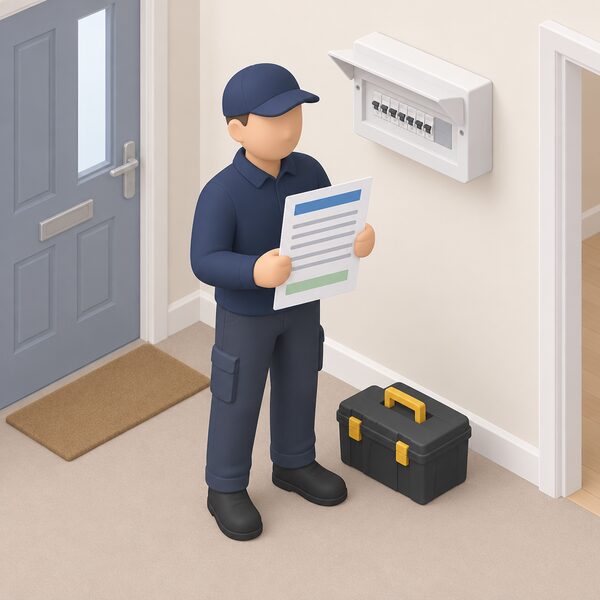
An Electrical Installation Condition Report is the document that records the outcome of the inspection. Electrical safety checks need only be carried out once every five years, assuming no remedial work is needed, and the visit takes about half a day to complete3. For a homeowner, Electrical Safety First suggests an EICR every 10 years; the rented sector's five-year rule is stricter8.
There is one route around the five-year inspection. Where a landlord holds an Electrical Installation Certificate for a newly built or completely rewired property, no further checks or report are required for five years after the certificate was issued2. The certificate must be less than five years old and relate to either a complete rewire or a newly built property9.
The regime now reaches beyond the private rented sector. The regulations came into force for the social rented sector on 1 November 20252. For social housing tenancies granted before 1 December 2025, they came into force on 1 May 2026, and those landlords must ensure electrical installations are inspected and tested by a qualified person before 1 November 20262. For the social rented sector specifically, a record must also be provided covering the details of any electrical equipment provided by the landlord, including its condition, whether it is suitable for use in the property, and the outcome of the checks4.
| Sector | Position | Key date |
|---|---|---|
| Private rented (England) | Five-year maximum inspection interval1 | In force |
| Social rented (England) | Regulations apply to new tenancies2 | 1 November 2025 |
| Social rented, older tenancies | First inspection required2 | Before 1 November 2026 |
| Northern Ireland | Five-yearly EICRs for new private tenancies | From April 2025 |
| Wales | Five-yearly checks committed to under the Renting Homes (Wales) Act10 | Not yet in force |
In Wales, the Welsh Government has committed to introduce regulations for mandatory five-yearly electrical safety checks on properties in the private and social rental sectors through the Renting Homes (Wales) Act10. Until those regulations are made, the position in Wales differs from England.
Appliances supplied with the tenancy: the landlord's maintenance duty
Where an appliance comes with the tenancy, the maintenance duty follows it. HMO landlords must ensure any appliances supplied as part of the tenancy agreement, such as washing machines and electric cookers, are maintained in a safe and working condition5. Social landlords who provide electrical equipment must also have it tested2.
Gas appliances carry a parallel and more detailed regime. A landlord must ensure that a communal appliance used by multiple dwellings is maintained by a Gas Safe registered engineer and is checked as part of the annual gas safety check11. Appliances left behind by a previous tenant must either be removed or checked for safety by a Gas Safe registered engineer11. Once a tenant has bought an appliance from the landlord, the tenant becomes responsible for the annual gas safety check and maintenance11.
The dividing line is ownership. Tenants are responsible for making sure that their own electrical equipment is safe2. Anything the landlord provides, whether fixed wiring or a freestanding appliance, sits on the landlord's side of that line.
"HMO landlords must also ensure any appliances supplied as part of the tenancy agreement, such as washing machines and electric cookers - are maintained in a safe and working condition"
Fit for habitation: the overarching repair duty
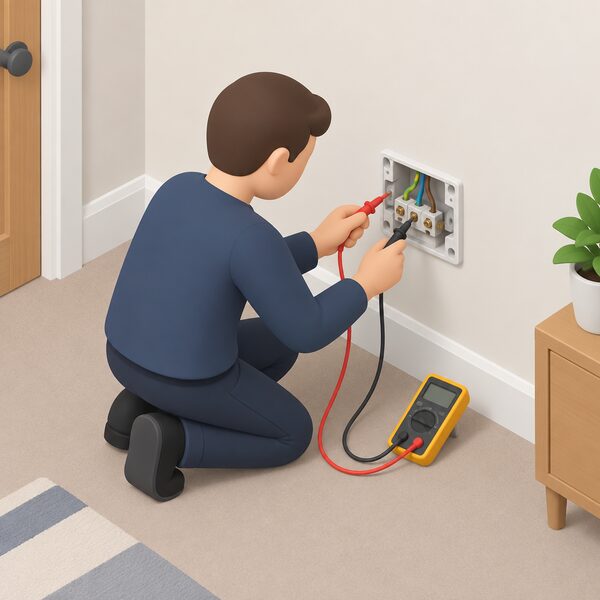
Beyond the electrical regulations, a general repairing duty covers the wiring itself. The Landlord and Tenant Act 1985 requires landlords of properties with short leases to keep the electrical wiring in repair and in proper working order8. That duty is older than the EICR regime and operates independently of it.
Building regulations sit alongside, governing how electrical work is carried out rather than how often it is inspected. Those rules were introduced to help reduce the number of deaths, injuries and fires caused by faulty installations12. Approved Document P provides further practical guidance for undertaking electrical work covered by the Building Regulations13, and BS 7671 delivers consistency for almost all domestic and similar electrical installations14.
In Wales, the Fitness for Human Habitation Regulations set the standard a dwelling must meet to be fit for human habitation, and the guidance for landlords sets out what that means in practice6. In Scotland, detection of carbon monoxide is covered in section 4.5 of the Scottish Government guidance for local authorities on licensing of HMOs, with physical standards set by the licensing local authority15.
For a household, the practical consequence is that a repair duty exists even where no recent report has been produced. A landlord cannot rely on the absence of an EICR to avoid dealing with wiring that is out of repair.
Awaab's Law and the extension to private rented homes
Awaab's Law began with social housing. The Social Housing (Regulation) Bill amendment announced in February 2023 mandated landlords to investigate and fix serious problems within strict time limits and gave new powers to the Housing Ombudsman. Phase 1 came into force for social landlords in England on 27 October 2025, imposing legally enforceable timescales for investigating and fixing damp, mould and emergency hazards, with tenants able to sue for breach of contract.
Government plans to extend Awaab's Law to the private rented sector via the Renters' Rights Bill, with implementation expected later in 2026. The Renters' Rights Act 2025 has been commenced in stages: specified tenancy reform and other provisions came into force on 1 May 2026, and further specified provisions came into force on 22 June 2026. In Scotland, sections 50 to 55 of the Act came into force on 1 May 2026.
The link to electrical safety is indirect but real. Awaab's Law creates deadlines for hazards, and a hazard can be electrical as well as damp-related. The extension to the private rented sector would put those deadlines on a statutory footing for HMO landlords as well as single lets.
What tenants can ask for: records, servicing and upgrades
A tenant can ask for the documents that the law requires a landlord to hold. The gas safety record must include the date on which the appliance or flue was checked, the address of the premises, the landlord's name and address, a description and location of the appliance or flue, any safety defects identified, any remedial action taken, confirmation that the check complies with the regulations, and the checker's name, signature and registration number with an approved body16. An electronic copy is allowed if it can be reproduced in hard copy when required, is secure from loss and interference, and uniquely identifies the gas operative who carried out the check17.
In an HMO, the manager must make their name, address and any telephone contact number available to each household and clearly display the details in a prominent position in the HMO19. That gives a tenant a named point of contact for reporting a fault.
On servicing, the landlord in rented accommodation is responsible for servicing boilers and appliances annually and must provide an up-to-date gas safety record, which is a legal requirement17. For solid fuel, a HETAS Approved Servicing Technician will check over all aspects of the installation including things such as door rope seals, air intake and carbon monoxide alarms20.
On upgrades, the tenant's position depends on who holds the account. Private renters can choose a smart meter if the energy bills are in their name or they prepay for energy, after checking the tenancy agreement and letting the landlord know21. If you pay a supplier directly for the electricity or gas you use at home, you can choose to switch to a different supplier or tariff at any time22. Where the landlord holds a business contract, residents may not have the right to choose their own energy supplier or switch suppliers themselves23.
For electrical alterations, work in special locations is notifiable to building control unless the installer is a member of a Competent Persons Self Certification Scheme. That covers kitchens, bathrooms, shower rooms, swimming pools, paddling pools, hot air saunas, electric floor or ceiling heating systems, garden lighting or power installations, solar photovoltaic power supply systems, small scale generators such as micro combined heat and power units, and extra low voltage lighting installations, unless they are pre-assembled, CE-marked lighting sets12. Additional local rules may also affect what permissions are needed13.

Sources23 cited
- The Electrical Safety Standards in the Private Rented Sector (England) Regulations 2020, regulation 3, legislation.gov.uk, 2026
- Electrical safety standards in the private and social rented sectors: guidance, GOV.UK, 2025
- Electrical checks in privately rented homes: your questions answered, Electrical Safety First, 2026
- Millions of social renters to be protected from electrical faults as new laws come into force, Electrical Safety First, 2026
- Charity supports safety for migrant communities, Electrical Safety First, 2026
- Fitness for human habitation: guidance for landlords, Welsh Government, 2026
- The Private Tenancies (Northern Ireland) Order 2024, legislation.gov.uk, 2024
- Electric blankets, Electrical Safety First, 2026
- Householders and landlords help hub, NICEIC, 2026
- Electrical safety in Wales, Electrical Safety First, 2026
- Gas safety checks: what a landlord must do, Health and Safety Executive, 2026
- Building regulations: general information, Planning Portal, 2026
- Electrical safety and building regulations, Cumberland Council, 2026
- BS 7671: Requirements for Electrical Installations, BSI, 2026
- Carbon monoxide alarms in private rented properties: guidance, Scottish Government, 2016
- Gas Safety (Installation and Use) Regulations 1998, legislation.gov.uk, 1998
- Gas safety and carbon monoxide, nidirect, 2025
- Gas safety in domestic premises: frequently asked questions, Health and Safety Executive, 2026
- The Licensing and Management of Houses in Multiple Occupation and Other Houses (Miscellaneous Provisions) (England) Regulations 2006, legislation.gov.uk, 2006
- Servicing, HETAS, 2026
- Smart meters, Energy Ombudsman, 2026
- Switch your home energy supplier, Ofgem, 2026
- If you live in a home with a business energy contract, Ofgem, 2026
 HMOs and Shared HousesWho is responsible for the electrics, the gas and the fire alarms when you rent a room in a shared house?
 Landlord Electrical ChecksWho is responsible for checking the electrics are safe in your rented home, and how often should it happen?
 Landlord Energy and SafetyWhat a landlord must provide and maintain across the four nations: working heating and hot water, an EPC before letting, alarms, gas and electrical safety, and fitness for habitation, with the points where Scottish, Welsh and Northern Irish duties differ from England.
 Energy in Social HousingWhat must your landlord do if your home is cold, damp or mouldy?
 Gas Safety in the HomeYour landlord has to arrange a yearly gas safety check by a Gas Safe registered engineer and give you the record if you rent.
 Rented Homes and Landlord MetersWho is responsible for the energy in your rented home?