
In this guide
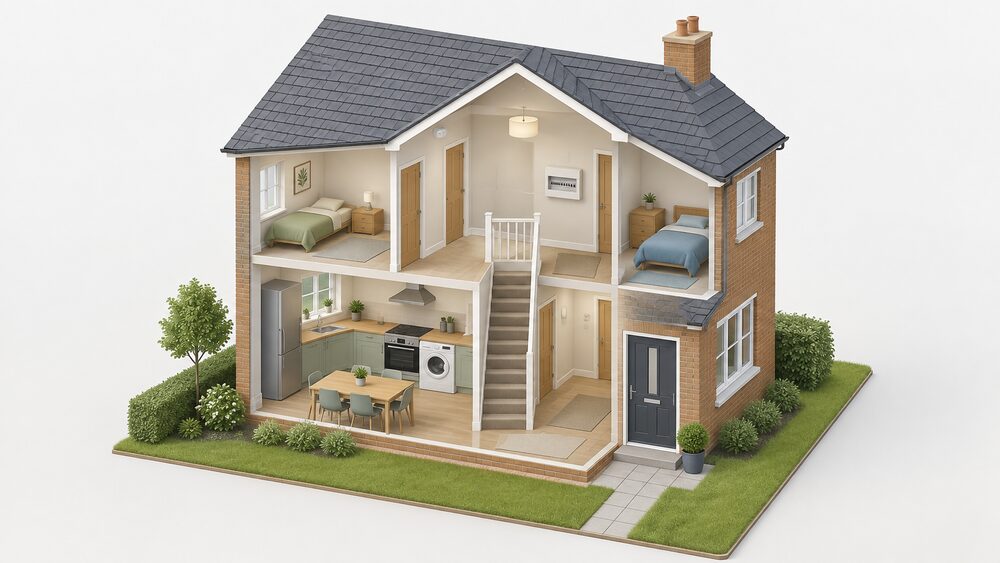
A house in multiple occupation is a building where separate households share facilities, and almost every additional rule that attaches to it follows from that one fact. Shared kitchens, shared circuits, shared escape routes and shared appliances mean that one person's habits become everybody's risk. The management regulations make this explicit: fixtures, fittings or appliances used in common by two or more households must be maintained in good and safe repair and in clean working order, and the list of items covered runs from lighting and space or water heating appliances through bathroom and lavatory items to food storage, preparation and cooking appliances and washing machines or other laundry appliances1. Where a licence is required, it covers property standards, management, fire safety, room sizes and suitability for occupation2.
On top of that sit the duties that apply to any rented home. A landlord must ensure that the electrical safety standards are met during any period when the residential premises are occupied under a specified tenancy3, and government guidance for landlords, tenants and local councils states that landlords have the electrics in their rented properties checked at least every five years4. Where the landlord owns and provides LPG appliances, a Gas Safe registered engineer must carry out a safety check at least once every twelve months5. Building regulations for electrical work exist, in the Planning Portal's words, to help reduce the number of deaths, injuries and fires caused by faulty installations6.
For a household's energy independence, an HMO is the hardest case in the private rented sector. Occupants rarely control the heating system, often cannot change the fabric, and in many cases pay for energy through a rent-inclusive charge they cannot see broken down. What an occupant does control is appliance use, reporting faults in writing and the evidence trail that forces action.
Electrical safety is the fire risk that shared living multiplies
Nothing in a shared house concentrates risk the way the electrical installation does. A property designed for one household is let to five, each with a kettle, a heater, a charger and a laptop, and the circuits do not grow to match. That is the reason building regulations were introduced for domestic electrical work in the first place: to help reduce the number of deaths, injuries and fires caused by faulty installations6. In industrial or commercial buildings the Health and Safety Executive is responsible for making sure that electrical installation work is safe; in dwellings the route runs through building control and the competent person schemes6. The wider purpose of the regulations, as building control guidance in Northern Ireland puts it, is that all householders will have a safe and healthy home in which to live and a home which is energy efficient9.
Two features of HMOs make the electrical position distinct from a single-family let. First, common parts: landing lights, hallway sockets, shared kitchen circuits and any communal heating are nobody's private property, so faults sit unreported while each occupant assumes someone else has raised them. The management regulations close that gap by putting shared fixtures, fittings and appliances, explicitly including lighting and space or water heating appliances, on the manager1. Second, turnover: rooms change hands at different times, so the person who noticed a scorched socket in March has moved out by June and the knowledge leaves with them.
The practical consequence is that the five-yearly inspection is the floor rather than the ceiling of what a busy shared house needs4. Between inspections, the evidence that matters is dated written reports of individual faults. Further detail on the inspection regime itself, including how it differs across the four nations, sits with electrical safety checks in rented homes, and the HMO-specific duties are set out at landlord electrical safety responsibilities in an HMO.
What landlords must do: licensing, checks and the standard of repair
The duty is drafted as a continuing one. The landlord must ensure that the electrical safety standards are met during any period when the residential premises are occupied under a specified tenancy, which means compliance is not discharged by a certificate obtained once and filed3. Government guidance addressed to landlords, tenants and local councils sets the inspection interval at least every five years4. Where LPG appliances are owned and provided by the landlord, the annual check by a Gas Safe registered engineer is a separate and more frequent obligation5.
Licensing adds a layer that does not exist in an ordinary let. An HMO licence ensures things such as property standards, management, fire safety, room sizes and suitability for occupation2. Conditions are set by the local council and are enforceable against the licence holder, so a failing that would be a repairs dispute in a single-family house can become a licensing matter in an HMO.
Energy and safety duties also interact. The government response on a reformed Decent Homes Standard states that any measures taken to meet energy efficiency requirements such as heating system upgrades or insulation must comply with relevant building and fire safety regulations and preserve essential safety features10. In a shared house that principle bites hard: insulation or a new heating system must not compromise compartmentation, escape routes or ventilation. Northern Ireland guidance on whether a home is fit to live in lists what a landlord should do on fabric, including insulating roof spaces, replacing draughty and ill-fitting windows and doors, draught proofing external doors and windows but not rooms containing an open-flue gas appliance, insulating exposed water pipes and fitting the hot water tank with a good quality insulation jacket11. The open-flue exception is the clearest example of an energy measure being limited by a combustion safety rule.
Minimum energy efficiency rules reach HMOs unevenly. Guidance for landlords of domestic private rented property describes compliance with the 2018 minimum level of energy efficiency standard, EPC band E12. The exclusions list in the private rented property regulations covers listed or officially protected properties where the requirements would unacceptably alter them, temporary buildings used two years or less, places of worship, low-energy industrial sites, workshops or non-residential agricultural buildings, detached buildings under 50 m2 of total floor space, buildings occupied less than four months a year with expected energy consumption under 25% of all-year use, properties due for demolition with consents, and certain HMOs not sold or let as a single rental in the past ten years13. That last exclusion is specific rather than general, so the letting history of the individual property decides.
When tenants report a problem and nothing happens
Awareness among renters is rising but is not universal: 54% of renters said they were aware of minimum energy standards for rental properties in Winter 2025, up from 48% in Winter 20248. Knowing the duty exists is the first step in enforcing it.
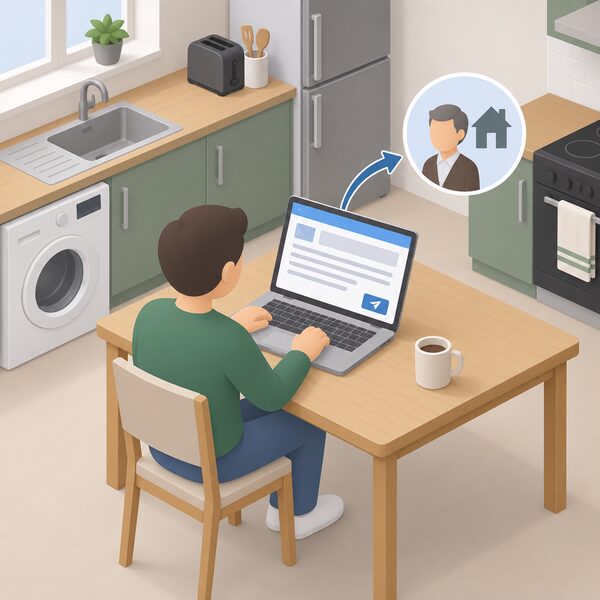
The reporting point matters legally, not just practically. In Northern Ireland the private tenancy regulations require a landlord to replace an alarm when notified it is faulty, which makes the tenant's notification the trigger for the obligation14. The same logic runs through most repair duties: an undated verbal complaint in a shared kitchen is worth very little, while a dated email naming the room, the appliance and the fault is evidence. Where several households share a house, one occupant reporting on behalf of all of them keeps the record coherent.
Consent runs in both directions. Guidance on private rented property standards states that landlords must not unreasonably refuse tenant requests for energy efficiency improvements funded at no cost to the landlord, for example through grants or third-party funding13. Against that, the regulations provide that the relevant requirements do not apply at any time when the landlord has, within the preceding five years, been unable to raise the property's energy performance indicator to the minimum level because a tenant refused consent to a relevant energy efficiency improvement, or because third party consent was refused or granted subject to a condition the landlord cannot reasonably comply with15. In an HMO with several tenancies, a single refusal can therefore stall work for the whole building. Approaching the landlord is covered at asking a landlord for energy improvements.
Scotland is moving to a different enforcement model. Consultation proposals for a Heat in Buildings Bill would require private landlords to meet a minimum energy efficiency standard by the end of 2028, with properties failing that standard not allowed to be leased to a new tenant, and private landlords subject to civil penalties if they do not meet it; owner occupiers would need to have met the standard at the end of 203316. These are consultation proposals rather than duties in force.
Portable heaters in shared rooms
Room-by-room electric heaters are common in shared houses, either because the central system is controlled elsewhere or because one room runs cold. They are also the appliance most often involved in avoidable winter fires, which is why Electrical Safety First publishes specific rules of use. The charity's advice is that a heater should sit on a level surface, well away from anything or anyone that could knock it over, and well away from combustible materials such as paper, furniture or curtains17. Its heater guidance puts a figure on that clearance: at least one metre away from combustible materials7.
"Never leave your heater unattended for long periods whilst in use, or while you are asleep."
The remaining points are short and absolute. Never leave a heater unattended for long periods while in use, or while occupants are asleep17. Inspect it regularly for damage and deterioration, and do not use it if it is not in good condition17. Buy from manufacturers or retailers that are known and trusted, avoid second-hand heaters, and if buying second-hand ask what safety checks are carried out17. Use smoke alarms or heat detectors nearby7.
In a shared house these rules are harder to keep than in a family home. Bedrooms doubling as living rooms, studies and drying rooms put fabric close to heat sources; doors are closed, so a fire in one room is unobserved. The clearance rule and the drying rule exist precisely for that arrangement.
Where a house has a wet system, control quality determines whether occupants can heat only the room they use. Guidance for new dwellings, and for cases where a heat generator such as a boiler is replaced in an existing dwelling, is that each room should be provided with thermostatic room controls able to separately adapt the heating output in each room served. A boiler replacement in an HMO is therefore an opportunity to get room-level control, which is what reduces reliance on plug-in heaters in the first place.
Shared kitchens, white goods and extension leads
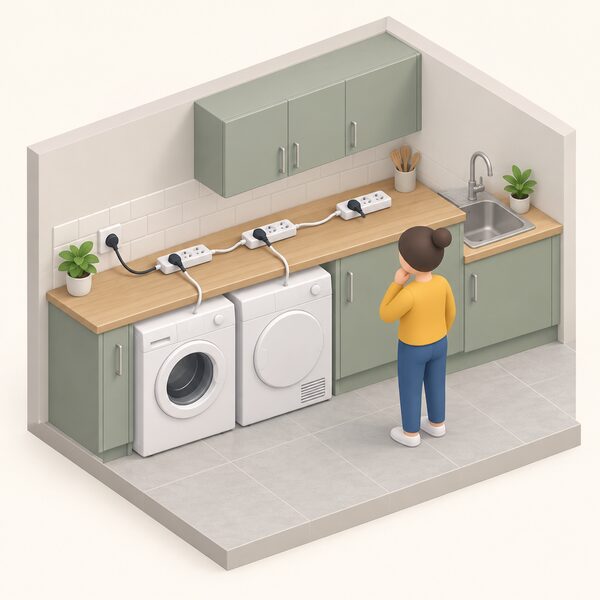
The kitchen is where an HMO's electrical load peaks and where the management regulations are most directly engaged. Shared fixtures, fittings and appliances must be maintained in good and safe repair and in clean working order, and the definition expressly includes food storage, preparation or cooking cupboards, shelving or appliances, and washing machines or other laundry appliances, as well as lighting and space or water heating appliances and bathroom or lavatory items1.
Tumble dryers, washing machines and heaters draw heavily and continuously. In a house let by the room, several such loads may run at once on circuits that were never designed for simultaneous use, and extension leads daisy-chained across a kitchen are the visible symptom. Where a shared appliance is added or a laundry point is created, building regulations in Wales apply to providing services and fittings in a building such as washing and sanitary facilities, hot water cylinders, foul water and rainwater drainage, replacement windows, and fuel burning appliances of any type18.
| Item in a shared house | Who is responsible | Rule that applies |
|---|---|---|
| Shared kitchen appliances, laundry appliances | HMO manager | Maintained in good and safe repair and in clean working order1 |
| Fixed electrical installation | Landlord | Standards met throughout occupation3; checked at least every 5 years4 |
| Landlord-provided LPG appliances | Landlord | Gas Safe registered engineer check at least every 12 months5 |
| Faulty alarm (Northern Ireland private tenancy) | Landlord, on notification | Replace the alarm when notified it is faulty14 |
| Portable heater brought in by an occupant | Occupant, within house rules | One metre from combustibles, not on an extension lead7 |
Recalled products and goods bought online
Second-hand and online purchases arrive in shared houses constantly, and nobody keeps a register of what is in the building. Electrical Safety First's position on buying is direct: buy from manufacturers or retailers that are known and trusted, and avoid second-hand heaters, or ask what safety checks were carried out17.
Two product regimes bear on what is sold. The Ecodesign for Energy-Related Products and Energy Information Regulations 2021 aim to increase producer responsibility, reduce energy usage and electrical waste, and enable consumers to identify the most energy efficient products on the market19. Separately, the consumer connectable product security regulations apply to relevant consumer products that can connect to the internet or a network20, which in a shared house means smart plugs, smart heaters, cameras and speakers as well as phones.
Where a fuel-burning appliance is implicated rather than an electrical one, the rule after suspected carbon monoxide poisoning is unambiguous: affected appliances should not be used again until they have been serviced by a registered engineer21. Guidance and recommendations on the installation of carbon monoxide alarms are available in BS EN 50292:202322. The symptoms themselves are covered at signs of carbon monoxide poisoning in the home.
Alarms and the night-time risk
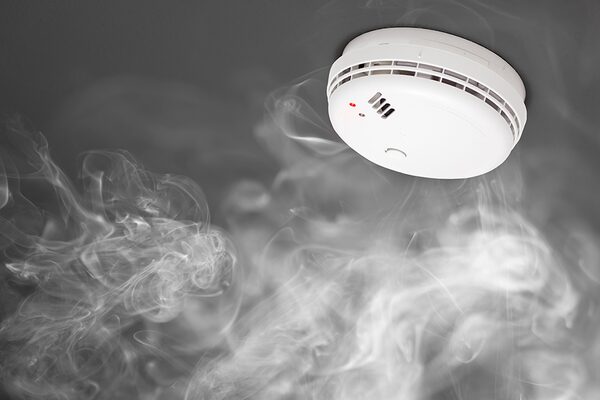
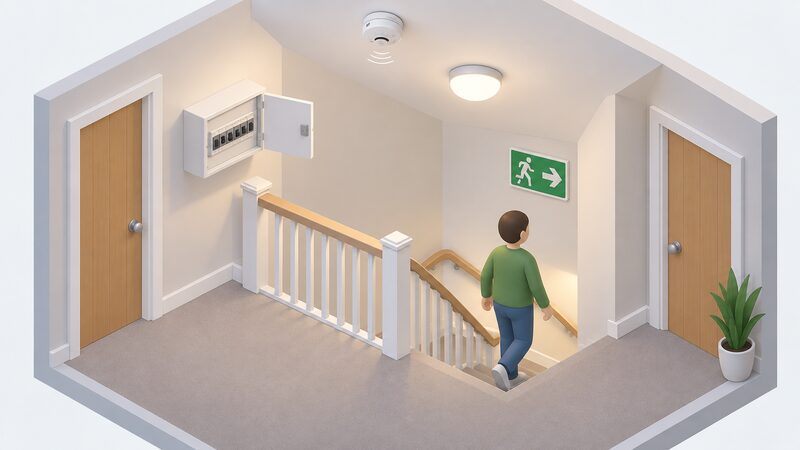
Fire risk in a shared house is concentrated at night, when occupants are behind closed doors and each relies on a device rather than on hearing a neighbour. Electrical Safety First's advice is to have a working smoke alarm on every floor and to test it regularly17. Scottish scheme rules describe interlinked alarms in dwelling houses where energy efficiency measures are installed as one smoke alarm in the living room or the room used most, one smoke alarm in every hallway or landing, and one heat alarm in the kitchen, with smoke alarms to BS EN14604:200523. In Northern Ireland, private tenancy legislation requires smoke and heat alarms to be installed and maintained in accordance with British Standard BS 5839-6, and requires the landlord to replace an alarm when notified it is faulty14. Portable heater guidance adds the instruction to use smoke alarms or heat detectors near a heater in use7.
Interlinking matters more in an HMO than anywhere else, because a detector sounding in an empty ground-floor kitchen is of no use to someone asleep on the second floor. The nation-by-nation detail is set out at smoke and carbon monoxide alarm rules in rented homes. Escape routes are also a building regulations matter in their own right: the regulations covering doors and windows apply to thermal performance and other areas such as safety, air supply, means of escape and ventilation24, which is why replacing a window in a shared house is not purely an energy decision.
Heating, metering and how bills are split
Most HMO occupants pay for energy through rent, a service charge or an informal split, and very few see a meter reading that relates to their own use. That is the central weakness in a shared house's energy position: consumption is collective, so no individual gains the full benefit of using less, and nobody carries the full cost of using more.
Where a house connects to a heat network, metering is addressed directly. Scheme guidance for a new district heating connection requires the installation of a heat meter for each household25. Room-level control on a wet system rests instead on the thermostatic room controls expected in new dwellings and on boiler replacement, each able to separately adapt the heating output in each room served. Together, per-household metering and per-room control are the two things that make a shared house's energy use attributable rather than communal.
Retrofit work in occupied shared housing carries its own risk record. Analysis of ECO4 and the Great British Insulation Scheme found that 6% of external wall insulation installations and 2% of internal wall insulation installations were found to have health and safety risks to the occupants26. Where such risks are identified, installers are required to make them safe within 24 hours27. In a house with several households and no single occupant coordinating access, that reporting chain needs to be clear before work starts.
For the wider picture on what occupants can and cannot change, see renting and home energy and energy independence when you rent or live in a flat. Houses let to students raise many of the same questions and are covered at energy in student accommodation, and the sector context sits in the guide to the UK private rented sector and the pillar guide to home energy by household type.
Finding a registered electrician
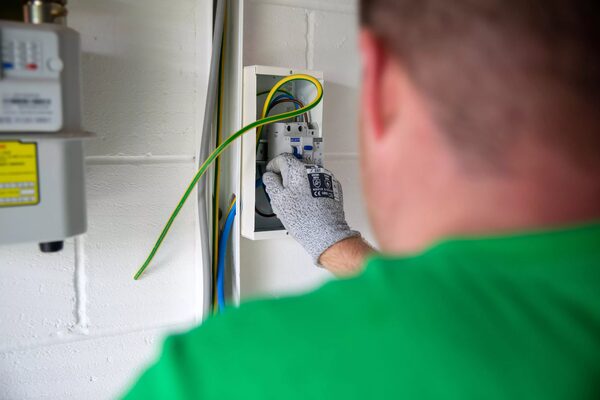
Two routes exist for having electrical work checked. Welsh government guidance sets them out as using an electrician registered with a competent person scheme, or notifying the building control section of the local authority28. The competent person route means an electrician who is registered by an organisation authorised by the Secretary of State and is able to certify the work as safe without notifying building control28. Registration is with an approved self-certification organisation29, and whether a given electrician is registered can be checked on the Competent Persons Register30.
For an HMO this matters twice over. It matters for the fixed installation, where the five-yearly inspection regime applies4, and it matters for small jobs done between inspections, where an unregistered addition to an already loaded circuit is exactly the kind of work the building regulations for electrics were introduced to control6. Verifying registration before work starts, rather than after, is the only point at which the check is useful.
What remains outside an occupant's control
Even a well-run shared house leaves its occupants dependent. The heating system, the fabric, the tariff and often the supplier are the landlord's choices. Minimum standards reach some HMOs and, through the exclusions list, not others13. Consent rules mean that one tenant's refusal can block an improvement for an entire building for up to five years15, and in Scotland the proposed 2028 landlord deadline and civil penalties are still consultation proposals rather than law16. What occupants hold is narrower but real: safe use of their own appliances, written reports that start a duty running, and the right not to have an improvement unreasonably refused where it costs the landlord nothing13.
Sources30 cited
- The Management of Houses in Multiple Occupation (England) Regulations 2006, legislation.gov.uk, 2006-02-15
- Common queries about planning permission and HMO licences, Wiltshire Council, 2026
- Electrical Safety Standards in the Private Rented Sector Regulations 2020, regulation 3, legislation.gov.uk, 2026
- Electrical safety standards in the private and social rented sectors: guidance, GOV.UK, 2025-11-01
- Domestic gas safety: frequently asked questions, Health and Safety Executive, 2026
- Building regulations for electrical work: general information, Planning Portal, 2026
- Portable heaters: safety advice, Electrical Safety First, 2026-09-17
- DESNZ Public Attitudes Tracker: heat and energy use in the home, Winter 2025, DESNZ, 2025
- Building control frequently asked questions, Building Control Northern Ireland, 2026
- Consultation on a reformed Decent Homes Standard: government response, GOV.UK, 2026-01-28
- Checking your home is fit to live in, nidirect, 2026
- Minimum energy efficiency standards for landlords, Carmarthenshire County Council, 2026-09-20
- Minimum energy efficiency standards: guidance for landlords, Isle of Anglesey County Council, 2026-05
- The Private Tenancies (Smoke, Heat and Carbon Monoxide Alarms) Regulations (Northern Ireland) 2024, legislation.gov.uk, 2024-05-30
- Energy Efficiency (Private Rented Property) Regulations 2015, regulation 31, legislation.gov.uk, 2026
- Delivering net zero for Scotland's buildings: Heat in Buildings Bill consultation, Scottish Government, 2023-11
- Potential risk to households this winter as millions use electrical heaters, Electrical Safety First, 2026-09-19
- Building regulations: when you need approval, Planning Portal Wales, 2026
- Ecodesign and energy labelling regulations briefing, House of Commons Library, 2026
- Regulations for consumer connectable product security, GOV.UK, 2024-01-08
- Carbon monoxide poisoning, nidirect, 2026
- Approved Document J: combustion appliances and fuel storage systems, Welsh Government, 2024-10-04
- Area Based Scheme information released under EIR, Scottish Government, 2024-08
- Building regulations for doors and windows, Planning Portal, 2026
- ECO4 new measures and products guidance, version 3.0, Ofgem, 2026-03-26
- Energy Company Obligation research briefing CBP-9585, House of Commons Library, 2025-11
- Retrofit measures: ECO4 and GBIS, Hansard, 2025-10-13
- Building regulations: electrics, Welsh Government, 2026
- Electrical safety and building control, Cumberland Council, 2026
- Building control application guidance notes, London Borough of Bromley, 2026
 Controls in Rented HomesCan you change the heating controls in a rented home, and who pays if they break?
 Energy in Social HousingWhat must your landlord do if your home is cold, damp or mouldy?
 Rented Homes and Landlord MetersWho is responsible for the energy in your rented home?
 Landlord Energy and SafetyWhat a landlord must provide and maintain across the four nations: working heating and hot water, an EPC before letting, alarms, gas and electrical safety, and fitness for habitation, with the points where Scottish, Welsh and Northern Irish duties differ from England.
 Monitoring in Flats and RentalsCan you get a smart meter in a rented flat, and who decides?
 Social and Rented Home StandardsWhat condition is your landlord legally required to keep your home in?