
In this guide
Energy independence for a renter or a flat dweller is not the same thing as energy independence for a homeowner. You cannot decide the fabric of the building, you usually cannot put a heat pump on the wall without consent, and in a block of flats the outdoor unit of an air source heat pump is capped at 0.6 cubic metres under permitted development1. What you can do is narrower and more practical: choose your supplier and tariff if the bills are in your name, take a smart meter, use the cheap hours an Economy 7 tariff gives you, and add portable equipment that leaves with you when the tenancy ends.
The dividing line throughout is who pays the bill. Ofgem states that if you have to pay your energy bills, you can choose to switch your supplier or tariff at any time3. If the landlord pays, or you buy heat through a landlord or site owner on a business contract, you may not have the right to choose your own supplier at all4. That single fact decides most of what follows.
What energy independence can mean when you rent or live in a flat
For a household that does not own the building, independence is a set of partial moves rather than a single installation. The first is contractual: the right to pick a supplier and a tariff. Ofgem's position is that a tenant who pays the bills can switch at any time3. The second is informational: a smart meter and its in-home display, which shows near real-time usage data and turns an invisible bill into a visible number10. The third is temporal: shifting load into cheaper hours, which an Economy 7 tariff makes possible for all-electric homes6. The fourth is portable: heaters, and small kit that can be unplugged and taken to the next address.
What remains is substantial and worth stating plainly. You are still connected to the grid, still buying units from a supplier, and still exposed to whatever the building's fabric and heating system do to your bills. In Scotland, private rented dwellings were more likely to use electricity as their primary fuel type, at 21% compared with 8% of owner-occupied homes, so a renter is more likely than an owner to be on an all-electric setup where timing and storage matter most11. In a flat, the roof, the walls and the plant room are shared, and any change to them runs through a landlord, a freeholder or a management company.
Smart meters: renters who pay the bills can choose one
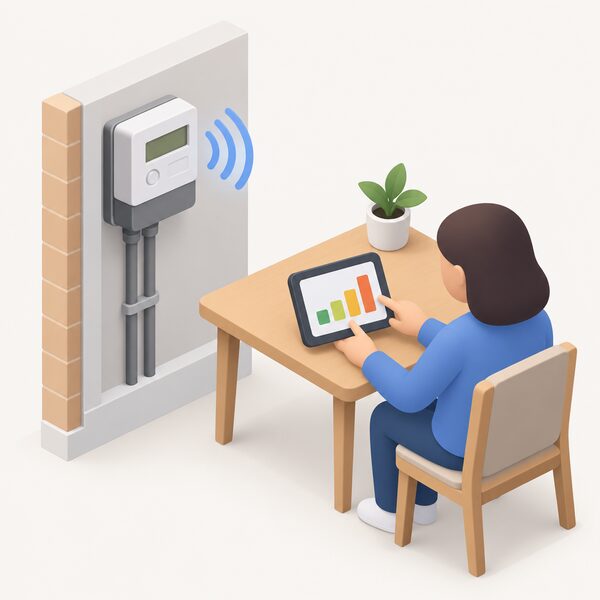
The eligibility rule is straightforward. If you are a private renter and the energy bills are in your name, or you prepay for your energy, you can choose to have a smart meter, after checking the tenancy agreement and letting the landlord know5. The same applies if you are renting, are a prepay customer, or if the meter sits outside your property, which covers flats with communal meter boxes12. Where the landlord pays the energy bills, it is their decision whether a smart meter is installed13.
Where a lease says the landlord's permission is needed to change the meter, Ofgem, the energy regulator, says they should not unreasonably prevent this13. That is the sentence to hold on to if a managing agent objects. It does not override a lease, but it sets the expectation against which a refusal would be judged.
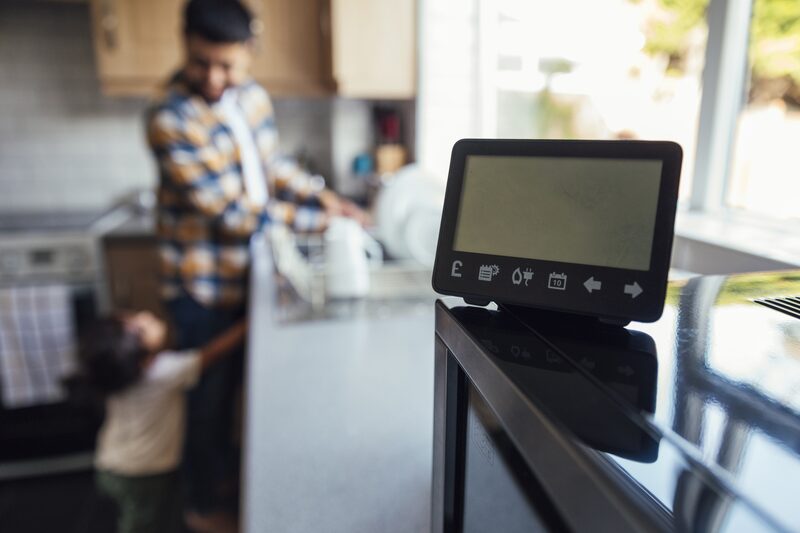
The in-home display is a portable touchscreen device that shows near real-time energy usage data10. It is paired to the property's meter, not to you, so after you move out you leave the display in the property13. The meter itself stays as the supply point's meter. A new tenant moving in can ask the supplier about the display and about the meter's current mode, particularly if a previous occupant ran it in prepayment mode.
For a household's independence, the meter changes two things. It removes estimated billing, and it makes the cost of a given appliance visible while it is running. Neither reduces dependence on the grid, but both reduce dependence on guesswork.
Smart prepay: topping up online and automatic support credit
Prepayment is often treated as the least independent arrangement, and in one sense it is: you pay before you use. In another sense it is the most controllable, because the balance is explicit and the top-up can now be remote. The smart meter network allows end consumers to add credit to their meters through an over-the-air top-up14. That removes the trip to a shop and the risk of running out at an awkward hour.
The protections attached to prepayment matter more than the convenience. Under draft guidance for heat networks, suppliers are obliged to offer a reasonable amount of additional support credit in a timely manner where a prepayment consumer has self-disconnected or self-rationed in circumstances in which any occupant of the household is in a vulnerable situation15. That is a duty on the supplier, not a favour, and it applies where the household includes someone vulnerable.
For a renter, smart prepay is a genuine if limited form of independence: the account is yours, the top-up is instant, and the balance is knowable. The dependence that remains is on the supplier's credit terms and on the network that carries the top-up signal.
Portable electric heaters: what a plug-in unit can and cannot do
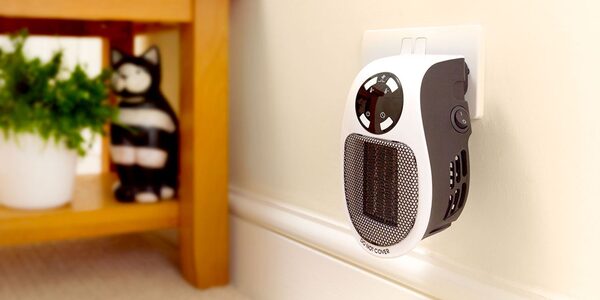
A portable electric heater is the most common piece of kit a renter adds, and its limits are set by physics and by the wiring, not by the model. It heats the room it is in. It does not heat a home, and it does not store heat for later. Every portable heater must be fitted with a UK three-pin plug8.
The scheme rules give a useful sense of how officialdom treats these units. Under the Domestic Renewable Heat Incentive, a heating appliance designed and installed to heat only one room, such as a fireplace or plug-in heater, is treated as a metering exception rather than as a whole-home system16. That is the regulatory view in miniature: a plug-in heater is a room appliance.
There is also a boundary worth knowing if a landlord is considering upgrades. Under ECO4, electric storage heaters without solar PV can be installed in the private rented sector provided listed measures are part of the same project and the unit does not replace an existing storage heater, an electric heating system or a boiler17. A portable heater is not a storage heater and does not qualify in that way, but the rule shows where the line sits between temporary kit and installed measures.
| What a plug-in heater does | What it does not do |
|---|---|
| Heats the room it stands in | Heat the whole home |
| Runs from a standard wall socket | Store heat for cheaper hours |
| Moves with you at the end of a tenancy | Replace a fixed heating system |
| Gives immediate local warmth | Reduce the unit rate you pay |
For independence, the honest summary is that a portable heater shifts which room you heat and when, and nothing more. It does not reduce your reliance on the grid or on a supplier.
Using portable heaters safely: placement, clearance and overnight use
The safety rules for portable heaters are short and absolute, and they come from Electrical Safety First rather than from any manufacturer.
- Keep the unit at least one metre away from combustible materials8.
- Never leave the heater unattended while in use or while you are asleep8.
- It is recommended not to use a portable heater overnight8.
- Use smoke alarms or heat detectors nearby8.
- Avoid powering a heater from an extension lead8.
"Never leave your heater unattended while in use or while you are asleep."
The extension lead point deserves emphasis because it is the most commonly broken rule in rented flats, where sockets are few and furniture is arranged around them. A heater draws a high current continuously, and a lead intended for occasional use can overheat at the plug or along its length. The guidance is to avoid it, not to use a heavier lead.
Where a rented home's fixed heating is inadequate, that is a repair and standards question rather than a heater question. In Northern Ireland, the fitness standard for rented accommodation requires adequate provision for lighting, heating and ventilation, among other criteria19. Similar duties exist across the UK, and they are dealt with in more detail on landlord duties on energy, heating and home safety.
Economy 7 tariffs: cheaper night electricity for all-electric homes

Economy 7 gives cheaper electricity for seven hours during the night6. The cheaper period runs for a seven-hour window at some point between 11.00pm and 8.00am, and the meter tracks usage on two separate rates: a 17-hour day period and the night period6. The exact start and end times depend on the supplier and the meter, so the cheap window is not necessarily the whole night, and a household shifting load needs to know its own times rather than assume them.
The tariff suits homes that can move demand into the night: storage heaters, an immersion heater on a timer, a washing machine or dishwasher on a delay. It suits them badly if the home is heated and occupied during the day, because the day rate is higher than a single-rate tariff would be.
For a renter, Economy 7 is one of the few levers that works without touching the building. It does not reduce total consumption, and it does not reduce dependence on the grid. It changes when you buy, and therefore what you pay. In an electrically heated flat, that can be the difference between a bill that tracks the weather and one that tracks the cheap hours.
Air source heat pumps in flats: the 0.6 cubic metre limit and other permitted development rules
A heat pump is the measure that would most reduce a flat's reliance on gas or on direct electric heating, and it is also the measure most constrained by planning. The permitted development rights for air source heat pumps apply to the installation, alteration or replacement of a unit on a house or block of flats, or within the curtilage of either, including on a building within that curtilage20. The volume of the outdoor compressor unit, including any housing, must not exceed 1.5 cubic metres on a house or 0.6 cubic metres for a block of flats20.
That 0.6 cubic metre figure is the binding constraint in a block of flats. It is repeated across official guidance and in the legislation itself: in the case of installation on, or within the curtilage of, a block of flats, the unit must not exceed 0.6 cubic metres1. Some guidance phrases the same limit as 0.5 cubic metres on a house or 0.6 cubic metres for a block of flats, so the house figure varies between documents while the flat figure is consistent21.
| Property type | Maximum unit volume (including housing) | Units allowed under permitted development |
|---|---|---|
| Detached house | 1.5 cubic metres20 | Two7 |
| Semi-detached or terraced house | 1.5 cubic metres20 | One2 |
| Block of flats | 0.6 cubic metres2 | One2 |
The quantity limit is the second constraint. Class G permitted development allows no more than one air source heat pump on, or within the curtilage of, a dwellinghouse which is not a detached dwellinghouse, or a block of flats2. Guidance from councils states the same in plainer terms: where the property is not detached, or is a block of flats, and there is more than one air source heat pump, planning permission is required1. A second unit on a block of flats therefore needs an application.
Other conditions attach. Development is permitted only if the installation complies with the Microgeneration Certification Scheme Planning Standards, and only if there is no existing wind turbine on the building or within its curtilage20. Additional wind turbines or air source heat pumps at the same property require a planning application20. The unit must be located within your property and meet the size and location limits22. Where an existing air source heat pump is already present on a non-detached dwelling or block of flats, or two exist on a detached house, planning permission is required22.
The practical consequence for a flat dweller is that a heat pump is rarely a solo project. It is a building project, and it is covered in more depth on energy improvements in flats and apartments and leasehold consent for energy work.
Noise, siting and the 42 decibel limit
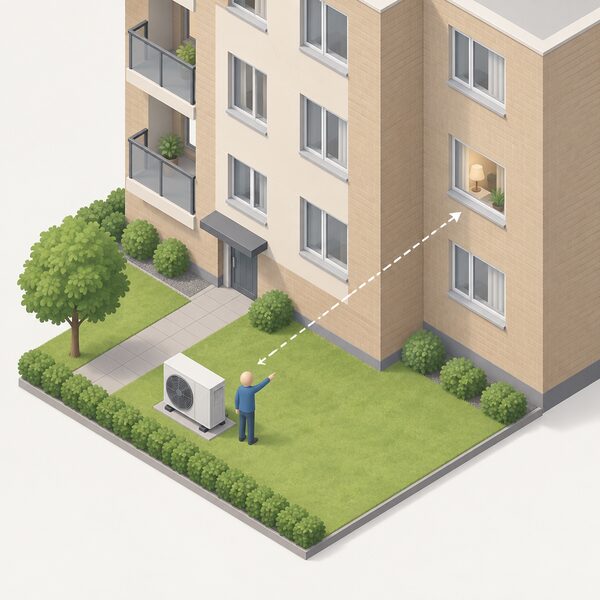
Noise is the constraint that most often decides whether a heat pump can go where the household wants it. The limit is expressed in two ways in official guidance, and the two readings differ on the exact measurement point. One states that the unit must be at or below 42 decibels from a metre away from any habitable room, for the heat pump on its own22. Another states that an air source heat pump cannot exceed 42dB at a distance of 1 metre from the centre of a neighbour's habitable room window, known as the assessment point22. Both figures are 42 decibels; the difference is where the measurement is taken, and the second is the more demanding reading because it is anchored to a neighbour's window.
Siting rules interact with noise. In a conservation area, planning permission is needed if the pump would be on a wall or roof which fronts a highway, or be nearer to any adjoining highway than any part of the building22. Planning permission is also needed if the house or flat is a listed building, or within the garden or grounds of a listed building22. Class G permitted development does not apply where the dwellinghouse or block of flats is a listed building7.
Ground source heat pumps follow a different route: installation within the curtilage of a house or block of flats does not require planning permission, but listed building consent may be required if the property is listed22. That distinction matters in a flat, where a ground loop is usually impractical but a shared ground array on communal land is not impossible.
For a household, the noise limit is the reason a heat pump cannot simply be placed outside the nearest window. It is also the reason a flat project needs the freeholder or management company involved early, because the assessment point may be a neighbour's window rather than the occupant's own.
Who decides: landlord consent, leases and the billpayer rule
The billpayer rule decides most questions in a rented home. If you have to pay your energy bills, you can choose to switch your supplier or tariff at any time3. If you are on a landlord's business contract, you may not have the right to choose your own energy supplier or switch suppliers yourself4.
Where you pay a landlord or site owner by meter readings or estimates, the position is different again. You do not have the right to choose your own energy supplier24. You do have the right to be charged only for energy at the unit rate agreed in your tenancy, licence or occupancy agreement, and to see the bills and contract between the landlord or site owner and the energy supplier24. Those two rights are the practical tools available where the account is not yours.
The regulatory framework reaches further than many tenants realise. The Minimum Energy Efficiency Regulations apply to all privately rented properties in England and Wales which are legally required to have an Energy Performance Certificate and which are let on a relevant tenancy type9. Private, local authority and other public body landlords are all covered, as well as a tenant who sub-lets a property9. The minimum standard is a rating of band E or above25.
In Scotland, the position is being reshaped. Proposals for tenement regulation set out a phased approach: at phase 1, individual flats within tenement buildings would be required to meet new energy efficiency standards where this is feasible and cost-effective, alongside the rest of the housing stock, and some tenement types may not initially be asked to replace fossil fuel systems until more suitable options are offered26. At phase 2, all individual flats could be required to meet both new energy efficiency standards and use a zero direct emissions heating system26. A separate Scottish proposal would prohibit the use of polluting heating systems after 2045, and before then at the point of property purchase or when a heat network connection is available in a Heat Network Zone27.
For a renter, the consent chain is the real constraint. A landlord's permission, a lease, a freeholder and sometimes a management company all sit between the household and any fixed change. The routes through that chain are set out on asking a landlord for energy improvements and renting and home energy.
EPC reform and what it may change for rented homes

The Energy Performance Certificate is the instrument that ties rented housing to an efficiency floor, and it is being rebuilt. The current minimum standard for domestic private rented property in England and Wales is a rating of band E or above25. The regulations carry exceptions: listed or officially protected properties where the requirements would unacceptably alter them, temporary buildings used for two years or less, places of worship, low-energy industrial sites, workshops or non-residential agricultural buildings, detached buildings under 50 square metres of total floor space, buildings occupied less than four months a year with expected energy consumption under 25% of all-year use, properties due for demolition with consents, and certain HMOs not sold or let as a single rental in the past ten years25.
The funding rule matters as much as the rating. A recommended measure is only a relevant energy efficiency improvement where third-party funding covers the full cost, or the cost is £3,500 or less inclusive of VAT, or a combination of landlord self-funding and third-party funding totals £3,500 or less inclusive of VAT25. That ceiling is what determines whether a landlord can be required to act or can claim an exemption.
The reform itself is scheduled. The Energy Performance of Buildings regime reforms will replace the single efficiency score with four headline metrics from the second half of 202729. In Scotland, a consultation on proposals for regulations introducing a Minimum Energy Efficiency Standard ran from 6 June to 29 August 202530. The impact assessment behind the 2022 amendment regulations in England and Wales was rated green, meaning fit for purpose31.
For a renter, EPC reform is the lever most likely to change the building rather than the account. A four-metric certificate that reports fabric, heating and cost together makes the gap between a flat's rating and its running cost harder to hide, and it gives a tenant a document to point at. It does not give the tenant the power to commission the work, and that remains the central limit on energy independence in rented housing.
Sources31 cited
- Air source heat pumps: householder planning advice, Central Bedfordshire Council, 2026-09-17
- Class G: installation or alteration of air source heat pumps, legislation.gov.uk, 2026-09-17
- Switching your home energy supplier, Ofgem, 2026
- If you live in a home or business on an energy contract, Ofgem, 2026
- Smart meters, Energy Ombudsman, 2026-09-20
- Economy 7 guide, Uswitch, 2026-09-08
- Class G paragraph G.2, legislation.gov.uk, 2025-05-29
- Portable heaters, Electrical Safety First, 2026-09-17
- Guidance on PRS exemptions and exemptions register evidence requirements, GOV.UK, 2026-05
- How do smart meters help the environment, Smart DCC, 2026
- Scottish House Condition Survey 2024: key findings, Scottish Government, 2024
- How to get a smart meter, Smart DCC, 2026
- Smart meters for renters, Smart Energy GB, 2026-03-16
- How do smart meters send readings, Smart DCC, 2026
- Heat networks consumer protection draft guidance, Ofgem, 2025-09-05
- Domestic RHI: installers and metering, Ofgem, 2026-09-17
- ECO4 delivery guidance v3.2, Ofgem, 2024-04-05
- Summary of updates to ECO4 delivery guidance, Ofgem, 2024-04-05
- Checking your home is fit to live in, nidirect, 2026-09-17
- Planning permission: air source heat pump, Planning Portal, 2026-09-17
- Air source heat pumps, Cornwall Council, 2026-09-17
- Heat pumps, New Forest District Council, 2026-09-17
- Air source heat pumps, Westmorland and Furness Council, 2026-09-17
- Alternative homes energy guidance, Ofgem, 2026
- Minimum energy efficiency standards guidance, Isle of Anglesey County Council, 2026-05
- Tenements short life working group: energy efficiency and zero emissions heating, Scottish Government, 2023-11-28
- Energy efficiency in homes, Scottish Government, 2045
- Energy Performance Certificates guide: buildings for let, Scottish Government, 2023-11-29
- EPC system reform, Scottish Government, 2027-07
- Proposals for a Heat in Buildings Bill, Scottish Government, 2025-08-29
- The Energy Efficiency (Private Rented Property) (England and Wales) (Amendment) Regulations 2022, GOV.UK, 2024-04-22
 Energy Improvements in FlatsLiving in a flat, what can you actually change yourself and what needs the freeholder or management company to agree?
 Meters and Energy IndependenceDo smart meters really save you money, and can you still get one fitted for free?
 Renting and Home EnergyThe position of a tenant in a privately rented home: which measures need no permission, which are fixtures the landlord controls, and what the law says about heating, insulation, certificates and bills across the four UK nations.
 Monitoring in Flats and RentalsCan you get a smart meter in a rented flat, and who decides?
 Which Tariffs Your Meter AllowsHow meter type decides which energy tariffs a household can access, from single-rate and two-rate meters to smart, prepay and restricted configurations, and the constraints faced by flats, rented homes and homes without a working smart connection.
 Controls in Rented HomesCan you change the heating controls in a rented home, and who pays if they break?