

In this guide
Social housing is the tenure where energy upgrades are most often planned in bulk, funded by grant, and delivered street by street rather than house by house. A social tenant does not commission the work and does not pay for it directly: the landlord, a council or a registered provider, applies to a government programme, contributes its own money, and chooses which blocks and estates are done in which order. In England, the Warm Homes: Social Housing Fund pays for energy efficiency upgrades and low carbon heating measures in social housing, aimed at stock currently below Energy Performance Certificate band C1. In Scotland, the Social Housing Net Zero Heat Fund offers capital grant funding to social landlords to install clean heating systems and energy efficiency measures3. Wales runs the Optimised Retrofit Programme for registered social landlords and councils4.
The standards are not identical across the UK. Scotland's Energy Efficiency Standard for Social Housing was introduced to improve the energy efficiency of social housing and to help reduce energy consumption, fuel poverty and greenhouse gas emissions, with a first milestone for social rented homes by 31 December 2020 and a second requiring all social housing to meet, or be treated as meeting, EPC band B by the end of December 2032, or to be as energy efficient as practically possible within the limits of cost, technology and necessary consent5. A UK-wide commitment set out in 2024 is for all social housing in the UK to reach an EPC rating of at least C or equivalent by 20307.
On condition rather than efficiency, the sharpest recent change is Awaab's Law. From October 2025 it requires social landlords in England to investigate and resolve damp and mould in homes within set time periods8. That converts what was often a discretionary repairs queue into a timed duty, and it sits next to the energy question rather than separate from it: a cold, poorly heated home is where condensation damp most often appears.
What social housing energy efficiency means for a tenant
For the household, the practical meaning of these standards is that the fabric and the heating system of the home are someone else's capital programme. The tenant's leverage is in reporting, evidence and consultation, not in procurement. That is a different position from an owner occupier and different again from a private renter, who must ask permission for almost any change; the page on asking a landlord for energy improvements covers the private side.
The stock itself is comparatively good. Scottish Government material describes social rented homes as some of the most energy efficient in Scotland, with 85% already achieving EPC band D or above6. That is the legacy of the first standard, which required social landlords to meet an energy efficiency rating equivalent to EPC bands C and D, and of the programme funding that followed11. The standard was framed as encouragement to landlords to improve the stock rather than as a penalty on tenants12.
What remains is the harder end: flats in tenements and towers, homes off the gas grid, solid-walled properties and blocks where a communal heating decision has to be taken for everyone at once. Those are the homes where a landlord may reach the limits of cost, technology and necessary consent written into the Scottish standard5, and where a tenant may wait several funding rounds. Independence gained is real but partial: better insulation cuts the amount of energy the home needs whoever supplies it, while a heat pump or a heat network connection moves the household from gas to electricity and, in the case of a network, ties it to a single heat supplier it did not choose.
Awaab's Law and the duty on damp and mould

Awaab's Law applies to social landlords in England. From October 2025 it requires them to investigate and resolve damp and mould in homes within set time periods8. The significance is the clock: the obligation is triggered by the report, and the landlord must act inside defined windows rather than when a contractor becomes available. The law has been introduced in phases, widening over time from damp and mould to further housing hazards.
Detailed timings, the written summary a landlord must provide, and what counts as an emergency are set out in the regulations themselves and are covered on the page on damp and mould in rented homes, alongside the hazard assessment councils use in the Housing Health and Safety Rating System.
Energy work and damp duties are being joined up in practice. In Wales, social landlords working through the Optimised Retrofit Programme monitor health indicators such as mould and moisture levels13, and landlords under the programme's third phase are required to install environmental and energy sensors in homes14. Sensors give a landlord continuous evidence about temperature and humidity; they also mean data about the inside of a home flows to the landlord and its systems, which is a dependence worth naming.
How social homes are upgraded: fabric first, then heating
Retrofit in this sector follows a familiar order. The measures in scope include insulating roofs, walls and floors, replacing windows, improving ventilation, draught-proofing, installing an efficient heating and hot water system and adding renewable generation such as solar panels15. English funding for non-social homes within a wider scheme is available for insulation, associated ventilation and communal low carbon heating, with other measures only on an exceptional basis and with justification, which shows how tightly programmes police the fabric-first order16.
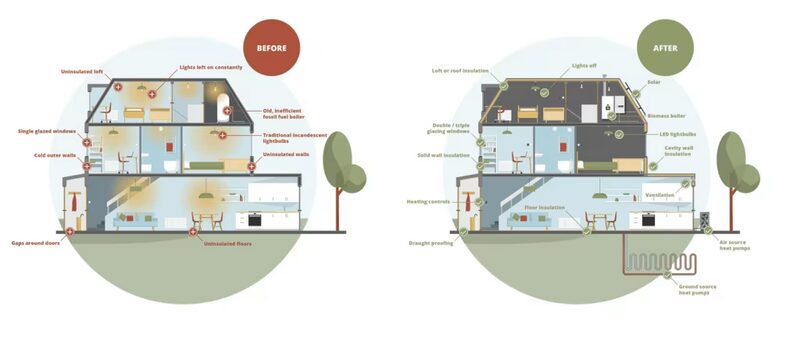
The national evidence base for what measures actually deliver is the National Energy Efficiency Data-Framework, which assesses the impact of installing home efficiency measures such as loft insulation on household energy consumption17. On the heating side, eligible low carbon technologies in English social housing funding are limited to air source heat pumps, ground source heat pumps, shared ground loops and heat network connections16.
Programmes are also pushing data-led delivery. Strategic partnership applications under Warm Homes: Social Housing Fund Wave 3 can pursue digitalisation of retrofit: using smart technology, sensors or monitoring platforms to collect real-world data from the properties being retrofitted for assessment and for post-retrofit monitoring, using building information modelling to design retrofit solutions from that data, and using energy efficiency measurement and electricity demand management tools to optimise energy usage, including reducing peak demand16.
Where a whole block is involved, the carbon case for keeping the building matters. Edinburgh's high-rise retrofit and upgrade programme treats retrofitting existing high-rise blocks as the lower-carbon option compared with demolition and reconstruction, with a reduction in whole-life carbon emissions in the range of 50% to 75%18. Work on tall buildings brings its own regime, covered on energy work in high-rise flats and higher-risk buildings.
Shared ground loops: promising on paper, rare in the numbers
A shared ground loop puts one ground array under a site and connects individual heat pumps in each home to it, which suits terraces and blocks where no single household has space for its own boreholes. It is an eligible low carbon heating technology in English social housing funding16 and appears in the Warm Homes: Local Grant list alongside air source heat pumps, ground source heat pumps and high heat retention storage heaters19. Under ECO4, a district heating connection using shared ground loops installed in social housing at SAP band D has to be treated as an innovation measure20.
Deployment has been thin. Boiler Upgrade Scheme reporting recorded 11 grants paid for shared ground loop ground source heat pumps cumulatively to November 2023, rising to 17 by February 202421. Ground source heat pumps overall are a small share of that scheme: 2,388 voucher applications received and 1,567 redemptions paid cumulatively from May 2022 to July 2026 in England and Wales10.
| Measure | Figure | Period |
|---|---|---|
| Shared ground loop grants paid, Boiler Upgrade Scheme | 1121 | cumulative to November 2023 |
| Shared ground loop grants paid, Boiler Upgrade Scheme | 1722 | cumulative to February 2024 |
| Ground source heat pump voucher applications, England and Wales | 2,38810 | May 2022 to July 2026 |
| Ground source heat pump redemptions paid, England and Wales | 1,56710 | May 2022 to July 2026 |
Installing a ground array on domestic premises is usually considered permitted development and does not need a planning application, though councils should be contacted about local requirements in listed buildings and conservation areas23. Technically, guidance expects ground arrays, including header pipes and manifolds, to be flushed as one system to remove all debris and purged to remove all air, a closed-loop installation to be pressure tested in accordance with BS EN 805 section 11.3.3.4, and commissioning information given to the dwelling owner to include details of the fluids used and their commissioned concentrations24.
Grants and funding: who pays, nation by nation

No social landlord funds this from rent alone, and the funding routes differ across the four nations.
| Nation | Main programme | What it funds |
|---|---|---|
| England | Warm Homes: Social Housing Fund | Energy efficiency upgrades and low carbon heating in English social housing1; supports local authorities and social housing landlords to improve energy performance25 |
| England | Warm Homes: Local Grant | Energy performance improvements and low carbon heating improvements; social housing landlords contribute at least 50% of total cost19 |
| Scotland | Social Housing Net Zero Heat Fund | Capital grant funding for social landlords to install clean heating systems and energy efficiency measures3 |
| Wales | Optimised Retrofit Programme | Insulation, efficient heating systems and renewable energy installations in social housing13 |
| Northern Ireland | Household energy efficiency grants | Loft and cavity wall insulation and a new boiler or heating system27 |
England's earlier vehicle, the Social Housing Decarbonisation Fund, was a grant programme for energy efficiency and low carbon heating measures in social homes28. Wave 1 supported energy performance improvements in up to 20,000 social housing properties and Wave 2.1 proposed improvements to around 90,000 social homes29. Its successor, the Warm Homes: Social Housing Fund, provides funding to local authorities, registered providers of social housing and registered charities that own social housing30, and targets stock currently below EPC band C up to that standard2. Under Wave 3 an on-gas-grid low carbon heating incentive allows up to 10% of homes in an application to access a £20,000 grant fund per home16.
The Scottish fund is designed to accelerate the delivery of energy efficiency and clean heat to existing social housing26. Published descriptions of its capital contribution are inconsistent: one government response states capital support of up to 50% for energy efficiency, while the same document elsewhere gives 60%, and the two figures have not been reconciled31. Scottish area-based schemes have also widened to cover more whole house retrofits including zero or low carbon heating and microgeneration such as solar photovoltaics, where technically feasible and where it helps reduce fuel poverty.
In Wales the Optimised Retrofit Programme is described as helping registered social landlords reduce the carbon footprint of existing social housing4, and is available to registered social landlords and local authorities to install a variety of home decarbonisation measures in existing stock32.
Funding is also being devolved. In the West Midlands, a Buildings Retrofit Pilot will replace three centrally funded retrofit programmes: the Warm Homes: Social Housing Fund, the Warm Homes: Local Grant and the Public Sector Decarbonisation Scheme33. Its primary outcomes are expected to be fuel poverty alleviation in homes and reductions in carbon emissions in homes and public sector buildings34. Tenants of landlords in a devolved pilot area may find the application route and eligibility look different from the national scheme.
Where the Boiler Upgrade Scheme fits
The Boiler Upgrade Scheme is the England and Wales grant most households have heard of, and it is aimed at property owners rather than at tenants. Scheme guidance sets the ground source heat pump grant at £7,500, with a voucher valid for six months10. Installer guidance gives the same £7,500 grant value from 21 July 202636. The £7,500 figure covers water source heat pumps and those on shared ground loops as well, and cumulative redemptions paid for ground source heat pumps reached 1,567 between May 2022 and July 202610. Social landlords generally work through the social housing funds above rather than through this scheme; how much you pay yourself under the Boiler Upgrade Scheme covers the owner-occupier position.
Standards, EPCs and the reform of the ratings system
Every target above is expressed through the EPC, which provides an assessment of a home's energy efficiency37. That makes the reform of the certificate itself consequential for social housing.
In Scotland, reformed regulations are intended to introduce a new rating system for domestic and non-domestic properties giving improved information on energy efficiency and on the emissions and performance of the heating system, plus a new heat retention rating that considers installed energy efficiency measures38. The new rating system is also proposed to support regulation such as a private rented sector minimum energy efficiency standard39. The Climate Change Committee has advised that reforms to EPC rating metrics should be applied alongside wider improvements to the EPC system to improve the quality of assessments and use of data40. That caveat matters in social housing, where a whole programme's targeting and reporting rests on assessment quality.
The targets themselves stack up as follows. Scotland's EESSH2 sets EPC band B by the end of December 2032, or as energy efficient as practically possible5. Earlier Scottish consultation proposed maximising the number of social rented homes achieving EPC B by 2032 with no detriment to environmental impact or air quality, and that no social housing should be let after 2025 with a rating lower than EPC D6. The UK-level commitment is EPC C or equivalent for all social housing by 2030, alongside preventing private landlords from letting homes below EPC C or equivalent7. In England, a government response to the consultation on improving the energy efficiency of socially rented homes was expected in early 202642.
Scotland is also legislating more broadly. Proposals for a Heat in Buildings Bill would set minimum energy efficiency standards for all homes by the end of 2033, with private landlords required to meet the standard by the end of 2028 and homeowners by 203343. For flats, a phased approach to tenements has been considered: at phase 1 individual flats would be required to meet new energy efficiency standards where feasible and cost-effective alongside the rest of the stock, with some tenement types not initially asked to replace fossil fuel systems until more suitable options are offered; at phase 2 all individual flats could be required to meet both the new efficiency standards and a zero direct emissions heating system45. Supply is part of the same plan: a Scottish commitment is to deliver 110,000 energy efficient, affordable homes by 2032, at least 70% of them in the social rented sector and 10% in remote, rural and island communities46.
Tenure-level statistics for England and Wales come from the Office for National Statistics, which publishes energy efficiency of dwellings, estimated CO2 emissions and main fuel type of central heating by property type, tenure and whether new or existing. The 2025 release was delayed from 6 October to 28 October 2025 because of a data quality issue found during quality assurance, and the next release is due in October 202647.
Tenant rights: reporting, evidence and the limits of them

A social tenant's rights in this area are procedural. The strongest is the damp and mould duty already described, which is triggered by a report and runs to a timetable8. Reports should be in writing, dated, and kept, because the landlord's clock and any later complaint both depend on when the problem was raised.
Electrical safety is one of the few areas where the rules are written for both tenures at once: the government guidance on electrical safety standards in the private and social rented sectors is addressed to landlords, tenants and local councils alike49, and electrical safety checks in rented homes sets out how the inspection regime works. The wider set of obligations is covered on landlord duties on energy, heating and home safety and on the Decent Homes Standard and its equivalents.
Consultation on a retrofit programme is a different matter from a repair. A tenant in a block being upgraded is normally consulted rather than given a veto, and the decision on technology is the landlord's and its funder's: the eligible technology list is set by the scheme, not by the household16. Where sensors are installed as a condition of programme funding, as in Wales14, the household gains monitoring it did not request.
What this means for a household's energy independence
Insulation is the part of the programme that is unambiguously the tenant's gain: a better-insulated home needs less energy from any source, the benefit does not depend on a tariff, and it cannot be withdrawn. Ventilation added alongside it protects against the condensation damp that tight homes otherwise suffer, which is why programmes fund insulation with associated ventilation together16.
Heating changes are more mixed. Moving from a gas boiler to a heat pump removes a gas standing charge and a gas dependence, and puts the home wholly on electricity, where solar generation on the landlord's roof or a smart tariff can help. It also makes the household dependent on a single supply, on the landlord's maintenance contract for a machine it does not own, and, in shared ground loop and heat network cases, on a communal asset that cannot be left behind by one household alone. Independence in social housing is therefore mostly fabric independence. The rest is a change of dependency, negotiated on the tenant's behalf. Further reading on tenure-specific constraints sits on energy independence when you rent or live in a flat and across the wider guide at /homes-audiences/.
Sources49 cited
- Warm Homes: Social Housing Fund statistics, August 2026, GOV.UK, August 2026
- Warm Homes: Social Housing Fund Wave 3 budget allocation, GOV.UK, 21 November 2024
- Heat in Buildings progress report 2025, Scottish Government, 2 October 2025
- Optimised Retrofit Programme, Welsh Government, 4 November 2021
- Energy efficiency in social housing, Scottish Government
- Energy efficiency in homes, Scottish Government
- Accelerating to net zero: response to the CCC progress report, GOV.UK, 17 December 2024
- Energy and net zero impact assessment: heat and buildings, GOV.UK, 2025
- Warm Homes: Local Grant policy guidance, GOV.UK, July 2026
- Boiler Upgrade Scheme statistics, July 2026, GOV.UK, 27 August 2026
- Energy efficiency of domestic private rented property regulations: business impact assessment, Scottish Government, 6 June 2025
- EESSH guidance for social landlords, Scottish Government, 18 February 2019
- Welsh Government boosts funding for warmer, cheaper social homes, Welsh Government, 26 November 2025
- Optimised Retrofit Programme 3 year 4 guidance 2025 to 2026, Welsh Government, 8 May 2025
- Do you need planning permission for retrofitting, South Oxfordshire District Council, 15 August 2025
- Warm Homes: Social Housing Fund Wave 3 scheme guidance addendum, GOV.UK, June 2026
- National Energy Efficiency Data-Framework: impact of measures, GOV.UK, 26 June 2025
- High Rise Retrofit and Upgrade Programme Phase 1, City of Edinburgh Council, 20 April 2026
- Warm Homes: Local Grant, Greater Manchester Combined Authority
- Summary of updates to ECO4 delivery guidance and measures table, Ofgem, 26 June 2025
- Boiler Upgrade Scheme quarterly report issue 6, Ofgem, 30 November 2023
- Boiler Upgrade Scheme quarterly report issue 7, Ofgem, 29 February 2024
- Heat pumps: planning permission, Planning Portal
- Approved Document L volume 1 consultation version, Welsh Government, August 2025
- Reforming consumer protection for home upgrade schemes, GOV.UK, 17 June 2026
- Scottish Government response to the Green Heat Finance Taskforce, Scottish Government, 17 December 2025
- Home heating grants, Belfast City Council
- Social Housing Decarbonisation Fund Wave 1 impact evaluation, GOV.UK, 27 August 2026
- Social Housing Decarbonisation Fund, GOV.UK, 13 May 2024
- Warm Homes: Social Housing Fund, Greater Manchester Combined Authority
- Scottish Government response to the Green Heat Finance Taskforce, part 4, Scottish Government, 17 December 2025
- Grant funding will support decarbonising 100 homes in Flintshire, Welsh Government, 4 June 2024
- The Buildings Retrofit Pilot, West Midlands Combined Authority
- Devolved retrofit pilot FAQs, West Midlands Combined Authority
- Boiler Upgrade Scheme guidance for installers version 5, Ofgem, 28 April 2026
- Boiler Upgrade Scheme guidance for installers version 5.1, Ofgem, 2 July 2026
- Solar photovoltaic panels and EPCs, London Borough of Bromley
- Scoping consultation on the Heat and Energy Efficiency Technical Suitability Assessment, Scottish Government, 6 June 2025
- EPC reform: government response, Scottish Government, 11 July 2025
- Letter on reform of domestic EPC rating metrics, Climate Change Committee
- Heat in Buildings Strategy: Fairer Scotland Duty assessment summary, Scottish Government, November 2021
- Reforms to the Energy Performance of Buildings regime: partial government response, GOV.UK, 9 March 2026
- The Heat in Buildings programme, Scottish Government
- Proposals for a Heat in Buildings Bill, Scottish Government, 29 January 2026
- Tenements Short Life Working Group final report, Scottish Government, 28 November 2023
- Tackling fuel poverty in Scotland: periodic report 2021 to 2024, Scottish Government, 1 April 2025
- Energy efficiency of housing in England and Wales: 2025, Office for National Statistics, 28 October 2025
- Energy efficiency of housing, England and Wales, five years rolling, Office for National Statistics, 28 October 2025
- Electrical safety standards in the private and social rented sectors: guidance, GOV.UK, 1 November 2025
 Social and Rented Home StandardsWhat condition is your landlord legally required to keep your home in?
 Controls in Rented HomesCan you change the heating controls in a rented home, and who pays if they break?
 Rented Homes and Landlord MetersWho is responsible for the energy in your rented home?
 HMOs and Shared HousesWho is responsible for the electrics, the gas and the fire alarms when you rent a room in a shared house?
 Insulation in Rented HousingWho pays for insulation when you rent, and who has to agree to it?
 Where to Start If You RentRenting means you can switch supplier or get a smart meter yourself, but insulation, glazing and heating need your landlord's agreement.