In this guide
Dimplex is the brand most closely associated with domestic storage heating in the UK, and it has been since 1961, when the company produced the first marketed domestic storage heater. The current installed range splits into two families: storage heaters, which charge on cheap off-peak electricity and release heat the following day, and direct acting heaters, which provide instant warmth at the standard rate1.
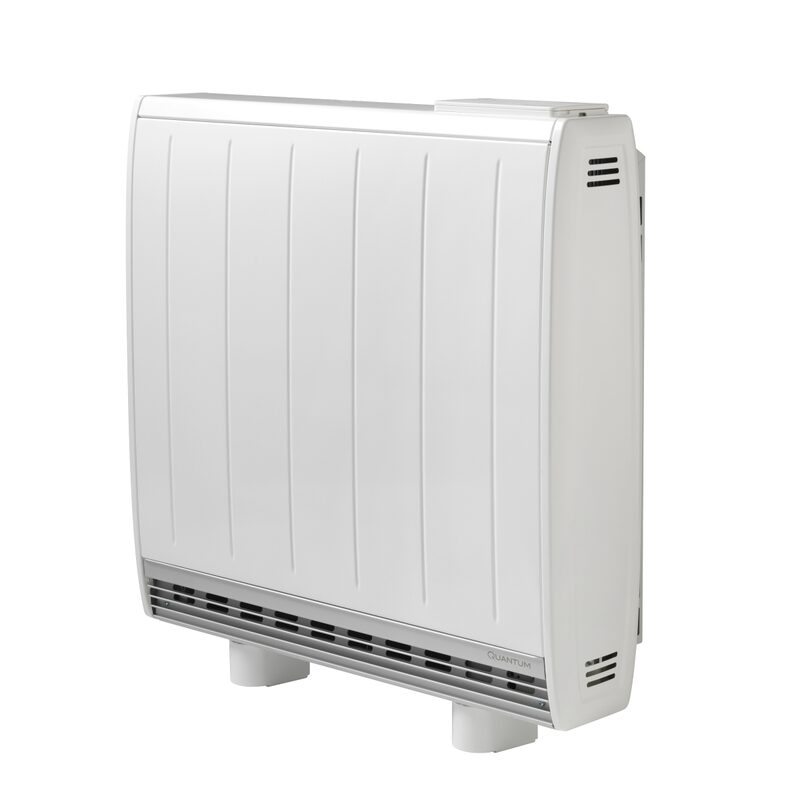
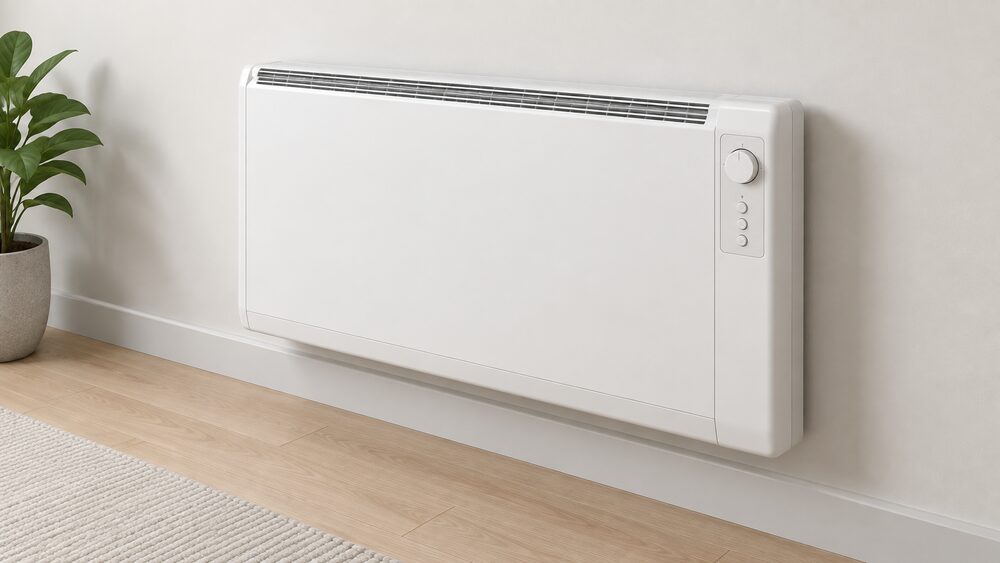
The flagship is the Quantum, a high heat retention (HHR) storage heater using intelligent and adaptive controls2. Below it sits the XLE Slimline, which Dimplex describes as the new non-high heat retention standard for storage heating, available in five models3. Panel heaters, electric radiators and convector heaters fill out the direct acting side of the range4.
For a household, the appeal is straightforward: no gas supply, no pipework, no flue and no chimney connection2. The dependence is equally clear. Every one of these products runs on electricity, so the home stays on the grid and with an electricity supplier, and the running cost advantage of a storage heater depends entirely on being on a tariff with a cheap overnight window.
The Dimplex range and what runs it
Dimplex offers two types of installed electric heater. Direct acting heaters provide instant warmth with standard rate electricity. Storage heaters store thermal energy generated during off-peak hours from low-cost electricity1. That single distinction governs everything else about the range, from the model a household chooses to the tariff it needs and the way the heating behaves across a day.
The storage side is led by the Quantum, which Dimplex calls the most advanced high heat retention storage heater on the market today1. The XLE Slimline is positioned beneath it as the new non-high heat retention standard, an electric storage heater with a clean look and reliable performance, and a modern replacement for older storage heaters3. Dimplex also sells a range of compact high heat retention heaters under the Stiebel Eltron name in the wider market, and all of its storage heating solutions comply with Lot 20 of the ErP Directive2.
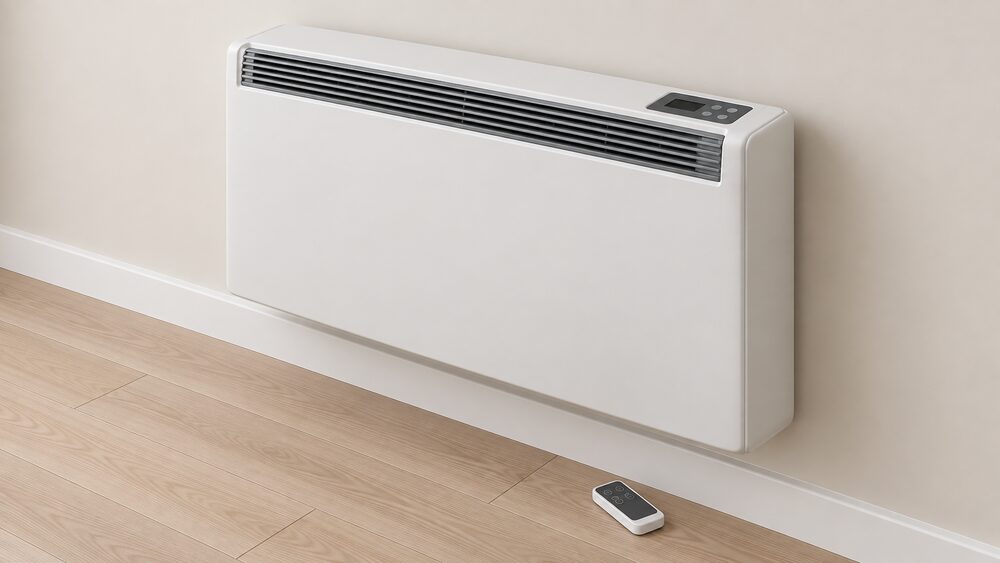
The direct acting side covers panel heaters, electric radiators and convectors. Dimplex panel heaters are either wall mounted or ceiling mounted, and run on standard rate electricity4. The Q-Rad electric radiator complements the Quantum range and can be used with the Edel hot water heat pump5. Portable options include the HeatLite convector range, which delivers instant warmth to rooms up to 20m², and the DXUC2BS ceramic fan heater with PTC ceramic technology and tip-over protection6.
| Product | Type | Electricity | Key feature |
|---|---|---|---|
| Quantum | High heat retention storage heater | Off-peak, with peak top-up | Adaptive controls, remote control with Hub2 |
| XLE Slimline | Storage heater, non-HHR | Off-peak core plus peak boost | Dynamic storage calculation, fan assisted3 |
| Panel heaters | Direct acting | Standard rate | Wall or ceiling mounted4 |
| Q-Rad | Electric radiator | Standard rate | Complements Quantum, Edel compatible5 |
| HeatLite convector | Portable convector | Standard rate | Rooms up to 20m²6 |
How storage heaters work: off-peak charging and controlled discharge
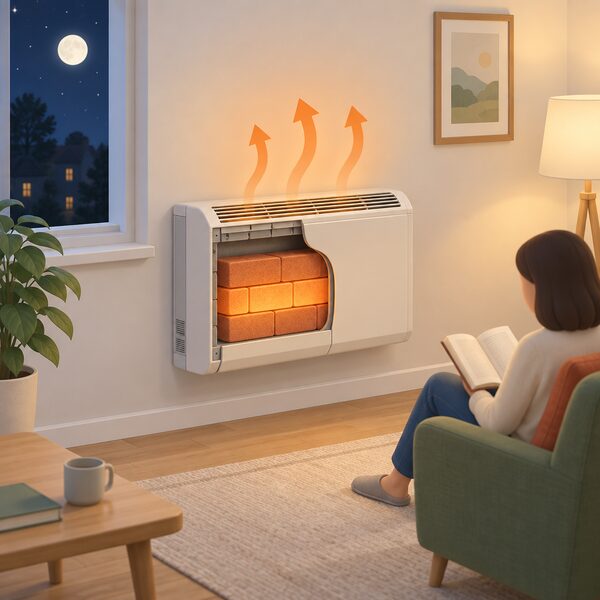
A storage heater is designed to mainly use off-peak electricity, likely topped up with peak-rate electricity for extra warmth12. The mechanism is consistent across the independent guidance: storage heaters use cheap off-peak electricity available with an Economy 7 tariff to heat high thermal capacity bricks, releasing heat the following day13. They charge during off-peak hours when electricity is cheaper, usually overnight14. Smart Energy GB describes the same principle, noting that storage heaters work by using cheaper, off-peak night-time electricity to create and store heat for use the next day, and are sometimes called Economy 7 heaters15.
The Centre for Sustainable Energy puts it in similar terms: storage heaters work by storing heat generated by cheaper night-time electricity and releasing this heat during the day16. The Energy Saving Trust adds that they are often used with special energy tariffs that offer lower rates during off-peak times, helping to lower heating costs17.
Dimplex's own description of the XLE shows how the two supplies are separated in practice. Two electrical supplies are required: a peak supply to control the electronics, fan and boost, and an off-peak supply for the storage core3. The heat source is off-peak heat stored in the core, supplemented by direct acting peak energy3. That is the honest picture of how a storage heater runs: the bulk of the heat is bought cheaply overnight, but the top-up and the controls run at the standard rate.
Official guidance reinforces the control requirement. Approved Document L states that automatic control of input charge should be provided for electric storage heaters18. Northern Ireland's current Decent Homes Standard summary table lists electric storage heaters on an off-peak or Economy 7 tariff as qualifying efficient heating19.
"Storage heaters work by charging up when electricity is cheaper, then releasing heat gradually through the next day."
Quantum, XLE Slimline and panel heaters: which model fits which home
The choice between the three main families comes down to how the household uses heat and what tariff it is on.
The Quantum is the high heat retention option. It uses intelligent and adaptive controls, and Dimplex describes it as the most advanced HHR storage heater on the market today1. It is Lot 20 compliant for increased energy efficiency9. It suits a home that wants the bulk of its heat bought overnight and released slowly across the day, with the least possible peak-rate top-up.
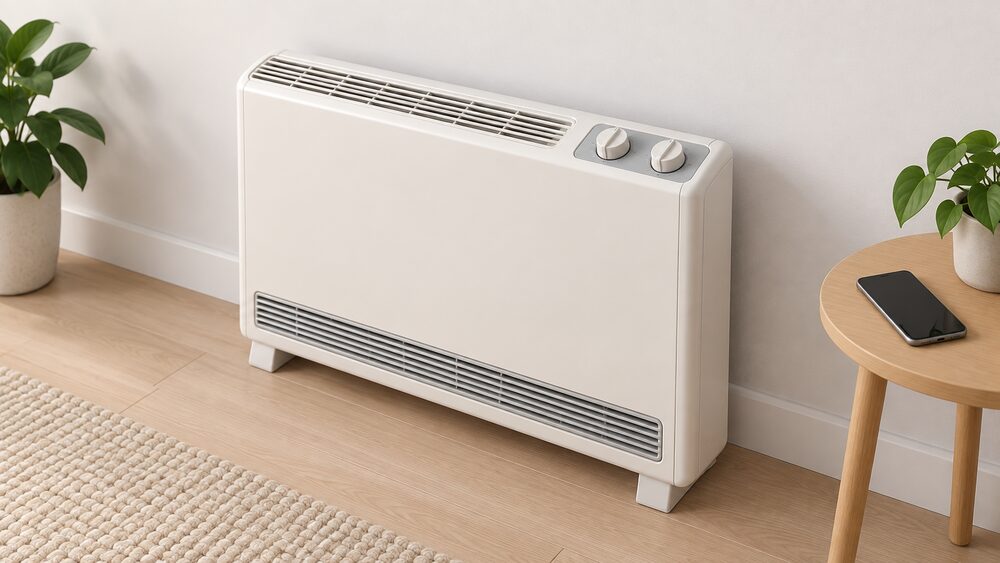
The XLE Slimline is the standard storage heater in the current range, available in five models2. Dimplex describes it as a modern replacement for older storage heaters, with heat leakage greatly reduced compared with conventional storage heaters3. It offers dynamic storage calculation, adjusting the amount of energy stored to meet the user's requirements without wastage, and it is fan assisted to distribute heat quickly and quietly3. It is not app controlled3.
Panel heaters are the direct acting option. Dimplex panel heaters use standard rate electricity to heat a space up quickly by convection, or by a combination of radiant and convection heat4. They are wall or ceiling mounted and connect to a mains supply with no additional plumbing4. The PLXE classic panel heater can deliver heat as a standalone unit or be installed alongside the Edel hot water heat pump as a smart heating and hot water system20.
| Model | Best suited to | Heat source | App control |
|---|---|---|---|
| Quantum | Homes wanting maximum off-peak share | Off-peak core, adaptive | Yes, with Hub9 |
| XLE Slimline | Like-for-like replacement of old storage heaters | Off-peak core plus peak boost | No3 |
| Panel heaters | Rooms needing quick, occasional heat | Standard rate | Range dependent4 |
A household on a time-of-use tariff with a long cheap window gets the most from a storage heater. A household that needs heat at unpredictable hours, or that is on a single-rate tariff, gets more from direct acting heaters, at the cost of buying every unit at the standard rate. The comparison between the two approaches is set out in direct acting electric heating vs storage heaters.
High heat retention: extra insulation and dynamic storage calculation
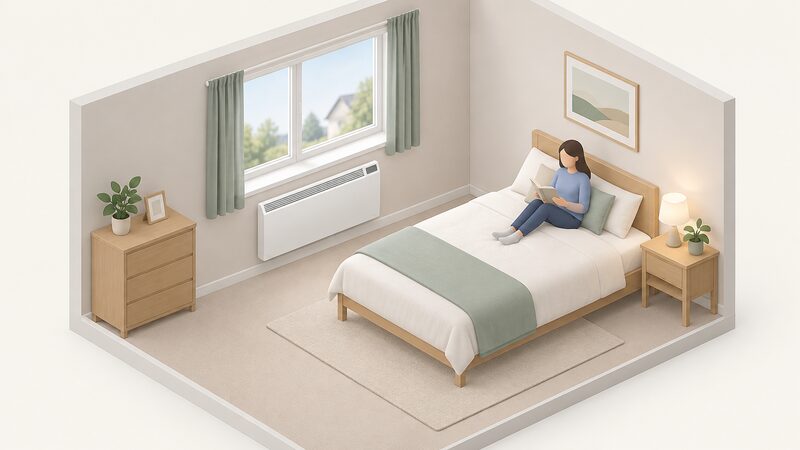
High heat retention is the technical difference that matters most in the current range. Dimplex states that HHR storage heaters like the Quantum provide additional layers of insulation to retain heat longer than a conventional storage heater2. Independent guidance agrees: modern storage heaters have higher heat retention, meaning they hold heat for longer, and they generally come with improved heating controls including an automatic charge control, thermostat and programmer21.
The Centre for Sustainable Energy describes the same effect in more detail, noting that these models achieve even better heat retention and are able to estimate the next day's heating demand based on user heating habits and climatic conditions, so input settings need no adjustment16. That is the practical gain: the household does not have to guess how much to charge the heater each night.
The assumed split between on-peak and off-peak electricity used in modelling reflects the difference between the two classes. Integrated storage heaters have an assumed 85:15 split, and high heat retention storage heaters have an assumed 90:10 split8. That is a modelling assumption rather than a metered outcome, and it depends on the household running the heater as intended.
The XLE takes a different route to the same problem. Rather than extra insulation, it uses dynamic storage calculation, adjusting the amount of energy stored to meet the user's requirements without wastage, and it reduces heat leakage compared with conventional storage heaters3.
Controls and smart function: thermostats, timers and the Dimplex Hub
Dimplex storage heaters have digitally controlled, electronic thermostats and a 7 day programmable user timer2. That is the baseline across the range. Independent guidance lists the features now common on modern storage heaters as thermostats, remote wi-fi controls, programmable timers, fans to help disseminate the heat, and open window detectors22.
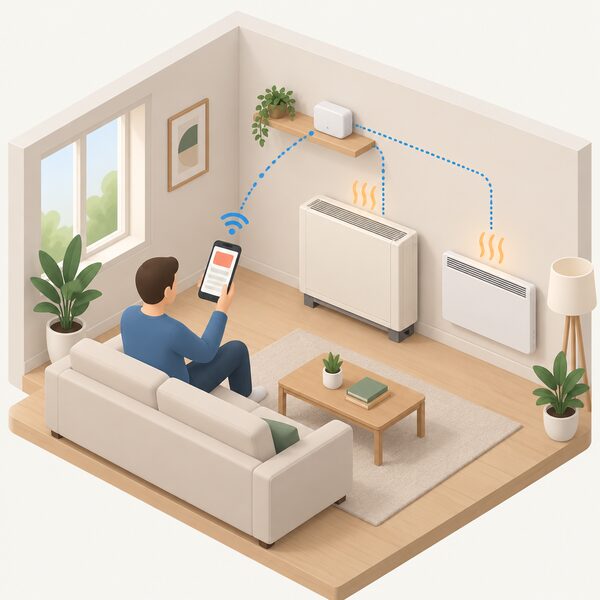
Remote control is an add-on rather than a built-in. The Dimplex Control Hub enables remote control of supported Dimplex electric radiators, panel heaters, high heat retention storage heaters, hot water cylinders and hot water heat pumps, individually or by zone, with energy usage tracking and remote diagnostics, and it is sold separately23. The Hub connects via Ethernet or Wi-Fi to allow control and monitoring of heating and hot water through Dimplex Control24. It also allows heaters to be grouped into zones to control and track their usage, and to view and change heating mode quickly24.
The Quantum can be controlled remotely using the Dimplex Control smartphone app when purchased together with the Dimplex Control Hub9. The Hub connects Quantum heaters to the internet and acts as the bridge between RF Dimplex products and the Dimplex Control Cloud server9. The app provides remote heating management and energy usage monitoring, including control, user access sharing, scheduling, energy usage monitoring, quick manual override and sites and zone management9.
Dimplex describes its smart heating controls as helping households be more mindful of energy consumption and reduce excess heating any time, anywhere from smart devices25. The Q-Rad requires the Dimplex Control Hub, sold separately, for app control5.
This is where the range creates its clearest dependence. Local control at the heater and the 7 day timer continue without an internet connection. Remote scheduling, energy monitoring and remote diagnostics depend on a home broadband connection, Dimplex's cloud server and the manufacturer's app. A household that wants no cloud dependency can run the heaters on their own controls and lose only the remote functions. Wider context on controls is at heating controls and thermostats.
Warranty: two-year standard guarantee and free extension on registration
All Dimplex products come with a two-year standard guarantee, and registration within 28 days of purchase or installation brings an extended guarantee on select ranges3. The same terms are repeated across the panel heater and electric radiator pages: a 2 year guarantee, with the option to extend on selected Dimplex panel heaters when the product is registered4.
The extension is not universal. It applies to select ranges only, so the two-year term is the one that applies by default and the one a household should treat as the floor. Registration is the trigger, and it must happen within 28 days of purchase or installation3.
Some products carry different terms. Dimplex convector heaters carry a 3 Year Product Promise6. The BPH100G bathroom panel heater is listed with a 2 year guarantee26.
Registration is handled through Dimplex's own product registration route. The general principles of guarantee registration, including what a registration actually secures and what voids a claim, are covered at boiler warranties and guarantee registration.
Sizing and installation: no gas or pipework, and help with heat loss calculations
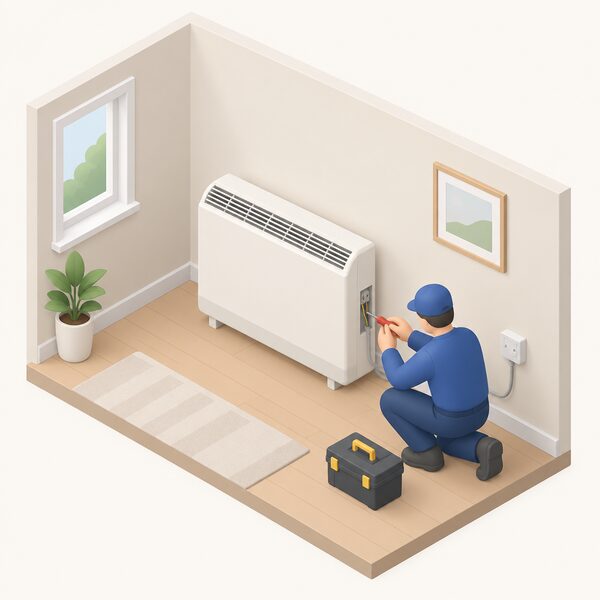
Dimplex installed heating systems are designed for individual rooms or entire homes1. The installation advantages are real and specific. Storage heaters have no requirements for gas or pipework, making them easier to install than a wet radiator heating system2. Panel heaters connect to a mains supply with no additional plumbing required4. Night storage heaters need no chimney connection and no heating tank7.
The XLE needs two electrical supplies: a peak supply for the electronics, fan and boost, and an off-peak supply for the storage core3. That is a wiring requirement rather than a plumbing one, but it is a requirement nonetheless, and it means the property needs an off-peak supply to get the full benefit.
Electric space heaters need no regular maintenance27. Dimplex water heaters comply with the appropriate regulations and are supplied with all necessary safety kits28. The ECSd cylinder requires no cold water storage tank, freeing up living space28.
Sizing is the part that decides whether the system performs. Dimplex publishes guidance on calculating a room's heating requirements when choosing electric heating29. The general method for sizing any heating system is at boiler sizing, and the electrical supply implications of an all-electric heating system are at electrical safety and supply for electric heating.
For a household, the independence position is this: no gas connection, no flue, no pipework, no annual gas safety check. What remains is a dependence on the electricity grid, on an electricity supplier, and on an off-peak tariff to make the storage heater economics work. A storage heater does not remove the household from the energy system; it shifts when it buys from it.
Independent evidence: the NEA case study on Quantum replacing old heaters
The strongest independent evidence on Dimplex storage heaters comes from the National Energy Action case studies. NEA published a case study in October 2017 of Aspire Housing replacing old storage heaters with Dimplex Quantum HHR heaters and unvented cylinders in off-gas North Staffordshire homes30. In March 2019, NEA published a further report on a project replacing storage heaters in 24 NCHA properties with Dimplex Quantum heaters and new cylinders31.
These are case studies of real installations rather than laboratory tests, and they are the closest thing to independent field evidence on how the Quantum performs when it replaces older storage heating in off-gas homes. The Centre for Sustainable Energy also maintains a Dimplex Quantum advice guide, reviewed in June 202632.
The wider policy context matters for households in the devolved nations. NEA Northern Ireland calls for a flexible approach to technologies, including hybrid heat pumps, and for a dual-support model combining heating grants with energy efficiency upgrades33. Its Manifesto for Warmth asks for improved protections for renters against cold, damp homes and for regulatory oversight of the heating oil market34. Official statistics for Northern Ireland record 134 heating replacements under innovative schemes in 2024/2535. NEA's retrofit work with Cambridge City Council has funded air-source heat pumps, solar PV, Mechanical Ventilation with Heat Recovery systems and Myenergi Eddi solar power diverters36.
On solar specifically, the position is mixed. Dimplex states that Quantum high heat retention storage heaters are designed to work effectively with Economy 7 tariffs2. Independent guidance notes that solar panels could generate the electricity a heat pump needs or power a dry electric underfloor heating system, and that a battery to store excess solar electricity would make this more efficient37. Electric thermal store boilers can also be powered using solar panels22, and thermal stores can be used with solar, wind, biomass and hydro renewable systems38. Solar generation peaks during the day while storage heaters charge at night, so without a battery the two do not align. The tariff side of this is covered at Economy 7 and time-of-use tariffs.
Sources38 cited
- Installed heating, Dimplex, 2026
- Storage heaters, Dimplex, 2026
- XLE Slimline storage heater, Dimplex, 2026
- Panel heaters, Dimplex, 2026
- Q-Rad electric radiator, Dimplex, 2026
- Convector heaters, Dimplex, 2026
- Storage heating, Stiebel Eltron, 2026
- Electric heating, Centre for Sustainable Energy, 2026
- Quantum brochure, Dimplex, July 2025
- HeatLite Smart convector heater, Dimplex, 2026
- Ceramic fan heater, Dimplex, 2026
- Heat the whole house or one room, Uswitch, 2026
- Heating fuel, Uswitch, 2026
- A guide to using electric storage heater controls, Energy Saving Trust, 2026
- What is Economy 7, Smart Energy GB, 2026
- Night storage heaters, Centre for Sustainable Energy, 2025
- Electric heating, Energy Saving Trust, 2026
- Approved Document L, HM Government, 2023
- Decent Homes Standard summary table, Northern Ireland Department for Communities, August 2025
- Residential housing, Dimplex, 2026
- Electric storage heaters, Energy Saving Trust, May 2026
- Electric central heating, Which?, 2025
- Dimplex Control Hub, Dimplex, 2026
- Dimplex Hub, Dimplex, 2026
- Smart controls, Dimplex, 2026
- Bathroom panel heater, Dimplex, 2026
- Benefits of electric space and water heating, BEAMA, 2026
- Water cylinders, Dimplex, 2026
- Why choose Dimplex, Dimplex, September 2026
- Dimplex Quantum storage heaters case study, National Energy Action, October 2017
- Comparison of modern electric heaters, National Energy Action, March 2019
- Dimplex Quantum night storage heaters, Centre for Sustainable Energy, June 2026
- Support for low carbon heat in the residential sector, National Energy Action, May 2026
- NEA NI Manifesto for Warmth, National Energy Action, 2026
- NISEP Annual Report 2024-25, Utility Regulator Northern Ireland, 2026
- Beyond retrofit, National Energy Action, July 2026
- Underfloor heating, Centre for Sustainable Energy, November 2025
- Storage, Electricity North West, September 2026
 Dimplex Quantum storage heaterThe Dimplex Quantum is a high heat retention storage heater that charges overnight on off-peak electricity, with a claimed 27% running cost advantage over standard storage heaters, four timer modes, a PIN lock and a two-year guarantee that can extend to ten years on registration.
 Dimplex heat pumps and hot waterDimplex heat pumps are mainly for hot water, not for heating your whole house.
 Dimplex Control, Alta Thermostats and Storage Heater ControlsHow the Dimplex Control app, Hub and Alta thermostats work with Dimplex storage heaters, panel heaters and hot water, what the app needs to run, and the guarantee terms and deadlines behind it.
 Dimplex electric heating and heat pumpsDimplex makes both storage heaters and heat pumps, so which one suits your home?