
In this guide
A hot water heat pump is a heat pump that heats only the water in a cylinder, taking its heat from the air rather than from a boiler flame. It is not a full heating system. It does one job, and it does it at an efficiency no gas boiler can match: official guidance puts heat pumps at around 300%, meaning for every unit of electricity they consume they deliver roughly three units of heat1. Independent guidance describes the same ratio as three to four units of heat per unit of electricity2.
The reason a household looks at one is usually a cylinder that has to be replaced, a combi boiler that cannot serve a future heat pump, or a hot water demand that a full air to water system would over-serve. The technology is recognised in official methodology: heat pumps providing water heating only are tested to EN 16147:2017, the standard that covers this class of product specifically3.
What follows is what the rules, the standards and the published evidence say about cost, efficiency, siting, planning and running costs, and where the dependence on the grid, a supplier and a manufacturer remains.
What a hot water heat pump is: a heat pump that heats only your water
A hot water heat pump is a heat pump whose output is hot water and nothing else. It does not heat radiators, underfloor loops or any wet central heating circuit. Official methodology treats this as a distinct product class: heat pumps providing water heating only, tested according to EN 16147:20173. That standard exists because a cylinder-only heat pump has a different duty cycle from a whole-house unit, drawing heat over a longer period to bring a stored volume of water up to temperature.
The distinction matters for how the product is assessed and, in practice, for what a household is buying. A full air to water heat pump transfers heat drawn from surrounding air to water in a wet central heating system9. A hot water heat pump does the same transfer but stops at the cylinder. It is a water heater, not a heating system.
The heat source is ambient air. Official guidance describes an air source heat pump as moving heat from the air to a hot water supply10, and independent guidance describes air source heat pumps as taking warmth from the outside air and using it for heating and hot water11. A cylinder-only unit takes that same ambient heat and puts all of it into stored water.
There is a naming trap worth clearing up. A water source heat pump is defined in legislation as a heat pump where the collecting medium is water12. That is a different product from a hot water heat pump, which collects heat from air and delivers it to water. The two are easily confused in search results and in conversation.
For a household's energy independence, the position is straightforward. A hot water heat pump removes gas from the hot water side of the home entirely. It does not remove the electricity supply, the grid connection or the need for a tariff. It shifts one load from a fuel that must be piped in and burned to a fuel that can, in principle, be generated on the roof.
How it works: heat from the air, stored in a cylinder
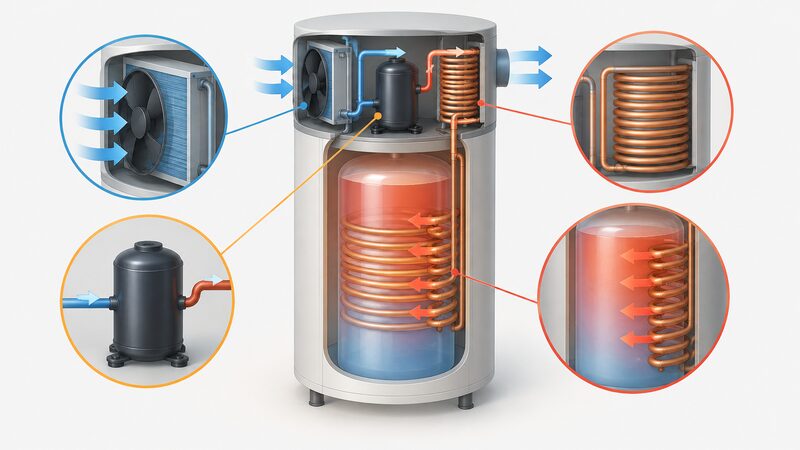
The mechanism is the same refrigeration cycle used in any heat pump, applied to a stored volume of water. Air is drawn across an evaporator, the refrigerant absorbs heat from it, the compressor raises the temperature, and a condenser coil inside or wrapped around the cylinder transfers that heat into the water. The air, now cooler, is expelled.
The cylinder is not optional. Official guidance states that to provide hot water, heat pumps require a water storage cylinder, similar to older generations of gas boiler systems13. Independent guidance is equally direct: unlike combi boilers, heat pumps do not provide hot water instantly, so a hot water cylinder is needed1. The cylinder is usually the way of storing hot water for a standard heat pump5.
That storage is what makes the low-grade heat usable. A heat pump raises water temperature gradually over a period, and the cylinder holds the result until a tap, shower or bath calls for it. Independent guidance describes an air source heat pump as able to heat water stored in a hot water cylinder for hot taps, showers and baths11.
"To provide hot water, heat pumps require a water storage cylinder, similar to older generations of gas boiler systems."
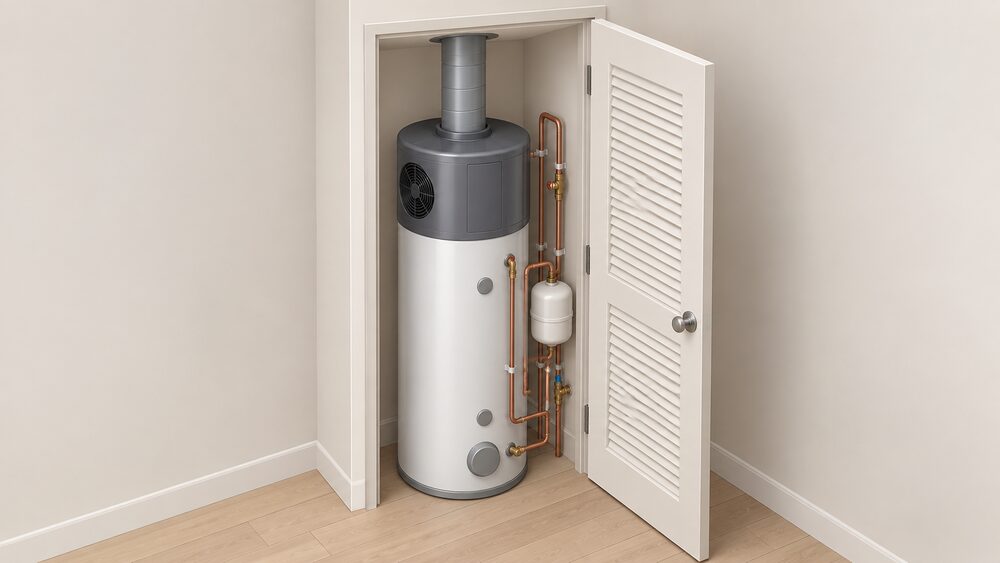
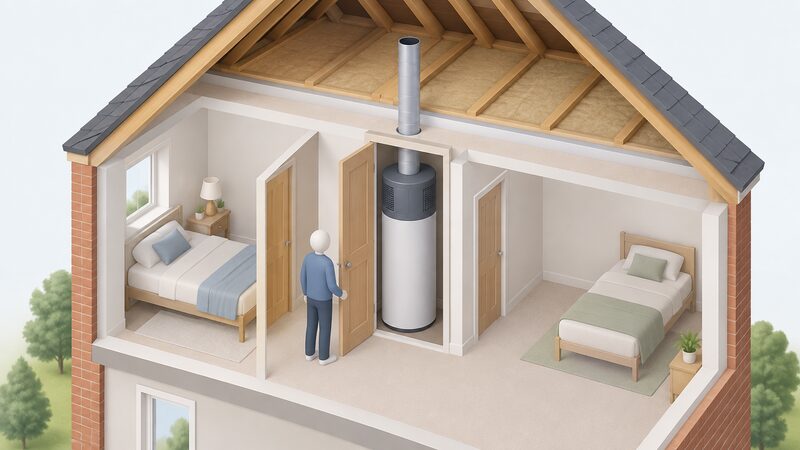
The practical consequences follow from that design. A cylinder takes floor space, usually in an airing cupboard, a utility room or a garage. It needs an air path: a cylinder-only heat pump draws air from the room it sits in, from a loft, or through ducting to outside, and that air has to be able to move. A unit starved of air flow loses efficiency and can trip on a safety cut-out.
The stored volume also sets the recovery pattern. A larger cylinder gives more hot water before the heat pump has to catch up, and a smaller one recovers faster but holds less. Sizing is a matter of how many outlets run at once and how much water a household draws in a morning, not of how big the house is.
Hot water heat pump, exhaust air heat pump or full air-to-water system: which fits which home
Three products can heat a cylinder, and they are not interchangeable. The choice turns on what else the home needs heated and how much air the building can spare.
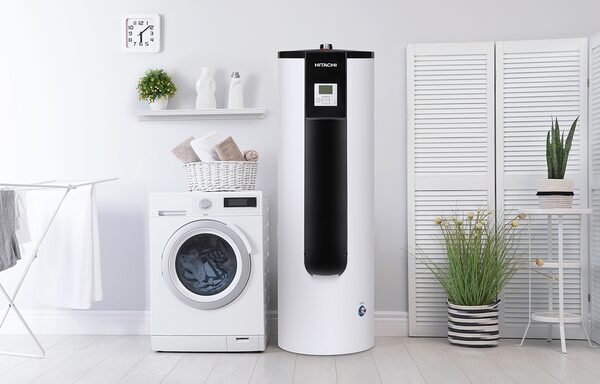
A hot water heat pump heats water only. It suits a home that already has a satisfactory heating system and a cylinder that needs replacing, or a property where the hot water load is the problem rather than the space heating load. It is the narrowest of the three options and the least disruptive to install.
An exhaust air heat pump recovers heat from ventilation exhaust air rather than from ambient air. Official guidance lists the heat sources as ambient air, ventilation exhaust air, or a water or ground heat source14. Independent guidance states that an exhaust air heat pump can heat water stored in a hot water cylinder for hot taps, showers and baths15, and that in some cases it can deliver all of a home's heating needs15. Whether it does depends on the size of the home, how much hot water is needed, and how airtight the home is15. That last condition is the binding one: an exhaust air unit depends on a controlled ventilation rate, so it fits a well-sealed modern property far better than a draughty one.
A full air to water heat pump does both jobs. It transfers heat drawn from surrounding air to water in a wet central heating system9, and it heats the cylinder as part of the same installation. It is the option that replaces a boiler outright.
| System | Heat source | What it heats | Where it fits |
|---|---|---|---|
| Hot water heat pump | Ambient air | Cylinder only | Homes with working heating and a cylinder to replace |
| Exhaust air heat pump | Ventilation exhaust air | Cylinder, and in some cases the whole home | Airtight homes with mechanical ventilation |
| Air to water heat pump | Ambient air | Cylinder and wet central heating | Homes replacing a boiler outright |
The independence question differs across the three. A hot water heat pump leaves the space heating fuel untouched, so a gas boiler remains for warmth. An exhaust air heat pump can remove the boiler entirely in the right building. A full air to water system removes it in most buildings, subject to insulation and emitter sizing. Only the last two change the household's relationship with the gas network.
Efficiency: around 280 to 380%, several times the heat per unit of electricity
The headline figure is consistent across official and independent sources. Official guidance states that heat pumps typically achieve an efficiency rating of 300%, meaning for every unit of electricity they consume they deliver around three units of heat1. Official news guidance puts it at around three units of heat for every unit of electricity used16. Welsh official guidance describes heat pumps as typically producing three to four units of heat for every unit of electricity2, and independent guidance gives the same three to four ratio4.
That is the coefficient of performance, or COP, and it is the reason a cylinder-only heat pump can beat a gas boiler on running cost even though electricity costs more per unit than gas. The Committee on Climate Change states that heat pumps are around three to four times more efficient than gas boilers, which should lead to lower household energy bills17.
The range matters as much as the headline. A COP of 3 is a different proposition from a COP of 4, and the difference is driven by the temperature the unit has to reach and the temperature of the air it draws from. A cylinder-only heat pump heating water to a lower stored temperature, in a mild air source, will sit at the top of the range. One working hard in a cold loft in midwinter will sit lower.
For a household's independence, efficiency is the whole argument. Every unit of heat delivered at a COP of 3 uses a third of the electricity a resistive immersion heater would need for the same output. That reduces the imported energy a home depends on, and it reduces the size of the solar array or battery that would be needed to cover the load. Efficiency is what converts a grid-dependent appliance into one that can plausibly run on self-generated power.
Cost: roughly £10,000 to £13,000 installed, with grant support available
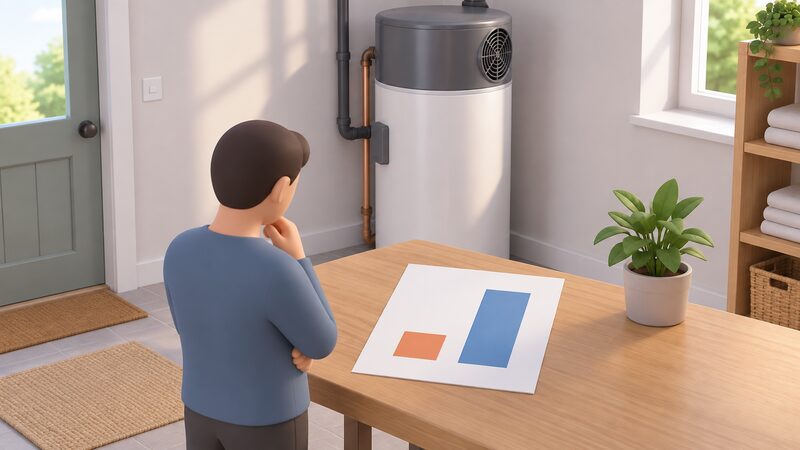
Cost is where the published figures diverge most, and the divergence is between two different purchases. A standalone hot water heat pump is not the same product as a full air source heat pump that heats the whole house, and the price ranges reflect that.
Independent guidance puts the cost of installing a hot water solution at between £1,000 and £4,000, depending on whether a basic immersion heater or heat battery, smart hot water cylinder or hot water heat pump cylinder is chosen6. That is the band that covers cylinder-only approaches, and it spans a wide set of technologies within it.
A full heat pump installation is a larger figure. A parliamentary committee report records a wider range in the cost of installing a heat pump of between £8,000 and £15,000, depending on the work that needed to be done to the home7. That range includes the fabric and emitter work that a whole-house system often requires, which a cylinder-only unit does not.
Grant support exists but is scheme-specific. Official guidance states that the government offers grants to cover part of the cost of installing a heat pump18, and directs households to the Clean Energy website to find out if one applies18. The application route runs through the installer: your installer applies for the grant on your behalf through Ofgem, and a quote comes via the MCS find a heat pump installer tool or an energy supplier19.
| Scheme | Support | Applies to |
|---|---|---|
| Boiler Upgrade Scheme | £7,500 for ground source heat pumps20 | Air source and ground source heat pumps |
| Home Energy Scotland Grant and Loan | Up to £7,500 as a grant and £7,500 as an interest free loan21 | Heat pump installation in Scotland |
| Warm Homes Local Grant | Hybrid heat pumps as an eligible measure22 | Eligible households under the scheme |
Where no published price exists for a specific cylinder-only unit, prices are installer-quoted. The figures above are the published bands for the categories, not a quotation for any particular home.
Running costs and savings: when it beats a gas boiler and when it does not

The running cost case is real but conditional, and the condition is the tariff. Independent guidance states that a heat pump can cost less to run than a gas boiler on a heat pump time-of-use tariff, and that switching to such a tariff reduces running costs significantly11. Official guidance notes that running costs for heat pumps are typically lower when compared to those of traditional gas boilers, but adds the caveat that this depends on the system13.
The comparison against other fuels is different again. Independent guidance on hot water solutions states that at current energy pricing, the costs are likely to be lower than using an oil boiler and similar to a gas boiler or an air to water heat pump with a standard electricity tariff6. That is a useful benchmark: on a standard tariff, a hot water heat pump is roughly level with gas, and clearly ahead of oil.
The mechanism behind the saving is the efficiency ratio. At three to four units of heat per unit of electricity2, a heat pump needs far fewer units of electricity than a resistive heater would for the same hot water. Whether that translates into a lower bill than gas depends on the ratio of electricity price to gas price at the time, which is why the tariff matters more than the appliance.
Solar changes the arithmetic. Independent guidance states that using the free energy solar panels generate to power a heat pump can save more5. A cylinder heats over hours rather than in a burst, which makes it well suited to running when a solar array is generating, or to a time-of-use tariff that prices off-peak electricity cheaply.
The independence position is mixed and worth stating plainly. A hot water heat pump removes gas from the hot water load, and with solar it can run largely on self-generated electricity. It does not remove the grid connection, the electricity supplier, the tariff, or the manufacturer's control electronics and any app the unit depends on. It reduces dependence; it does not end it.
Space, siting and noise: the cylinder indoors and the unit outdoors
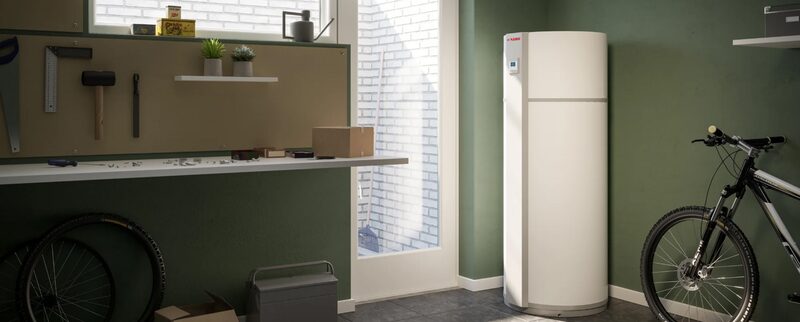
A cylinder-only heat pump has two spatial demands, and they are in different places. The cylinder goes indoors, typically in an airing cupboard, utility room or garage, and it needs the floor area a conventional cylinder needs plus clearance for the unit and its air path. The air side, whether a fan unit on top of the cylinder or a separate outdoor compressor, needs somewhere to draw and discharge air.
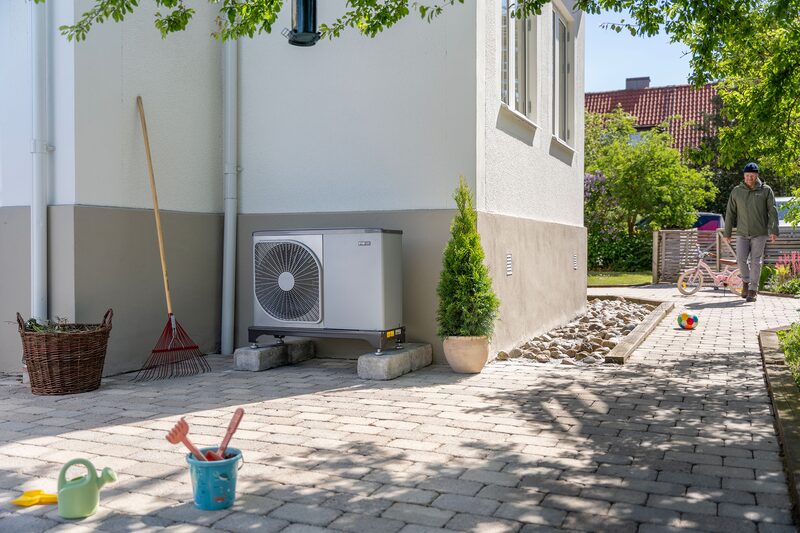
Outdoor space is modest. Independent guidance states that air source heat pumps need less outdoor space than two wheelie bins stood side-by-side, around 1.5 metres wide5. That is the footprint for a whole-house unit, and a cylinder-only heat pump's outdoor component, where it has one, is smaller.
Noise is assessed rather than asserted. The MCS 020 noise assessment calculator applies a pass or fail noise limit of 37.0 dB(A) for a two heat pump assessment, and supports single, two and four heat pump assessments8. The calculator's output is a sound pressure level at the assessment point, which is what the planning test turns on.
Siting is not only about the household's convenience. Class G permitted development carries a condition that the air source heat pump is, so far as practicable, sited so as to minimise its effect on the amenity of the area24. Official guidance repeats the requirement to site the unit so as to minimise its effect on the external appearance of the building and its effect on the amenity of the area25.
Planning and permitted development: size, boundary and noise limits
Permitted development rights for air source heat pumps are conditional, and the conditions are specific. The rights apply to the installation, alteration or replacement of an air source heat pump on a house or block of flats, or within the curtilage of a house or block of flats, including on a building within that curtilage25. Development is permitted only if the installation complies with the Microgeneration Certification Scheme Planning Standards, MCS 020a25.
The size limits are set by volume. The volume of the air source heat pump's outdoor compressor unit, including housing, must not exceed 1.5 cubic metres on a house or 0.6 cubic metres for a block of flats25. Local guidance gives the same figures, describing the pump itself including housing as limited to 0.5 cubic metres on a house or 0.6 cubic metres for a block of flats26. The documents give the house figure differently, and the applicable limit depends on which standard is being applied.
| Condition | Requirement |
|---|---|
| Certification | Must comply with MCS Planning Standards (MCS 020a)25 |
| Volume, house | Outdoor compressor unit including housing must not exceed 1.5 cubic metres25 |
| Volume, block of flats | Must not exceed 0.6 cubic metres25 |
| Boundary | Must not be within 1 metre of the curtilage of the property26 |
| Flat roof | All parts at least one metre from the external edge of the roof25 |
| Pitched roof | Installations on pitched roofs are not permitted development25 |
| Listed building | Rights do not apply within the curtilage of a Listed Building or a Scheduled Monument site25 |
| Cooling | Not used solely for cooling purposes25 |
The installation count is limited. Only the first installation of an air source heat pump would be permitted development on a house which is not detached or a block of flats, while for detached houses the first two air source heat pumps are considered permitted development25. Additional wind turbines or air source heat pumps at the same property require an application for planning permission25. Local guidance states the same limit more simply: only the first installation of an air source heat pump would be permitted development27.
There are further conditions. Development is permitted only if there is no existing wind turbine on a building or within the curtilage of that property25. On land within a Conservation Area or World Heritage Site the unit must not be installed on a wall or roof which fronts a highway, or be nearer to any highway which bounds the property than any part of the building25. On other land, the unit must not be installed on any part of a wall above the level of the ground floor storey if that wall fronts a highway25. The unit must be removed as soon as reasonably practicable when it is no longer needed for microgeneration25.
Where the conditions are not met, planning permission is required. Local guidance lists the triggers: the installation does not meet permitted development rules, a listed building, a conservation area with restrictions, a prominent position such as the front of the property, or an unacceptable impact on neighbours such as noise or visual impact28.
The four nations differ. In Wales, official consultation material states that proposals include means by which the noise level of the air source heat pump is predicted, and that method includes a maximum noise level for air source heat pumps to be considered permitted development29. In Scotland, official impact assessment material covers permitted development rights for air source heat pumps24. In Northern Ireland, official guidance on heat pumps is published separately30. Where compliance with the noise standard is not achieved, a planning application will be required31.
Suitability: insulation, hot water demand and existing heating
Insulation is the first condition. Official guidance states that heat pumps are best suited to buildings with good insulation levels, and that insulation may need to be added internally or externally if homes do not already have good levels32. Northern Ireland official guidance puts it plainly: in all cases, proper insulation is needed for the best performance30.
For a cylinder-only heat pump the insulation requirement is narrower than for a whole-house system. The unit is not trying to heat the building, so the fabric of the home matters less to its performance than the temperature of the air it draws and the standing losses from the cylinder. A well-insulated cylinder and a mild air source do more for a hot water heat pump than wall insulation does.
Hot water demand is the second condition. A cylinder has to be sized to the household's draw, and a cylinder-only heat pump recovers more slowly than a boiler. A household that runs several showers in sequence needs a larger stored volume or a higher recovery rate than one that draws hot water once in the morning.
Existing heating is the third. Where a home has a working heating system and the cylinder is the problem, a cylinder-only unit is the least disruptive route. Where the home needs a full replacement, the scheme rules point the other way: the heat pump must provide both space and hot water heating and be capable of meeting the full space heating and hot water heating demands of the property23. A supplementary heating appliance is acceptable only so long as the heat pump can provide the full space heating demands of the property33.
Hybrid arrangements exist for buildings that cannot take a standalone heat pump. Official guidance states that hybrid heat pumps are suitable for buildings with existing heating systems, or buildings needing significant fabric, energy efficiency and pipework upgrades for a standalone heat pump30.
Living with one: maintenance, lifespan and what servicing involves
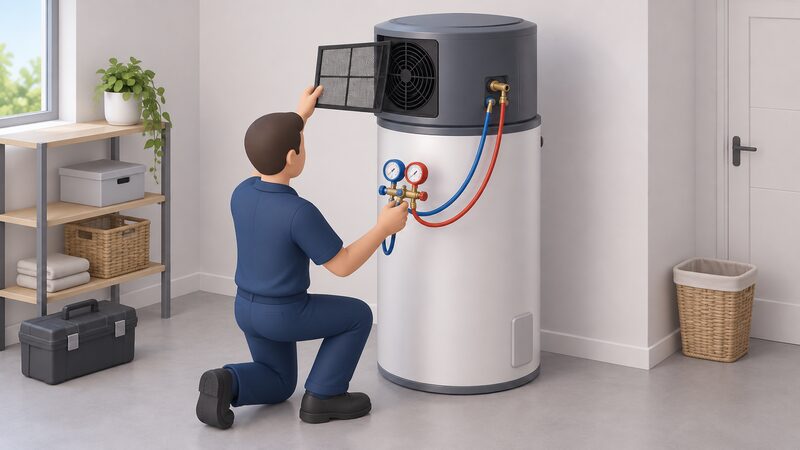
Servicing is annual. Independent guidance recommends an annual service for heat pumps5. A service covers the refrigerant circuit and its pressures, the fan and the air path including any ducting, the cylinder and its immersion backup where fitted, the controls and the safety cut-outs. Ducting that has come loose or a filter that has clogged will show up as a drop in performance long before the unit fails.
Manufacturers describe the technology as low-maintenance. Maker guidance describes an air to water heat pump as environmentally friendly and easy to maintain, with a long service life34. That is the maker's own characterisation of its own products, and it is consistent with the absence of a combustion chamber, a flue and the annual safety checks a gas appliance requires.
Lifespan is longer than a boiler's. Independent guidance gives heat pumps a lifespan of 20 or more years4. That compares with the 10 to 15 years typically quoted for a gas boiler, and it reflects lower operating temperatures and fewer high-stress components. The parts most likely to need attention first are the fan, the controls and the cylinder's own fittings rather than the compressor.
The independence ledger for a household living with one is worth setting out. On the positive side, the hot water load comes off gas entirely, the unit can run on self-generated solar electricity, and the running cost case improves on a time-of-use tariff11. On the other side, the unit depends on a mains electricity supply and a supplier, on a tariff that prices electricity competitively against gas, on a manufacturer for parts and any control app, and on the grid for every hour the sun is not generating. A hot water heat pump reduces a household's exposure to the gas network. It does not remove its exposure to the electricity system, and it adds a new dependency on a manufacturer's continued support for the product.
Sources34 cited
- Air and Ground Source Heat Pumps, Croydon Council, 2026
- Heat Pumps: An Expert Guide for Homeowners, Development Bank of Wales, 2024
- HEM TP 12 Heat Pump Methodology, GOV.UK, January 2026
- Heat Pumps vs Boilers, The CPA, 2025
- Is Now a Good Time to Get a Heat Pump, Energy Saving Trust, 2025
- Air to Air Heat Pumps: Common Questions, Nesta, 2026
- Public Accounts Committee: Heat Pump Costs, UK Parliament, 2024
- MCS 020a Calculator, MCS Certified, 2025
- ECO4 New Measures and Products Guidance v3.0, Ofgem, 2026
- Air Source Heat Pumps Fact Sheet, Pendle Borough Council, 2026
- Air Source Heat Pumps, Energy Saving Trust, 2026
- The Town and Country Planning (General Permitted Development) Order 2015, Schedule 2 Part 14, legislation.gov.uk, 2026
- What Impact Can Heat Pumps Have in Domestic Heating, GOV.UK, 2023
- Approved Document L: Conservation of Fuel and Power, Volume 1, GOV.UK, 2023
- Exhaust Air Heat Pumps, Energy Saving Trust, 2025
- Heat Pumps Explained: Experts Answer Your Questions, GOV.UK, 2024
- The Seventh Carbon Budget, Climate Change Committee, 2025
- Homes and Energy, Manchester City Council, 2026
- Heat Pump, Clean Energy Campaign, 2026
- Boiler Upgrade Scheme Guidance for Installers V5, Ofgem, 2026
- Scotland's Climate Change Plan 2026-2040, Scottish Government, 2025
- Apply for a Warm Homes Local Grant, Liverpool City Council, 2026
- Boiler Upgrade Scheme Guidance V2.3, Ofgem, 2023
- Permitted Development Rights for Air Source Heat Pumps, legislation.gov.uk, 2026
- Planning Permission: Air Source Heat Pump, Planning Portal, 2026
- Air Source Heat Pumps, Cornwall Council, 2026
- Building Regulations Renewables Guidance, Bedford Borough Council, 2026
- Air Source Heat Pumps, Westmorland and Furness Council, 2026
- Permitted Development Rights Impact Assessments, Scottish Government, 2026
- Heat Pumps, nidirect, 2025
- Changes to Permitted Development Rights: Summary of Responses, Welsh Government, 2025
- Heat Pumps, New Forest District Council, 2026
- Boiler Upgrade Scheme Guidance for Installers v5.1, Ofgem, 2026
- When Should I Choose an Air Water Heat Pump, NIBE, 2026
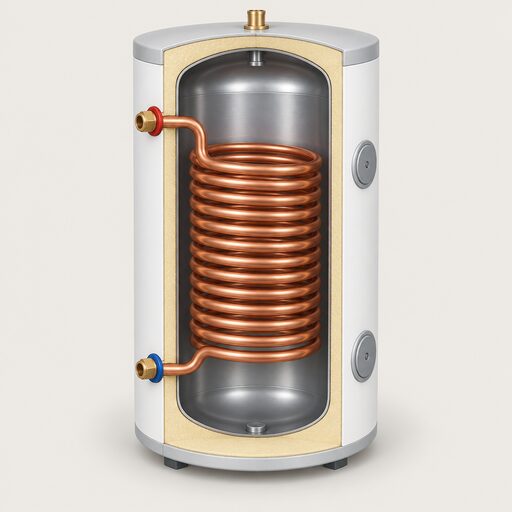 Hot Water CylindersA heat pump needs a cylinder to store hot water, so swapping a combi means getting one.
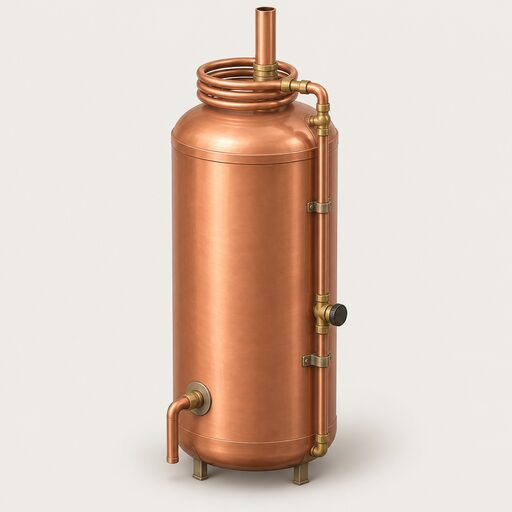 Regular and Heat-Only BoilersGot tanks in the loft and a hot water cylinder in the airing cupboard?
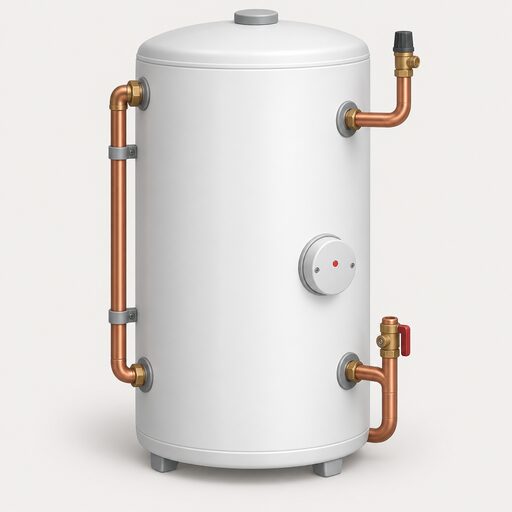 Air-to-Water Wet SystemsAir-to-water heat pumps feed radiators, underfloor heating and a hot water cylinder, and are the most common domestic heat pump in the UK.
 Using a Heat Pump for CoolingCan a heat pump cool your home in summer as well as heat it in winter?
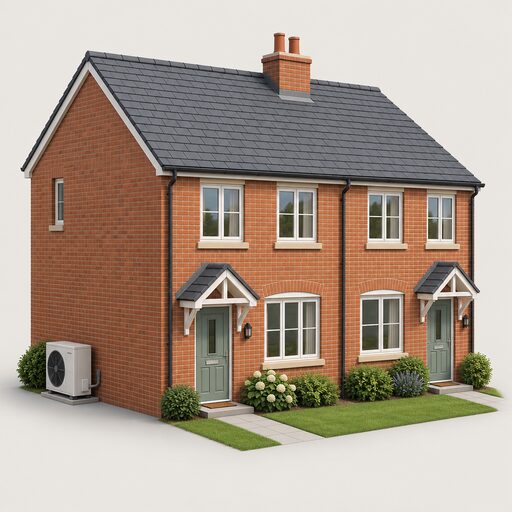 Which Homes Suit a Heat PumpMost UK homes can have a heat pump fitted, so the real question is whether yours makes it easy or expensive.
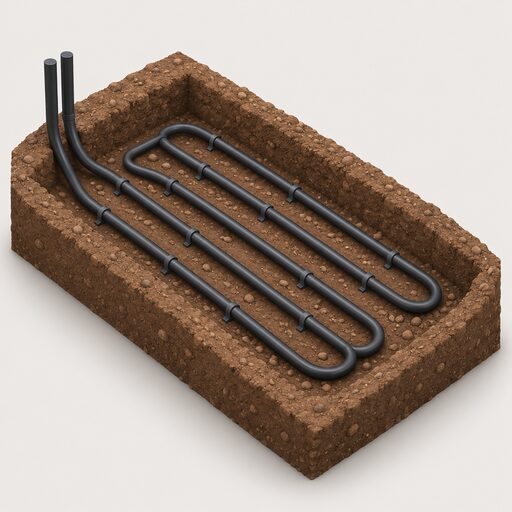 Heat Pumps vs BoilersWill a heat pump actually cost less to run than my boiler, and does it heat the house as well?