
In this guide
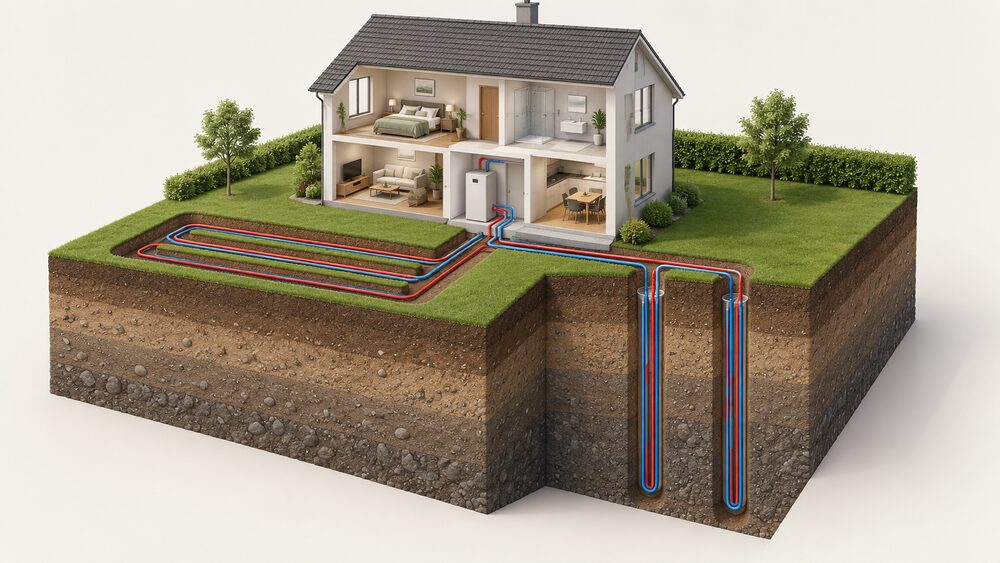
A ground loop is the buried half of a ground source heat pump: a sealed circuit of pipe through which a water and antifreeze mixture is pumped to gather heat from the soil or rock and carry it back to the heat pump unit. The collector takes one of two forms, pipes laid in trenches in the ground or vertical pipes within boreholes, and the choice between them is decided by how much open ground a property has and whether a drilling rig can reach it1.
The scale is larger than most households expect. Which? reports that a borehole could be up to 200 metres deep, although it is less than a metre in diameter, and that horizontal systems use lengths of pipe laid in shallow trenches around one to two metres deep2. For horizontal arrays it gives a working rule of 10 metres of trench per kilowatt of heat pump size for space heating2. A ground source heat pump installation is not a DIY job: sizing, design and installation should be done by a suitably qualified professional2.
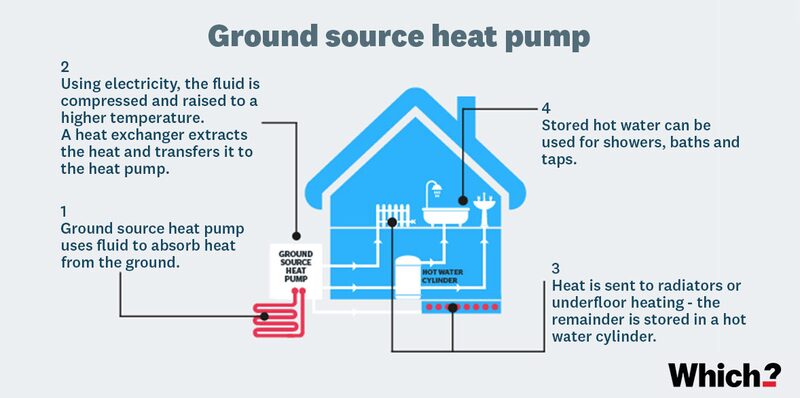
What the collector buys a household is independence from delivered fuel. The heat itself is the natural heat stored in the earth, transferred by the heat pump to heat the home and domestic hot water3. What remains is dependence on electricity to run the compressor and pumps, on a competent designer to size the array correctly, and on the ground itself, which cannot be expanded later without new groundworks.
What a ground loop does: extracting heat from the earth
A ground source heat pump does not burn anything. It extracts heat from pipes buried in the ground to heat your home and water, as the Department for Energy Security and Net Zero puts it in its public attitudes tracker7. Northern Ireland guidance describes the same process in more detail: ground source heat pumps make use of heat stored in the ground to pre-heat water for the heating system, and this water is then heated to the required standard using electricity8. The ground loop is the part that does the gathering.
The collector is a closed circuit. The heat pump unit pumps heat transfer fluid, typically a mixture of water and antifreeze and often referred to as brine, around the buried pipework9. That fluid absorbs heat from the surrounding ground, returns to the unit, gives up its heat to the refrigerant circuit, and is pumped round again. The ground is not consumed by this: it is a heat exchanger, and heat flows back into the disturbed ground from the surrounding mass, from rainfall and from the sun over the course of a year.
The earliest official description of the technology in this country still describes it accurately: ground source heat pumps extract heat from the ground from a series of pipes buried in the soil either in a horizontal network or in deep vertical holes10. Those two families, horizontal and vertical, cover almost every domestic installation, and the choice between them is the single biggest determinant of what the groundworks will involve.
Horizontal loops or vertical boreholes: which collector fits your plot
The two collector types are not interchangeable, and the deciding factors are land area, access and how much ground disturbance a household will accept.
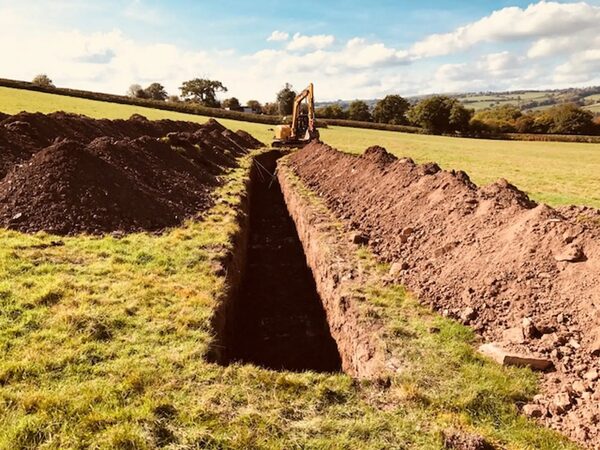
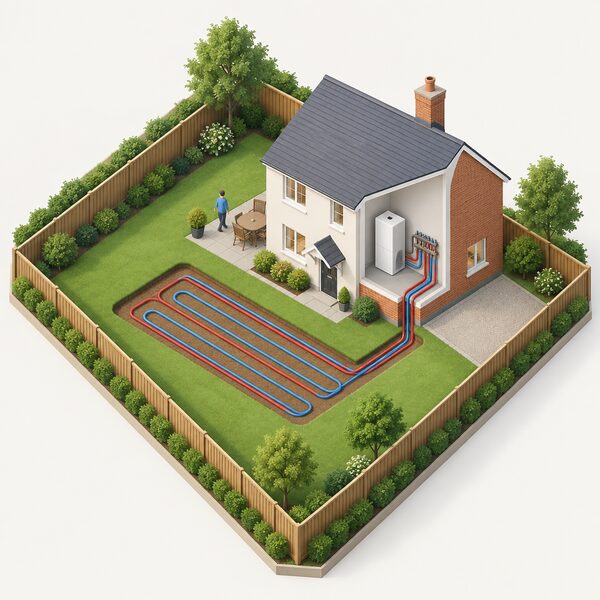
Horizontal collectors need open ground. Croydon Council's retrofit guidance states that you will need outside space for trenches or boreholes, deep holes in the ground, and enough room inside for a heat unit11. Which? describes horizontal systems as lengths of pipe laid in shallow trenches around one to two metres deep2. The trenches are dug, the pipe is laid, and the ground is reinstated. Lawns, borders and driveways are all disrupted in the process, and the ground above the trenches cannot be built on or deeply planted afterwards.
Vertical boreholes need far less surface area but need a drilling rig. Which? reports that the borehole could be up to 200 metres deep, although it is less than a metre in diameter2. A rig needs access to the drilling position, which rules out some tight urban plots and many rear gardens reached only through a house or over a wall. Where access exists, a vertical array can serve a property with almost no garden at all.
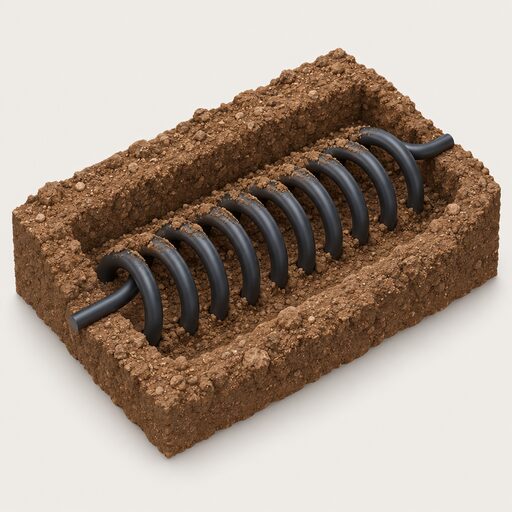
A third variant sits between the two. Slinky coils lay the pipe in overlapping loops within a shorter, wider trench rather than running it straight, which reduces the length of trench needed for a given amount of pipe. The ground area required is not reduced in proportion, because the coils still need spacing to avoid the loops competing for the same heat, and the trench itself is wider.
| Collector type | Ground area | Access needed | Ground disturbance |
|---|---|---|---|
| Horizontal trenches | Large, open ground | Excavator to the trench line | Trenches around one to two metres deep2 |
| Slinky coils | Large, open ground | Excavator to the trench line | Shorter but wider trenches |
| Vertical boreholes | Small surface footprint | Drilling rig to each borehole position | Boreholes up to 200 metres deep, less than a metre in diameter2 |
Energy Saving Trust notes of a ground source installation in a rural off-gas home that it requires more outdoor work to install one12. That is the trade a household makes: more groundworks than an air source unit, in exchange for a collector that is out of sight and unaffected by air temperature.
Sizing the array: trench lengths, depths and borehole specifications
Sizing is where a ground loop installation succeeds or fails, and it is not a matter of matching pipe length to floor area. The array must be long enough to draw the heat a property needs across a whole heating season without over-cooling the ground around it.
The published rule of thumb is a starting point, not a design. Which? gives 10 metres of trench per kilowatt of heat pump size for space heating2. The length of pipe in the ground depends on the size of the property and the amount of heat needed, and longer loops draw more heat but need more space2. A horizontal loop is laid in a shallow trench of 1 to 2 metres, and where space is limited a vertical borehole can be drilled instead2. Borehole depth is set by the same heat demand and by what the drill encounters: Which? gives up to 200 metres as the outer figure for a borehole, with a diameter under a metre2.
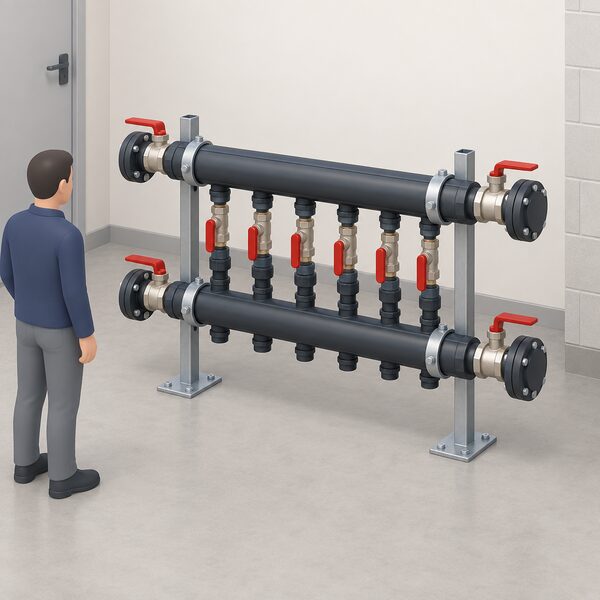
Where more than one borehole is drilled, the array needs managing as a set rather than a single pipe. Scottish Government guidance states that separate control of each collector loop is needed with multiple borehole installations9. That matters because boreholes in the same array can interact thermally if they are spaced too closely, and because a fault in one loop should not take the whole array out of service.
The standards picture is thinner than households might assume. The same Scottish guidance records that there are no British Standards specifically for collector loops, nor for the installation of such loops9. What exists instead is a mix of European and industry material: BS EN 15450:2007 covers the design of heat pump heating systems and includes some guidance such as commissioning of ground loops1, and the Ground Source Heat Pump Association publishes its own standards covering closed loop vertical boreholes, thermal piles and shallow ground source design, installation and materials13. The IGSHPA closed-loop design and installation standards are described as most relevant to individual loops13.
An undersized collector shows itself slowly. The ground around the pipe cools through the heating season and does not fully recover before the next one, so the fluid returning to the heat pump gets colder year on year, the compressor works harder and running costs rise. Because the pipe is buried, correcting it means new groundworks.
The brine circuit: fluid, pressure testing and commissioning standards
The collector loop is a pressure system buried in the ground, and the rules around it are about proving it is sound before it is covered over.
The fluid is a mixture of water and antifreeze, typically referred to as brine9. The antifreeze concentration is not incidental: it sets the temperature at which the loop can operate without freezing and it is recorded as part of handover. Approved Document L, the building regulations guidance for conservation of fuel and power in dwellings, states that commissioning information should include details of the fluids used and their commissioned concentrations14. The Welsh Government's consultation version of the same document repeats the requirement that commissioning information provided to the dwelling owner should include details of the fluids used and their commissioned concentrations15.
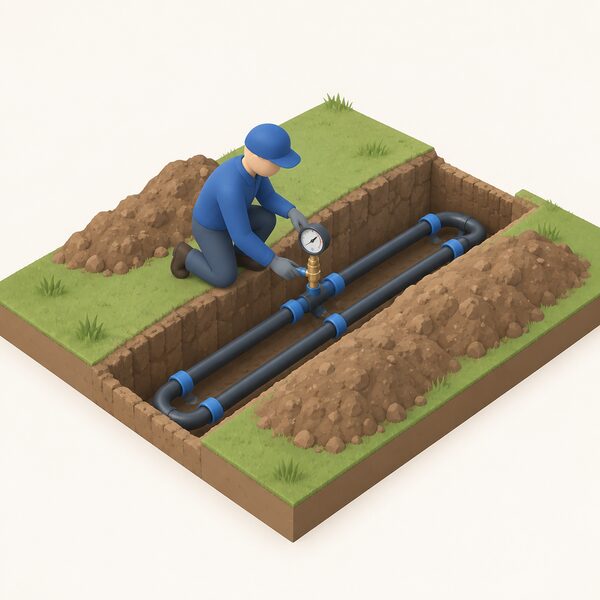
Pressure testing is specified rather than left to judgement. Approved Document L requires a pressure test in accordance with BS EN 805, section 11.3.3.4 for closed-loop ground source heat pump installations14, and the Scottish guidance states that a pressure test in accordance with BS EN 805, section 11.3.3.4 should be conducted9. The test happens before the trenches are backfilled, because a leak found afterwards means re-excavation.
Flushing and purging are the other commissioning steps. Ground arrays, including header pipes and manifolds, should be flushed as one system to remove all debris and purged to remove all air9. Debris left in a collector can block a loop or damage the pump; air left in it causes circulation problems and noisy operation.
"Ground arrays, including header pipes and manifolds, should be flushed as one system to remove all debris and purged to remove all air"
For a household, the practical consequence is a paper trail. The commissioning record should name the antifreeze and its concentration, and the pressure test should be documented. Those documents are what a future service engineer, a warranty claim or a buyer's surveyor will ask for.
Shared ground loops: when two or more homes draw on one array
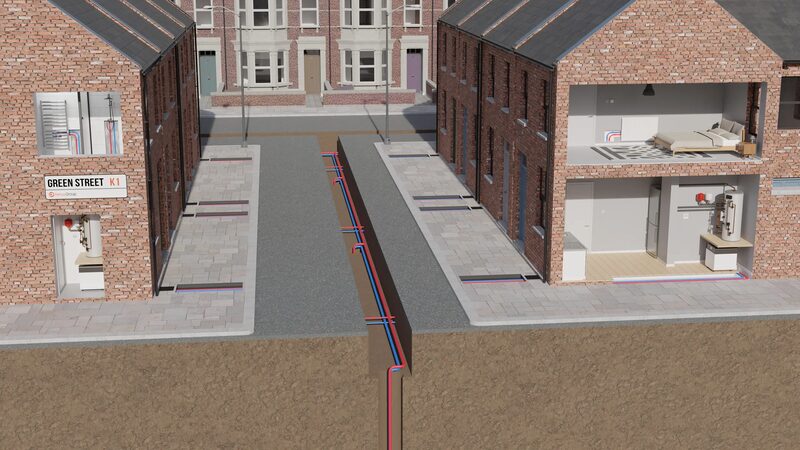
A shared ground loop is the answer for properties that have no ground of their own to dig. A ground loop is shared when two or more ground source heat pumps receive the heat from the same loop through a hydraulic connection16. Each dwelling has its own heat pump; the collector is communal.
This suits terraces, flats, blocks and small developments where individual gardens cannot hold a horizontal array and where a drilling rig cannot reach every rear plot. One array is drilled or trenched once, and the cost and the ground disturbance are spread across the homes connected to it. The arrangement also means the collector is maintained as shared infrastructure rather than by each household separately.
Shared loops are recognised in the grant rules. Ground source heat pumps forming part of a shared ground loop system are eligible under the Boiler Upgrade Scheme17, and the scheme's installer guidance lists ground source heat pumps as part of a shared ground loop among eligible technologies19. There is a capacity ceiling: the combined capacity of all heat pumps on the shared loop cannot exceed 300kWth19.
The dependence a shared loop creates is different from a private one. A household no longer owns its heat source outright; it relies on the loop operator or the management arrangement for maintenance, and on the other connected homes for the loop being kept in good order. In exchange, it gets a ground source system where a private collector would not have been possible.
Water source systems: the open-loop alternative and its permits
Where a property has a suitable body of water, a water source heat pump can use it instead of a buried collector. The Boiler Upgrade Scheme treats these alongside ground source systems: the £7,500 grant covers a ground source heat pump including water source heat pumps and those on shared ground loops20.
The distinction that matters is open loop against closed loop. A closed loop system keeps its fluid inside the pipework and never discharges anything. Defra's draft exemption conditions for closed loop ground source heat pump activities require that the system must be closed loop only and have no discharge of pollutants other than transfer of heat to the environment, and that it must not cause pollution of surface water or groundwater13. A closed loop that meets those conditions sits in the low environmental risk category.
Open loop systems are different in kind. They abstract water, pass it through a heat exchanger and return it, which brings them under abstraction and discharge rules. Croydon Council's guidance states that open loop systems require Environment Agency approval11. Planning guidance adds that if you are installing a new ground source heat pump after 1 October 2023 you may need to get a permit from the Environment Agency21.
There is also a siting condition for larger shared schemes. Defra's exemption conditions require a closed loop system to be not within 50m for a group of 4 or more houses or a single community building from a wetland designated as a Site of Special Scientific Interest, European site or Ramsar site13.
Cost: what a ground loop installation runs to, before and after the grant
Ground source installations cost more than air source ones, and the collector is a large part of the reason: excavation or drilling, pipework, antifreeze, pressure testing and reinstatement all sit in the groundworks line.
The most recent official figures come from the Boiler Upgrade Scheme statistics. The nominal median cost of an air-to-water heat pump and a ground source heat pump in the most recent quarter, 2026 Q2 covering April to June, was £12,908 and £27,232 respectively, including the grant value5. The spread around that median is wide: the lower quartile reported cost of installation was £18,136 and the upper quartile £42,1105. Croydon Council's guidance gives a simpler headline, putting ground source heat pumps at more than £10,00011.
Those figures are reported costs of installations supported by the scheme, so they reflect what households and installers recorded, not a quoted price list. Ground conditions, drilling depth, access and the amount of reinstatement all move the number, and prices are installer-quoted.
| Measure | Figure | Period |
|---|---|---|
| Median installed cost, ground source | £27,232 including grant value | 2026 Q25 |
| Lower quartile reported cost | £18,136 | 2026 Q25 |
| Upper quartile reported cost | £42,110 | 2026 Q25 |
| Median installed cost, air-to-water | £12,908 including grant value | 2026 Q25 |
| Croydon guidance headline | More than £10,000 | 202611 |
VAT treatment is favourable on the materials. HMRC's internal manual lists ground source heat pumps among energy-saving materials for the reduced rate22, and the same manual series covers grant-funded heating supplies23. The grant itself is applied to the cost and installation of the system.
The Boiler Upgrade Scheme grant and the off-gas-grid uplift
The Boiler Upgrade Scheme provides upfront capital grants towards the cost of installing approved heat pumps and, in limited circumstances, biomass boilers24. It operates in England and Wales: the Welsh Government describes it as providing grants for heat pump installations across England and Wales25.
The standard grant for a ground source heat pump is £7,500 off the cost and installation26. The scheme also covers water source heat pumps and systems on shared ground loops at the same level20. From 21 July 2026, eligible off-gas grid properties can apply for an uplifted grant of £9,0004. The approved grant category is a ground source heat pump in an off-gas grid property that is replacing a liquefied petroleum gas heating system27, and the scheme rules describe £9,000 off the cost and installation of air-to-water or ground source heat pumps in eligible off-gas grid properties6. The statistics release describes it as £9,000 towards an air-to-water or ground source heat pump for eligible off-grid properties heated by LPG or oil5.
The uplifted value is available until 31 March 20276. A property claiming it must not be attached to a heat network19.
Take-up gives a sense of scale. Cumulative ground source heat pump voucher applications received in England and Wales from May 2022 to July 2026 were 2,388, with 2,024 vouchers issued and 1,567 redemptions paid5. Ground source is a small fraction of scheme activity, which reflects the groundworks and cost rather than any limit in the grant rules.
Planning permission, permits and building regulations
For most houses, the collector does not need a planning application. The Planning Portal states that the installation of a ground source heat pump or a water source heat pump on domestic premises is usually considered to be permitted development, not needing an application for planning permission21. Croydon's guidance says installing a ground source heat pump is typically considered permitted development11, and Richmond Council states that ground source heat pumps do not usually require planning permission as long as permitted development criteria are met29.
The permitted development rights themselves are framed around the curtilage of a dwellinghouse. Welsh Government guidance describes rights that permit the installation, alteration or replacement of a ground source heat pump or water source heat pump within the curtilage of a dwellinghouse30, and Rother District Council describes the same scope for a microgeneration ground source heat pump within the curtilage of a dwellinghouse or a block of flats31. New Forest District Council states that installation within the curtilage, the garden or grounds, of a house or block of flats does not require planning permission, but that listed building consent may be required if the property is listed32.
Listed buildings and conservation areas are where the position changes. Croydon's guidance notes that listed building consent is needed for listed buildings11, and Brighton and Hove City Council states that installing a ground source heat pump and its associated housing or boxing equipment within the curtilage of a listed building will need listed building consent33. Bristol City Council's guidance on alterations to listed buildings makes the same point about renewable energy installations generally34. Planning guidance notes that in a listed building or a conservation area, local requirements are checked with the council21.
Building regulations apply as they do to any heating installation. Croydon's guidance states that the relevant building regulations requirements are the same for ground source heat pumps as for air source heat pumps11. The Approved Document L requirements on pressure testing and commissioning records, described above, are part of that.
Is your home suited to a ground loop system?
The suitability question comes down to ground, access and heat demand, in that order.
Ground is the first test. A horizontal array needs open land, and the trench rule of 10 metres per kilowatt means a typical home needs a substantial garden or paddock2. A vertical array needs far less surface area but needs a drilling rig to reach the borehole position, and boreholes run up to 200 metres deep with a diameter under a metre2. A property with no garden and no rig access cannot have a private collector at all, which is where a shared loop comes in.
Heat demand is the second test. The collector is sized against the heat the property loses, so a poorly insulated house needs a longer array, more boreholes or both. The ground loop does not change the fabric of the building; it changes how the heat is sourced. Northern Ireland guidance notes that excavation is needed for installing the ground loop system but that it offers long-term energy savings and less maintenance8.
The third test is what the household wants from independence. A ground source heat pump transfers energy from the natural heat stored in the earth to heat the home and domestic hot water3, which removes delivered fuel from the equation entirely. What it does not remove is electricity: the compressor and circulation pumps run on mains power, so the household remains connected to the grid and to a supplier. A ground loop is a heat source, not an electricity supply.

How installation proceeds, from groundworks to commissioning
The sequence is groundworks first, then the heat pump, then commissioning, and the groundworks are the part that dominates the programme.
The preparatory work is recognised in legislation. The definition of installing energy-saving materials includes carrying out groundworks, or dredging a body of water, in order to install pipework or other equipment necessary for the operation of a ground source heat pump or a water source heat pump35. That matters for VAT treatment as well as for describing the job: the digging is part of the installation, not a separate project.
The steps run in a fixed order:
- Heat loss calculation and ground assessment, which set the array size and the collector type.
- Excavation of trenches or drilling of boreholes, with the pipework laid or inserted.
- Pressure testing to BS EN 805, section 11.3.3.4, before backfilling9.
- Flushing of the ground array, including header pipes and manifolds, as one system to remove debris, and purging to remove air9.
- Connection to the heat pump unit and filling with the water and antifreeze mixture9.
- Commissioning, with the fluids used and their commissioned concentrations recorded for the dwelling owner14.
The heat pump itself is quick to install once the collector is in. Which? reports that the installation of a ground source heat pump typically takes one to two days for a professional installer to complete2. That figure covers the unit, not the groundworks, which run to a different timescale set by the excavation or drilling.
The 6 month voucher validity for ground source heat pumps exists for this reason: it is longer than the 3 months allowed for air-to-water, air-to-air and biomass vouchers, because a collector installation has to fit around groundworks and, in some cases, a drilling schedule4.
Sources35 cited
- Generating your own energy: heat pumps, Welsh Government, 2018
- Installing a ground source heat pump, Which?, 2025
- VAT Energy Saving Materials: ground source heat pumps, HMRC, 2026
- Boiler Upgrade Scheme guidance for installers v5.1, Ofgem, 2026
- Boiler Upgrade Scheme statistics, July 2026, GOV.UK, 2026
- Boiler Upgrade Scheme, Ofgem, 2026
- DESNZ Public Attitudes Tracker: heat and energy use in the home, summer 2025, GOV.UK, 2025
- Heat pumps, nidirect, 2025
- Ground source heat pumps and water source heat pumps, Scottish Government, 2010
- Social housing to get green heaters, GOV.UK, 2011
- Air and ground source heat pumps, Croydon Council, 2026
- Air source heat pump for rural off-gas home, Energy Saving Trust, 2026
- Draft exemption conditions for closed loop ground source heat pump activities, Defra, 2026
- Approved Document L, Conservation of fuel and power, Volume 1: Dwellings, GOV.UK, 2023
- Approved Document L Volume 1 consultation version, Welsh Government, 2025
- Boiler Upgrade Scheme quarterly report, issue 17, Ofgem, 2026
- Boiler Upgrade Scheme guidance for installers v2.1, Ofgem, 2023
- Boiler Upgrade Scheme installer guidance, Ofgem, 2022
- Boiler Upgrade Scheme: installers, Ofgem, 2026
- Apply for the Boiler Upgrade Scheme: what you can get, GOV.UK, 2026
- Heat pumps, Planning Portal, 2026
- VAT Energy Saving Materials: reduced rate, HMRC, 2026
- Insulation, nidirect, 2026
- Boiler Upgrade Scheme annual report, April 2023 to March 2024, Ofgem, 2024
- £5 million to help Welsh households invest in greener homes, Welsh Government, 2026
- Boiler Upgrade Scheme, Find government grants, 2026
- Notice of approved grant categories and values for the Boiler Upgrade Scheme, GOV.UK, 2026
- Boiler Upgrade Scheme guidance for installers V5, Ofgem, 2026
- Planning guidance: heat pumps, Richmond Council, 2026
- Planning permission: heat pumps, Welsh Government, 2026
- Renewable energy, Rother District Council, 2026
- Heat pumps, New Forest District Council, 2026
- Improving energy saving and sustainability in conservation areas and listed buildings, Brighton and Hove City Council, 2026
- Making alterations to a listed building, Bristol City Council, 2026
- The Energy-Saving Materials (Rate of Value Added Tax) (Amendment) Regulations 2024, legislation.gov.uk, 2024
 Shared Ground Loop NetworksA shared ground loop lets several homes draw heat from one set of underground pipes, each with its own heat pump.
 Ground Source Heat Pump CostWhat a ground source heat pump costs in the UK, splitting groundworks and drilling from the heat pump and internal works, and how the £7,500 Boiler Upgrade Scheme grant and the £9,000 off-gas-grid uplift change the figure.
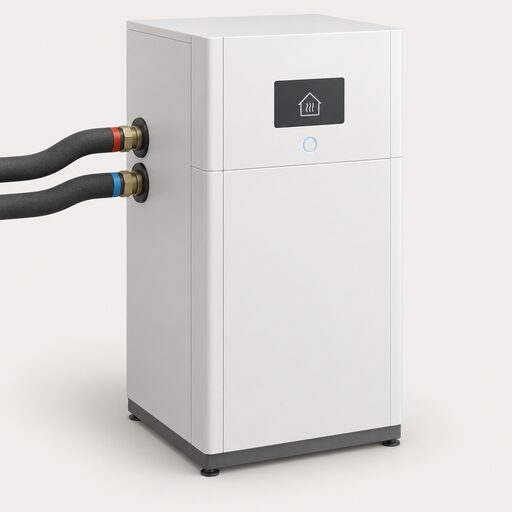 Ground Source Heat PumpsA ground source heat pump takes warmth from the ground to heat your home and water.
 Hybrid Heat PumpsHow hybrid systems pair a heat pump with a gas, oil or LPG boiler, what decides which appliance runs, what they cost, how much gas they displace, and why the Boiler Upgrade Scheme will not fund them.
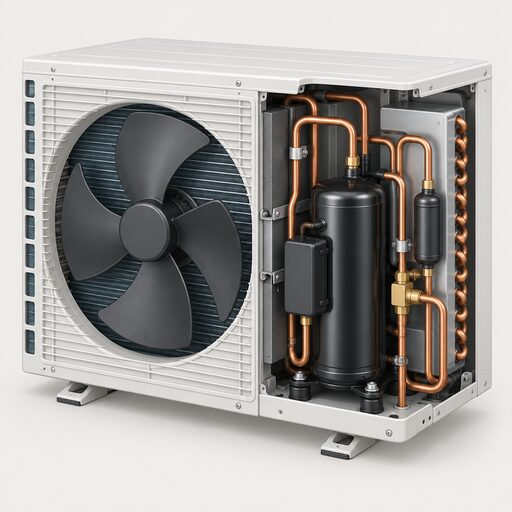 Air Source Heat PumpsHow an air source heat pump takes heat from outdoor air, the difference between air-to-air and air-to-water systems, typical efficiency, the £7,500 Boiler Upgrade Scheme grant, noise and planning limits, and what ownership means for a household's energy independence.
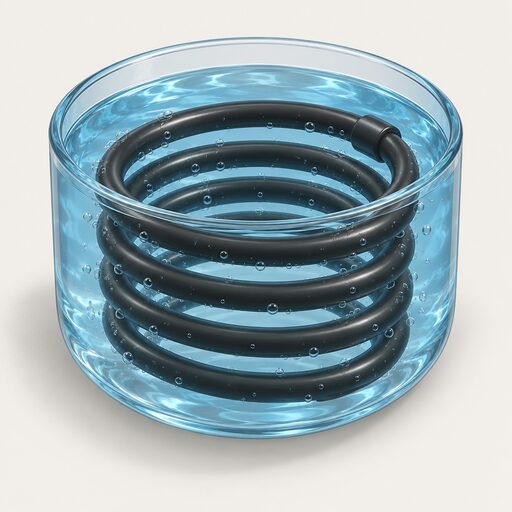 Water Source Heat PumpsYour home sits near a river, lake or the sea.