In this guide
Every heat pump works by moving a fluid called refrigerant round a closed loop, and the choice of that fluid now decides what can legally be sold. Two refrigerants dominate UK domestic air source machines: R290, which is propane, listed on UK product pages with a global warming potential of 3, and R32, a hydrofluorocarbon with a global warming potential of 675. The direction of travel is one way: the majority of hydronic monobloc heat pumps may use R290 (propane), and F-gas restrictions are tightening around anything higher.
The regulatory pressure comes from two numbers. Since 2025, F-gases with a global warming potential above 750 are banned in single split systems containing less than 3 kg of refrigerant. The revised European F-gas Regulation adds prohibitions at a global warming potential above 150 for stationary air-conditioning and heat pumps placed on the market, ahead of the wider phase-out dates. R32 at 675 clears the first threshold and fails the second, which is why makers have moved to propane for new monobloc ranges rather than wait.
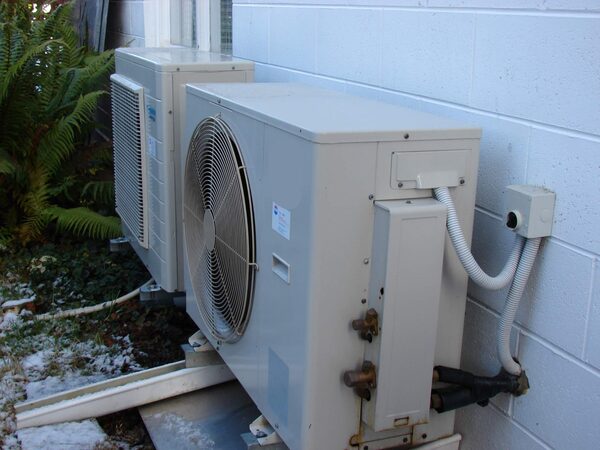
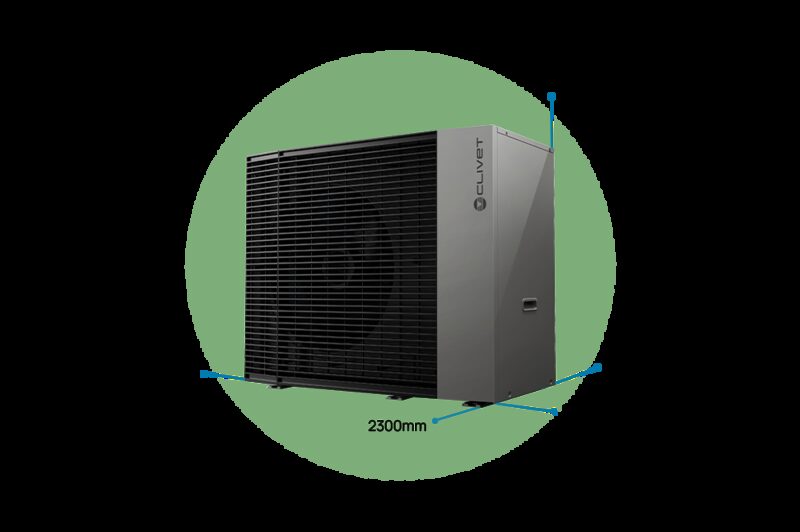
For a household the practical consequences are about siting and servicing rather than paperwork. Propane is highly flammable, so it is used almost exclusively in monoblocs where the whole charge is sealed in the outdoor unit; the Heat Pump Association requires that manufacturer minimum clearances be strictly followed so that a leak cannot enter the building. In return, installers of monobloc units do not require F-gas qualifications, because no refrigerant is handled on site.
What the refrigerant actually does inside the machine
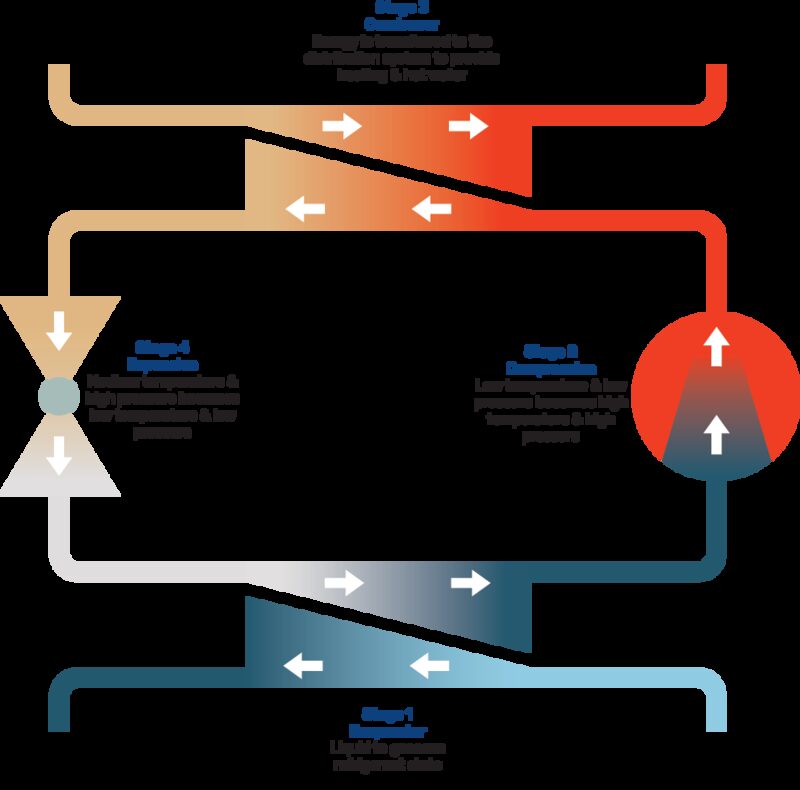
The heat transfer medium in a heat pump is called refrigerant, and the device that uses it can be thought of as a refrigerator operating in reverse. The refrigerant absorbs heat from an external source such as air, ground or water, causing it to evaporate into a gas. The refrigerant cycle has four phases: evaporation, compression, condensation and expansion. Compression raises the temperature of the gas, and the heat is then transferred to water for radiators, underfloor heating and the hot water cylinder.7
Everything a householder notices about a heat pump is downstream of that cycle. Heat pumps send water to pipes and radiators at a lower temperature than traditional gas or oil boilers, and with underfloor heating the flow temperature can be lower than with radiators, which should result in the heat pump running more efficiently.11 The refrigerant sets the ceiling on what flow temperature is achievable at reasonable efficiency, which is why the government's innovation needs assessment lists low global warming potential refrigerants that can allow high efficiencies at high temperatures (above 60°C) as a research priority rather than a solved problem.12
That matters because the refrigerant is not a consumable in normal use. It sits in a sealed circuit for the life of the unit, and the charge is what a service engineer checks rather than replaces. Where more detail on the thermodynamics is useful, see heat pump efficiency: COP, SCOP and SPF explained and heat pump flow temperature.
The refrigerants in UK domestic heat pumps
Three groups appear in practice. Natural hydrocarbons, chiefly R290, are the current choice for new monobloc ranges. Lower-GWP hydrofluorocarbons, chiefly R32, remain in split and high-temperature products. Older, higher-GWP HFCs such as R134a sit behind them: R32 and R134a, two HFCs used in small heat pumps, have global warming potentials of 675 and 1430 respectively.2
| Refrigerant | Stated GWP | Where it appears in the UK | Source type |
|---|---|---|---|
| R290 (propane) | 3 | LG Therma V R290 Monobloc range, Grant Aerona 290, NIBE S735-4, InstaGen IG4-MP1-A1, Trianco Activair Pro1 | maker and independent product pages |
| R290 (propane) | 0.02 | Midea M Thermal Nature Plus Series MHC-V12WD2N7-B217 | independent product page |
| R32 | 675 | Daikin Altherma 3 H HT18, and stated as an HFC GWP in official consultation material2 | product page and official consultation |
| R134a | 1430 | small heat pumps2 | official consultation |
The two figures quoted for R290 disagree: most listings give a global warming potential of 3, while the Midea M Thermal Nature Plus Series pages state 0.02 for the same refrigerant. Both are reproduced here because the documents differ; the 3 figure is the one used almost universally across UK listings and is the safer basis for comparison. Either way the gap to R32 at 675 is of a different order.
Product ranges are moving with the rules. A new generation residential air-to-water heat pump announced for the UK market is described as using R290 refrigerant as the mainstream product.19 Model-by-model detail sits on the maker pages, including LG Therma V heat pumps, Grant heat pumps: Aerona air source range and Viessmann Vitocal heat pumps. A direct comparison is set out in R290 vs R32 heat pumps.
Why propane became the default for monoblocs
Two forces pushed makers the same way. The first is the global warming potential thresholds: a refrigerant at 3 is untouched by any foreseeable phase-down, while one at 675 has to be defended against a 150 limit. The second is that propane suits the monobloc architecture. In a monobloc, all refrigerant is sealed within the outdoor unit, so installers do not require F-gas qualifications.5 That removes both a site-work hazard and a skills bottleneck at the same time, because no refrigerant lines are brazed or charged inside the house.
Official analysis of the Great Britain phase-down expects that the majority of hydronic monobloc heat pumps may use R290 (propane).2 The Heat Pump Ready Programme, Stream 2 Wave 2, defines low-GWP refrigerants as those below 150 GWP, which places R290 comfortably inside and R32 outside.20
The trade-off is flammability. Propane is a highly flammable refrigerant, which is why propane machines are outdoor monoblocs with defined safety clearances rather than split systems with indoor refrigerant pipework. Split systems keep their place where refrigerant must cross into the building or where a higher water temperature is wanted, and that is the practical dividing line explained in monobloc and split heat pumps: the difference.
For a household, the independence consequence is modest but real: a sealed propane monobloc has no ongoing supply relationship attached to its refrigerant, and no gas connection of any kind. Heat pumps eliminate the need for fuel deliveries required by other types of domestic heating.8
Global warming potential: the number the rules are built on
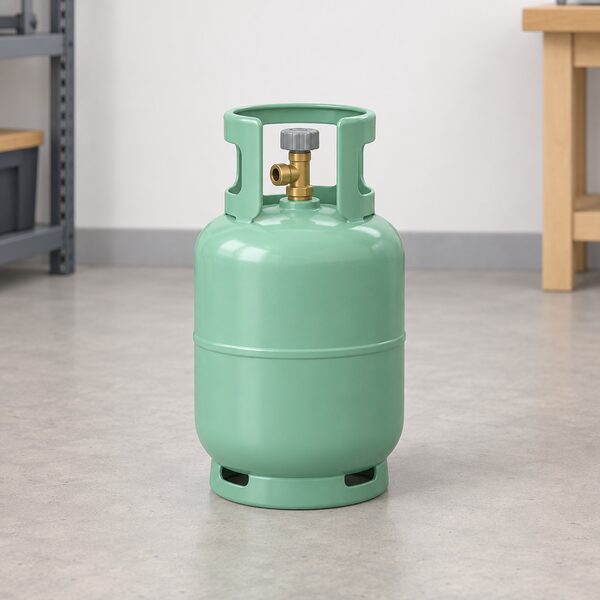
Global warming potential expresses the warming effect of a mass of gas relative to the same mass of carbon dioxide. It is a leakage metric, not an efficiency one: a machine with a high-GWP refrigerant is no worse in use, but any loss from its circuit carries hundreds or thousands of times the climate effect of the same loss from a propane machine. That is why thresholds, not efficiencies, drive the bans.
Three thresholds appear in current UK and European material:
- 150 GWP, used as the definition of a low-GWP refrigerant in the Heat Pump Ready Programme, Stream 2 Wave 220, and as the level above which the revised European F-gas Regulation sets prohibitions for stationary air-conditioning and heat pumps placed on the market before the phase-out dates4.
- 750 GWP, the level above which F-gases have been banned since 2025 in single split systems containing less than 3 kg of refrigerant3.
- No threshold at all for larger equipment: government guidance states plainly that there are no bans for larger air-conditioning or heat pump systems, such as chillers or larger split systems3.
Product listings show how far apart the options are. The NIBE S735-4 and S735-7 are described as having a global warming potential of only 3, as are the InstaGen IG4-MP1-A1 and IG12-MP1-A1, the LG Therma V R290 Monobloc models, the Grant Aerona 290 and the Trianco Activair Pro.14 The Daikin Altherma 3 H HT and its E-Series variant are described as using R32 with a global warming potential of just 675.18
"Low global warming potential refrigerants that can allow high efficiencies at high temperatures (above 60°C)"
The F-Gas rules for split and monobloc systems
Great Britain runs its own F-gas regime after leaving the EU, and the enforcement bodies differ by nation. Certification of an F-gas handler for stationary refrigeration, air-conditioning and heat pump equipment is regulated by the Environment Agency in England and Wales, the Scottish Environment Protection Agency in Scotland and the Northern Ireland Environment Agency in Northern Ireland, with City and Guilds among the qualifying bodies. The UK recognises equivalent qualifications issued by an EU Member State.22
The equipment rules bite at the point of sale, not use. Since 2025, F-gases with a global warming potential above 750 are banned in single split systems that contain less than 3 kg of refrigerant, and there are no bans for larger air-conditioning or heat pump systems such as chillers or larger split systems.3 The revised European F-gas Regulation, adopted in 2024, adds prohibitions above 150 GWP for stationary air-conditioning and heat pumps placed on the market ahead of the general phase-out dates4; further F-gas restrictions expand across other system categories through 2035, and split systems up to and including 12 kW face a prohibition on any F-gas from 1 January 2035 under the EU schedule.
Building regulations reinforce the point for new homes. The Domestic Building Services Compliance Guide states that if installed in a new dwelling, heat pumps should use refrigerants complying with the provisions of current F-gas Regulations.23 Welsh consultation material on Approved Document L adds that refrigerant pipework for heat pumps in dwellings should be fully insulated, and that operating and maintenance information given to a new dwelling owner should include the heat loss calculation, design flow temperature, competent person scheme confirmation, size of emitter circuit and minimum set back temperatures.24 The Energy Saving Trust has supported applying the new F-gas regulation's global warming potential limits to the products within the Ecodesign review's scope, including air-to-air heat pumps.5
What already-installed heat pumps face
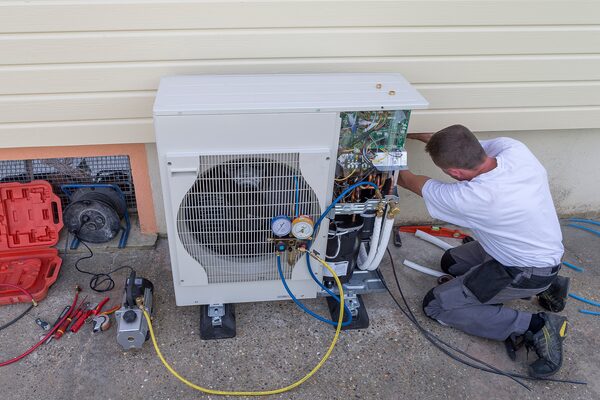
A machine on a wall today is not affected by a placing-on-the-market ban. The prohibitions restrict what may be sold as new equipment; they do not require removal, and government guidance confirms there are no bans for larger air-conditioning or heat pump systems.3 Owners of R32 or older HFC machines can continue to run and service them.
What can change is the practical supply of refrigerant for a top-up, because the HFC phase-down works by shrinking quota over time rather than by banning use. The EU quota schedule reaches zero in 2050 under the general schedule. The consequence for a household is economic rather than legal: as quota falls, the cost and availability of a high-GWP top-up on an ageing machine can deteriorate, which is an argument for expecting a like-for-like repair to become harder rather than illegal. Expected service life is covered in what is the lifespan of an air source heat pump?.
Two related grandfathering points are worth separating out, because they are often confused with refrigerant rules. Under existing permitted development rights a single heat pump on a block of flats is currently permitted, and Welsh consultation responses confirm this will be retained.25 And where thermal storage is concerned, VAT relief consultation material notes that retrofitting storage to an existing heat pump, or upgrading the storage, is not eligible. Neither has anything to do with what is in the refrigerant circuit.
Servicing, leak checks and what an engineer actually does
For a sealed monobloc there is no on-site refrigerant handling at installation, since all refrigerant is sealed within the outdoor unit and installers do not require F-gas qualifications.5 Routine servicing still touches the charge indirectly. A heat pump service typically covers cleaning coils, cleaning fan blades, inspecting filters, checking refrigerant level and pressure, and checking that all electrical connections are safe.26
The stronger driver for most households is contractual rather than statutory. Government guidance on finding a heat pump installer states that regular servicing is often a requirement of guarantees and warranties27, and independent guidance says the same of the annual service.26 Faults are better fixed quickly, to reduce the risk of the heat pump breaking down in winter.26 The interaction between servicing records and cover is set out in does servicing a heat pump affect the warranty? and heat pump servicing and maintenance.
Where refrigerant handling is required, competence is a regulated matter. Certification as an F-gas handler for stationary refrigeration, air-conditioning and heat pump equipment is regulated by the Environment Agency, the Scottish Environment Protection Agency or the Northern Ireland Environment Agency depending on nation.22 Certification bodies for product performance are separate again: the Heat Pump KEYMARK requires third-party performance tests based on EN 14511, EN 15879 and EN 16147, with regular surveillance of the certified products and of factory production control.28 Certification is covered further in heat pump standards, testing and certification.
Safety rules for flammable refrigerants
The governing product safety standard is IEC 60335-2-40:2024, Edition 8.0, published on 11 December 2024, an International Standard of 308 pages with a stability date of 2028; amendment content is incorporated into the consolidated version IEC 60335-2-40:2024+AMD1:2026. It deals with the safety of electric heat pumps, sanitary hot water heat pumps and air conditioners incorporating motor-compressors, as well as hydronic fan coil units, dehumidifiers, thermoelectric heat pumps and partial units. It covers A1, A2L, A2 and A3 refrigerants as defined by ISO 817, with flammable refrigerants limited to those of a molar mass of 42 kg/kmol or more based on worst case formulation, and applies to appliances with a maximum rated voltage of not more than 300 V single phase and 600 V for other appliances including DC-supplied and battery-operated ones. Containers for storing heated water in sanitary hot water heat pumps are covered by IEC 60335-2-21 instead, and supplementary heaters designed as part of the appliance package with controls incorporated are within scope.6
Two gaps in that standard matter to householders. It does not specify criteria to ensure the competence of persons during installation, servicing and disposal, and safety requirements during disposal are not specified.6 Competence and end-of-life handling therefore sit with the F-gas certification regime and with manufacturer instructions rather than with the product standard.
That is precisely the ground the Heat Pump Association's flammable refrigerants policy statement occupies. Its purpose is to explain that manufacturers' manuals may advise different approaches to mitigating possible risks from residential outdoor air-to-water heat pumps containing higher flammability refrigerants, and that installers, specifiers, designers and system owners or operators must follow manufacturer guidance. CE or UKCA marking is mandatory for refrigeration, air conditioning and heat pump products.29
"it must be ensured that in the event of a refrigerant leak, appropriate measures are put in place to reduce the risk of"
In full, the requirement is that measures reduce the risk of refrigerant entering the building through openings, vents, doors or similar pathways, and ensure that no people outdoors or in adjacent buildings are endangered, with manufacturer instructions strictly followed regarding safety-relevant minimum clearances and other mitigation measures.29 Those clearances are model-specific, which is why the manual and not a general rule of thumb governs where a propane unit can stand. Practical siting consequences are covered in where a heat pump outdoor unit can go.
Other British Standards bear on installation and site protection, including BS EN 378-3:2008 on refrigerating systems and heat pumps, safety and environmental requirements, installation site and personal protection, and BS EN 15450:2007 on the design of heat pump heating systems.28
What a leak means in practice

A refrigerant leak shows up first as lost performance, because the cycle depends on the correct charge to move heat at all. Checking refrigerant level and pressure is part of a normal service for that reason.26 With a sealed monobloc the Daikin Altherma 3 H HT product page describes a sealed refrigerant circuit in the outdoor unit18, and the design intent across the monobloc format is that the circuit is never opened on site.
With a flammable refrigerant the second concern is dispersal. The Heat Pump Association's requirement is directed at pathways rather than quantities: measures must reduce the risk of refrigerant entering the building through openings, vents, doors or similar pathways, and ensure that no people outdoors or in adjacent buildings are endangered.29 Propane is heavier than air, which is why clearances relate to low-level openings, light wells and basements rather than to the general footprint of the unit. Where a fault is suspected, it is better fixed quickly to reduce the risk of a breakdown in winter.26 Diagnosis and symptoms are set out in heat pump faults and troubleshooting.
What refrigerant choice means for household energy independence
Refrigerant choice does not make a heat pump more independent on its own: it changes what regulatory and supply risk the household carries over the machine's life. A propane monobloc at a global warming potential of 3 is on the right side of every threshold in current rules, including the 150 GWP definition used in the Heat Pump Ready Programme, so it faces no phase-down pressure on its refill supply.20 An R32 machine at 675 sits above the newer 150 limit and within a shrinking quota.2
The dependence that remains is the grid and the manufacturer. A heat pump is an electrically driven machine: Domestic RHI rules defined an eligible heat pump as one using an electricity-driven compressor that provides space heating or a combination of space heating and hot water, and cannot exclusively provide hot water.31 The electricity has to come from somewhere, and a sealed circuit means the manufacturer and its authorised engineers control the one repair a household cannot do itself. Manufacturer instructions must be strictly followed on clearances, which also means the maker's documentation, not the householder's judgement, governs siting.29
What the evidence supports at national level is narrower and clearer. Independent analysis finds that households with a heat pump and an electric vehicle are far less dependent on foreign oil and gas imports and make more use of British electricity, and that insulating homes and running electric heat pumps and cars on an evolving wind and solar supply would boost energy independence. [29 is not the source here] Heat pumps also eliminate the need for fuel deliveries required by other types of domestic heating, which removes a logistics dependence for off-grid homes in particular.8 Government modelling of heat pump savings assumes a standard three-bedroom detached house with good insulation, a heat pump with typical efficiency, a smart electricity tariff enabled by a smart meter, gas standing charges removed in the heat pump scenario, and a fully electric home with no gas used for cooking in either scenario, which shows how much of the saving depends on conditions beyond the machine.
The honest summary is that R290 removes a future regulatory and refill risk and adds a flammability constraint that has to be managed by siting. Neither changes the household's reliance on electricity supply. Those wider questions are handled in heat pumps and household energy independence and across the full UK heat pump guide.
Sources31 cited
- LG Therma V R290 Monobloc 7kW 1 phase, Quiet Mark, 2026-09-17
- HFC phase-down reform de minimis assessment, Defra, 2025-09-02
- Bans on F-gas in new equipment, GOV.UK, 2025
- Final adoption of the revised European F-gas Regulation, Heat Pumping Technologies, 2024-02-06
- Air-to-air heat pumps added to Boiler Upgrade Scheme, HHIC, 2026-01-20
- IEC 60335-2-40:2024, International Electrotechnical Commission, 2024-12-11
- How a heat pump works, Heat Pumping Technologies, 2025-09-26
- Heat pumps technology overview, Association for Renewable Energy and Clean Technology
- About heat pumps, European Heat Pump Association, 2026-04-24
- Heat pumps explained: DESNZ talk to industry experts, MCS, 2024-04-03
- Underfloor heating advice, Energy Saving Trust, 2025-10-02
- Energy innovation needs assessment: heat and buildings, Department for Energy Security and Net Zero, 2025
- Grant Aerona 290 15.5kW, Quiet Mark, 2026-09-17
- NIBE S735-4, Quiet Mark, 2026-09-17
- InstaGen IG4-MP1-A1, Quiet Mark, 2026-09-17
- Trianco Activair Pro, Quiet Mark, 2026-09-17
- Midea M Thermal Nature Plus Series MHC-V12WD2N7-B2, Quiet Mark, 2026-09-17
- Daikin Altherma 3 H HT, Quiet Mark, 2026-09-17
- Viessmann Climate Solutions to launch new residential air source heat pump, CIPHE, 2026-05-14
- Heat Pump Ready Programme Stream 2 Wave 2 projects, GOV.UK, 2026-05-28
- LG Therma V R290 Monobloc 12kW 1 phase, Quiet Mark, 2026-09-17
- F-Gas Handler for stationary refrigeration, air-conditioning and heat pump equipment, Regulated Professions Service, 2026-09-17
- Domestic Building Services Compliance Guide 2022, Scottish Government, 2022-06
- Approved Document L Volume 1 consultation version, Welsh Government, 2025-08
- Class G permitted development for air source heat pumps, legislation.gov.uk, 2026-09-17
- Is now a good time to get a heat pump, Energy Saving Trust, 2025-12-12
- Find a heat pump installer, GOV.UK, 2022-07-05
- Relevant British Standards for ground source heat pump activities, Defra, 2026-09-17
- HPA UK statement on the R290 safety zone, Heat Pump Association UK, 2026-05-12
- HPA statement on R290 safety zone, October 2025, Heat Pump Association UK, 2025-10-06
- Household energy: buying British, Energy and Climate Intelligence Unit, 2024-04-15
 Which Homes Suit a Heat PumpMost UK homes can have a heat pump fitted, so the real question is whether yours makes it easy or expensive.
 The Full Heat Pumps GuideWill a heat pump keep my house warm in winter, and what does one cost to buy and run?
 Policy, Targets and Coming RulesHeat pumps are central to the government's plans for greener home heating.
 Future Homes StandardWill your new build still have a gas boiler, and when do the new rules actually start?
 How They Perform in UK HomesHow well do heat pumps really work in UK homes, and why do some run far better than others?
 Using a Heat Pump for CoolingCan a heat pump cool your home in summer as well as heat it in winter?