
In this guide
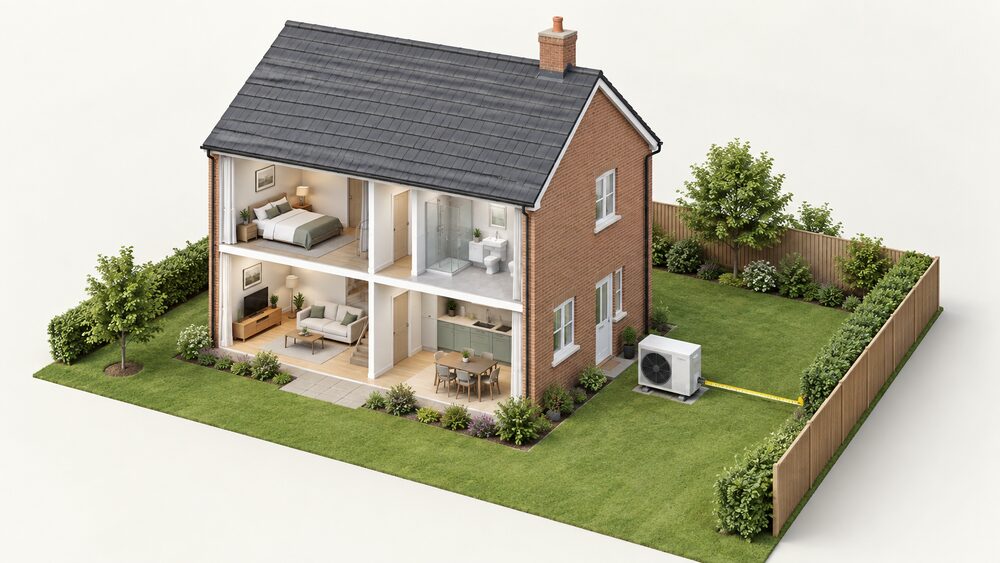
In Scotland, a domestic air source heat pump is generally permitted development, meaning no full planning application is needed, provided the installation meets a set of conditions on size, siting, noise and location. The same applies to ground source and water source heat pumps within the curtilage of a house or a building containing a flat1. The catch is that Scottish rights are narrower than England's in one important respect: domestic air source heat pumps are subject to prior notification to the planning authority on siting and design, so the authority sees the proposal before it goes in3.
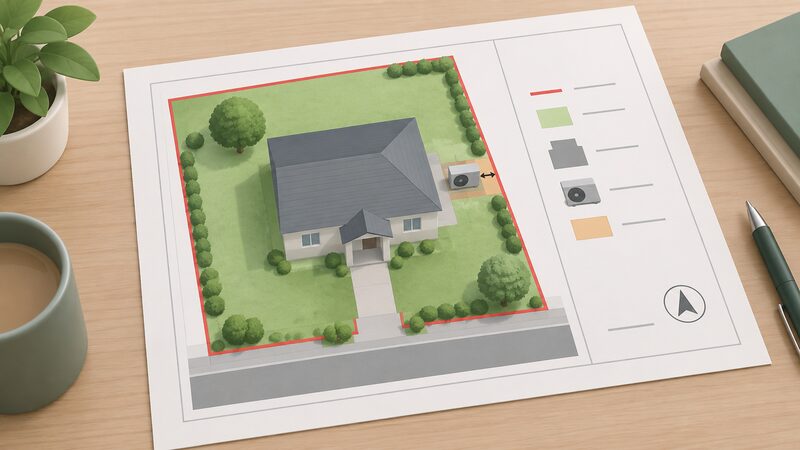
The conditions are specific. The outdoor compressor unit, including any housing, must not exceed 1.5 cubic metres on a house or 0.6 cubic metres on a block of flats4. All parts must sit at least one metre from the property boundary, and at least one metre from the external edge of a flat roof if roof-mounted6. The unit must not go on a pitched roof at all7. Noise must meet the MCS 020 Planning Standards, which set a 42 decibel target external threshold measured one metre from a neighbouring habitable room window3.
Where those conditions are met, the household avoids a planning application but still deals with the planning authority through prior notification, and still needs a building warrant where building regulations apply. Where they are not met, a full application follows. Listed buildings, scheduled monuments and parts of conservation areas sit outside permitted development entirely8.
Permitted development, not automatic permission
Scotland treats domestic heat pumps as permitted development, which means the right to install is granted by the general permitted development order rather than by an individual decision. The Scottish Government has published guidance on permitted development rights, and the domestic air source heat pump rights were introduced through an amendment to the Town and Country Planning (General Permitted Development) (Scotland) Order 19921. Ground source heat pumps are typically considered permitted development, and the installation of a ground source or water source heat pump on domestic premises is usually considered to be permitted development, not needing an application for planning permission13.
That is not the same as automatic permission. Permitted development is a conditional right: it applies only if every condition in the order is satisfied. Development which does not meet the criteria or thresholds within the legislation will not be considered to be permitted development, and requires a planning application instead3. The Scottish Government's 2015 consultation on the original rights set out the reasoning, adopting the principles of the provisions from England but applying them in a way consistent with existing Scottish approaches to permitted development rights14.
For a household, the practical effect is that the installer's survey and the siting decision carry legal weight. A unit placed a few centimetres inside the boundary, or a model whose housing pushes the volume over the threshold, converts a permitted development into a project that needs consent. The rights cover the installation, alteration or replacement of an air source heat pump on a house or block of flats, or within the curtilage, including on a building within that curtilage15.
Prior notification to the planning authority
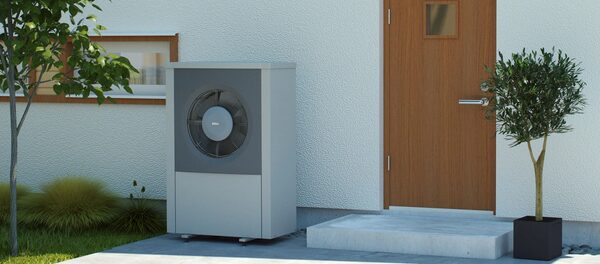
The step that distinguishes Scotland from England is prior notification. Domestic air source heat pumps in Scotland are subject to prior notification to the planning authority on siting and design3. This is not a full planning application. It is a notification that gives the authority the siting and design details before the work proceeds, and it was part of the original 2015 framework rather than a later addition14.
In practice, the household or installer submits the proposed position of the unit, how it will look from outside, and the supporting information on noise and siting. The authority then considers whether the siting and design raise issues. Because the notification is a condition of the permitted development right, skipping it leaves the installation without a lawful basis even where every other condition is met.
The Scottish Government's Heat Pump Sector Deal Expert Advisory Group has argued that consumer engagement and acceptance matter as much as the technical rules, recommending that trusted comprehensive information and advice on heat pumps be available for householders and consumers17. Prior notification is one of the points where that information gap shows: households often assume that permitted development means no contact with the council at all.
The MCS 020 Planning Standards your installation must meet
Development is permitted only if the air source heat pump installation complies with the Microgeneration Certification Scheme Planning Standards (MCS 020) or equivalent standards6. The standards set installation requirements including an assessment of sound impact on neighbours11. The Scottish Government's 2025 consultation on permitted development rights confirms that all air source heat pumps installed under permitted development rights will need to comply with MCS 020(a) standards, and that where compliance is not achieved a planning application will be required20.
The MCS 020 approach sets a 42 decibel target external noise threshold, measured one metre from a neighbouring habitable room window3. Some guidance describes the same limit as noise levels for an air source heat pump on its own staying at or below 42 decibels from a metre distance away from any habitable room6. The two descriptions of the measurement point differ, and the documents do not resolve which applies in every case; the underlying threshold is the same figure.
The standards also carry the siting expectations that sit behind the numeric conditions. The unit must be sited, so far as is practicable, to minimise its effect on the external appearance of the building and its effect on the amenity of the area15. It must not be used solely for cooling purposes15.
For a household, MCS 020 compliance is normally demonstrated by the installer as part of the design, and it is one of the documents a planning authority will expect with a prior notification. The MCS 020 noise assessment is the mechanism, and the wider heat pump noise picture explains what the figure means in practice.
Size and quantity limits
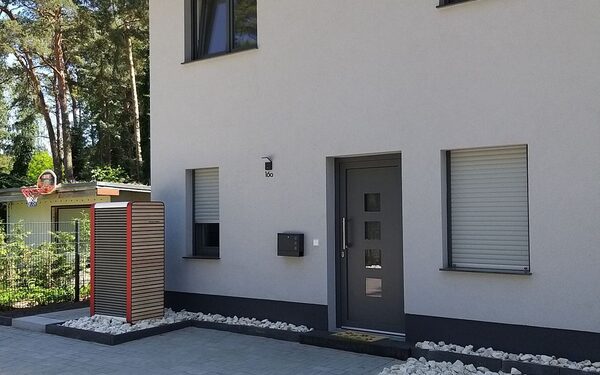
The volume limit is the condition most likely to catch a household out, because it applies to the outdoor compressor unit including any housing, not to the unit alone. The volume of the air source heat pump's outdoor compressor unit, including any housing, must not exceed 1.5 cubic metres on a house or 0.6 cubic metres on a block of flats4. Council guidance repeats the same figures, describing the pump itself including housing as limited to 0.5 cubic metres on a house or 0.6 cubic metres for a block of flats, and separately stating that a unit exceeding 1.5 cubic metres within the curtilage of a dwelling house, or 0.6 cubic metres within the curtilage of a block of flats, requires planning permission21. The 0.5 cubic metre figure and the 1.5 cubic metre figure appear in different documents and are not reconciled; the legislation and the majority of guidance use 1.5 cubic metres for a house.
Quantity limits follow the building type. Detached houses can install up to two heat pumps, while a non-detached house or a block of flats can install only one unit10. Council guidance states that if the property is detached and there are more than two air source heat pumps on the building or within the garden, planning permission is required, and that if the property is not detached or is a block of flats and there is more than one unit, permission is required23. A single existing unit on a non-detached dwelling, or two existing units on a detached dwelling house, triggers the same requirement24.
The Scottish Government consulted in 2025 on proposals that would allow for the installation of up to two air source heat pumps on detached dwellinghouses, while any proposal that would result in more than one unit attached to a dwelling, or more than two on a detached dwellinghouse, would still need a planning application25. The consultation also proposed that planning authorities continue to be able to assess such proposals on a case-by-case basis25.
| Property type | Units within permitted development | Volume limit per unit |
|---|---|---|
| Detached house | Up to two10 | 1.5 cubic metres4 |
| Semi-detached or terraced house | One10 | 1.5 cubic metres4 |
| Block of flats | One10 | 0.6 cubic metres4 |
Siting rules: the one-metre boundary distance and roof restrictions
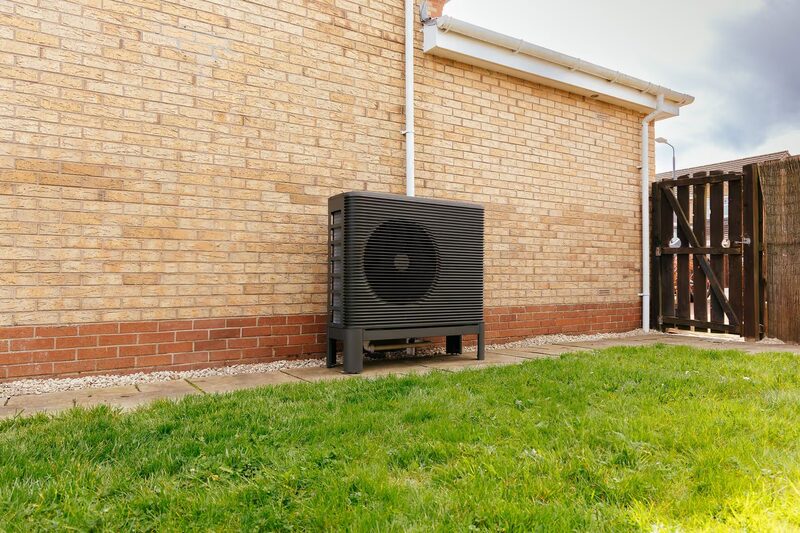
All parts of the air source heat pump must be at least one metre from the property boundary6. The same rule appears in council guidance as a requirement that the pump must not be within 1 metre of the curtilage of the property26. The Scottish Government's 2015 consultation described the equivalent English condition as no part of the air source heat pump to be within 1 metre of the site boundary, and proposed a Scottish version allowing development that does not extend the floor area of a dwelling where it has a protrusion from the external surface of the building of no more than 1 metre14.
Roof siting is more restrictive. Installations on pitched roofs are not permitted development, and a heat pump on a pitched roof would require planning permission7. Council guidance states plainly that you cannot install an air source heat pump on a pitched roof11. A flat roof is possible, but all parts of the unit must be at least one metre from the external edge of that roof6.
There is also a wall-height rule. On land other than a conservation area or World Heritage Site, the unit must not be installed on any part of a wall above the level of the ground floor storey if that wall fronts a highway15. The unit must not be installed on a pitched roof, and the removal condition applies throughout: the air source heat pump must be removed as soon as reasonably practicable when no longer needed12.
Noise: the 42 dB limit measured from a habitable room
The noise condition is the one most likely to decide whether a Scottish installation stays within permitted development. The MCS 020 approach sets a 42 decibel target external noise threshold, measured one metre from a neighbouring habitable room window3. Council guidance describes the same limit as noise levels for an air source heat pump on its own staying at or below 42 decibels from a metre distance away from any habitable room6. The two measurement points are described differently across the documents and the conflict is not resolved; the threshold figure is consistent.
Where a unit exceeds the MCS standards and permission is needed, a different limit can apply. Council guidance states that noise levels emitted from the air source heat pump must not exceed 37 dB LAeq at any time, as measured on the boundary of the site with any neighbouring residential property, in cases where the unit exceeds the MCS standards and permission is required23. That is a boundary measurement rather than a window measurement, and it is a stricter figure.
The practical consequence is that the noise assessment is not a formality. A unit placed close to a neighbour's bedroom window, or a larger model running at higher output, can fail the threshold and convert the project into a planning application. The heat pump noise page sets out what the decibel figures mean in everyday terms, and the MCS 020 noise assessment explains how the calculation is carried out.
"42 decibel target external noise threshold (measured 1 meter from a neighbouring habitable room window)"
Where permitted development rights do not apply

Several categories of building and site sit outside the permitted development framework entirely. Permitted development rights do not apply for installations within the curtilage of a listed building or within a site designated as a scheduled monument15. The unit must not be on a listed building or within its grounds, or within a scheduled monument site10. Where a home is a listed building or on a site of a designated scheduled monument, planning permission, and in some cases listed building consent, may be required16.
Conservation areas and World Heritage Sites are treated differently again: permitted development can still apply, but with an extra restriction. On land within a conservation area or World Heritage Site, the air source heat pump must not be installed on a wall or roof which fronts a highway, or be nearer to any highway which bounds the property than any part of the building15. Council guidance puts it as: if you are in a conservation area or on a World Heritage Site you cannot install it on an elevation that fronts a highway26. Where the installation is not within a conservation area, on a listed building or on a scheduled monument, the highway-facing restriction does not bite in the same way20.
Ground source heat pumps are less constrained. Installing a ground source heat pump within the property's curtilage is permitted development, and the Scottish permitted development order covers the installation, alteration or replacement of a ground source heat pump and any associated pipes or apparatus within the curtilage of a dwellinghouse or building containing a flat29. The same order covers water source heat pumps on the same basis30.
| Designation | Air source heat pump position |
|---|---|
| Listed building or its curtilage | Permitted development does not apply; planning permission and listed building consent needed15 |
| Scheduled monument site | Permitted development does not apply15 |
| Conservation area or World Heritage Site | Permitted development applies, but not on a wall or roof fronting a highway, or nearer to a highway than the building15 |
| Non-domestic building | Permitted development rights do not extend to it16 |
When you will need a full planning application
A full planning application is needed whenever any condition of the permitted development right fails. The clearest triggers are the ones the legislation names: a unit on a pitched roof, a unit within one metre of the boundary, a volume above 1.5 cubic metres on a house or 0.6 cubic metres on a block of flats, a second unit on a non-detached property, a third on a detached one, an existing wind turbine on the building or within the curtilage, or a noise level above the MCS 020 threshold12.
The wind turbine condition is worth stating separately because it is easy to overlook. Development is permitted only if there is no existing wind turbine on a building or within the curtilage of that property, and planning permission is needed if a wind turbine is installed on the same building or within the curtilage of the dwelling house or block of flats15. The same logic applies to additional heat pumps: only the first installation of an air source heat pump would be permitted development, and additional units at the same property require planning permission6.
Where a unit fails the noise criterion, the position is explicit: if your heat pump fails to meet this criterion then a planning application will be required18. Building regulations run alongside the planning position rather than replacing it. Building Regulations parts A to T apply to air source heat pumps plus Regulation 76. A household that has cleared the planning conditions may still need a building warrant, and the two processes are separate.
Why Scotland is pushing heat pumps: the Heat in Buildings Strategy targets
The planning rules sit inside a wider Scottish programme. The Heat in Buildings Strategy aims to decarbonise over 1 million homes and the equivalent of 50,000 non-domestic buildings by 203031. Emissions from heat in buildings will have to fall by 68% by 2030 as compared to 2020. On energy efficiency, the target is that by 2030 a large majority of buildings should achieve a good level of energy efficiency, which for homes is at least equivalent to an EPC Band C, with all homes meeting at least this standard by 2033.
The Committee on Climate Change has set out the pace required: annual heat pump installations in existing homes will need to accelerate rapidly, reaching nearly 35,000 by 2030, and by 2035 around a quarter of existing homes are expected to be heated by a heat pump, either as standalone or communal systems. The Scottish Government's 2025 progress report notes that the number of homes with a heat pump installed has risen, along with increased public awareness. The proposed Heat in Buildings Bill is intended to give industry and homeowners the certainty they need to invest, boost heat network development and set a long-term direction of travel that is deliverable and affordable for households and businesses.
The strategy also acknowledges what has to accompany the rules: supply chain readiness, a clear regulatory framework, support from the public through engagement, and a plan for Scotland's many unique buildings, such as tenements, and rural areas. The Scottish Government's own impact assessment estimates that the additional jobs supported in 2030 will exceed those displaced by an estimated 16,400 as a result of investment in zero emissions heat jobs31.
For a household, the planning position is the practical expression of that policy. Permitted development with prior notification is designed to make installation straightforward in ordinary houses while keeping the authority involved where siting, noise or designation raise issues. The dependence that remains is on the grid for electricity, on the planning authority for the notification, and on the installer's compliance with MCS 020 for the right to proceed without an application. The heat pump planning permission in England and Wales pages set out how the other UK nations differ, and the heat pumps pillar covers the technology itself.
Sources31 cited
- Heat pumps, City of Edinburgh Council
- The Town and Country Planning (General Permitted Development) (Scotland) Order 1992 amendment, legislation.gov.uk
- Permitted development rights for non-domestic solar panels and domestic air source heat pumps, Scottish Government, 2015
- Heat pumps, Planning Portal
- Air and ground source heat pumps, London Borough of Croydon
- Class G: installation or alteration of air source heat pumps on domestic premises, legislation.gov.uk
- Class G paragraph G.2, legislation.gov.uk
- Class G: installation or alteration of air source heat pumps on domestic premises (made), legislation.gov.uk
- The Town and Country Planning (General Permitted Development) (Scotland) Order 1992, legislation.gov.uk
- Heat pumps, London Borough of Richmond upon Thames
- Planning permission: air source heat pump, Planning Portal
- Building regulations and renewables guidance, Bedford Borough Council
- Air source heat pump fact sheet, Pendle Borough Council
- Heat pumps, New Forest District Council
- Improving energy saving and sustainability in conservation areas and listed buildings, Brighton & Hove City Council
- Air source heat pumps, Cornwall Council
- Air source heat pumps: householder planning advice, Central Bedfordshire Council
- Air source heat pump guide, Eastleigh Borough Council, 2025
- Permitted development rights: support and provision for new homes consultation, Scottish Government, 2025
- Heat in Buildings Strategy, Scottish Government, 2021
- Scotland's carbon budgets, Climate Change Committee
- Heat in Buildings progress report 2025, Scottish Government, 2025
- Heat in Buildings Strategy: Fairer Scotland duty assessment, Scottish Government, 2021
- Heat Pump Sector Deal Expert Advisory Group interim report, Scottish Government, 2021
- Delivering net zero for Scotland's buildings, Scottish Government, 2023
- Heat in Buildings progress report 2023: conclusion, Scottish Government, 2023
- Identification and assessment of improvements to energy standards in new domestic buildings, Scottish Government
- Heat in Buildings Strategy: business and regulatory impact assessment, Scottish Government
- Heat in Buildings Strategy: child rights and wellbeing impact assessment, Scottish Government
- Heat in Buildings Strategy consultation, Scottish Government
- ECO4 new measures and products guidance, Ofgem, 2026
 Home Energy Planning ScotlandDo you need planning permission for solar panels or a heat pump in Scotland?
 Planning Permission in EnglandDo you need planning permission for an air source heat pump?
 Planning Permission in NIDo you need planning permission for a heat pump in Northern Ireland?
 Planning Permission ScotlandHow Scottish permitted development rules treat external air conditioning and air-to-air heat pump units, where they differ from England, and the position for conservation areas, listed buildings and flats.
 Planning Permission in WalesDo you need planning permission for a heat pump in Wales?
 Planning Permission in ScotlandDo you need planning permission for a home battery in Scotland?