
In this answer
Short answer
An air source heat pump on a dwelling in Scotland is normally permitted development, which means no planning application is needed, provided the unit meets the size and location limits set out in the legislation. The installation, alteration or replacement of an air source heat pump on a dwelling or within the curtilage of a dwelling falls within Class 6H of Part 1 of Schedule 1 of the Town and Country Planning (General Permitted Development) (Scotland) Order 19921.
The limit that most households measure against is volume. The volume of the air source heat pump unit, including any housing, must not exceed 0.6 cubic metres; above that threshold a planning application is required2. The same 0.6 cubic metre figure applies to an outdoor compressor unit on a block of flats3. Development that does not meet the criteria or thresholds within the legislation is not considered to be permitted development, and requires a planning application4.
The location question is more complicated than the size question, because Scotland's rules have changed. Permitted development rights for domestic air source heat pumps once applied only where the unit was sited 100 metres or more from the curtilage of another dwelling4. The Scottish Government consulted on removing that restriction, and has since confirmed that in Scotland there is already no such restriction in the permitted development rights5.
Who the Scottish permitted development rights apply to
Class 6H covers the installation, alteration or replacement of an air source heat pump on a dwelling or within the curtilage of a dwelling1. That is the core of the answer for a householder: the rights attach to domestic premises, and the unit has to sit on the property or on land within its curtilage. Guidance for permitted development in England frames the same idea as the unit being located within your property and meeting the permitted development size and location limits7.
The rights are not the same for every kind of home. Permitted development rules for air source heat pumps are more restricted for flats and shared buildings, and planning permission is more likely to be required7. A block of flats has its own volume threshold of 0.6 cubic metres for an outdoor compressor unit including any housing3. Where a building is divided into separate households, the question of whose curtilage the unit sits in, and who is affected by it, becomes part of the assessment rather than a formality.
The Scottish Government has consulted on how far the rights should stretch in denser housing. Its 2025 consultation asked whether planning authorities should continue to be able to assess proposals for more than one air source heat pump on flatted buildings or terraced and semi-detached properties on a case-by-case basis5. That is a live question rather than a settled rule, and it matters most to households in tenements, terraces and conversions where a single unit may not serve the whole building.
The wider policy context is that Scotland is committed to decarbonising heat in buildings by 20458, and has required new homes to install clean heating8. Permitted development rights are the mechanism that keeps domestic retrofit out of the planning system where the impact is small, which is why the size and location limits carry so much weight for a household deciding how to heat its home. The devolved framework behind those rights is set out in energy and buildings policy in Scotland.
Size limits: 0.6 cubic metres and what counts
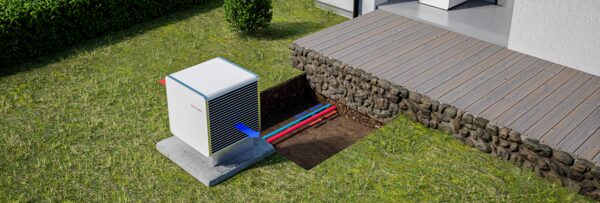
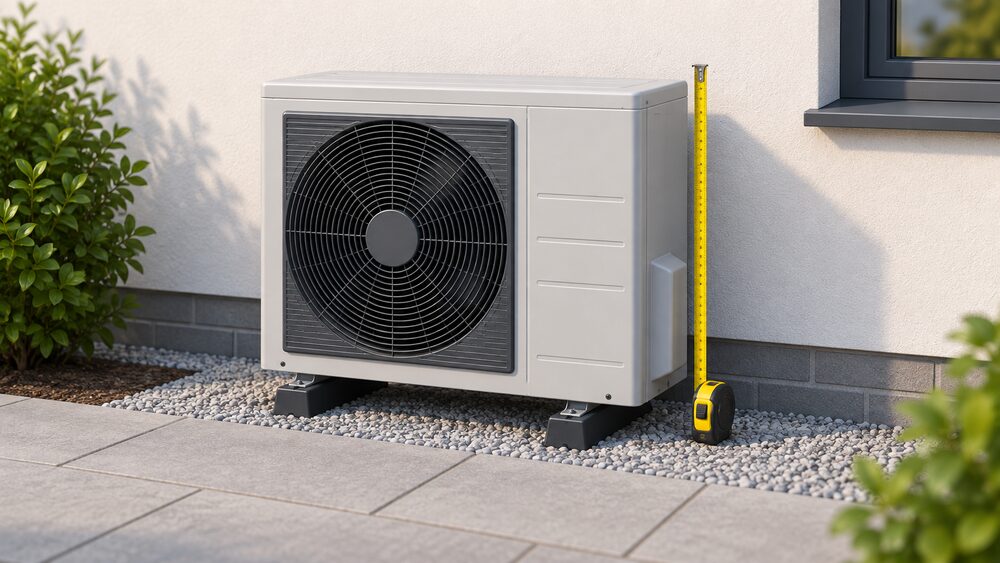
The headline figure is 0.6 cubic metres. The volume of the air source heat pump unit, including housing, must not exceed 0.6 cubic metres, or the installation needs planning permission2. The measurement includes any housing, so an acoustic enclosure, a decorative casing or a protective box counts towards the total rather than sitting outside it. That is the figure a householder should have to hand before ordering a unit, because it is the threshold that decides whether the project stays inside permitted development.
The same 0.6 cubic metre limit appears in the legislation for a block of flats, expressed as an outdoor compressor unit including any housing3. Guidance for permitted development in England states the limit as 0.5 cubic metres on a house or 0.6 cubic metres for a block of flats9. The two figures are not interchangeable: a unit sized for the English house threshold may sit above or below the Scottish one depending on the model, and the Scottish figure is the one that governs a Scottish installation.
Wales has moved in a different direction. Air source heat pumps there now fall under permitted development rights if they are up to 1.5 cubic metres in size, instead of 1 cubic metre10. That is a Welsh figure and does not apply in Scotland, but it shows how far the size thresholds diverge across the UK, and why a householder comparing quotes across borders should not assume the same limit travels with the product.
For a Scottish household, the practical consequence is that the size limit is a constraint on product choice rather than on the principle of installing a heat pump. Most domestic units are designed to sit within it, but the measurement has to be taken on the actual unit and its housing, not on a brochure dimension. Where a unit exceeds 0.6 cubic metres, the route is a planning application rather than a redesign, and the application is assessed on siting, design and impact rather than on volume alone.
Location, the 100 metre rule and what replaced it
The location rules in Scotland have a history that still shapes how people describe them. Permitted development rights for air source heat pumps existed for domestic units where they were sited 100 metres or more from the nearest neighbour's curtilage4. That condition was widely described as a barrier, because it excluded most homes in towns, villages and suburbs from permitted development altogether.
The Scottish Government consulted on removing it. Its 2015 consultation set out the intention to remove the restriction for the air source heat pump to be 100 metres or more from the curtilage of another dwelling11, and the same proposal appears in the consultation's preferred approach, which was to adopt the principles of the provisions from England but apply them in a way consistent with existing approaches to permitted development rights in Scotland12. The consultation also proposed bringing air source heat pumps effectively within the alterations to a dwelling house that are permitted within 1 metre of the external surface of the building11.
The current position, as stated in the Scottish Government's 2025 consultation on permitted development rights, is that in Scotland there is already no such restriction in the permitted development rights5. The 100 metre rule is therefore part of the history of the rights rather than a condition a householder now has to satisfy. It still appears in older guidance and in summaries written before the change, which is why it continues to circulate.
What replaced it is a set of conditions closer to the English model. Scottish Government proposals include a method by which the noise level of the air source heat pump is predicted, and that method includes a maximum noise level for a unit to be considered permitted development6. The 2015 consultation described the same mechanism, with proposals including means by which the noise level is predicted and a maximum noise level in order for air source heat pumps to be considered permitted development11. Noise, rather than distance, is now the main constraint on where a unit can go.
"Our proposals include means by which the noise level of the air source heat pump is predicted and that method includes a maximum noise level in order for air source heat pumps to be considered to be permitted development"
Conditions, exceptions and when a planning application is needed
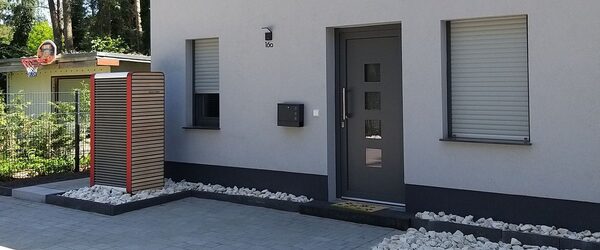
Permitted development is not unconditional. Guidance for permitted development in England describes air source heat pump installation as subject to a number of limits and conditions13, and the same structure applies in Scotland: the rights apply only where the unit meets the size and location limits, and where the other conditions in the legislation are satisfied.
A planning application is required where the installation does not meet permitted development rules, where the building is listed, in a conservation area with restrictions, where the unit would sit in a prominent position such as the front of the property, or where there would be an unacceptable impact on neighbours through noise or visual impact7. Development that does not meet the criteria or thresholds within the legislation is not considered to be permitted development4. Conservation areas are a specific trigger: planning permission is required for air source heat pumps subject to certain restrictions on size and location14.
Compliance with the relevant standard is part of the picture in some UK frameworks. Welsh Government consultation material states that installations must comply with MCS 020a standards to benefit from permitted development rights, and that where compliance is not achieved a planning application will be required15. That is a Welsh statement, and the Scottish position is set by the Scottish legislation and guidance, but it illustrates the principle that a noise assessment standard can sit behind the permitted development test rather than beside it. The certification framework itself is explained in MCS explained.
The Scottish householder guidance deals with air source heat pumps in Section 6, which discusses the installation, alteration or replacement of a biomass heating system flue or a combined heat and power system alongside the heat pump provisions16. Circular 1/2024 sets out the householder permitted development rights framework that sits around Class 6H15. Where a proposal falls outside the rights, the application route is the same as for any other householder development, and the assessment turns on siting, design, noise and the effect on neighbours.
How a householder works through the limits
The process is a sequence of measurements and checks rather than a single test. Working through it in order avoids the situation where a unit is ordered and then found to need permission.
- Confirm the unit is an air source heat pump serving a dwelling or within its curtilage, which is the scope of Class 6H1.
- Measure the volume of the unit including any housing. If it exceeds 0.6 cubic metres, a planning application is required2.
- For a block of flats, check the outdoor compressor unit against the 0.6 cubic metre limit including any housing3.
- Check the building's status: listed buildings, conservation areas with restrictions and prominent positions such as the front of the property all require an application7.
- Consider noise and its effect on neighbours, which is both a permitted development condition and a ground on which an application can be refused6.
- Where the installation does not meet the rules, apply for planning permission through a planning application4.
The Scottish Government's own assessment of the administrative effect of these rights put the scale in context. Its impact assessment assumed an application rate of approximately 804 per year for domestic air source heat pumps in Scotland12, and calculated an estimated annual planning fee saving of £162,408 on the basis of 804 applications at £202 each6. Those figures describe the volume of applications the rights were expected to remove from the system, not a cost to a householder, but they show how many installations would otherwise have needed a full application.
For a household, the practical position is that the size limit is the figure to check first, the location rule is now about noise and siting rather than distance, and the exceptions are about the building and its setting rather than the technology. Where the unit and its position meet the limits, the installation proceeds without a planning application. Where they do not, the application is the route, and the assessment is on the same grounds a planning authority would apply to any other householder proposal.
Sources16 cited
- The Town and Country Planning (General Permitted Development) (Scotland) Order 1992, article 3, legislation.gov.uk, 2016
- An introduction to heat pumps, Which?
- The Town and Country Planning (General Permitted Development) (England) Order 2015, Class G, legislation.gov.uk, 2025
- The Town and Country Planning (General Permitted Development) (Scotland) Order 1992, explanatory note, legislation.gov.uk, 2016
- Permitted development rights: support and provision for new homes consultation, Scottish Government, 2025
- Permitted Development Rights consultation: impact assessments, Scottish Government
- Air source heat pumps, Westmorland and Furness Council
- Heat in buildings: plans, Scottish Government
- Air source heat pumps, Cornwall Council
- Changes to permitted development rights: summary of responses, Welsh Government, 2025
- Permitted Development Rights: Non Domestic Solar Panels and Domestic Air Source Heat Pumps, Scottish Government, 2015
- Permitted Development Rights: Non Domestic Solar Panels and Domestic Air Source Heat Pumps, consultation document, Scottish Government, 2015
- Do I need planning permission, Cornwall Council
- What could the next Senedd do on heat pump planning, Nesta, 2026
- Circular 1/2024: householder permitted development rights, Scottish Government, 2024
- Householder permitted development rights guidance, Scottish Government, 2021
 Planning Permission in ScotlandDo you need planning permission for a heat pump in Scotland?
 Planning Permission ScotlandHow Scottish permitted development rules treat external air conditioning and air-to-air heat pump units, where they differ from England, and the position for conservation areas, listed buildings and flats.
 Home Energy Planning ScotlandDo you need planning permission for solar panels or a heat pump in Scotland?
 Planning Permission in EnglandDo you need planning permission for an air source heat pump?
 Planning Permission EnglandExplains when an external air conditioning or air-to-air heat pump unit in England needs planning permission, and how permitted development applies.
 Planning Permission NIHow Northern Ireland's planning rules apply to external air conditioning and air-to-air heat pump units, when consent is needed, and how the position differs from England, Scotland and Wales.