In this guide
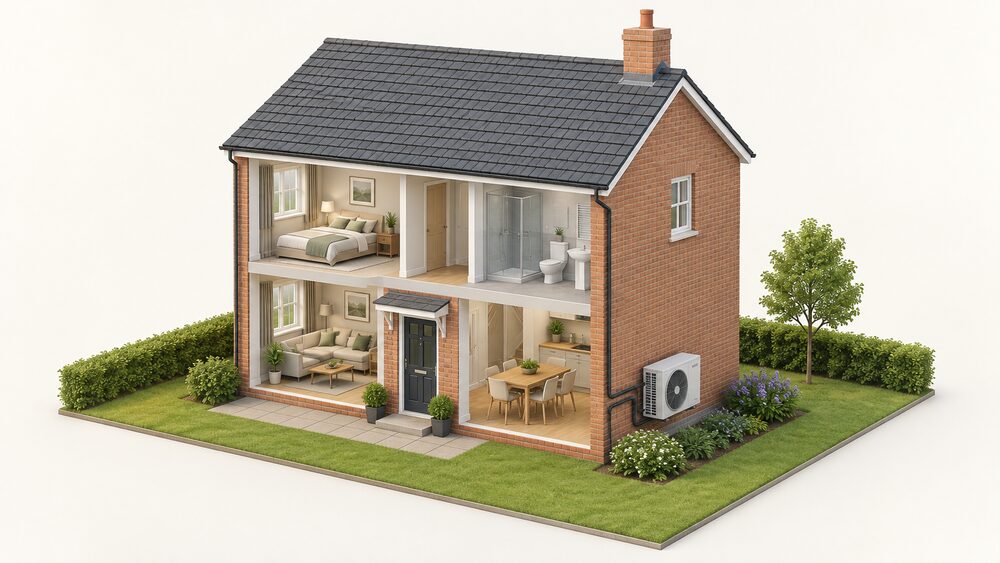
For most houses in England, an air source heat pump is permitted development. Since 1 December 2011 the installation of an air source heat pump on domestic premises has been treated as permitted development, not needing an application for planning permission, provided all the limits and conditions are met1. The right sits in Class G of Part 14 (Renewable Energy) of the Town and Country Planning (General Permitted Development) (England) Order 20152.
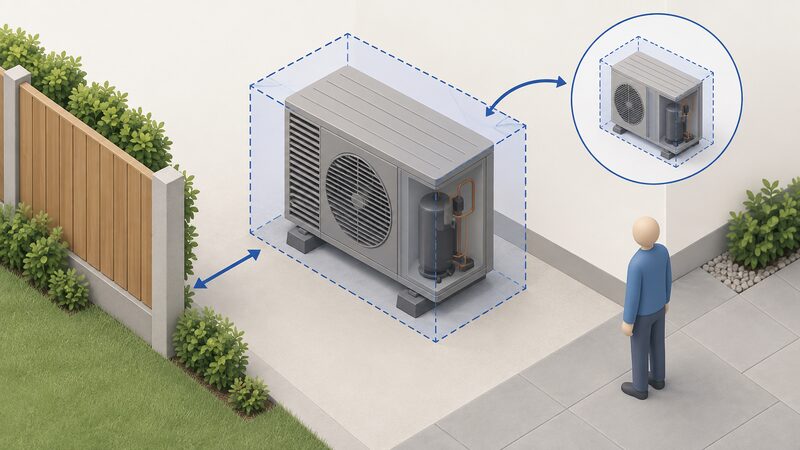
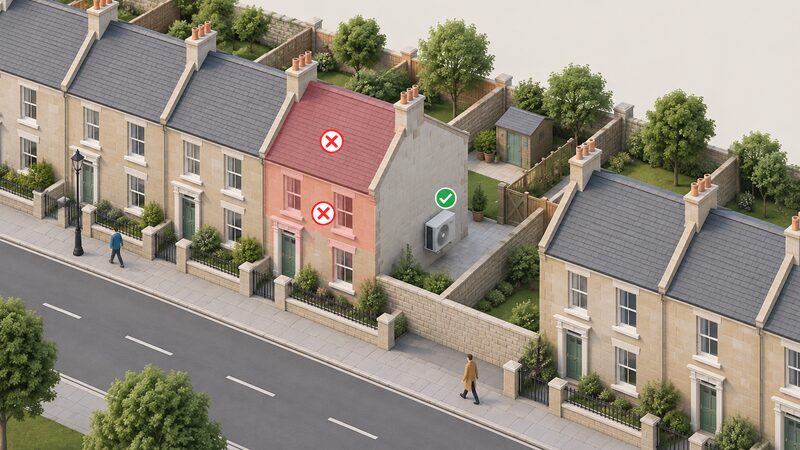
The conditions are specific and they bite. The outdoor compressor unit, including any housing, must not exceed 1.5 cubic metres on a dwellinghouse or 0.6 cubic metres on a block of flats2. A detached house may have up to two air source heat pumps; any other dwellinghouse or a block of flats is limited to one2. The unit cannot go on a pitched roof, and it cannot be installed at all where the property is a listed building2. In a conservation area or World Heritage Site there are extra restrictions on walls and roofs that front a highway2.
Where the property is a listed building, or sits within the garden or grounds of one, planning permission is needed, and in some cases listed building consent as well3. Flats and shared buildings face tighter rules, and planning permission is more likely to be required5. An Article 4 direction, most common in conservation areas, can remove the right entirely, in which case a full application follows6.
What the Class G right actually grants
Class G covers the installation, alteration or replacement of a microgeneration air source heat pump on a dwellinghouse or a block of flats, or within the curtilage of either, including on a building within that curtilage2. That last phrase matters: a unit mounted on a shed or outbuilding inside the garden falls within the same class as one bolted to the house wall, so long as the other conditions hold.
The right is conditional, not automatic. Development is not permitted by Class G unless the air source heat pump complies with the MCS Planning Standards or equivalent standards2. Council guidance repeats the point: compliance with the Microgeneration Certification Scheme, or an equivalent, is required for the installation to be permitted development10. The MCS Planning Standards include a noise assessment method, and the government's own consultation on the original right noted that the method includes a maximum noise level for air source heat pumps to be considered permitted development11.
Two further conditions are easy to overlook. The pump must not be used solely for cooling purposes, and it must be removed as soon as reasonably practicable when no longer needed2. The first rules out a unit installed purely as an air conditioner under this class; the second means the right does not create a permanent fixture by default.
The right also carries a compatibility restriction: no wind turbine may be installed on the same building or within the curtilage where the air source heat pump is installed2. Council guidance states the same rule from the householder's side: an air source heat pump cannot be installed if a wind turbine is already there10.
Size, number and siting: the figures that decide it
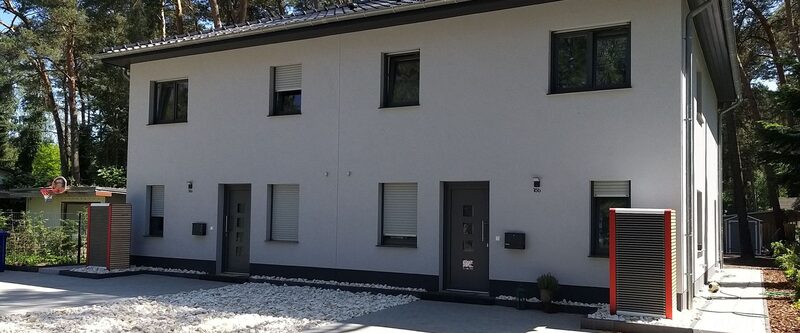
The volume threshold is the figure most likely to catch a household out, because it is measured on the unit including its housing rather than on the bare compressor. The legislation sets 1.5 cubic metres for a dwellinghouse and 0.6 cubic metres for a block of flats2. Council guidance reproduces both figures11.
There is a discrepancy worth knowing about. Cornwall Council's guidance states that the pump itself, including housing, is limited to 0.5 cubic metres on a house or 0.6 cubic metres for a block of flats10. That is lower than the 1.5 cubic metres in the Order.
| Condition | Dwellinghouse | Block of flats |
|---|---|---|
| Outdoor unit volume, including housing | 1.5 cubic metres2 | 0.6 cubic metres2 |
| Maximum number of units | Two on a detached house, one otherwise2 | One2 |
| Pitched roof installation | Not permitted2 | Not permitted2 |
| MCS Planning Standards | Required2 | Required2 |
| Wind turbine on same building or curtilage | Not permitted2 | Not permitted2 |
Siting conditions apply on top of the size limits. The unit must, so far as practicable, be sited so as to minimise its effect on the external appearance of the building2. On land within a conservation area or a World Heritage Site, it must not be installed on a wall or a roof which fronts a highway, or nearer to any highway bounding the curtilage than the part of the building nearest to that highway2. On other land, it must not be installed on a highway-fronting wall above the level of the ground floor storey2. Council guidance puts the same rules plainly: in a conservation area or World Heritage Site the unit cannot go on an elevation that fronts a highway, and on a front wall elsewhere it must be at ground floor storey level and not above10.
When a planning application is needed instead
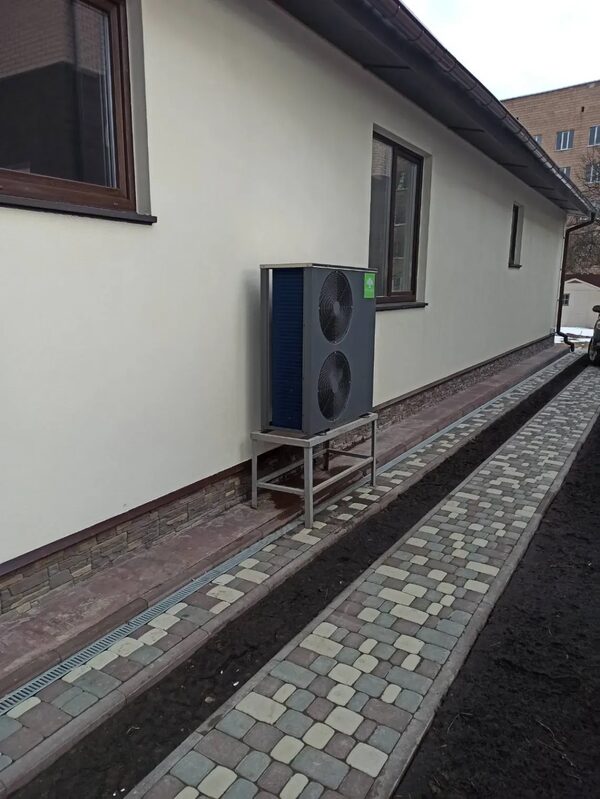
A planning application is required where the installation does not meet the permitted development rules, where the property is a listed building, where a conservation area restriction applies, where the unit would sit in a prominent position such as the front of the property, or where there would be an unacceptable impact on neighbours through noise or visual impact5. Those five triggers cover most of the cases that fall outside Class G.
Listed buildings are the clearest exclusion. Class G does not permit installation on a building or on land within the curtilage of a dwellinghouse or block of flats if that property is a listed building2. Council guidance states that planning permission, and in some cases listed building consent, may be required for a listed building or a site of a designed scheduled monument4. Elsewhere the requirement is put as planning permission and listed building consent for listed buildings3. Brighton and Hove's heritage guidance notes that for unlisted domestic buildings in conservation areas the installation of an air source heat pump within the curtilage may still be permitted development, subject to criteria, but that it is not permitted development if it would be installed on a wall or roof fronting a highway, or nearer to any public highway than the nearest part of the house13.
Flats and shared buildings are the second common trigger. Permitted development rules for air source heat pumps are more restricted for flats and shared buildings, and planning permission is more likely to be required5. The volume limit drops to 0.6 cubic metres and the quantity limit to one unit2.
A third trigger is the number of units. Bedford's guidance states that only the first installation of an air source heat pump would be permitted development, and that additional units at the same property require planning permission8. That is a stricter reading than the two-unit allowance for detached houses in the Order, and it is another point where local guidance and the legislation do not line up exactly.
Conservation areas, World Heritage Sites and Article 4 directions
A conservation area does not remove the Class G right by itself. What it does is add location restrictions: within a conservation area or World Heritage Site the unit must not be installed on a wall or roof fronting a highway, or nearer to any highway bounding the curtilage than the nearest part of the building2. Brighton and Hove's guidance confirms that an air source heat pump within the curtilage of an unlisted domestic building in a conservation area may be permitted development subject to those criteria13.
An Article 4 direction is a different matter. A local planning authority is allowed to remove permitted development rights in some or all of its area by issuing one6. Directions are made when the character of an area of acknowledged importance would be threatened, and they are most common in conservation areas16. Where one covers a property, permitted development rights may have been removed, and an application for planning permission will be required7.
The mechanics are set out in government guidance. An Article 4 direction can remove specified permitted development rights related to operational development or change of use, with temporary or permanent effect, so that a particular development cannot be carried out under permitted development and therefore needs a planning application18. An immediate direction must be confirmed by the local planning authority within 6 months of coming into effect to remain in force, and once confirmed it can remain in place permanently18. It cannot prevent development which has been commenced or already carried out, and it cannot be used to restrict changes between uses in the same use class18.
Coverage is patchy, which is why the check is local. Wirral Council states that there is only one conservation area in Wirral to have an Article 4 Direction, Bromborough Pool19. Householders are often told their solicitor should have informed them whether a direction exists when they purchased the property17.
How the rules differ across the UK nations
The Class G right described here is an England instrument. The Town and Country Planning (General Permitted Development) (England) Order 2015 is the principal order for England, and it sets out classes of development for which planning permission is automatically given, subject to stated conditions and exemptions16. Planning Portal guidance states directly that the guidance relates to the planning regime for England and that the policy in Wales may differ20.
Wales has its own position. Welsh Government guidance states that domestic heat pumps benefit from permitted development rights, so that in most cases no planning permission is required to install them, subject to certain limitations and conditions21. The same guidance confirms that permitted development rights permit the installation, alteration or replacement of a ground source heat pump or water source heat pump within the curtilage of a dwellinghouse21. Welsh Government also publishes separate guidance on fuel tanks, external walls and flues, which is where the boundary between permitted development and an application is drawn for those elements7.
Scotland took a different route. A 2015 Scottish Government consultation on permitted development rights for non-domestic solar panels and domestic air source heat pumps set out the principle that development falling within the criteria and thresholds established by the rights would not require planning permission but would remain required to gain non-planning consents such as a building warrant22. That distinction between planning consent and building standards consent is a Scottish feature.
Northern Ireland has its own instrument. The Planning (General Permitted Development) Order (Northern Ireland) 2015 provides for new permitted development for domestic air-source heat pumps and ancillary development within existing mine and quarry sites23.
For a householder in England, the practical consequence is that the England Order governs, and the Welsh, Scottish and Northern Irish regimes are separate questions. Pages covering those regimes are linked below.
What it means for household energy independence

Planning permission is the gate a household passes through before any of the energy independence benefits of a heat pump become available. Once through it, the household stops buying gas for space heating and hot water and starts buying electricity instead, which shifts the dependence rather than removing it: the home still relies on the grid and on an electricity supplier, and the heat pump itself depends on a manufacturer for parts and on an installer for commissioning and servicing.
The permitted development route is what makes that shift cheap to start. A household that needs a full planning application faces a fee, a wait and a decision that can go against it. For non-domestic uses the 2015 consultation noted that the planning application would likely fall under Section 5 of the fee schedule of the 2014 Regulations, at £401 for each 0.1 hectare22. That figure is for non-domestic applications, not householder ones, but it shows the order of cost that a planning route introduces.
The scale of the friction is documented. The government's own impact assessment records that 34% of those who order a heat pump are discouraged or drop out for reasons due to planning permission24. The same figure appears in a government press release, attributed to Octopus Energy, describing 34% of those who order a heat pump as discouraged or dropping out for reasons attributed to planning permission9. That is a measure of how much the planning step, rather than the technology, shapes whether a household completes an installation.
Government has moved on the boundary. A November 2024 announcement set out allowing more households in England to install an air source heat pump without the need to submit a planning application, opening from early next year, including removing the rule requiring them to be installed at least one metre from a property's boundary, while noting that rules still in place around listed buildings remain9. The direction of travel is towards a wider permitted development right, but the listed building exclusion and the conservation area restrictions are the parts that have held.
For a household, the independence question is therefore two-part. The planning rules decide whether a heat pump can be installed at all without an application, and the answer for most houses in England is yes. What remains after installation is dependence on the electricity grid, on a supplier, and on the manufacturer and installer for the life of the unit. Planning permission does not change any of that; it only decides how easily the household gets to the starting line.
Sources24 cited
- Planning permission: air source heat pump, Planning Portal, 2011
- Class G: installation or alteration etc of air source heat pumps on domestic premises, legislation.gov.uk, 2026
- Air and ground source heat pumps, Croydon Council, 2026
- Fact sheet 5: air source heat pumps, Pendle Borough Council, 2026
- Air source heat pumps, Westmorland and Furness Council, 2026
- Permitted development rights, Planning Portal, 2026
- Planning permission: fuel tanks, Welsh Government, 2026
- Building regulations and renewables guidance, Bedford Borough Council, 2026
- Help to save households money and deliver cleaner heat to homes, Department for Energy Security and Net Zero, 2024
- Air source heat pumps, Cornwall Council, 2026
- Heat pumps, New Forest District Council, 2026
- Air source heat pumps: householder planning advice, Central Bedfordshire Council, 2026
- Improving energy saving and sustainability in conservation areas and listed buildings, Brighton and Hove City Council, 2026
- Permitted development rights, Cornwall Council, 2026
- Do I need planning permission, Cornwall Council, 2026
- Permitted development rights, Planning Portal, 2026
- Planning permission: external walls, Welsh Government, 2026
- When is permission required, Ministry of Housing, Communities and Local Government, 2014
- Solar panels, Wirral Council, 2026
- Heat pumps, Planning Portal, 2026
- Planning permission: heat pumps, Welsh Government, 2026
- Permitted development rights for non-domestic solar panels and domestic air source heat pumps, Scottish Government, 2015
- The Planning (General Permitted Development) Order (Northern Ireland) 2015, legislation.gov.uk, 2015
- RPC Opinion: The Town and Country Planning (General Permitted Development) (England) (Amendment) Order 2025, Regulatory Policy Committee, 2025
 Planning Permission in ScotlandDo you need planning permission for a heat pump in Scotland?
 Planning Permission EnglandExplains when an external air conditioning or air-to-air heat pump unit in England needs planning permission, and how permitted development applies.
 Planning Permission in NIDo you need planning permission for a heat pump in Northern Ireland?
 Planning Permission in WalesDo you need planning permission for a heat pump in Wales?
 Home Energy Planning ScotlandDo you need planning permission for solar panels or a heat pump in Scotland?
 Building Regulations EnglandAdding a heat pump, solar panels or an extension usually needs building regulations approval, and it is separate from planning permission.