In this guide
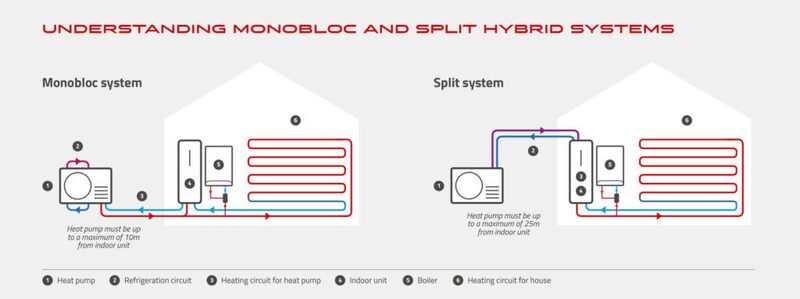
A monobloc and a split heat pump do the same job with the same technology. The difference is where the refrigerant circuit lives. In a monobloc, the refrigerant circuit is fully contained inside one factory-sealed outdoor unit1, and only water pipes run into the house. In a split system, the refrigeration circuit is divided between an outdoor unit and an indoor unit and connected by refrigerant lines installed on site1, so refrigerant pipework enters the building and forms a closed circuit between the two modules2.
That single structural difference drives almost everything a household notices. A monobloc is a self-contained heat generator with all the hydronic, refrigeration and electrical components inside the casing, in that respect similar to a boiler3, and it needs no F-Gas certification to install because the refrigeration circuit is hermetically sealed3. A split needs an F-Gas certified installer for the refrigerant work4, an indoor unit taking up wall space, and yearly leak checking of the lines5. In exchange, the split's outdoor unit is much lighter and more compact than a monoblock of comparable output6, and the monobloc's larger outdoor footprint is a real constraint on tight sites5.
Neither is the better machine. Comparing monoblock and split models from the same manufacturer, there is barely any difference in efficiency6, the same refrigerants can be used in both5, and the choice is an application and integration decision rather than a question of quality. The UK market has answered clearly anyway: Air-to-Water monobloc units dominate7, and one official modelling scenario assumes all heat pumps in new homes from 2025 are monoblocs8.
Monobloc: one sealed outdoor unit, water pipes into the house
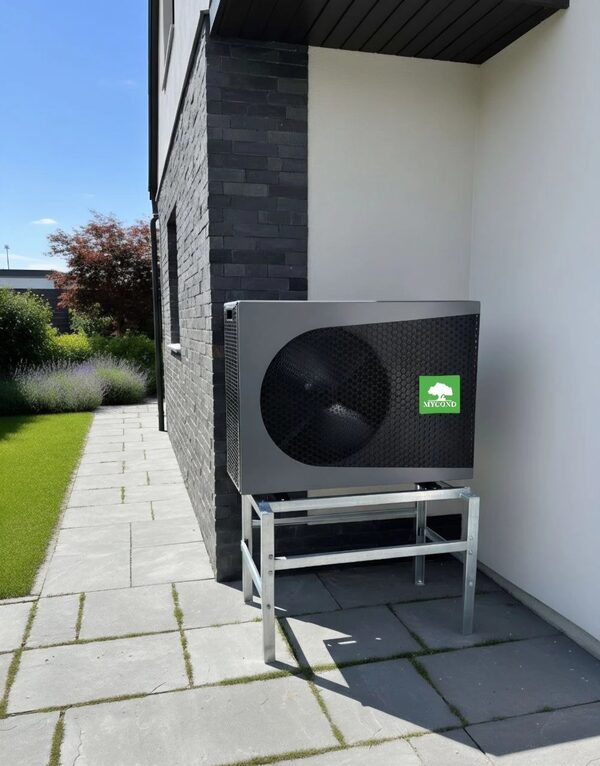
A monobloc is described by manufacturers as a single, self-contained air-to-water heat pump unit installed on the outside of the property, connecting to the heating system and hot water cylinder in the dwelling11. All the necessary components sit within one unit5: the fan, evaporator, compressor, condenser, controls and pump are factory-assembled and charged, and the circuit is closed5. The outdoor unit is connected to the heating system through hydraulic piping, with no additional work on refrigerant circuits required12.
For the household, the practical consequence is that installation is a plumbing and electrical job. The Centre for Alternative Technology notes that monobloc units make installation easier because all the workings are in the outdoor unit, so no separate indoor unit is needed13. An Energy Saving Trust case study of a household installation records the same thing: a monobloc system that combines all components in one unit and did not require an indoor unit14.
A monobloc still needs indoor equipment. It connects to a hot water cylinder within the dwelling15, so cylinder space and the pipe runs to it remain part of the design, covered in more detail on hot water cylinders for heat pumps. What it avoids is refrigerant inside the building.
Two costs come with that simplicity. First, footprint: the monobloc unit's footprint is larger than the outdoor unit of a split system5, which matters on narrow side passages and small courtyards, and is dealt with in where a heat pump outdoor unit can go. Second, water: because heated water is carried outdoors and back, freeze protection of the external pipework becomes part of the design in a way it is not for a split. Monobloc units can also be installed indoors, but then air ducts are needed in the building to supply and discharge ambient air6, which is rarely practical in a UK house.
Split: an indoor and outdoor unit joined by refrigerant lines
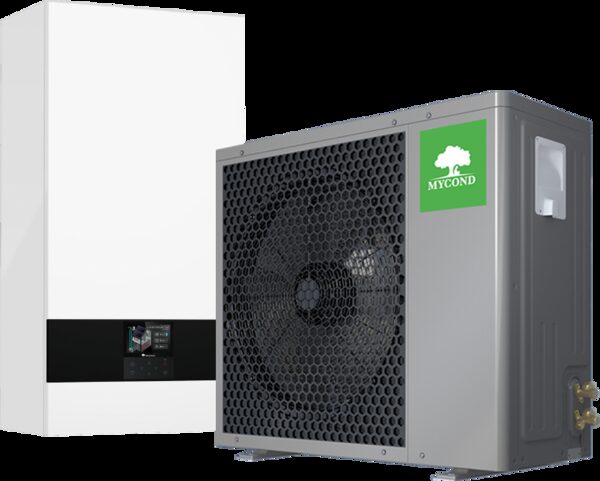
In a split system, the refrigerant circuit is divided into a compact indoor unit and an outdoor unit6. The outdoor unit holds the fan, the evaporator and the compressor; only the condenser, the circulation pump and the control and safety technology are located indoors10. During operation, the fan in the outdoor unit draws in outdoor air and channels it to the evaporator, the refrigerant is compressed by an electrically powered compressor, and heat is transferred to the heating system via the condenser10. The indoor unit serves as the interface between the system and the building's heating and hot water infrastructure2, while the outdoor unit interfaces with the external environment2.
Because the refrigerant does the travelling, no water goes outside. That removes freezing risk from the external run: one manufacturer lists "no danger of system freezing" as a split advantage6. It also means the design does not require costly wall outlets or the routing of air ducts10.
The split is classified by system architecture rather than by heat source, temperature level or building application2, and the configuration itself does not determine system performance, which depends on operating conditions and system integration2. Split models are used in both residential and commercial contexts2.
Manufacturers list further capabilities on their split ranges: reversible operation for room cooling in summer through convectors or surface cooling systems, readiness for connection to a solar system, a modular design allowing additional heat pumps if heating or cooling needs increase, and remote control through a smartphone app10. Those are model features rather than properties of the architecture, and app control introduces a dependence on the manufacturer's cloud service, which is worth weighing against the independence the heat pump itself delivers. Cooling in UK wet systems is covered in using a heat pump for cooling.
What each configuration asks of your home
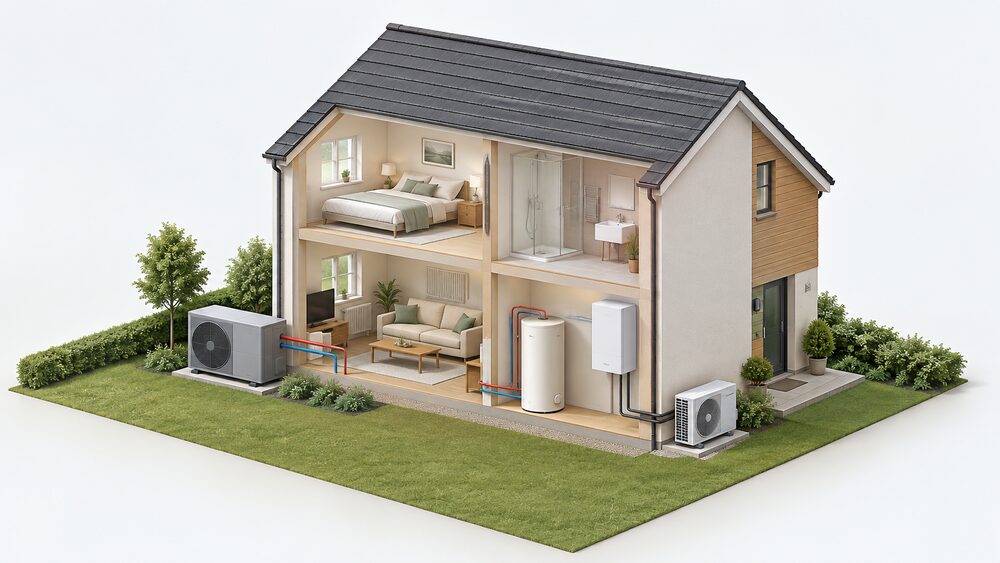
A split needs sufficient indoor space for a hot water cylinder and an indoor unit, though the outdoor unit can be placed more flexibly4. Inside the building, space requirements for a split are lower than for the indoor installation of a complete monoblock appliance6, and the split's indoor unit is significantly smaller than an indoor monoblock6. Split units often already contain a buffer cylinder for hot water heating or central heating backup6, which can save a separate vessel; see buffer tanks, volumisers and low-loss headers.
A monobloc asks the opposite trade. It requires no dedicated indoor space for the appliance itself12 but presents a larger object outdoors5. On constrained plots the split's lighter, smaller outdoor unit6 can be the deciding factor.
| Question the home poses | Monobloc | Split |
|---|---|---|
| Refrigerant inside the house | No, circuit sealed outdoors1 | Yes, lines run to the indoor unit2 |
| Dedicated indoor appliance space | Not needed12 | Indoor unit plus cylinder4 |
| Outdoor unit size | Larger footprint5 | Lighter and more compact6 |
| Water in external pipework | Yes | No, so no danger of system freezing6 |
| Can be installed wholly outside or wholly inside | Yes, outdoors, or indoors with air ducts6 | No, split appliances cannot be installed entirely outside or entirely inside6 |
Installation: who can fit it, and what certification is needed

The certification difference is the sharpest practical distinction. Monobloc style air source heat pumps contain a hermetically sealed refrigeration circuit and do not require F-Gas certification to install3. The Heating and Hotwater Industry Council puts it the same way: for monoblock units, all refrigerant is sealed within the outdoor unit, so installers do not require F-gas qualifications16. Clivet states plainly that a monobloc is compact and easy to install, with an F-Gas licence not required12.
For a split, the refrigerant circuit is completed on site and the rules bite.
"assembly of both units into a closed refrigeration circuit may only be carried out by a certified refrigeration specialist"
Nesta records the commercial consequence: splits have higher installation costs due to refrigerant charging, which requires an F-Gas certified installer9. Stiebel Eltron lists an F-Gas certified installer as a requirement for air-to-water split systems17 and names air-to-air and air-to-water monobloc as the lowest installation cost options17.
No certification removes the need for competence on the water side. Baxi states that to install and service a monobloc or split air source heat pump, strong knowledge of plumbing and heating is needed18. For grant access and consumer protection in the UK, the route is an MCS-certified heat pump installer19; the wider sequence is set out in heat pump installation and the certification framework in heat pump standards, testing and certification. Wolf notes that for monoblock units fitters do not need a refrigeration certificate, generally held only by qualified refrigeration technicians, whereas split installation and maintenance are more complex and costly because technicians must work on the refrigerant circuit6.
Noise, freezing and siting
Between the two architectures the acoustic difference is small. Dimplex states that the overall noise levels of monobloc and split system air source heat pumps are similar5, and Wolf finds not much difference between monoblock and split as long as their performance is suitably similar6. Both have noise emissions from a built-in fan6. What a split can do is lower the noise heard inside, because the compressor sits outdoors6. A monobloc always has its compressor outdoors too, so that advantage applies against indoor monoblocs rather than the ordinary outdoor kind.
Siting is where noise decides the outcome. Noise regulations in densely built-up areas can preclude outdoor installation and so prevent split appliances from being used6. In the UK, the assessment used for permitted development includes the heat pump installation location as a project detail20; the method is explained in MCS 020: the heat pump noise assessment and the practical figures in how noisy is a heat pump. Planning rules differ between England, Scotland, Wales and Northern Ireland, each covered on its own page, beginning with heat pump planning permission in England.
Freezing runs the other way. A split carries no water outdoors and so has no danger of system freezing6, whereas a monobloc's external water pipework must be protected. Upkeep applies to both outdoor units: owners are advised to keep units at ground level or on a balcony clear of debris, dirt, leaves or sticks, and where an outdoor unit is attached to an external wall, to contact local technical support for checks and preventive maintenance21. More in heat pump servicing and maintenance.
Cost: what you pay up front and afterwards
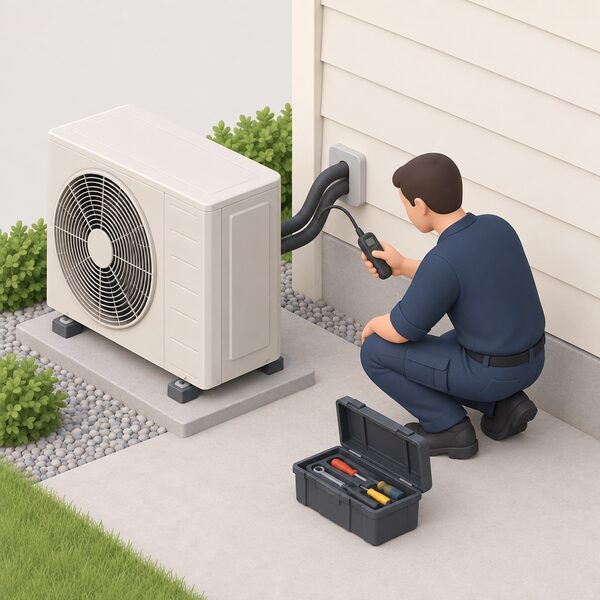
Split heat pumps are more complicated to install than monobloc versions and are therefore more initially expensive4. Nesta attributes the gap specifically to refrigerant charging and the F-Gas certified labour it requires9. Stiebel Eltron places air-to-water monobloc among the lowest installation cost heat pump choices17. Ferroli and Clivet both market monobloc ranges on compact design and ease of installation22.
Published prices for either architecture are not the useful number. Costs are installer-quoted, and official cost modelling for heat pumps includes one-off installation costs covering some home retrofit such as replacing radiators8. That retrofit, radiators, pipework, cylinder and electrical supply, typically dwarfs the monobloc or split premium. How much does a heat pump cost in the UK and radiators, underfloor heating and emitters for a heat pump go into that in detail.
Afterwards, the split carries a recurring obligation the monobloc does not. The lines need to be checked for leaks on a yearly basis5. Viessmann states that the system user must have the refrigerant circuit of larger systems checked annually for leaks by a refrigeration specialist10, and Wolf notes an obligatory refrigerant test may apply annually where the charge exceeds the applicable reference value for carbon dioxide equivalent6. BEAMA's report records annual maintenance as required, including for warranties and checking refrigerant23. A monobloc still needs servicing, but its sealed circuit removes the site-made joint that the leak regime is designed around.
Running costs are a matter of system efficiency, not architecture: efficiency between comparable monoblock and split models from one manufacturer barely differs6. See heat pump running costs and heat pump efficiency: COP, SCOP and SPF explained.
Refrigerants and the F-gas rules reshaping split systems
The same refrigerants can be used in both monobloc and split system air source heat pumps5, so the regulatory pressure is not about which gas a monobloc may use, it is about where the gas can legally be handled and how much of it is exposed to site work. A monobloc unit has a closed-circuit system for the refrigerant5; a split's circuit is created by the installer.
UK guidance on bans on F gases in new products restricts F gases with a global warming potential above 750 in single split systems containing less than the stated small refrigerant charge, and lists exceptions: larger air-conditioning or heat pump systems, such as chillers or larger split systems; stationary single split air-conditioning systems used solely for cooling products; air to water single split system air-conditioning systems; and single split air-conditioning systems fitted to maritime craft24. The exceptions matter, because a domestic split is not automatically caught or automatically exempt. The chemistry, and the UK move to propane, is covered in heat pump refrigerants: R290, R32 and the F-Gas rules and compared in R290 vs R32 heat pumps.
The direction of the market is visible in official modelling. One Defra assessment produces an overall stock of 80% monobloc to 20% split system by 2050, and a second scenario 87% monobloc to 13% split8. It also assumes all heat pumps installed in new homes from 2025 are monoblocs8. Flammable propane in a sealed outdoor unit is easier to regulate than a charge split across a wall, which is part of why UK-facing ranges have moved that way.
Which UK brands sell monobloc and split models
The Heat Pump Association's UK sales data separates Air-to-Water monobloc units, Air-to-Water split units, Ground and Water Source units, domestic hot water heat pumps and an "other" category covering exhaust air and integrated hybrid heat pumps25. Its earlier release on sales by type points to the dominance of Air-to-Water monobloc units in the UK market7, measured as factory-gate sales7.
Both architectures are sold here. Ferroli's air-water heat pumps are available in both monobloc and split configurations22. Ideal Heating offers monobloc and split heat pumps across its range26, with the HP290 designed for the UK climate as a monobloc27 and the Logic Air range described as monobloc28; more on Ideal Heating Logic Air heat pumps. Vaillant's aroTHERM Split is MCS accredited29, covered on Vaillant heat pumps. LG's Therma V R290 range is monobloc, connected by water piping only and eliminating the need for refrigerant piping, and is sold in the UK30; see LG Therma V heat pumps. Dimplex lists both monobloc units and split systems comprising an outdoor fan unit and an indoor heating unit15. Viessmann has a German-engineered monobloc heat pump optimised for UK installations31. Clivet offers monobloc units and a hydronic-split arrangement in which an outdoor monobloc is combined with a hydronic module32.
Air-to-air is a separate family with its own monobloc variants. Which? notes wall-mounted monobloc air-to-air units that need no outdoor unit, just a couple of holes drilled through an external wall, but which heat and cool one room only and are not a whole-house solution33. Multi-split air conditioning outdoor units are specified differently again: one Daikin four-port outdoor unit is listed at 734 x 974 to 1044 x 401 to 408 mm high by wide by deep, 60 to 73 kg, 220 to 240V single phase 50Hz, R-32 refrigerant, 5.2 to 9.0 kW cooling and 6.8 to 10.0 kW heating, with maximum piping length up to 75 m34. See air-to-air heat pumps and the pillar guide.
What the choice means for household independence
Neither architecture changes the fundamental dependence: an air source heat pump runs on electricity from the grid, and energy security comes from insulation, sizing, controls and, where fitted, generation and storage. The relevant independence questions here are narrower and practical. A monobloc puts the sealed refrigerant circuit beyond the reach of routine site work, reduces the trades a household must call on, and needs no F-Gas certified visitor for ordinary service. A split adds refrigerant pipework inside the home, a yearly leak check by a refrigeration specialist, and in some ranges an app-based control path that runs through the manufacturer's service.
Against that, a split removes water from the external pipe run and the freezing exposure that comes with it, and offers a smaller, lighter outdoor unit where space or weight is tight. Both are held to the same standard on the things that actually determine bills and comfort: correct heat pump sizing, emitters capable of a low flow temperature, and competent commissioning. The architecture is a fitting decision. The system design is the one that pays.
Sources34 cited
- Monoblock heat pump, iDM Energiesysteme, 2026-07-06
- Split heat pump, iDM Energiesysteme, 2026-07-06
- What is a monobloc air source heat pump, Baxi, 2026-09-17
- Heat pumps: the different types, Ideal Heating, 2026-09-17
- The difference between monobloc and split system air source heat pumps, Dimplex, 2023-09-04
- Heat pump: monoblock or split, WOLF, 2026-09-17
- New data on UK heat pump sales by type, Heat Pump Association UK, 2024-09-23
- HFC phasedown reform de minimis assessment, Defra, 2025-09-02
- Reduce the cost of heat pumps, Nesta, 2022-03-02
- Split design air to water heat pumps, Viessmann, 2022-08-03
- Monobloc heat pumps, Dimplex, 2026-09-17
- Home heat pump solutions, Clivet, 2026-09-17
- Get warmed up to install a heat pump, Centre for Alternative Technology, 2022-08-17
- Stephen, Dina and Layla's air source heat pump, Energy Saving Trust, 2024-03-11
- Air source heat pumps, Dimplex, 2026-09-17
- Air to air heat pumps added to Boiler Upgrade Scheme, HHIC, 2026-01-20
- Which kind of heat pump is best for my home, Stiebel Eltron, 2026
- Do I have to be F-Gas certified, Baxi, 2026-09-17
- Heat pump guide: air source vs ground source explained, Institute of Assessors, 2026-09-20
- MCS 020 noise assessment calculator, MCS, 2026-09-19
- General tips for air conditioner maintenance, Hitachi Air Conditioning, 2026-09-17
- Heat pumps, Ferroli UK, 2026-09-17
- Future Homes Standard network to emitter impact report, BEAMA, 2023-04
- Bans on F-gas in new products and equipment, GOV.UK, 2019-08-21
- UK heat pump sales reach record high in 2025, Heat Pump Association UK, 2026-03-26
- Heat pumps, Ideal Heating, 2026-09-17
- Logic Air, Ideal Heating, 2026-09-17
- Ideal Logic Air 10kW heat pump, Quiet Mark, 2026-09-17
- Vaillant aroTHERM Split air source heat pump, Quiet Mark, 2026-09-17
- LG Therma V R290 Monobloc 14kW, Quiet Mark, 2026-09-17
- Viessmann Climate Solutions to launch new residential air source heat pump, CIPHE, 2026-05-14
- Home heat pump solutions, Clivet Group UK, 2026-09-17
- How a heat pump can cool your home, Which?, 2026-07-17
- Daikin 4-port multi air conditioner outdoor unit, Quiet Mark, 2026-09-17
 Using a Heat Pump for CoolingCan a heat pump cool your home in summer as well as heat it in winter?
 Which Homes Suit a Heat PumpMost UK homes can have a heat pump fitted, so the real question is whether yours makes it easy or expensive.
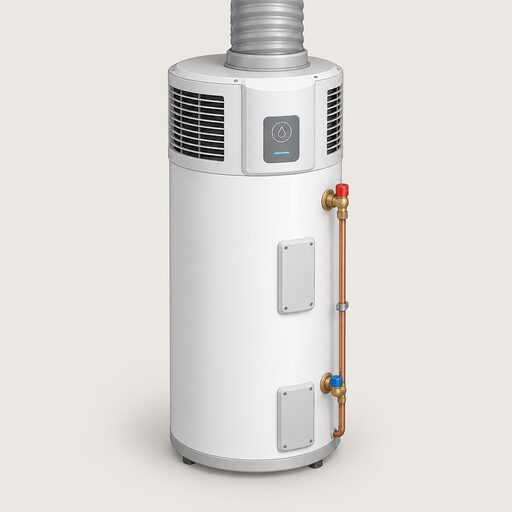 Hot Water Heat PumpsA hot water heat pump heats only the water in your cylinder, using air instead of a boiler flame.
 Split Air ConditioningA split air conditioning system cools or heats one room using an indoor unit and an outdoor unit linked by pipes.
 Choosing Heating by Home TypeWhat heating can you actually have in a flat, a park home, a listed building or a new build?
 Radiators and EmittersWill your radiators still heat the house properly with a heat pump?