In this guide
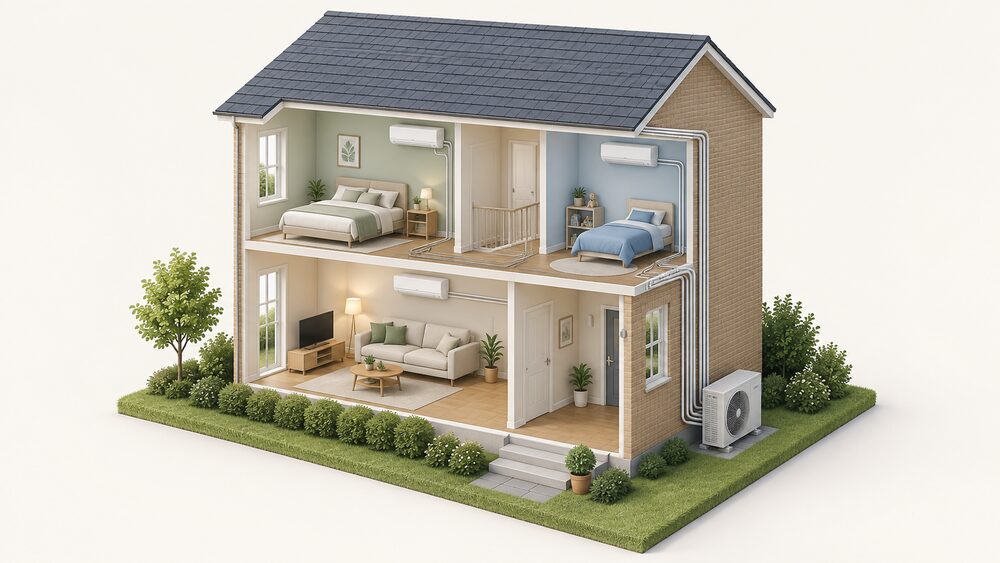
Multi-split air conditioning uses a single outdoor unit to serve several indoor units, each in a different room. Independent guidance describes the typical arrangement as two to five indoor units per outdoor unit1, and makers selling in the UK state an upper limit of five indoor units on one outdoor unit2. Each indoor unit can be set and run on its own, so a bedroom, a living room and a home office can be cooled, or heated, to different temperatures from one machine outside.
Almost all modern systems are heat pumps: they move heat rather than make it, and one UK supplier states that most have a coefficient of performance (CoP) of roughly 4, meaning around 4 kW of heating or cooling for every 1 kW of electricity used3. The Centre for Sustainable Energy, modelling household cooling costs in 2026, used a more conservative CoP of 3.54. Either way, a multi-split system runs entirely on electricity, so it keeps a household off gas for the rooms it serves but ties comfort to the grid, the supplier's tariff and, where there are panels, the home's own generation.
Prices depend on the number and size of indoor units. As one example, in September 2026 an electriQ multi-split kit with two 9000 BTU wall units was priced at £899.00 and one with five 12000 BTU wall units at £2399.98, with installation not included5. Most multi-split installations are priced by an installer after a survey, and the installed cost varies with pipe runs, wall types and the number of rooms.
One outdoor unit, several indoor units
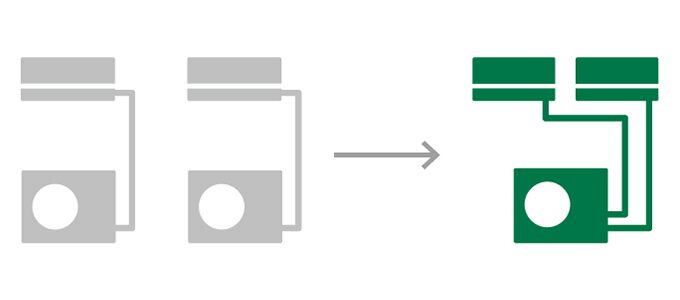
A standard split system has two halves: an indoor unit that sits in the room and an outdoor unit that holds the compressor and rejects heat outside. A multi-split extends that design so that one outdoor unit is connected to two or more indoor units8. The indoor units are all connected to the outdoor unit by refrigerant pipework, and each one conditions the room it is in9. Mitsubishi Electric describes multi-split as "a more advanced version of the split system"10, and Hitachi places it within a wider residential line-up that also includes ducted systems, cassettes, window units and floor-mounted consoles11.
The contrast with a single split is simple. A single split is one indoor unit connected to one outdoor unit, giving targeted climate control for one space12. A multi-split gives "one outdoor unit for multiple rooms", which Panasonic presents as suited to whole-home comfort13, and Ferroli states that multi-split systems "can climatise several rooms using a single outdoor unit"14.
Indoor unit types that can share one outdoor unit
Multi-split systems are usually built around wall-mounted indoor units, but makers' ranges also include ceiling-suspended units, ceiling cassettes, concealed ducted units and floor consoles11. Fujitsu, for example, pairs the same outdoor unit with a ceiling-suspended indoor unit, a four-way cassette and a slim ducted unit across its range. Which indoor types can be mixed on one outdoor unit is set by each maker's compatibility tables, and the combination is fixed at design stage. The styles themselves are covered in ducted and ceiling cassette air conditioning and the wider types of air conditioning.
Independent control of several rooms, with heating as well as cooling
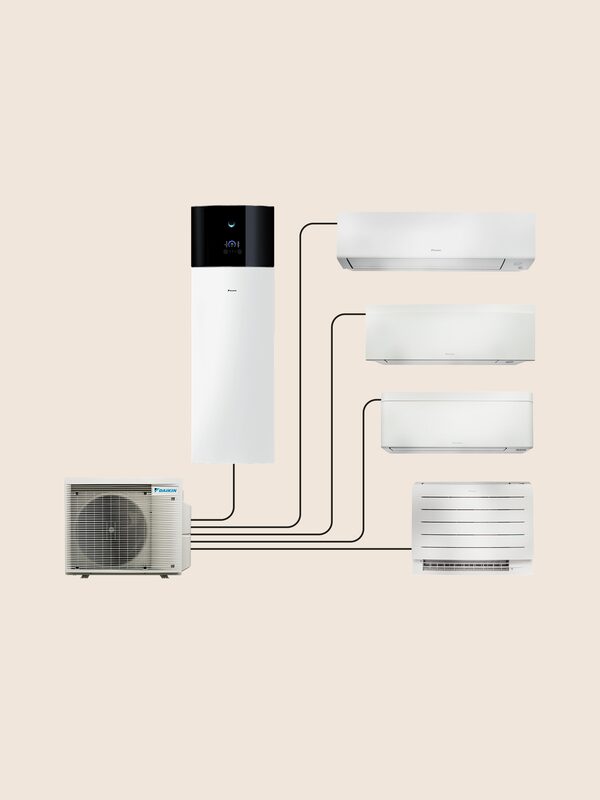
The main thing a multi-split does well is serve several rooms from one outdoor unit while keeping each room under its own control. Netatmo notes that this makes it possible to cool several rooms "unlike with a mono-split system", with each indoor unit adjusted independently15. Midea describes its multi-split systems as providing "individual room control, flexible installation, and smart climate management"16, and Clivet as "ideal to air condition more rooms in the same house with a single centralised system"17. Mitsubishi Electric states that they suit "homes with several rooms that need individual temperature control without ductwork"10.
Heating matters as much as cooling in the UK climate. Makers state that a multi-split can cool or heat several rooms, with each unit controlled individually18, and that "an air con system with multiple units can heat several rooms inside the home"19. Some products go further. Daikin's Multi+ Class 90 and Multi+ Class 68 are described as heat pump systems that provide "heating, cooling and hot water from one system", all from one outdoor unit20; the Class 90 connects up to four indoor units20.
| Maker or product | Stated maximum indoor units per outdoor unit |
|---|---|
| Daikin multi systems | up to five2 |
| Daikin air-to-air multi-split (guidance) | up to five22 |
| Haier Multi-Split | up to 5, with capacity to add units later23 |
| Daikin Multi+ Class 90 | up to four20 |
Haier notes that a system can be "future-proofed" to allow up to 5 indoor units on one outdoor unit23, which means a household can plan for rooms it does not yet want to condition, provided the outdoor unit is sized for them. The detail of limits by model is in how many indoor units a multi-split outdoor unit can serve, and heating use in air conditioning that heats.
For independence, the gain is that several rooms can be heated electrically at a CoP well above 1 without a gas boiler, and without a separate appliance in each room. The dependence is concentrated: every room served relies on one outdoor unit and one maker's controls and spare parts.
Where multi-split falls short: fitting work, noise and price
Makers who promote multi-split are frank about its drawbacks. Netatmo lists three:
"- Complex and potentially expensive fitting work required - The outdoor units can be noisy - High purchase price"
The fitting work comes from the pipework. Each indoor unit needs its own refrigerant and electrical connection back to the outdoor unit, plus a condensate drain, so the more rooms and the further they are from the outdoor unit, the longer and more disruptive the installation. Pipe length limits and minimums are set per model by each maker; why a minimum exists is covered in why there is a minimum pipe length for air conditioning, and the survey and commissioning steps in air conditioning installation.
Split systems of all kinds cost more than self-contained monobloc units, partly because the outdoor unit and other components have to be installed24. Set against that, the outdoor unit of a multi-split is compact: Daikin notes it "fits small spaces such as roofs or terraces and can even be installed on a wall"25.
There is one operational limit that single splits do not share. One UK supplier states that on a multi-split, all indoor units must be operating in cooling or heating mode simultaneously3. A south-facing bedroom cannot be cooled while a north-facing study is heated on the same system.
The outdoor unit is also a single point of failure. If it breaks down, every room on the system loses heating and cooling together, where separate single splits would fail one room at a time.
On noise, the comparison runs both ways. Monobloc units are described as "rather noisy" because of their compact size and integrated motor18, and packaged systems installed wholly indoors can be noisier than a split system26. A multi-split moves the compressor outside, which quietens the rooms but puts the noise at the wall or roof, where neighbours may hear it. Figures for a real outdoor unit follow below.
Efficiency: roughly 4 kW of output for every 1 kW of electricity

The headline efficiency figure is the coefficient of performance. One UK supplier states that most modern systems have a CoP of roughly 4, and that air conditioning is roughly 4 times more efficient than plug-in heaters; it also states that most modern systems are rated at least A, with many A+ or higher3. Daikin states a higher figure for heating, "approximately 5 kW of heat for each kW of electrical energy used"22. The Centre for Sustainable Energy's cooling model used 3.5, in which "1 kWh electricity gives 3.5 kWh cooling"4. The difference reflects who is speaking and for what purpose: makers quote rated performance for their own equipment, while the independent model adopts a cautious figure for estimating bills across many homes.
| Measure | Figure | Source type |
|---|---|---|
| Power rating, single-split | 0.8 to 2.5 kW6 | independent |
| Power rating, multi-split or ducted | 1 to 5 kW6 | independent |
| Power use, portable unit | 1 kW27 | independent |
| CoP used in cooling cost model | 3.54 | independent |
| CoP, most modern systems | roughly 43 | supplier |
| Heat output per kW electricity | approximately 5 kW22 | maker |
Capacity is a separate question from efficiency. Midea offers its multi-split systems in capacities from 4 kW to 12 kW16. On the sizing side, one supplier's table puts a 4.5 kW (15,000 BTU) output at a room of up to 40 m²28. On a multi-split the outdoor unit's capacity is shared between the indoor units, so the sum of the rooms' needs, and how many are likely to run at once, sets the outdoor unit size. Sizing by room is covered in what size air conditioner you need, and ratings in air conditioning efficiency.
In practice, a multi-split's higher power rating range simply reflects that it is running several rooms. What it means for independence is that each unit of electricity, whether imported or generated on the roof, yields several units of heat or cooling; running air conditioning on solar panels covers matching that load to generation.
Outdoor unit size, weight and sound: the AOEG30KBTB as a worked example
Fujitsu publishes full specifications for its outdoor units, which makes one a useful illustration of what a household is committing to on its wall. The AOEG30KBTB is the outdoor unit paired with Fujitsu's ceiling-suspended indoor unit in its range7.
| Specification | Fujitsu AOEG30KBTB | Fujitsu AOEG45KBTB |
|---|---|---|
| Net dimensions | 788 mm, 940 mm, 320 mm7 | not given |
| Weight | 52.0 kg7 | not given |
| Airflow | 3750 m³/h7 | not given |
| Sound, cooling | 53 dB(A)7 | 57 dB(A)29 |
| Sound, heating | 55 dB(A)7 | 60 dB(A)30 |
The AOEG45KBTB is the larger unit that pairs with Fujitsu's slim ducted unit and its four-way cassette29. Its 60 dB(A) heating figure is published alongside a sound power heading, so it may not be directly comparable with the other sound pressure figures.
Three practical points follow. First, at 52.0 kg the smaller unit needs a wall or ground mounting able to carry it. Second, heating mode is louder than cooling on both units, which matters in winter evenings as much as summer nights. Third, the airflow of 3750 m³/h needs clear space around the unit to work properly.
Some multi-split outdoor units have features aimed at noise. Daikin's Multi+ Class 90 and Class 68 outdoor units have a "night quiet" mode setting "to reduce the sound pressure during the night"20. Indoors, one supplier quotes its split indoor units at typically 21 to 42 dB(A)31. Further detail is in how noisy air conditioning is.
Installation and planning: permitted development in England and Scotland
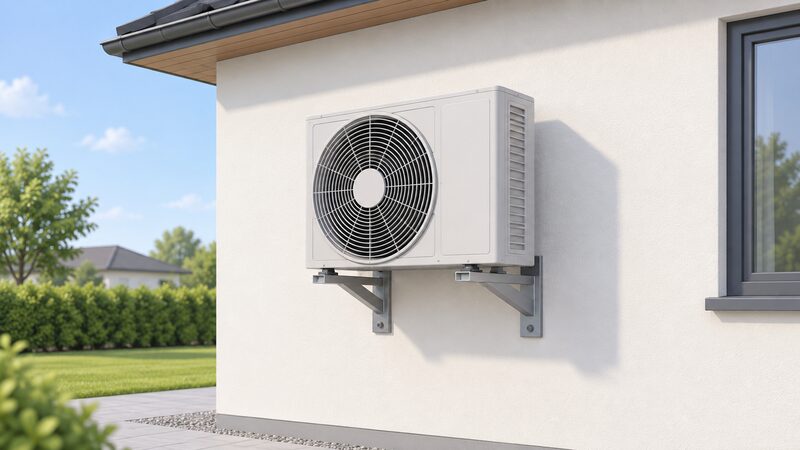
Official guidance for England states that adding air conditioning to a home "may be considered permitted development provided all the limits and conditions" set in legislation are met, with limits covering function, size, placement and number of units32. Carbon Brief, in July 2026, summarised the position as most AC units falling under permitted development rights, so that no planning application is required33.
In England, air conditioning that heats is dealt with as an air source heat pump. The Scottish Government reported in September 2025 that the UK Government had amended the English rules so that up to two air source heat pumps can be installed on detached dwellinghouses, used for heating and cooling but not solely cooling, and removed the one metre boundary restriction34. The original rules did not permit development that would result in more than one air source heat pump on the same building or within its curtilage35, and on a block of flats the outdoor compressor unit, including housing, must not exceed 0.6 cubic metres36. A single multi-split outdoor unit serving several rooms counts as one unit, which is an advantage under these limits compared with several single splits.
Scotland's permitted development rights sit in the Town and Country Planning (General Permitted Development) (Scotland) Order 1992, which was amended to bring in rights for domestic air source heat pumps38. In 2025 the Scottish Government consulted on following England: allowing up to two air source heat pumps on detached dwellinghouses and allowing heat pumps installed under permitted development to be used for heating and cooling, but not solely cooling, which would let air-to-air systems benefit34. These were proposals at the time of the consultation. The Scottish order also has separate classes for ground source and water source heat pumps and biomass flues, which do not cover air conditioning40. One supplier notes that the rules on air source heat pumps in England and Scotland were relaxed from 1 December 20113.
The pattern matters in practice: equipment used only for cooling is treated differently from equipment that heats and cools. The position in each nation is covered in England, Scotland, Wales and Northern Ireland, and for flats in air conditioning in flats.
Servicing, lifespan and warranty: what owning a system involves
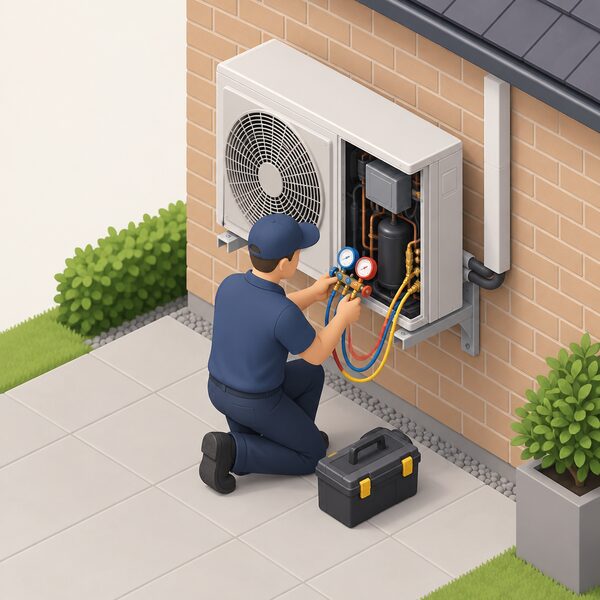
A multi-split cannot be fitted and forgotten. By law, all split systems need an F-Gas registered engineer to carry out the installation or at a minimum commission the system; only DIY-category monobloc products are exempt3. Afterwards, one supplier states that the system should be serviced annually by an F-Gas registered engineer, with indoor units cleaned every 1 to 3 months and the outdoor unit every 6 to 12 months depending on usage3. Independent guidance on air source heat pumps, of which air-to-air systems are one kind, likewise describes a detailed check by a professional installer typically every year41.
Warranty terms are set by each maker. One supplier states that most systems have a minimum 5 year warranty3. Because every room on a multi-split depends on one outdoor unit, the warranty and parts support of that one maker carry more weight than on single splits; see 5 year air conditioning warranties.
Stated lifespans differ widely. One supplier states "a minimum of 6 years reliable life" for correctly maintained systems used an average 8 hours a day for summer cooling and winter heating3. Netatmo states that a well-maintained, good quality reverse cycle system "can last between 15 and 20 years"18. The gap reflects a guaranteed floor against a typical range, and both depend on maintenance.
For larger systems, legislation requires air-conditioning systems to be inspected by an energy assessor "at regular intervals not exceeding five years"42. Scottish guidance describes inspection frequencies from three years for poorly maintained and inefficient systems up to five years for well maintained ones43. Filter cleaning and service routines are in air conditioning maintenance and refrigerant rules in F-Gas rules for home air conditioning.
Water, condensate and dehumidifying
A split system is sealed. One UK supplier states that the legionella concern is "a complete myth" for sealed systems:
"As there is no standing water, Legionnaires does not apply to air conditioning."
In cooling mode the system takes moisture out of the air, so it acts partly as a dehumidifier; there is also a Dry mode, but the same supplier states this is not designed to be a standalone dehumidifier and that dehumidification does not happen in heating mode3. Hitachi notes that in high humidity regions, units with a Dry Mode function help to lower ambient humidity44. The water removed in cooling has to be drained from each indoor unit, which adds a drain run per room to the installation. More is in air conditioning, Dry mode and humidity.
Cost and the 0% VAT position
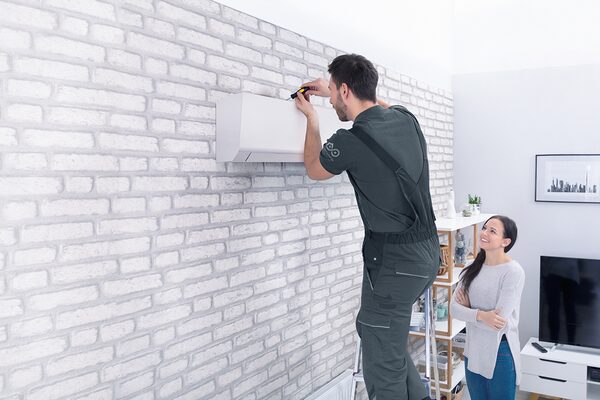
In Great Britain, official guidance states that households pay a rate of 0% VAT on both certain products supplied by the installer and the cost of all work to install those products in the home45. One maker states that the 0% rate applies to air conditioning installation in a private home26. The relief follows the product being installed by the installer: equipment bought separately and fitted by someone else does not fall within the same wording.
Northern Ireland differs. NI Direct states that installations of energy-saving materials, including solar panels and heat pumps, now benefit from a zero rate47, but HMRC guidance for Northern Ireland states a 5% rate on everything where the products (excluding VAT) are 60% or less of the total installation cost (excluding VAT)46. The documents describe different rules for the nation, and the rate applied to a given job depends on how the supply is structured.
| Nation | VAT position on qualifying installation |
|---|---|
| England, Scotland, Wales | 0% on qualifying products and installation work45 |
| Northern Ireland | zero rate on energy-saving materials47; HMRC guidance also sets a 5% rate where products are 60% or less of the cost46 |
The MCS Foundation has campaigned for zero-rated VAT to continue, to avoid "an up to 20% jump" in the cost of heat pumps and other measures48.
For equipment, the electriQ kits cited above (£899.00 for two 9000 BTU units, £2399.98 for five 12000 BTU units, September 2026) show how price scales with the number of rooms; the VAT position of those prices is not stated5. Full installed prices are quoted by installers after a survey and are not published as a range. Costs in more detail are in air conditioning cost and running costs; air conditioning grants sets out what support exists.
Multi-split or separate single-room units: which fits which home
Makers draw the line by the number of rooms. Hitachi states that single split wall-mounted air conditioners are ideal for single rooms, while multi-split units can be used in various rooms throughout the house44, and that a single split is "designed to provide climate control to one room"8. A mono-split can only serve the room in which its indoor unit is located15. Daikin notes that one air conditioner "may be all you need" in a smaller home such as a two-bedroom apartment25.
| Situation | Single split | Multi-split |
|---|---|---|
| Rooms served | one room or location3 | two to five rooms1 |
| Typical uses named by makers | bedrooms, living rooms, garden offices12; a bedroom or home office17 | homes needing room-by-room control without ductwork10 |
| Outdoor units on the building | one per room | one in total |
| Mode flexibility | each room chooses heat or cool | all rooms in the same mode3 |
| If the outdoor unit fails | one room affected | all rooms affected |
Several single splits suit a home where only one or two rooms need conditioning, where rooms want different modes, or where resilience against a single failure matters. A multi-split suits a home with several rooms needing heating and cooling, limited wall space for outdoor units, or planning limits on the number of units. Ferroli describes mono-split as suited to "individual rooms or targeted applications"14, and the side-by-side detail is in single split vs multi-split air conditioning, ducted vs multi-split and split air conditioning systems explained.
For energy independence, either route removes gas from the rooms it serves and turns them into an electrical load that can be matched to solar generation or cheaper tariff periods. What remains is dependence on the grid, on F-Gas registered engineers for servicing, and on the maker for parts, a dependence that a multi-split concentrates in one outdoor unit. The wider picture is set out in home cooling and energy independence and the home cooling guide.
Sources48 cited
- Air-to-air heat pumps: a low carbon solution for UK homes, Nesta, 2026-02-17
- Air conditioners for homes, Daikin UK
- Frequently asked questions, Cool Easy
- Summer fuel poverty and the new price cap, Centre for Sustainable Energy, 2026-08-26
- iQool multi-split air conditioners, electriQ, 2026-09-23
- Is air conditioning worth it in the UK?, Uswitch, 2026-07-14
- Ceiling split system specification, Fujitsu General
- Air conditioner buying guide, Hitachi
- Home air conditioning, Netatmo
- How to choose the right home air conditioning, Mitsubishi Electric, 2025-04-07
- How does air conditioning work?, Hitachi
- Easy-Fit single split systems, Cool Easy
- Domestic air conditioning ranges, Panasonic
- Air conditioners, Ferroli
- Home air conditioning guide, Netatmo
- Multi-split systems, Midea UK
- Home air conditioning, Clivet
- Reverse cycle air conditioners, Netatmo
- How does air conditioning work, Netatmo
- Daikin Multi+ Class 90, Quiet Mark
- Daikin Multi+ Class 68, Quiet Mark
- Replacing radiators with air conditioners, Daikin UK
- Multi-split outdoor units, Haier
- Reverse cycle air conditioner guide, Netatmo
- How to choose your air conditioner location, Daikin UK
- Packaged air conditioning, Netatmo
- The cost of keeping cool, Uswitch, 2026-04-30
- Air conditioning size guide, Cool Easy
- Slim duct system specification, Fujitsu General
- Cassette system specification, Fujitsu General
- iPAC air conditioning units, Cool Easy
- Planning Portal permitted development FAQ, Planning Portal
- Eight facts about air conditioning, Carbon Brief, 2026-07-10
- Permitted development rights to support provision of new homes: consultation, Scottish Government, 2025-09-03
- Class G, air source heat pumps (as made), legislation.gov.uk
- Class G, air source heat pumps, legislation.gov.uk
- Air source heat pumps planning advice, Cornwall Council
- Permitted development rights impact assessments, Scottish Government
- Potential development rights for new homes provision, Scottish Government
- General Permitted Development (Scotland) Order 1992, legislation.gov.uk
- Air source heat pumps, Plymouth Energy Community
- Energy Performance of Buildings Regulations 2012, Part 4, legislation.gov.uk
- Building Standards Technical Handbook, Domestic, April 2026, Scottish Government, 2026-03
- What size of air conditioner do I need?, Hitachi
- Tax on energy-saving products, GOV.UK
- VAT on energy-saving products, HM Revenue and Customs
- Support to generate your own electricity, NI Direct, 2025-09-22
- Zero carbon, zero VAT, MCS Foundation
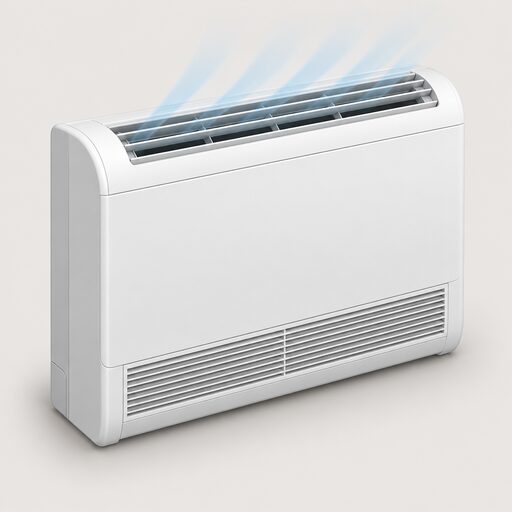 Split Air ConditioningA split air conditioning system cools or heats one room using an indoor unit and an outdoor unit linked by pipes.
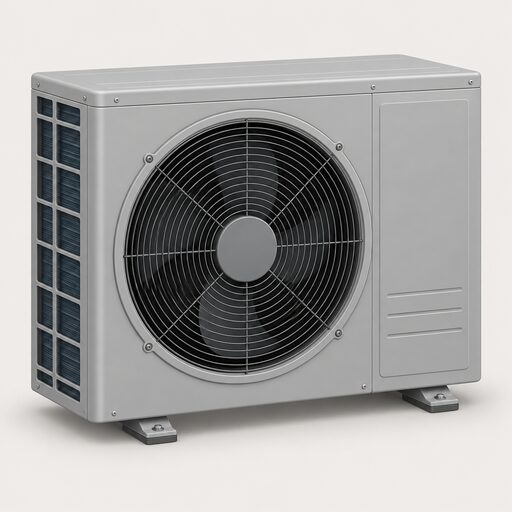 Cooling and Heat PumpsCan an air conditioner heat your home as well as cool it?
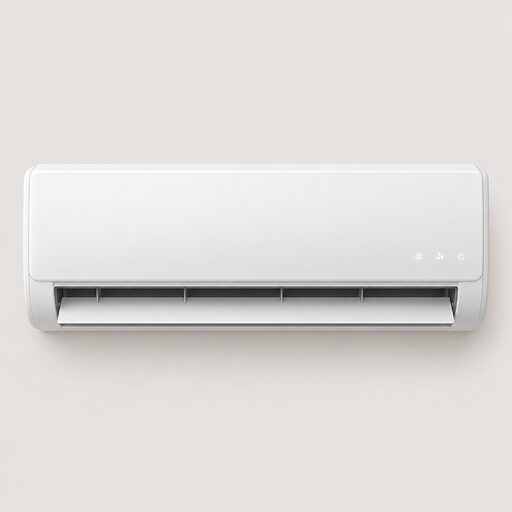 Air Conditioning CostPublished UK equipment prices and the parts of an installed price for portable, single split, multi-split and whole-house air conditioning.
 Planning Permission ScotlandHow Scottish permitted development rules treat external air conditioning and air-to-air heat pump units, where they differ from England, and the position for conservation areas, listed buildings and flats.
 Planning Permission EnglandExplains when an external air conditioning or air-to-air heat pump unit in England needs planning permission, and how permitted development applies.
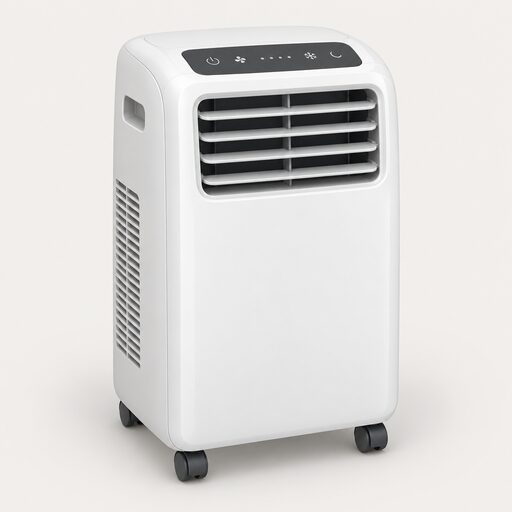 The Full Cooling and Air Conditioning GuideDo you really need air conditioning in a British summer, or would a fan and better shading do the job?