
In this guide
Fujitsu General sells split air conditioning into UK homes through wall-mounted and floor console indoor units, with cooling outputs spanning roughly 2.5 kW to 6.2 kW and a wider multi-split indoor line covering wall, floor, cassette and ducted formats1. The headline efficiency figures are strong: the floor console range's new 09 class is listed at SEER 8.50 for cooling and SCOP 4.30 for heating, ranking A+++ for cooling and A+ for heating3.
Noise is the other number buyers look for. The ABEG18KRTA ceiling-suspended unit runs at 31 dB(A) on its quiet setting and 38 dB(A) at high fan indoors, with the outdoor section at 50 dB(A) in cooling4. The smaller ASEH12KGTG wall unit is listed at 40 / 35 / 30 / 21 dB(A) across high, middle, low and quiet cooling speeds5.
Every unit in the current line uses R32 refrigerant at a global warming potential of 675, a figure confirmed both on the maker's product pages and in official consultation material4. That matters because the rules on which refrigerants may be sold in new split systems tighten from 2025 and again from 2029.
What Fujitsu General offers for UK homes
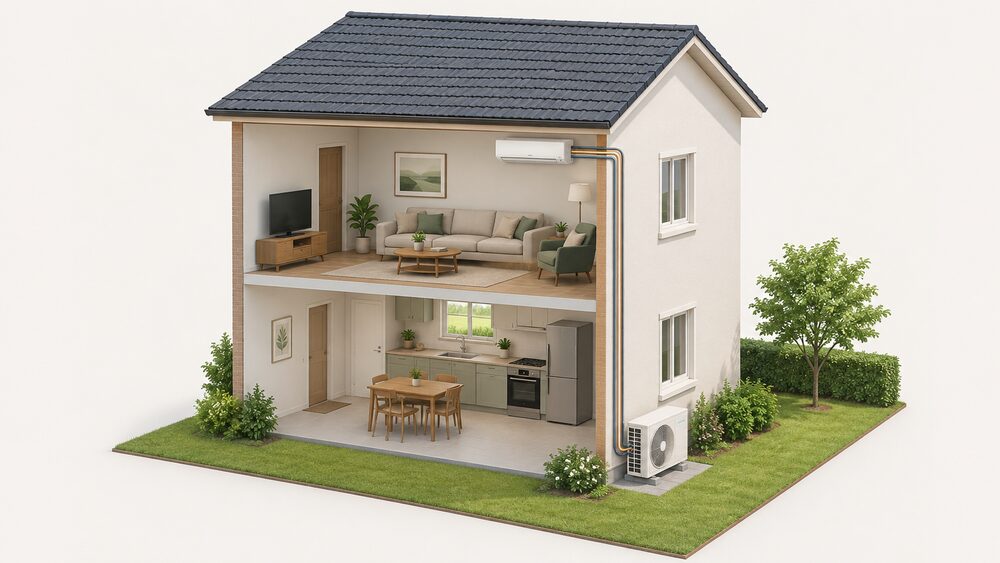
The core of the domestic offer is the split system: an indoor unit and an outdoor unit connected by wiring and piping, with no ductwork needed and professional installation required8. Fujitsu General describes the range as covering living rooms, bedrooms and children's rooms, including models with self-cleaning filters and models that clean the room air1.
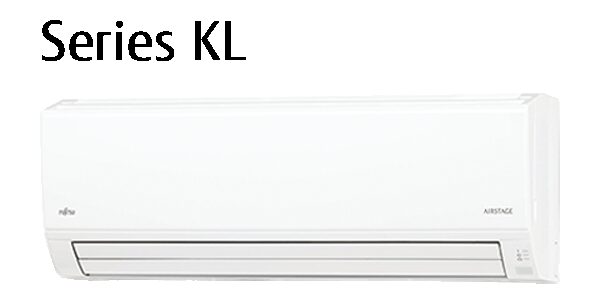
The wall-mounted format is the volume product. The ASEH12KGTG is a 3.5 kW wall-mounted type on a single phase 230 V supply, with net dimensions of 270 mm by 834 mm by 215 mm and a net weight of 10 kg5. Its pipe connections are 6.35 mm and 9.52 mm5. The larger ABEG18KRTA uses 6.35 mm and 12.7 mm pipework and delivers 5.2 kW of cooling from 1.550 kW of input power, with heating input of 1.620 kW and a heating design load of 4.4 kW at -10 °C4.
Beyond the wall unit, the multi-split indoor line lists wall mounted, floor, compact cassette, mini duct, slim duct, medium static pressure duct and ceiling connectable indoor unit types2. That breadth is what allows one outdoor unit to serve several rooms in different formats, which is covered in more detail on multi-split air conditioning.
For a household, the practical point is that Fujitsu General competes in the same wall-split territory as the other Japanese and Korean brands, and the choice between them usually turns on installer availability and price rather than on a decisive technical gap. The air conditioning brands page sets the range against its competitors.
The range at a glance: which model fits which room
Sizing guidance published in the sector maps output to floor area in a straight line. A 1.5 kW unit is given for about 12 m², 2.0 kW for about 16 m², 2.5 kW for about 20 m², 3.5 kW for about 30 m², 4.5 kW for about 40 m², 6.2 kW for about 50 m², 10.0 kW for about 80 m², 12.5 kW for about 100 m² and 14.0 kW for about 110 m²9. A 2.5 kW system is described as often suitable for smaller rooms such as compact bedrooms or small offices9.
Fixed wall-mounted air conditioning is described as usually better for regular use, especially in bedrooms, living rooms, offices and garden rooms, and can provide heating as well as cooling on many models9. That is the case for the Fujitsu wall range, which is a reverse-cycle heat pump rather than a cooling-only appliance.
| Output | Typical floor area | Format |
|---|---|---|
| 2.5 kW | about 20 m² | Wall split, small bedroom or office9 |
| 3.5 kW | about 30 m² | Wall split, ASEH12KGTG class5 |
| 5.2 kW | larger living space | Ceiling suspended, ABEG18KRTA4 |
| 6.2 kW | about 50 m² | Wall or floor console9 |
| 10.0 kW | about 80 m² | Larger open plan9 |
The table is a starting point, not a calculation. Glazing area, orientation, insulation and occupancy all move the required output, and the air conditioning sizing page sets out how a proper assessment is done. For a single room, the 2.5 kW vs 3.5 kW comparison covers the most common domestic decision.
Efficiency: SEER 8.50 and SCOP 4.30 at the top of the range
The efficiency figures published for Fujitsu General's floor console range are the strongest in the line. The new floor 09 class is listed at SEER 8.50 for cooling, ranking A+++ seasonal efficiency, and SCOP 4.30 for heating, ranking A+3. Those are seasonal figures, which model performance across a year of varying outdoor temperatures rather than at a single test point.
For comparison, an independent datasheet for a Carrier unit in the same domestic class lists SEER 6.2010. Official guidance for new dwellings in Wales sets a minimum seasonal energy efficiency ratio of 4.6 for air conditioning working in cooling mode11. The Fujitsu floor class figure sits well above both, though the comparison is not like for like: the Welsh minimum is a regulatory floor, not a market-leading figure.
The gap between SEER and SCOP is the normal pattern for a reverse-cycle unit. Cooling in a UK summer happens with a modest indoor-to-outdoor temperature difference, which flatters the cooling figure. Heating in a UK winter happens with a large temperature difference, which depresses the heating figure. A SCOP of 4.30 means that across a heating season the unit is modelled to deliver about 4.30 units of heat for each unit of electricity, which is the number that matters if the unit is being used as a heat pump rather than an air conditioner.
The air conditioning efficiency ratings page explains how SEER, SCOP and the energy label relate, and air conditioning that heats covers the reverse-cycle case in full.
Noise: from 21 dB(A) indoors to 55 dB(A) outdoors
Indoor noise is where the wall range performs best. The ASEH12KGTG is listed at 40 / 35 / 30 / 21 dB(A) across high, middle, low and quiet cooling speeds, with a sound power level of 56 dB(A) at high fan5. The quiet figure of 21 dB(A) is close to the noise floor of a quiet room.
Larger indoor units are louder, as the physics requires. The ABEG18KRTA runs at 38 dB(A) at high fan, 36 dB(A) at middle, 33 dB(A) at low and 31 dB(A) at quiet4. The ABEG22KRTA is listed at 31 dB(A) on quiet6, and the ABEG36KRTA at 44 dB(A) at high fan indoors7.
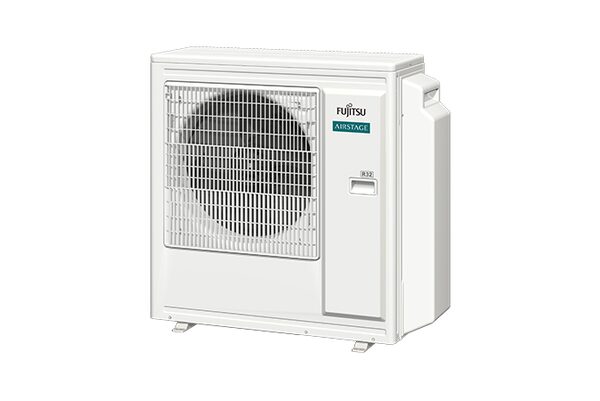
Outdoor noise is the figure that decides whether a neighbour complains. The ABEG18KRTA outdoor unit is listed at 50 dB(A) in cooling4, the ABEG22KRTA at 51 dB(A)6 and the AOEG36KBTB at 55 dB(A)7. Those are sound pressure figures at the stated test position, and they rise with capacity.
The air conditioning noise page covers the planning and neighbour dimensions, and the quietest air conditioning for a bedroom page deals with the night-time case.
Specifications and sizes: dimensions, pipe runs and electrical supply
The wall unit is a compact box. The ASEH12KGTG measures 270 mm by 834 mm by 215 mm and weighs 10 kg net5. Its pipe connections are 6.35 mm and 9.52 mm, and it runs on a single phase 230 V supply5. Airflow is listed at 700 / 560 / 430 / 270 m³/h across the four fan speeds5.
The larger ceiling-suspended ABEG18KRTA uses 6.35 mm and 12.7 mm pipework4. That step up in liquid line diameter is typical as capacity rises, and it affects the cost of the installation because larger pipework and longer runs cost more to fit.
The compact medium static pressure duct series takes a different approach to the outdoor side. Fujitsu General states that the outdoor unit in this series is smaller and lighter than a conventional outdoor unit and can be installed in tight spaces8. The indoor side of that series uses a V-shaped heat exchanger, an air stabiliser and a high efficiency DC fan motor to deliver efficient and quiet operation8.
Pipe runs, drainage and the electrical supply are the parts of a split installation that a household cannot assess from a datasheet. The air conditioning installation page covers the survey and commissioning process, and why there is a minimum pipe length explains a constraint that surprises many buyers.
Controls and smart features: occupancy sensing, weekly timers and WLAN control
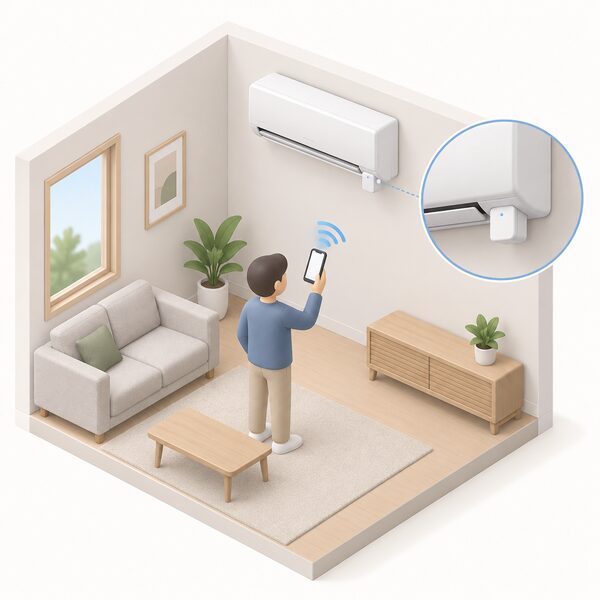
The ASEH12KGTG carries an occupancy sensor that detects the movement of people in the room and determines whether to switch to energy saving operation5. That is a genuine efficiency feature rather than a convenience one, because it removes the load when a room empties.
Remote control is optional and requires hardware. Fujitsu General states that the optional WLAN adapter enables the air conditioner to be operated by smartphone or tablet from outside the home5. The floor console range describes the same arrangement, with an optional wireless LAN adapter installed in the air conditioner allowing control from anywhere through the AIRSTAGE Mobile app3.
The ABEG18KRTA feature list includes economy mode, which adjusts a thermostat setting automatically according to room temperature to avoid unnecessary cooling, plus set temperature auto return, auto changeover, vertical swing louver, automatic fan speed, auto restart, a connectable fresh air duct, an auto-off timer, a weekly timer, a filter sign and an external ON/OFF input4. The compact medium static pressure duct series adds automatic airflow adjustment, which determines the airflow level required in each application and adjusts the airflow volume automatically8.
The air conditioning controls and Wi-Fi page covers the wider picture, including which wall-mounted units work with voice assistants.
Refrigerant: R32 at a GWP of 675
Every current Fujitsu General unit in this line uses R32. The ABEG18KRTA lists its refrigerant as R32 with a global warming potential of 6754. Official consultation material confirms the same figure, stating that R32 and R134a, two HFCs used in small heat pumps, have GWPs of 675 and 1430 respectively12. The same GWP of 675 appears on other makers' R32 equipment, which confirms it as a property of the gas rather than of the appliance13.
The regulatory direction is tightening. From 2025, F gases with a global warming potential above 750 are banned in single split systems that contain less than 3 kg of refrigerant14. R32 at 675 sits below that threshold, so current equipment complies. The next step is sharper: from 1 January 2029, only products containing a refrigerant with a GWP below 750 may be placed on the market for split systems above 12 kW, and only products with a GWP below 150 for split systems of 12 kW or less15.
That 2029 threshold of 150 is well below R32's 675, which means the domestic split market faces a further refrigerant transition. Official consultation material also notes a proposal to limit the size of air-to-air systems using flammable refrigerant to around 6.5 to 7 kW12, a constraint that would bear directly on larger domestic units.
What owning a Fujitsu split system means for household energy independence
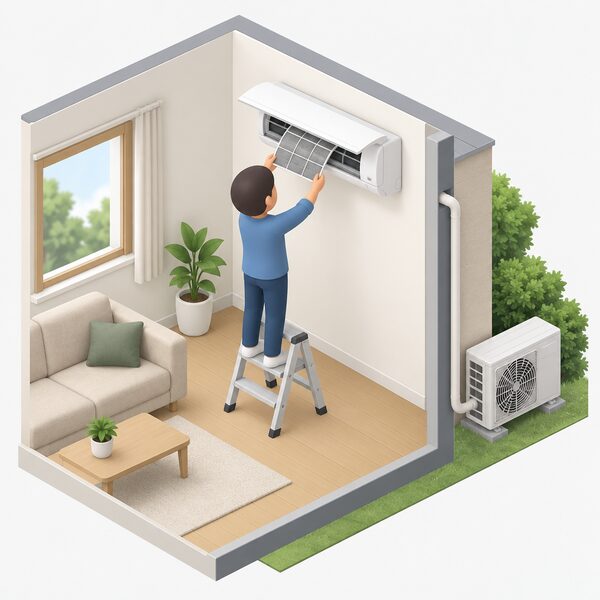
A split air conditioner is a heat pump, and that is the whole of its independence story. It moves heat rather than making it, so a unit with a SCOP of 4.30 delivers roughly 4.30 units of heat per unit of electricity across a heating season3. Against a resistive electric heater, which converts one unit of electricity into at most one unit of heat, that is a large difference in running cost and in the load a home places on the grid.
What it does not do is remove dependence. The unit runs on mains electricity from a supplier, so the household remains exposed to electricity prices and to the grid's carbon intensity. It does not use gas, which is a genuine change of fuel for a home that was heating with a gas boiler, but it substitutes one utility dependence for another rather than ending dependence.
The remote features add a further layer. Smartphone control requires the optional WLAN adapter, a broadband connection and the maker's app and servers3. Local control continues without any of that, but scheduling from away and remote diagnostics do not.
There is also a maintenance dependence. Official legislation requires that air conditioning systems are inspected by an energy assessor at regular intervals not exceeding five years16. Filter cleaning is a household task, and general safety guidance is to clean all filters regularly as per the manufacturer's instructions17. Running appliances at cheaper times is a separate lever that some households use to cut the cost of an electrically heated and cooled home17.
"Self-sufficiency was understood by participants as ultimately leading to cutting costs, which was another strong motivation."
That finding is about heat pumps rather than air conditioners, but the motivation transfers. The cooling and energy independence page develops the argument, and running air conditioning on solar panels covers the case where a household generates its own supply. For the wider context, the home cooling pillar sets out how split systems compare with the alternatives.
Sources18 cited
- Split air conditioners, Fujitsu General, 2026
- R32 multi-split indoor units, Fujitsu General, 2026
- Floor console split range, Fujitsu General, 2026
- ABEG18KRTA ceiling suspended unit, Fujitsu General, 2026
- ASEH12KGTG wall mounted unit, Fujitsu General, 2026
- ABEG22KRTA ceiling suspended unit, Fujitsu General, 2026
- ABEG36KRTA ceiling suspended unit, Fujitsu General, 2026
- Compact medium static pressure duct series, Fujitsu General, 2026
- Air conditioning size guide, Cool Easy, 2026
- Carrier 42QTD042D8S / 38QUS042D8S certificate, Eurovent Certification, 2026
- Approved Document L Volume 1 consultation, Welsh Government, 2025
- HFC phasedown reform de minimis assessment, Defra, 2025
- Compress 2000 AWF heat pump, Worcester Bosch, 2026
- Bans on F gases in new equipment, GOV.UK, 2025
- F-gas regulation for air to air heat pumps and air conditioners, Daikin UK, 2029
- F-gas and ozone regulation, inspection intervals, The National Archives, 2012
- Demand flexibility: running appliances at cheaper times, Electrical Safety First, 2026
- How the British population views heat pumps, Nesta, 2026