

In this guide
Nesta's heat pump research is one of the most frequently cited independent sources on what British households actually think about low carbon heating. Its largest single exercise surveyed 2,549 domestic heat pump owners and 1,025 domestic gas boiler owners in England, Scotland and Wales, with fieldwork between 13 and 31 December 20221. Among owners who had a heat pump installed while living in their current home, 81% reported being as satisfied or more satisfied compared with their previous heating system2.
The work has since widened. Nesta grouped the population of Great Britain into eight segments based on their relationships to heat pumps, built with Experian, and ran AI-powered interviews with 25 participants from each segment between October 2025 and February 20264. Its headline finding is that cost, comfort and confidence remain the three guiding principles across every segment, with cost the overriding priority6.
For a household weighing energy independence, the research is useful less as a verdict on the technology than as a map of who adopts it, what stops them, and who they believe. It also sets out plainly where the evidence is thin: several projects are small, pilot-stage or unfinished.
Eight consumer segments: who the research says buys heat pumps
Nesta's segmentation study grouped Great Britain's population into eight segments, labelled Segment A to Segment H, based on their relationships to heat pumps4. The segments were developed with Experian through advanced clustering of Mosaic groups, enriched with additional data, and Nesta describes them as bespoke profiles rather than a general read on public opinion6. The point of the exercise is stated directly: treating the population of Great Britain as a homogenous group when speaking about heat pumps is not going to result in the outcomes anyone wants6.
The segments matter commercially because they identify where advice lands. Nesta's separate readiness work names three groups in a good position to make their homes heat pump ready: homebuyers, renovators, and owners of older boilers9. Those are moments when a household is already making decisions about the fabric and heating of a home, rather than being persuaded cold.
One published segment, Segment B, covers techie young families. Within it, 32% cited installation costs as the biggest barrier to getting a heat pump10. That single figure illustrates the pattern across the research: even among younger, more digitally engaged households, upfront cost dominates.
The segmentation also underpins message testing. Nesta ran social media message testing from February to April 2026 using Meta audience profiles built with Experian, so the segments are being used to test how heat pump messages perform with specific groups rather than the public at large4.
For a household, the practical value is diagnostic. If a home is not in one of the readiness groups and cost is the binding constraint, the research suggests information alone will not move the decision. The data behind the segments is not open: access runs through Experian, either by discussing a licence or through an existing Experian Account Manager6.
Motivators and barriers: self-sufficiency versus cost
Nesta's summary of its segmentation work is unusually blunt about what drives adoption. Self-sufficiency is the strongest motivator, and cost is the biggest barrier6. Those two forces pull in opposite directions, and the research shows the tension repeatedly.
The cost barrier is consistent across sources and methods. Ofgem's 2025 tracking of consumers using low carbon and flexible products found cost remains the main barrier to adopting electric vehicles, heat pumps and solar panels11. Which?'s 2024 sustainability report found that the motivating factor most likely to encourage homeowners without a heat pump to install one was saving money on energy bills, at 34%12.
In Nesta's own stated preference experiment, of 5,025 participants who completed the task, 13% (n = 643) selected a heat pump, and among those who did not, the cost of installing the heating system and the running costs were most commonly selected as the top reasons, at 47% (n = 2,071)13.
| Reason selected as top, among those who did not choose a heat pump | Share |
|---|---|
| Installation cost and running costs | 47% (n = 2,071)13 |
Among those who did choose a heat pump in that experiment, running costs, carbon emissions and future-proofing the home were most often selected as the top reasons, with running costs at 28% (n = 181), future-proofing at 24% (n = 151) and installation costs at 17% (n = 112). Installation time was least often selected, at 8% (n = 50)13. Income shapes selection too: among participants with an income under £17.5k, 11.6% (81 of 701) selected a heat pump13.
The gender split in Nesta's 2025 poll is modest but consistent. Men were slightly more likely (45%) than women (42%) to consider installing a heat pump, and more women (40%) than men (28%) said they had heard of heat pumps but did not know what they were14. Sustainability as a factor was reported by 31% of women and 27% of men14.
Cost, comfort and confidence: the guiding principles
Nesta reduces its findings to three principles: cost, comfort and confidence, with cost the overriding priority6. The ordering is not arbitrary. Cost is the barrier that appears in every dataset, comfort is the concern that generates the rumours, and confidence is what determines whether a household acts on either.
The comfort concern is specific. Nesta's earlier adoption work found rumours circulating that heat pump units are noisy and that homes with heat pumps never get warm on the coldest days, alongside a general lack of knowledge about semi-continuous, low-temperature heating15. Those are not abstract worries; they are expectations about how a home will feel, and they are formed before any installer visits.
Confidence is where the research is most pointed. Nesta found a general lack of trust in tradespeople, a preference for personal recommendations or longstanding brand names, and households scarred by previous schemes, for instance solar PV installations, where householders have been ripped off15. Its later clean heat neighbourhoods work reached the same conclusion from a different direction: the overall theme is dealing with someone you trust, having confidence in the people doing it16.
The cost picture is complicated by what a quote does not include. Nesta's own heat pump cost estimator cannot access any information beyond what users enter, and factors including required upgrades to radiators, piping, or electrical systems may not be fully accounted for17. That is a limitation of a tool, but it reflects a real feature of the market: the number a household first sees is rarely the number it pays.
"Cost, comfort and confidence remain the three guiding principles across our segments, with cost being the overriding priority"
Who households trust: messengers and lived experience
Nesta's finding on trusted messengers is narrow and practical. Independent, consistent advice through respected neutral parties such as Which? and Money Saving Expert are critical sources, alongside forums and people with lived experience of heat pumps6. The research does not identify installers or manufacturers as the primary trusted voice, which is a notable gap given that both are central to the transaction.
Lived experience carries particular weight because so few households have any. In Nesta's 2025 poll, 11% of men and women knew someone with a heat pump14. That is the constraint the Visit a Heat Pump scheme exists to address: Nesta runs the service that allows people to host visitors to help them understand how low carbon technology could work in their own home18. More than 1,200 people had registered their homes by April 2026, two years after the scheme launched in April 20247. Nesta has described the scheme as currently at pilot stage19.
The household decision-making pattern differs by gender in ways that affect how information spreads. Women homeowners with gas heating were more likely to lean on the expertise of their household members (18%) than men (12%), and more likely to consult family (20%) than men (14%)14. Men were more likely to have discussed installing a heat pump with friends, families and neighbours, at almost a quarter (24%), compared with 20% of women14.
Nesta's visibility pilot tested a blunter approach: physical signs. It surveyed over 200 Visit a Heat Pump hosts and found 65% of homeowners were positive towards the idea of a heat pump sticker on their property20. The pilot identified four main stakeholder groups alongside homeowners: heat pump installers, the retail sector, social housing associations, and local authorities20.
The evidence base: surveys, interviews and smart meter analysis
The research spans methods, and the sample sizes vary enormously. The largest exercise remains the Eunomia survey of 2,549 heat pump owners and 1,025 gas boiler owners, fielded between 13 and 31 December 20221. Nesta's segmentation interviews covered 25 participants from each of the eight segments, run as AI-powered WhatsApp conversations between October 2025 and February 20264. Its readiness work spoke with 14 homeowners across the UK and user-tested a prototype with five people9. The visibility pilot drew on eight semi-structured interviews, a survey of over 200 hosts, 49 host responses and 12 follow-up responses20.
| Study | Method | Sample |
|---|---|---|
| Owner survey (Eunomia) | Survey | 2,549 heat pump owners and 1,025 gas boiler owners1 |
| Segmentation interviews | AI-powered WhatsApp conversations | 25 participants from each of eight segments4 |
| Readiness work | Interviews and prototype testing | 14 homeowners; five prototype testers9 |
| Visibility pilot | Interviews and host survey | Eight interviews; over 200 hosts; 49 and 12 follow-up responses20 |
| Early adoption research | Qualitative interviews | 15 owner occupiers and six installers21 |
| Remote control trial | Smart meter trial | 43 volunteer homeowners22 |
| Planning analysis | In-house AI tool | Nearly 20,000 applications from 260 council websites23 |
The qualitative work is older and smaller. Nesta's early adoption research interviewed 15 owner occupiers who had recently installed a heat pump and six heat pump installers21. Its clean heat neighbourhoods work took a participatory approach grounded in activity-based research24.
The consumption side uses smart meter data rather than surveys. Nesta's remote control trial recruited 43 volunteer homeowners, contacting Octopus Energy customers in three geographical areas where Octopus Energy Services could install the necessary equipment; half had their heat pumps remotely controlled for four-hour windows22. The trial reported an average 32% reduction of typical household electricity consumption (0.123 kWh per half-hour across a two-hour window) and an average 74% reduction of typical heat pump electricity consumption (0.382 kWh per half-hour across a two-hour window)22.
Nesta has also applied machine analysis to planning data. It built a custom in-house AI tool to access nearly 20,000 online planning permission applications in England, Wales and Scotland, drawn from 260 council websites across Great Britain, with the tool achieving around 85% accuracy in a sample checked by humans23. The analysis found planning delays that usually delay the process by weeks and occasionally months23.
Air-to-air heat pumps and other current projects
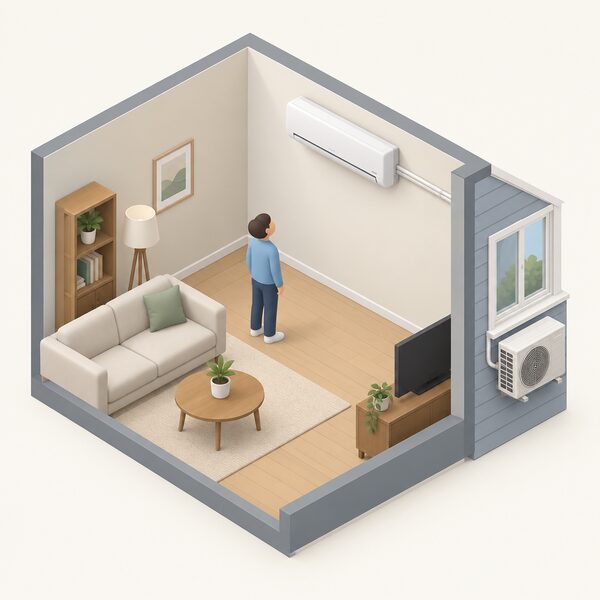
Nesta's air-to-air heat pump project focuses on evaluating the real-world suitability, practical installation challenges and benefits of these units, and on understanding more about the potential impact of air-to-air on grid capacity and emissions as they become year-round heating and cooling solutions25. The study drew on interviews with homeowners, HVAC engineers and industry professionals, and on a review of forum discussions, manufacturer datasheets and scientific papers8. Sixteen homeowners shared their time and experiences for the research8.
The policy context has moved. Air-to-air units are now included within air source heat pump permitted development rights, as long as they are used for heating, not just cooling26. Air-to-air heat pumps are now eligible for government grants5. The government's own literature review summarises the opportunities and challenges faced by air-to-air heat pumps in the UK27. Northern Ireland has separate provision: new permitted development for domestic air-source heat pumps18.
Other current work is more tentative. Nesta's project on developing support interventions for social housing tenants with heat pumps did not proceed as planned: Nesta was not able to identify a partner to work with on this project, and will look at identifying new projects that could support this area of work28. Its clean heat neighbourhoods research asks how to build confidence in clean heat neighbourhoods, how household preferences divide between what is collective and what is individual, and how to communicate information about the technology proposed for each home in a way that builds confidence29.
The cost estimator is the most directly usable output for a household. It enables integration with partners' own web pages and tools, but cannot access any information beyond what users enter17.
What the research means for household energy independence
Read as a whole, Nesta's work describes a household deciding about heat on three axes, and only one of them is technical. Cost is the overriding priority across every segment6. Comfort concerns are about whether a home stays warm and quiet15. Confidence is about who does the work and whether the household trusts them16.
That has a direct bearing on independence. A heat pump moves a home off gas for heating, but it does not remove dependence: it substitutes a gas supplier for an electricity supplier, and adds a dependence on whoever installs and services the system. Nesta's finding that households prefer personal recommendations or longstanding brand names, and carry scars from previous schemes, is a statement about how fragile that installer relationship is15.
The research also shows how thin the lived-experience base is. With 11% of men and women knowing someone with a heat pump, most households are deciding without a nearby example14. The Visit a Heat Pump scheme is a direct response, and its scale, more than 1,200 registered hosts by April 2026, is small against the housing stock7.
On running costs, the evidence is more favourable than the barrier data suggests. Two thirds (67%) of heat pump owners and 59% of gas boiler owners said they were satisfied with their running costs2. Among owners who previously used electric heating, oil or LPG boilers, over 80% were as or more satisfied with their heat pumps2. Even among those moving from gas boilers, 75% were as or more satisfied2.
The coordination burden is the least discussed finding and possibly the most consequential. Nesta's readiness work identified a deeper challenge it calls coordination fatigue, the effort a household expends managing a project that spans fabric, heating, installer and paperwork9. For a household pursuing independence, that is the real cost: not the unit, but the coordination.
Sources29 cited
- Heat pumps: a user survey, Nesta, 2023
- Heat pumps get thumbs up from British owners across all property types in first major survey, Nesta, 2023
- What it's really like to have a heat pump, Which?, 2022
- Methodology, Nesta, 2026
- How the British population views heat pumps, Nesta, 2026
- What our research means, Nesta, 2026
- More than 1,200 heat pump owners have registered with Nesta's Visit a Heat Pump scheme as it celebrates two years since launch, Nesta, 2026
- Air-to-air heat pumps: a low carbon solution for UK homes, Nesta, 2026
- What we learned from households, Nesta, 2026
- Segment B: Techie young families, Nesta, 2026
- Tracking energy consumers' use of low carbon and flexible products and services 2025, Ofgem, 2025
- Sustainability report 2024: home insulation and heating, Which?, 2024
- Understanding the public view on hydrogen boilers, Nesta, 2023
- Forget the thermostat wars, now men are pushing for heat pumps, Nesta, 2025
- How sector innovators can speed heat pump adoption, Nesta, 2022
- What did we do?, Nesta, 2025
- A calculator to estimate the cost of a heat pump, Nesta, 2025
- Heating oil households lined up for cheaper heat pump installations and savings of over £650 a year when switching under new government deal, Nesta, 2026
- Monitoring your heat pump's performance, Centre for Alternative Technology, 2025
- Increasing heat pump visibility through public signs, Nesta, 2024
- How understanding user journey heat pump adoption will generate innovation, Nesta, 2021
- Remote control operation of heat pumps can save money and carbon for households, Nesta, 2024
- Money down the drain: consumers across Great Britain spend millions on unnecessary heat pump planning permissions, analysis suggests, Nesta, 2026
- What do households want from clean heat neighbourhood schemes?, Nesta, 2025
- Air-to-air heat pumps, Nesta, 2026
- Planning guidance: heat pumps, Richmond Council, 2026
- Air-to-air heat pumps: literature review, GOV.UK, 2025
- Developing support interventions for social housing tenants with heat pumps, Nesta, 2026
- Improving the heat pump experience, Nesta, 2022