
In this answer
Short answer
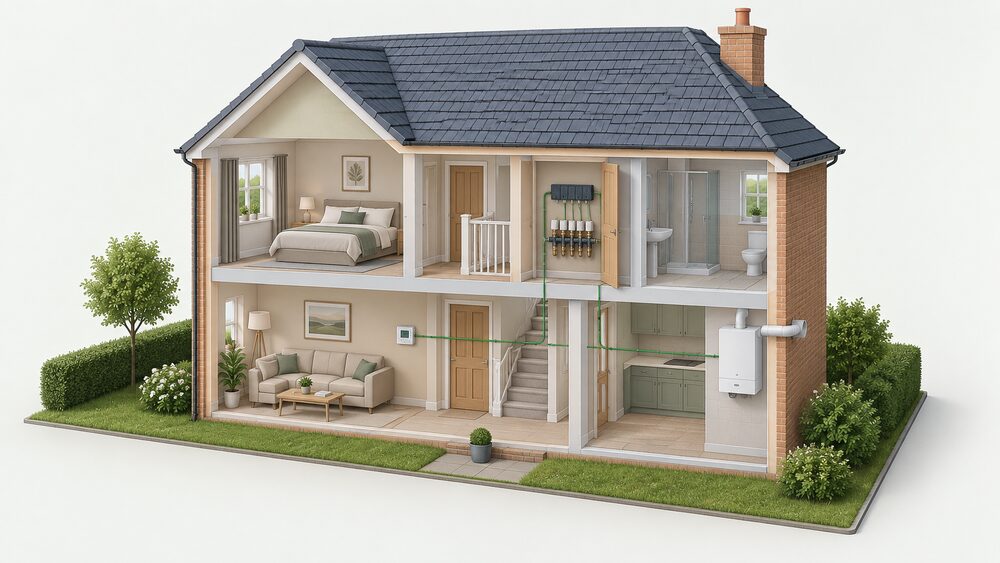
KNX is an open, wired building-control standard used in UK homes to run heating, hot water, lighting, blinds and other services from one system. It is not a thermostat you buy in a box: it is a specification that an integrator designs, installs and commissions, with devices from different manufacturers sharing a single bus. For heating, that means central and automatic control, timed operating modes, occupancy detection, weather-dependent control, individual room zoning, valve and fan coil control, floor heating control and boiler control, all listed as functions of a KNX installation in a Highlands case study1.
The appeal for a household is local operation. KNX devices talk to each other on the wiring, so heating keeps running when the internet drops, and there is no subscription standing between the household and its own radiators. The trade-off is that KNX is a professional installation, priced per project, with no published UK price for a domestic heating system. It suits homes being built, renovated or rewired, where the cabling can be planned in, rather than a quick swap of an existing thermostat.
This page covers what KNX does in a UK home, how local control works, what it can automate beyond heating, the current standard, what it means for energy independence, and how KNX homes are actually built.
What KNX heating control is and how it works in a UK home
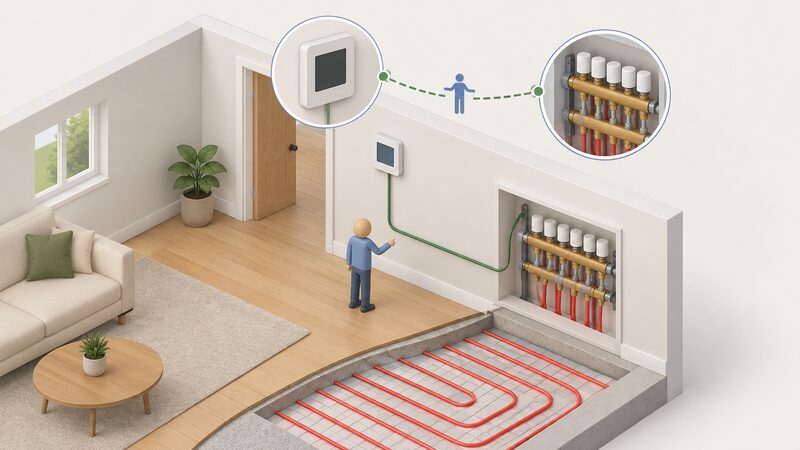
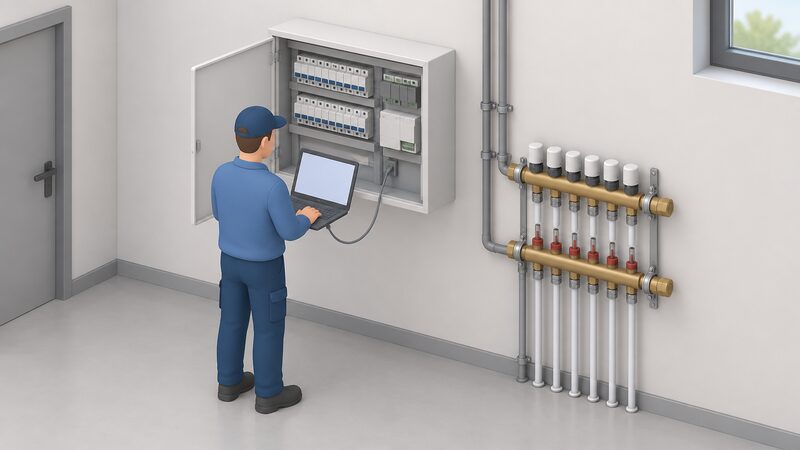
Heating controls exist to govern when a system runs and how warm each room gets, and KNX does that job through a wired bus rather than a single wall unit6. In a KNX home, sensors, room controllers, actuators and the boiler interface are separate devices on one network. A room temperature control unit reads the room, an actuator opens or closes the circuit to a zone valve or manifold, and the boiler or heat pump is told when to fire. The Highlands case study lists the full set of functions a KNX system can carry: central and automatic control, timed operation modes, automatic occupancy detection, weather dependent control, individual room or zone control, valve drive and fan coil control, floor heating control, and boiler and burner control1.
That structure is what separates KNX from a conventional setup. Zoning, which lets a household control the temperature of individual rooms, and programmable thermostats that keep a home heated to a schedule, are both established ways to cut bills7. KNX builds those functions into the fabric of the building rather than bolting them onto a single radiator or hallway. The practical result is that a KNX home can hold different temperatures in different rooms at different times of day, and can react to weather rather than only to a clock.
For a UK household, the fit is best where the wiring is being planned anyway: a self-build, a deep renovation, or a rewire. Official self-build guidance recommends installing smart systems that control lighting, heating and cooling based on occupancy and time of day, which is precisely the pattern KNX is designed around8. Retrofitting KNX into a finished house is possible but depends on cable routes, and it is a commissioning job rather than a consumer purchase.
Local control: why KNX runs without the cloud
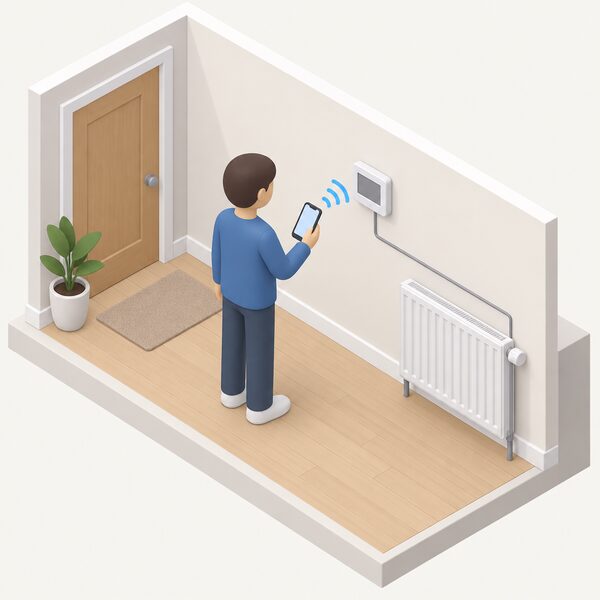
The defining feature of KNX for a household worried about dependence is that the control logic sits in the building. Devices communicate locally without the cloud, ensuring continuity even when offline, which is how one maker describes the local-first approach now spreading across smart home devices3. The same principle appears in simpler products: a programmable room thermostat that needs no Wi-Fi for local control of heating via an app using Bluetooth9. KNX takes that idea furthest, because the bus itself carries the commands, not a server.
This matters because cloud dependence is a real failure mode. Smart heating controls are defined by being connected to the internet and offering more functionality than conventional controls, and that connection is also their weak point when a service ends or a network fails10. A KNX heating circuit does not stop because a manufacturer's server is down or a subscription lapses.
There is a second, quieter advantage: load control. The Radio Teleswitch service, which has switched heating loads for decades, cannot vary heating load time without varying peak and off-peak times, a limitation that has driven its retirement11. A local control system that can decide when to run a heat source, a cylinder or a storage heater is a more flexible instrument than a one-way switching signal. KNX is one route to that, because the logic is programmable on site and does not depend on an external broadcast.
What remains dependent is the energy itself. A KNX home still draws gas or electricity from a supplier, and the grid still sets the carbon intensity and the price. Local control changes when and how much a household uses, not where it comes from.
What KNX can automate beyond heating, including EV charging
KNX is a building-control standard, not a heating-only product, and its scope is set by the actuators and interfaces an integrator fits. One KNX home automation range includes blind and switch actuators, dimming actuators and room temperature control units, with support for HVAC, garden sprinklers, lighting, curtains and blinds12. That breadth is the point: the same bus that opens a zone valve can raise a blind, dim a circuit or run a ventilation unit.
Electric vehicle charging and load management sit in the same family of functions. KNX project pages describe installations that combine energy management, photovoltaic generation with battery storage and electric vehicle charger integration, and others where heating logic and electrical load supervision were added to an existing system. The pattern is a controller that knows what the house is doing and can sequence loads rather than let them collide.
For electric heating specifically, the control question is different from gas. Storage heaters with automatic charge control regulate how much energy is used by storing more or less heat at night, and that decision is exactly the kind of thing a building controller can make on the household's behalf13. Night storage heaters cost £200 to £800 per heater depending on type, and high heat retention models £400 to £800 per heater, so the control layer is a small part of the capital cost but a large part of the running cost14.
KNX Standard v3.0.5: the current specification

KNX published version 3.0.5 of its standard on 15 September 2026, the current reference point for new specifications2. The standard is versioned and revised over time, and the version number matters to a household only indirectly: it determines which device profiles, functions and interoperability guarantees a product carries. A device built to the current standard should interoperate with others on the same bus, which is the whole reason an open standard exists.
The wider regulatory picture around heating controls is moving at the same time. Approved Document L, which governs the conservation of fuel and power in dwellings, sets the compliance framework for new and altered heating systems in England, with a parallel consultation version for Wales5. Under the Boiler Upgrade Scheme standards, Issue 2.0 of the Microgeneration Installation Standard MIS 3005-D, the Heat Pump Standard (Design), is the document that heat pump design must follow16. None of these name KNX, but they set the performance and commissioning expectations that any control system has to meet.
Where a KNX installation touches a heat pump, the design has to respect the appliance's own requirements. Variable capacity control heat pumps have a minimum modulation rate tied to the design flow temperature, with 55°C cited where EN 14825:2018 test data has been provided for a design flow temperature of 55°C17. A control system that cannot modulate down to that level will cycle the appliance rather than run it efficiently, which is why the interface between KNX and the heat pump matters more than the bus itself.
"Install and commission the system to the standards set out in this approved document"
Who can install and commission a KNX system
KNX work is carried out by trained integrators rather than general electricians working from a wiring diagram. The UK case studies name specialist firms: Function Control Ltd provided KNX design and commissioning services for the integration of a complex lighting scheme, heating control and motorised blind control in a luxury home renovation in Edinburgh, and designed a KNX system to control and monitor all aspects of a high specification building in the Highlands18. That is the shape of the trade: design, commissioning and integration, not a product sale.
Where the work falls under building regulations, the duties are explicit. The installer should install and commission the system to the standards set out in the approved document, and should give notice to the building control authority that commissioning has been carried out in accordance with it5. For underfloor heating, all installed equipment should be commissioned in accordance with BS EN 1264-415. These are the same obligations that apply to conventional heating controls, and they apply whether or not the system is KNX.
For a household, the practical question is who holds the design. A KNX system is only as good as its commissioning: zones that are not balanced, actuators that are not addressed, or a boiler interface that is not configured will underperform regardless of the standard behind them. The installer's competence, not the logo on the devices, is what determines whether the system delivers.
What KNX means for household energy independence
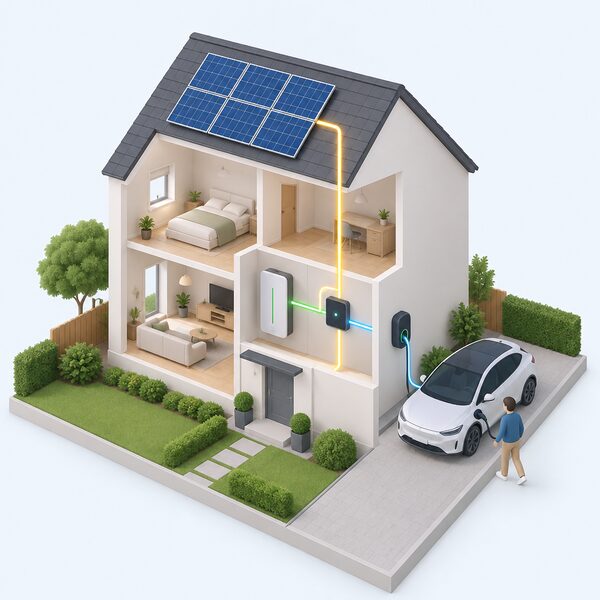
Energy independence for a household means controlling when and how much energy it uses, and reducing the number of external parties that can interrupt that control. KNX contributes on both counts. The control logic is local, so the heating runs without the internet3. The system can coordinate heating with generation and storage, as in KNX projects that combine energy management, photovoltaic generation with battery storage and electric vehicle charging. And it can supervise electrical loads so that a house does not draw more than it should at once.
What it does not change is supply. A KNX home still buys gas or electricity, still depends on the grid, and still depends on the manufacturer of every device on the bus for firmware and support. The standard is open, which limits lock-in at the protocol level, but the devices, the commissioning software and the integrator are all specific to the installation. If the integrator stops trading, the household needs another one who can read the project.
There is also a funding dimension. ECO Flex provides funding for energy efficiency improvements such as a new central heating system, upgrades to the existing heating system or insulation, and whole house solution schemes in Northern Ireland provide an upgraded heating system to a less carbon intensive fuel with full heating controls including smart controls19. Northern Ireland's one-stop shop service is designed to gatekeep different energy efficiency programmes, including NISEP, to guarantee impartiality and quality21. None of these schemes is KNX-specific, and none should be assumed to fund a KNX installation.
Case studies: how KNX homes are built in practice
The UK evidence for KNX in homes is thin but specific. The Highlands project is the clearest: a high specification building where a KNX system controls and monitors all aspects of the home, with the full function list set out earlier1. The Edinburgh renovation shows the integration side, with lighting, heating and blinds on one commissioned system18. Both are bespoke installations in higher-value properties, which is where the economics of a wired control system currently work.
Beyond the UK, KNX project pages describe a family house with advanced energy management, photovoltaic generation with battery storage and electric vehicle charging, a villa where a partially functioning heating installation was restored to full capability with heating logic and electrical load supervision added, and a farmhouse converted into an automated building using components from a single manufacturer. These are international examples and are included because the UK record is limited; they show the range of what the standard supports rather than what a UK household should expect to pay.
For households wanting to see real installations before committing, the Scottish Home Renewables Service runs a Green Homes Network where case studies from homeowners who have installed renewables can be viewed23. That is a route to seeing how control systems sit alongside heat pumps and solar in occupied homes, rather than in a showroom.
The wider pattern in social housing decarbonisation research is that most case studies installed air source heat pumps, which puts the control question at the centre of the retrofit rather than at its edge24. A heat pump needs a control system that can modulate, zone and schedule; whether that system is KNX or something else is a design decision, and the evidence base for KNX specifically in UK social housing is not there yet.
Sources24 cited
- Energy Efficient Home, Highlands, Scotland, KNX Association, 2026
- KNX Standard v3.0.5 release, KNX Association, 2026-09-15
- Matter smart home devices, tado°, 2026
- Tips to improve the EPC rating of your home, Energy Saving Trust, 2026-08-03
- Approved Document L, Volume 1: Dwellings, HM Government, 2026
- Thermostats and heating controls, Home Energy Scotland, 2026-09-20
- Underfloor heating system, NICEIC, 2026-09-17
- Self-build homes: sustainability, Planning Portal, 2026
- H3747 programmable room thermostat, Secure Meters, 2026-02-27
- Thermostats and heating controls, Energy Saving Trust, 2026-02-10
- Radio Teleswitch, Energy Networks Association, 2026-09-17
- Home automation, Schneider Electric, 2026-09-17
- A guide to using electric storage heater controls, Energy Saving Trust, 2026-05-21
- Electric heating advice, Centre for Sustainable Energy, 2026-06
- Approved Document L, Volume 1 consultation version, Welsh Government, 2025-08
- Boiler Upgrade Scheme: notice of standards, HM Government, 2026-07-21
- Modelling Heat Pumps within the Home Energy Model, HM Government, 2026-01
- Luxury Home Renovation, Edinburgh, KNX Association, 2026
- Energy efficient home, Swansea Council, 2026-08-25
- Energy grants Northern Ireland, Energy Saving Trust, 2026-09-17
- Decarbonisation in Northern Ireland: the potential of a one-stop shop, Energy Saving Trust, 2025-10-01
- Revised Decent Homes Standard, Energy Saving Trust, 2026-04-13
- Scottish Home Renewables Service, Energy Saving Trust, 2026-02-20
- Social housing decarbonisation case studies summary report, ClimateXChange, 2024-08-13
 Which Homes Suit a Heat PumpMost UK homes can have a heat pump fitted, so the real question is whether yours makes it easy or expensive.
 The Full Heat Pumps GuideWill a heat pump keep my house warm in winter, and what does one cost to buy and run?
 Smart Thermostats ExplainedWhat does a smart thermostat actually do, and is it worth it?
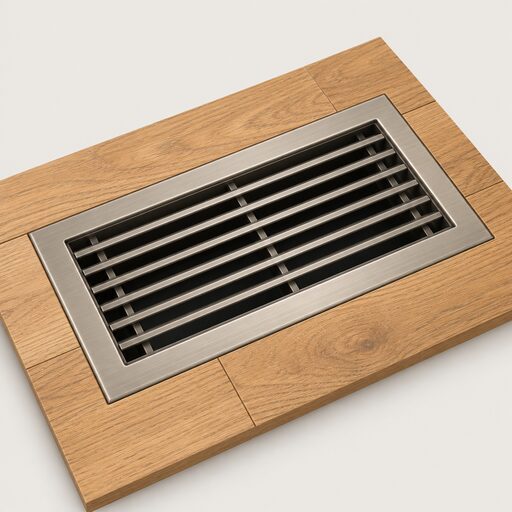 Warm Air Heating SystemsWarm air heating works by pushing heated air through vents in your floors or walls.
 The Full Heating Controls GuideA room thermostat, a programmer and valves on your radiators are the basics.
 UK Cooling DemandPublished data on air conditioning ownership and home overheating, with projections for summer temperatures in each UK nation, and what rising cooling demand means for summer electricity use.