In this guide
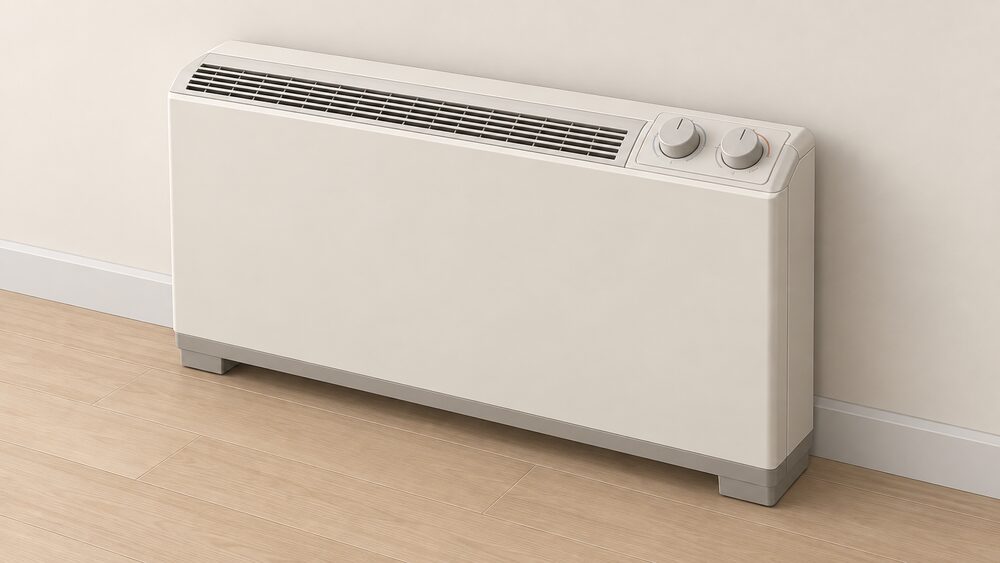
A storage heater has two jobs to do with one store of heat: decide how much electricity to take overnight, and decide how fast to let that heat out during the day. On older heaters those two decisions sit with the household, through an input dial and an output dial. On modern high heat retention units the first decision is taken automatically, using sensors and a programmer, and the household is left with a thermostat setting and a routine.
The controls matter because the heat is bought at one price and used at another. Storage heaters store heat generated from cheaper nighttime rates acquired on Economy 7 or Economy 10 tariffs1. Get the charge right and the day is covered from cheap units. Get it wrong in either direction and the household either runs out of heat by mid-afternoon or pays for stored heat it never uses.
What the controls do: input, output and the charge decision
A storage heater normally has at least two controls: one regulates how much electricity is used to determine how much heat is generated for storage, and the other controls how much heat is released6. Manual storage heaters consist of two main controls, input, which regulates the amount of heat that the heater stores, and output, which controls how fast heat is released7.
The input or charge control regulates the amount of heat that is stored up during the night. It is set higher in cold weather and turned down or off in warmer weather2. On a manual heater the household sets the input dial to decide how much heat to store: higher input means hotter bricks and more heat for the next day1. The higher the input, the more electricity the storage heater will use and the more heat it will store1.
The output or boost control regulates the rate at which the stored heat is released. It is left on a low setting during the day and turned up in the evening if more heat is needed2. Older heaters release heat continuously, and the output dial controls the flow; the higher the output setting, the quicker the heater releases its stored heat1.
That is the whole control system on a traditional unit: one dial for the purchase, one for the spend. Everything a modern heater adds, sensors, programmers, apps, is an attempt to make the first decision without the household having to think about tomorrow's weather.
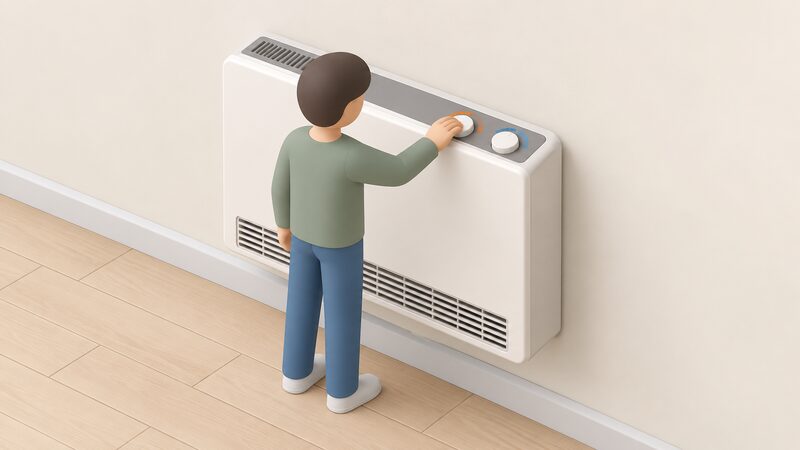
Input and output dials: how older manual controls work
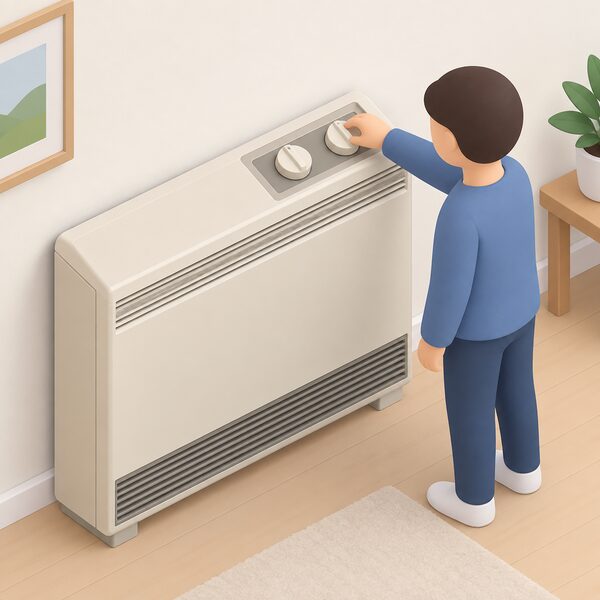
Older storage heaters use input and output dials to control heat8. An input dial, sometimes known as charge, controls how much heat the heater stores as it charges overnight. An output dial controls how much heat the heater releases during the day1. Some models add a third control, a boost setting, which is a different thing entirely and is covered below.
The practical difficulty with manual control is that the setting has to be made in advance, on a guess. Storage heaters need to charge the night before, and any changes to the input will not take effect until the next day9. A cold snap forecast for tomorrow has to be anticipated tonight, and a mild day means heat stored that will not be needed.
There is one consolation in the design. Most storage heaters will only charge up at night, so the input setting can be left without danger of using expensive day-rate electricity10. The charge circuit is the safeguard: the heater cannot draw peak-rate power through the input dial even if the dial is left high.
Manual storage heaters have been phased out and replaced by more efficient, automatic models3. That does not mean every manual heater in a UK home has gone, but it does mean replacements and new installations are automatic by default, and the dial-based routine described here is a legacy skill rather than a current design.
The overnight charge: how the off-peak circuit and meter control charging
Storage heaters charge during off-peak hours when electricity is cheaper, usually overnight1. Night storage heaters are set to charge up at night11. The heater itself does not decide when that window opens; the meter and the tariff do.
Economy 7 requires a special multi-rate meter to be installed at the home12. The meter has two sets of numbers, one marked low, which means night, and normal, which refers to today13. The cheaper Economy 7 time period runs for a seven-hour period at some point between 11.00pm and 8.00am, and the regional network operator, the company responsible for physically supplying electricity to the property, defines the exact hours14. Some variations offer 8.5 or 10 hours15.
This is the part of the system a household has least control over. The charge window is a property of the supply, not the appliance, and it can shift by region. A heater that charges fully between midnight and 7am in one area may be working to different hours a few miles away.
The tariff behind the controls: Economy 7 and Economy 10 off-peak windows
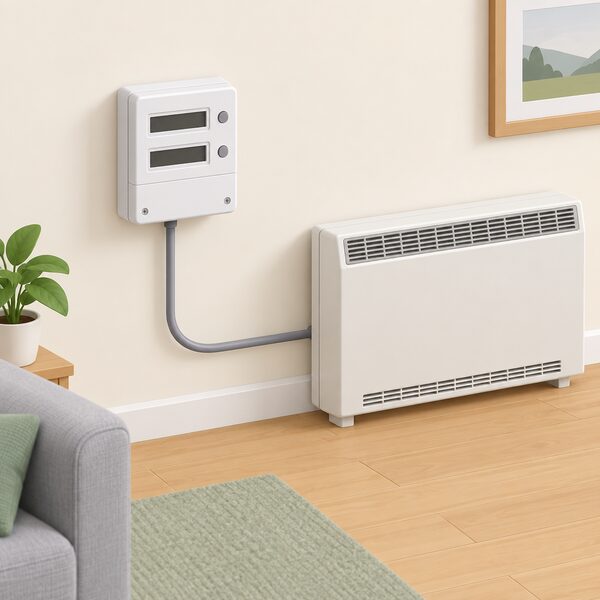
Economy 7 is a time-of-use electricity tariff that charges two different prices for the electricity used, giving a set number of hours of cheap electricity through the night with daytime electricity charged at a higher peak rate16. It is a dual rate tariff with two distinct electricity rates8. For energy customers who have electric storage heaters, the Economy 7 tariff is an ideal option as they can be heated overnight and used to give off heat the following day13.
The economics depend on how much of the household's electricity lands in the cheap window. For Economy 7 to be economical, at least 40% of electricity should be used at night2. A separate rule of thumb puts the threshold at more than 35% of electricity used at night to make Economy 7 cost-effective14. The two figures differ, so both are worth knowing: somewhere between roughly a third and two fifths of consumption needs to fall in the night window.
Economy 7 is only available for electricity-heated homes and not those with a gas supply17. In Scotland, Economy 7 meters are known as white meters, because the meters supplied by energy companies are white18.
Economy 10 works in the same way but offers 10 hours of low-cost electricity per night15. The Economy 10 tariff provides 10 set hours of cheaper off-peak electricity, and three of these hours are in the afternoon with seven overnight14. One description gives the split as three hours in the afternoon, two hours in the evening and five hours through the night2. The off-peak times that fall under an Economy 10 tariff vary from supplier to supplier and region to region19.
| Tariff | Cheap hours | Shape of the window | Notes |
|---|---|---|---|
| Economy 7 | 7 hours, usually between midnight and 7am2 | One overnight block, set by the regional network operator14 | Some variations offer 8.5 or 10 hours15 |
| Economy 10 | 10 hours15 | Split across afternoon, evening and night14 | Not as widely used as Economy 7; not all suppliers offer it2 |
Economy 10 has practical drawbacks. To get an Economy 10 tariff you must have an Economy 10 meter, and a supplier may charge a fee to install one as they are fairly uncommon19. Switching away may also carry a fee for a standard meter, and many price comparison sites cannot support comparisons for Economy 10 meters19. There simply are not many Economy 10 suppliers available19.
High heat retention heaters: automated and digital controls
High heat retention storage heaters have automated controls, are well insulated and retain more heat than other storage heaters8. They are described as the most efficient type of night storage heater5. More modern storage heaters use digital controls, while older heaters have manual controls1.
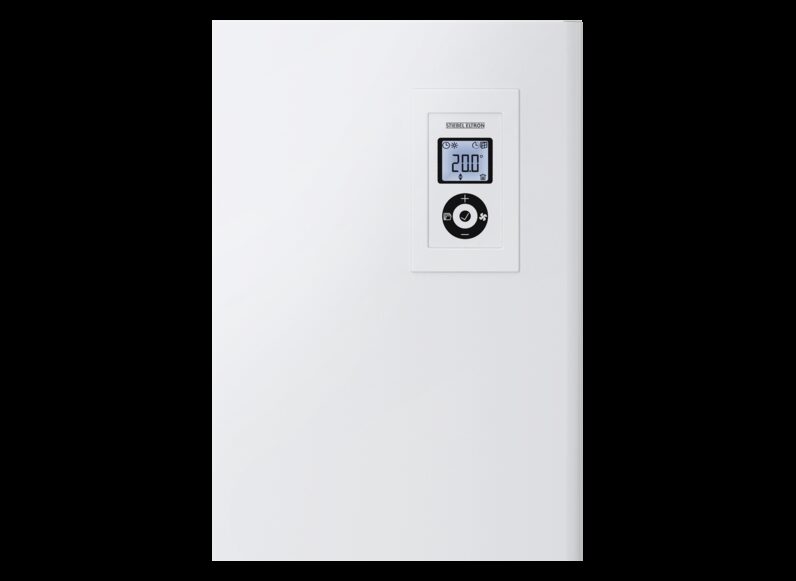
The defining feature is that the charge decision moves from the household to the heater. Modern heaters use sensors and smart controls to store just the right amount of heat1. These models achieve even better heat retention and are able to estimate the next day's heating demand based on user heating habits and climatic conditions, so input settings need no adjustment10. The automatic charge control works out how much electricity it needs to store to meet the programme and only uses the amount of electrical charge it needs8. To do this it looks at the temperatures inside and outside, as well as how much heat was needed the previous day1.
Modern storage heaters generally come with improved heating controls, including an automatic charge control, thermostat and programmer, and have higher heat retention, meaning they hold heat for longer than older units8. Many also feature a thermostat and timer through a programmer or mobile app, often with fan-assisted heat release and better insulation10. Depending on the model, it may be possible to control the storage heater with an app1.
Automatic charge control is not optional decoration on a new installation. Approved Document L states that automatic control of input charge should be provided, and the same requirement appears in the Welsh consultation version of the document20. A new electric storage heater is expected to manage its own charge.
Thermostats, programmers and automatic charge control on modern heaters
Once set, digital electric storage heater controls are easier to run than manual controls, because they automatically store enough heat for the set routine1. The household's job shifts from judging the weather to setting a routine and a temperature.
The thermostat lets the household set the temperature the storage heater should heat the room to1. The programmer carries the schedule. The automatic charge control then regulates how much energy is used by storing more or less heat at night1. If the routine is accurate, the charge follows it.
The Dimplex Quantum is the model most often described in UK guidance on this generation of controls. It has thermostats and a digital programmer, making it much more responsive to household needs21. Its boost option does not use heat already stored in the heater but uses the expensive rate of electricity to generate heat21.
| Control | What it does | Where it sits |
|---|---|---|
| Input or charge dial | Sets how much heat is stored overnight2 | Manual heaters only |
| Output dial | Sets how fast stored heat is released2 | Manual heaters only |
| Automatic charge control | Works out the charge needed for the programme and uses only that amount8 | Modern heaters |
| Thermostat | Sets the room temperature the heater works to1 | Modern heaters |
| Programmer or app | Carries the household's routine10 | Modern heaters, model dependent |
| Boost | Tops up from the grid at the expensive rate1 | Some models |
Should the boost be used during the day?
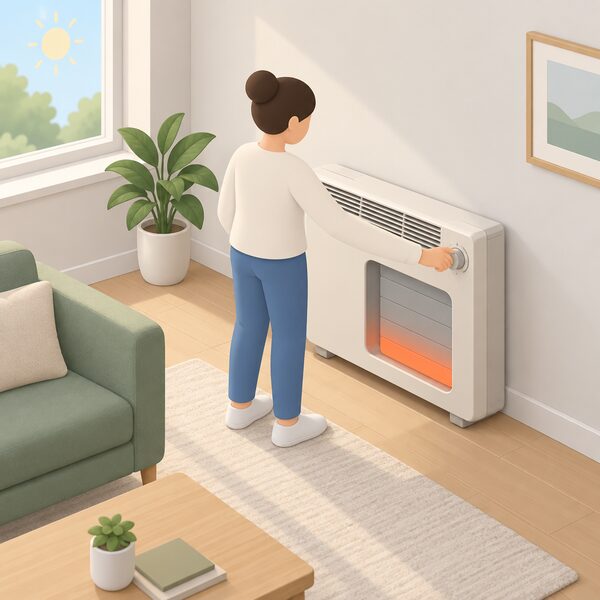
The boost is the one control that spends money rather than moving it. Some models have a boost function that tops up the electric storage heater by getting electricity from the grid as needed1. Integrated night storage heaters include a boost function for when stored heat runs out, and it uses more expensive on-peak electricity5. On older night storage heaters the boost setting does not use cheap-rate stored heat, it uses expensive daytime electricity10.
The distinction matters because the boost feels like the same appliance doing the same job. It is not. The stored heat was bought overnight at the off-peak rate; the boost is bought at the moment of use at the peak rate. It is a fallback for when the stored heat has run out, not a way to extend the day's heating cheaply.
Why a storage heater runs out of heat in the afternoon
Storage heaters can often leave a home very warm in the morning and struggle to stay warm in the evening22. The cause is usually the output setting rather than a fault. Older heaters release heat continuously, and the output dial controls the flow, so a high output setting empties the store early1.
Traditional night storage heaters require the household to manually set both how much heat to store overnight and when and how much to release during the day5. Two guesses, both made in advance, both capable of being wrong in the same direction. The output control is normally set to low unless extra heat is needed, and turned up in the evening2.
The fix on a manual heater is to hold the output down through the day and release heat in the evening when the house is occupied. On an automatic heater the same logic is built into the programme. High heat retention models are well insulated and hold heat for longer, which reduces the problem but does not remove the need for a sensible routine8.
Getting the settings right through the seasons
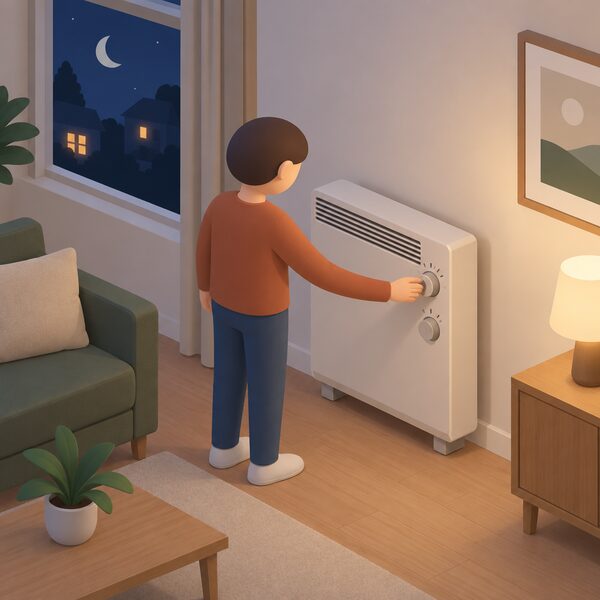
The input setting is the seasonal control. It is set depending on the expected next day temperature, higher in cold weather and turned down or off in warmer weather2. That is the whole seasonal adjustment on a manual heater: charge more before a cold day, charge less before a mild one.
The difficulty is that the setting is made the night before and any change to the input will not take effect until the next day9. Shoulder seasons, when a cold morning follows a mild afternoon, are where manual control is weakest. Automatic charge control removes the guesswork by reading indoor and outdoor temperatures and the previous day's demand1.
There is a wider point about controls generally. It is important to get the heating controls right before trying to change the flow temperature23. The same principle applies here: the charge and release settings are the foundation, and no amount of fiddling with anything else compensates for a store that is charged wrongly.
Charging with solar: a daytime alternative to off-peak charging
The standard storage heater model buys heat at night and spends it by day. A household with solar panels can invert that. Solar panel electricity could be used to charge storage heaters during the day so there is still warmth in the evening3.
The mechanism is the same store of bricks, filled at a different time. Solar panels are used to charge up an on-site battery storage system24, and the same daytime generation can feed the heater's charge circuit where the installation allows it. The attraction is obvious: the heat is bought at nothing rather than at the off-peak rate.
The limits are equally obvious. Solar output peaks in summer, when heating demand is lowest, and falls away in winter, when the storage heater needs its longest charge. A solar-charged storage heater is a supplement to the off-peak charge, not a replacement for it, and it depends on the household having panels and a suitable circuit arrangement.
What the controls mean for energy independence
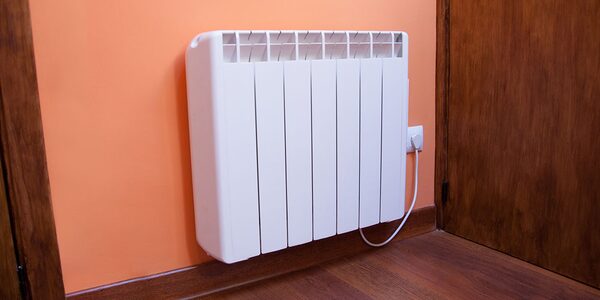
Storage heater controls sit at an unusual point in a home's energy arrangements. The heat is generated on site, from electricity, and stored in the fabric of the appliance. There is no boiler, no gas connection, no flue and no cylinder. A household with storage heaters and its own generation has removed the fuel supply from the equation entirely.
What remains is the tariff and the meter. The cheap charge depends on an off-peak window defined by the regional network operator and delivered through a specialist meter14. The controls cannot create that window; they can only use it well. A household on a single-rate tariff has the same heater and the same dials, but every unit of stored heat costs the daytime price.
The second dependence is on the manufacturer's control system. Automatic charge control, app control and smart charging all rely on the maker's hardware and, where an app is involved, on the maker's service continuing. A manual heater with two dials has no such dependency, which is one reason the older units keep working long after their controls have been superseded.
"Storage heaters use Economy 7 or Economy 10 tariffs for cheaper energy at night."
Sources24 cited
- A guide to using electric storage heater controls, Energy Saving Trust, 2026-05-21
- Getting the most from Economy 7, National Energy Action, 2026-09-10
- Storage heaters, Which?, 2026-06-01
- Research briefing CBP-9838, House of Commons Library, 2026
- Electric heating, Centre for Sustainable Energy, 2026-06
- Central heating systems, Uswitch, 2022-09-25
- Storage heaters, HIES Scheme, 2020-03-17
- Electric storage heaters, Energy Saving Trust, 2026-05-20
- How to save energy when you've got electric storage heaters, Home Energy Scotland, 2025-01
- Night storage heaters, Centre for Sustainable Energy, 2025-10
- Energy saving myths, Centre for Sustainable Energy, 2026-07
- Energy: your questions answered, Confused.com, 2026-07-03
- What is Economy 7, Energy Helpline, 2026-09-10
- Economy 7, Uswitch, 2026-09-08
- Should I switch to a time of use tariff, Energy Saving Trust, 2026-01-23
- Types of energy tariff, Confused.com, 2025-11-03
- Time of use tariffs explained, Which?, 2026-04-23
- Approved Document L, Volume 1 consultation version, Welsh Government, 2025-08
- Economy 10, Uswitch, 2025-12-08
- Approved Document L, Volume 1, HM Government, 2021 edition incorporating 2023 amendments
- Dimplex Quantum night storage heaters, Centre for Sustainable Energy, 2026-06
- Electric heaters vs storage heaters, Energy Helpline, 2026-09-20
- Should I turn my boiler's flow temperature down, Energy Saving Trust, 2026-05-19
- Solar panels, East Hertfordshire District Council, 2026-09-17
 Storage Heaters GuideHow night storage heaters charge on off-peak electricity and release heat through the day, and how high heat retention models with fans and controls differ from older bricks.
 Controls, Thermostats and TRVsWhich heating controls actually cut your bills, and what does each one do?
 Controls and Smart OperationWhy does a heat pump need different controls from a boiler, and what does weather compensation actually do?
 Installing Heating ControlsSwapping a thermostat or programmer looks simple, but which jobs can you safely do yourself and which need a registered installer?
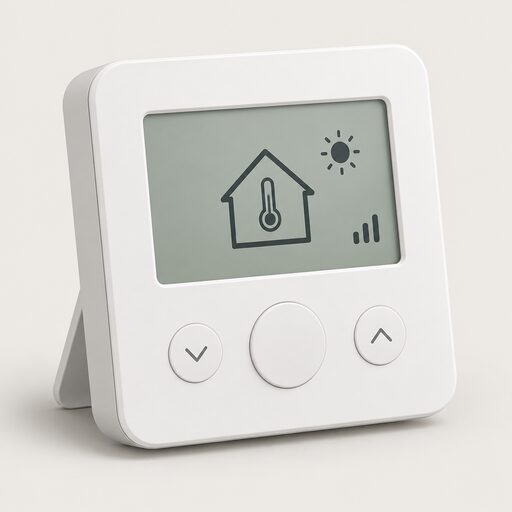 Room Thermostats ExplainedExplains mechanical, digital, programmable, wired, wireless and smart room thermostats, how they call for heat and switch it off, where to site them, how many zones a home needs under the building regulations, and what one degree on the dial is worth.
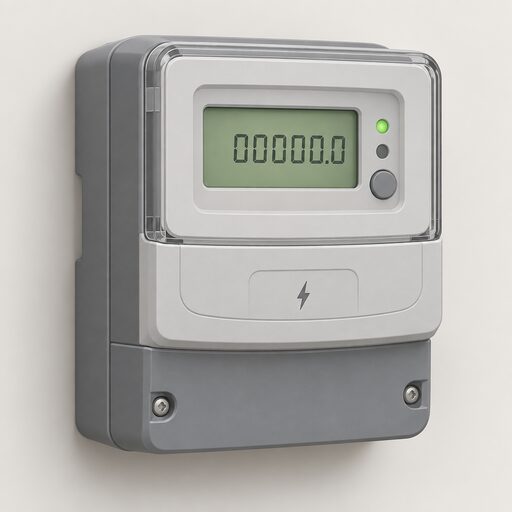 Take Control of Your EnergyHow do you read your own energy use and keep hold of your meter readings?