In this guide
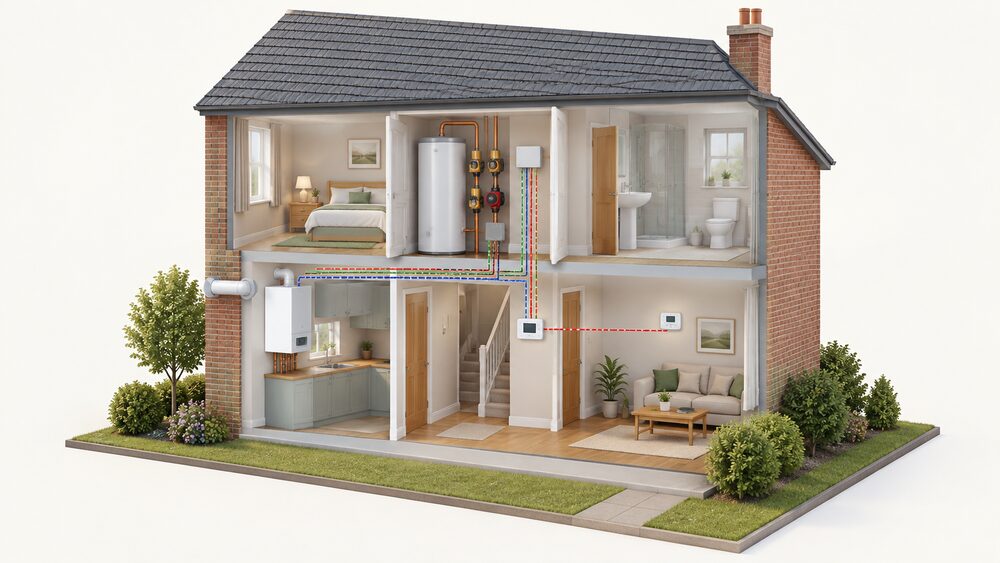
A domestic boiler is, in the formal definition used for UK energy assessment, a gas, liquid or solid fuelled appliance designed to provide hot water for space heating1. The control wiring that sits around it decides when that heat is called for, where it goes, and whether hot water and radiators can run separately. In the UK the standard layouts are known by letter: S-Plan, which uses separate zone valves for heating and hot water, and Y-Plan, which uses a single mid-position valve to share one circuit between the two. Controls sold for retrofit are normally specified against both: ESI's 4 Series programmable room thermostats are described as able to control combi boilers, system or heat only boilers via an S or Y Plan, which the maker says meets Boiler Plus requirements2.
The numbers a household actually needs are short. System pressure on a sealed system should sit between 1 and 2 bar when cold3. Flow temperature of 60 degrees Celsius or lower keeps a condensing boiler closer to condensing mode, but where there is a hot water cylinder the advice is not to go below 65 degrees Celsius without consulting an engineer, because of Legionella risk in stored water4. A service is due every twelve months6. A properly maintained modern boiler lasts between 10 and 15 years7.
The wiring also sets the limits of independence. Heating and hot water account for over half of what a household spends in a year on energy bills8, and none of that heat is available without mains electricity: gas boilers and heating stop working in a power cut9. The valves, the programmer and the pump are all electrically driven, so the control wiring is the point at which a home's warmth depends on the grid even when the fuel is stored on site.
What the boiler does, and what the wiring decides
The appliance itself produces hot water for the heat emitters and, in most homes, for the taps. A system boiler does the central heating but, rather than producing hot water on demand, heats a quantity of water held in a storage cylinder until it is required10. That single difference is what creates the need for a wiring plan at all: two separate demands, heating and stored hot water, have to share one heat source, one pump and one set of pipes.
The boiler's own thermostat is not part of that arbitration. It controls the temperature of the water flowing through the heating system, and does not control the temperature inside rooms11. Room temperature is the job of the room thermostat, timing is the job of the programmer, and the split between circuits is the job of the motorised valves. Boiler controls are separate from central heating controls such as the room thermostat, programmer and radiator valves12, and if the heating controls are not set correctly when the boiler thermostat is adjusted, the result may not be what was expected12.
Sizing sits upstream of all of this. An insulated and airtight home keeps heat in better, so a smaller and cheaper boiler may be sufficient10. A smaller appliance on a well zoned wiring plan cycles less and gives the controls more room to modulate, which is the subject of load compensation and modulation.
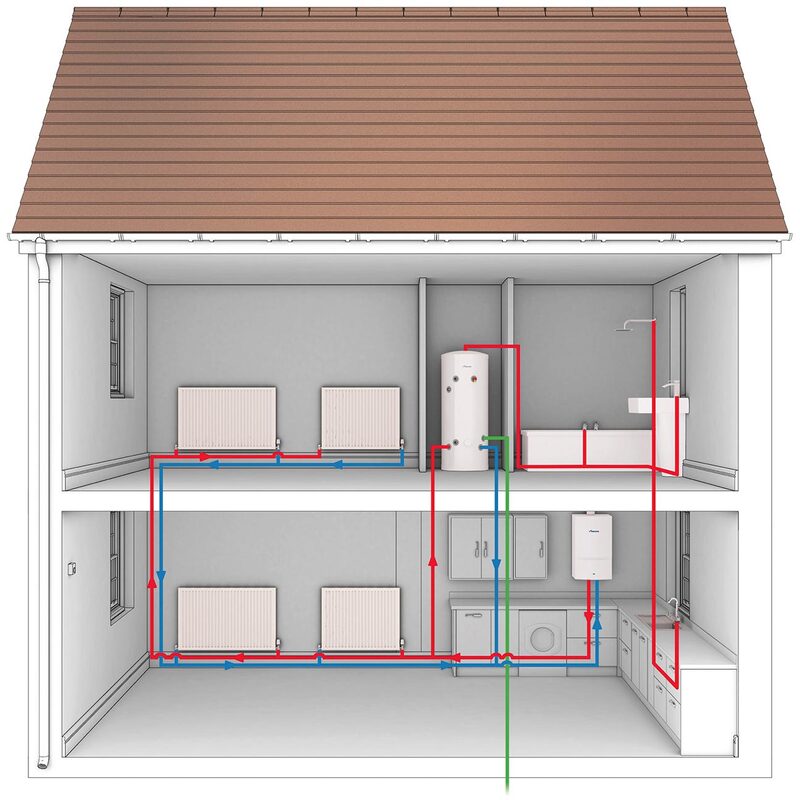
S-Plan, Y-Plan and X-Plan: how the layouts differ
The two long-established UK layouts are distinguished by how many motorised valves they use and how those valves are switched.
| Layout | Valve arrangement | What it allows |
|---|---|---|
| Y-Plan | A single mid-position valve shared between heating and hot water | Heating, hot water, or both, from one valve body; sold as a retrofit kit by ESI with a 3 year warranty13 |
| S-Plan | Separate two-port zone valves, one per circuit | Independent switching of each circuit |
| X-Plan (Intergas) | A boiler set-up with less wiring complexity than S-Plan and Y-Plan | Two distinct flow temperatures, one for space heating and one for water heating, without one affecting the other14 |
X-Plan is worth understanding because it answers a problem the older layouts cannot. On a shared circuit, the flow temperature that suits a cylinder is higher than the flow temperature that suits radiators, so one requirement drags the other away from its best setting. Intergas describes X-Plan as a simple way of setting up one of its boilers, with less wiring complexity than S-Plan and Y-Plan, to provide two distinct flow temperatures, one for space heating and the other for water heating, without one impacting on the other14. That is a manufacturer-specific arrangement and applies to that maker's appliances.
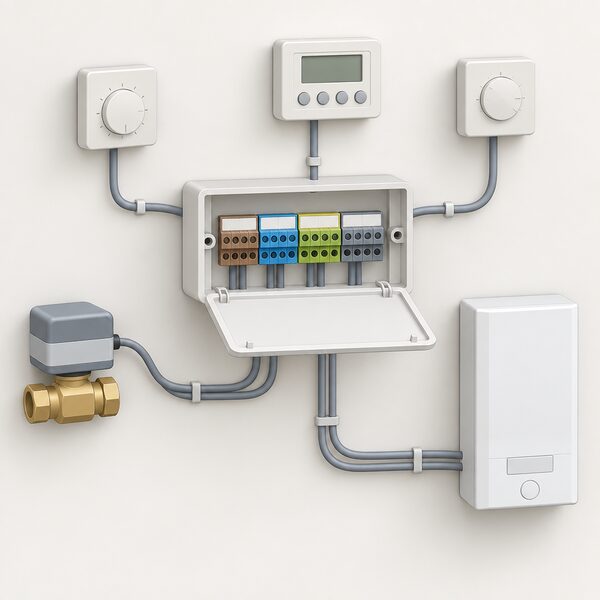
Whichever layout is present, the valves, the cylinder thermostat, the room thermostat, the programmer and the boiler's switched live all have to meet somewhere. In S-Plan and Y-Plan installations that meeting point is a junction box or a purpose-made wiring centre, which is simply a labelled terminal block that keeps the interconnections accessible. Underfloor systems use their own version of the same idea, covered under underfloor heating controls.
One useful practical point for householders: heating controls can be upgraded or installed independently of the boiler15. A wiring plan that already provides separate heating and hot water switching will usually accept a newer programmable thermostat without pipework changes. What changes when a programmer is replaced by a smart hub is the source of the switching signal, not the plan: the hub occupies the programmer's position in the wiring and drives the same valves. Which permutation a given product supports is set out by the maker, as with the ESI units quoted above for S and Y Plan systems2, and is discussed further under smart thermostat boiler compatibility and installing and replacing heating controls.
Flow temperature: why 65 degrees is the benchmark for cylinder systems
Two different figures circulate, and they are not in conflict once the system type is fixed.
For efficiency, lower is better. Condensing boilers should ideally be set to a flow temperature of 60 degrees Celsius or lower to run as close as possible to condensing mode4, and many boilers are set by default to heat water to 75 to 80 degrees Celsius5. The Energy Saving Trust suggests trying 65 degrees on a conventional boiler12. Default efficiency figures in the national assessment methodology are based on the design flow temperature of the water in the heat distribution system being 55 degrees Celsius or higher16, which is why real-world advice clusters in the fifties and sixties rather than the high seventies.
The floor is set by stored water, not by the radiators. Where the system has a water tank or cylinder, it is vital not to adjust the flow temperature beneath 65 degrees Celsius without consulting an engineer first, because of the risk of Legionella17. Which? repeats the point for heat-only and system boilers5. A combi has no stored water, so the constraint does not apply in the same way.
"For this reason, don't set the flow temperature lower than 65°C without asking an engineer first."
In wiring terms this is where S-Plan, Y-Plan and X-Plan diverge in consequence. On a shared mid-position arrangement a single flow temperature serves both duties, so the cylinder requirement effectively sets the radiator temperature during hot water demand. Where the layout or the appliance allows two flow temperatures, as Intergas describes for X-Plan, the two can be decoupled14. For the control side of the same question, see hot water controls and thermostat temperature settings.
Pressure: keeping a sealed system between 1 and 2 bar
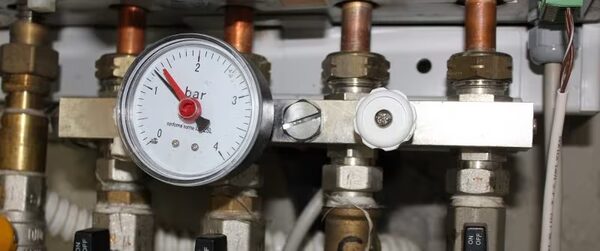
On a sealed system the gauge reading matters to the controls because low pressure trips the appliance and no amount of correct wiring will fire a boiler that has locked out. Intergas states the pressure needs to be between 1 and 2 bar when cold for the boiler to continue working properly3. Uswitch gives the same range6.
Manufacturers narrow it. Vaillant's fault codes F.22 and F.75 both describe system pressure below the normal range of 1 to 1.5 bar18. EDF's re-pressurising procedure says to shut off both valves at about 1.2 bar19. The documents therefore agree on the lower bound of 1 bar and differ on the working target, between about 1.2 bar and up to 2 bar. The figure printed in the instructions for the specific appliance takes precedence over any general range.
| Source | Stated range or target |
|---|---|
| Intergas, when cold | 1 to 2 bar3 |
| Uswitch | 1 to 2 bar6 |
| Vaillant, normal range in fault codes F.22 and F.75 | 1 to 1.5 bar18 |
| EDF, re-pressurising step 5 | shut off both valves at about 1.2 bar19 |
Two behaviours are worth knowing. The gauge reading should be taken cold, because heating the water raises the reading3. And a system that repeatedly falls below the range is losing water somewhere, which is a repair question rather than a control question. Persistent low pressure combined with an apparently dead programmer is a common false diagnosis: see heating control faults.
Annual servicing is the rule, and often a contractual condition
The interval is twelve months. Which? states plainly that a boiler should be serviced every year by a Gas Safe registered engineer20, Uswitch puts it as at least once a year, in other words every 12 months6, and the Centre for Sustainable Energy says the boiler should be serviced annually to ensure it stays in good working order and maintains its efficiency10. In Northern Ireland, boilers and tanks should be serviced annually as recommended by the Northern Ireland Health and Safety Executive21, and that applies to oil installations as well as gas.
Servicing is not only good practice. Warmflow describes an annual service as a warranty requirement as well as a way of keeping a boiler, cylinder or heat pump running at peak efficiency22. Which? notes that an annual service is essential for keeping a boiler running efficiently and safely and that many cover providers will only cover a household that has one23. The Heating and Hotwater Industry Council goes further on policy:
"HHIC believes that making annual servicing mandatory would help to reinforce the importance of regular maintenance and ensure high levels of safety are maintained"
Lifespan: 10 to 15 years, and what age closes off
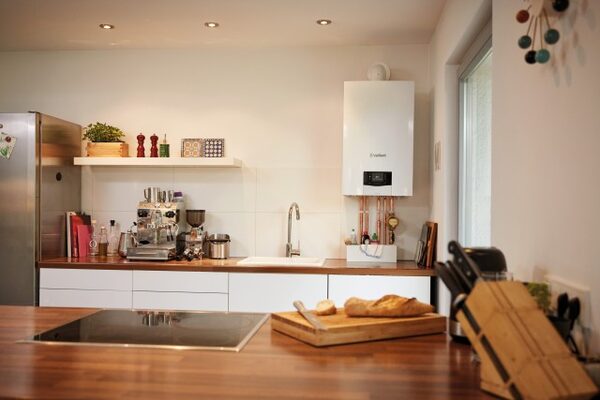
The most common figure is 10 to 15 years for a properly maintained modern boiler7. Uswitch gives 10 to 15 years in an average household where the appliance has been regularly serviced, and notes that in some cases boilers go beyond 15 years and even up to 2025. Vaillant says boilers can last up to 15 years or more depending on regular maintenance and servicing26. The planning guidance used for permitted development treats the current lifespan of a boiler as around 15 years27.
Age also closes doors. Ideal Heating states that its warranty and protection plans are not available for boilers over 15 years old, because they are considered a greater risk28. That matters when weighing a repair against a replacement: an appliance past that point cannot be brought back under a maker's plan, and the household carries the full cost of any failure.
Controls do not share the boiler's clock. Because controls can be upgraded independently of the boiler15, a wiring plan installed decades ago often remains serviceable while the programmer on the wall is replaced two or three times over. The decision points are different, and a control upgrade does not extend the life of the appliance it switches. The cost of heating controls is assessed separately from boiler replacement for that reason.
Who is responsible in a rented home
For a tenant, the servicing and wiring of the heating system is largely someone else's duty. The Energy Saving Trust puts it directly: where a home is rented, the landlord should arrange and pay for the service29. In Northern Ireland, the landlord is responsible for servicing boilers and appliances annually and must provide an up to date gas safety record, which is a legal requirement30. For private rented homes in England, Citizens Advice states that landlords must make sure the plumbing and heating work properly31.
There is a timing condition tenants should know. A landlord is usually only responsible for repairing a problem when they become aware of it, so the problem should be reported straight away32. Where a home is rented from a council or housing association, the landlord is responsible where the home is not safe to live in or where there is an ongoing serious problem affecting physical or mental health32.
That division has a direct bearing on controls. A tenant who wants zoning, a smart programmer or new TRVs is proposing a change to the landlord's wiring, not to their own. Heating controls in rented homes covers what is normally possible without altering fixed wiring.
Power cuts, safety lockouts and a frozen condensate pipe
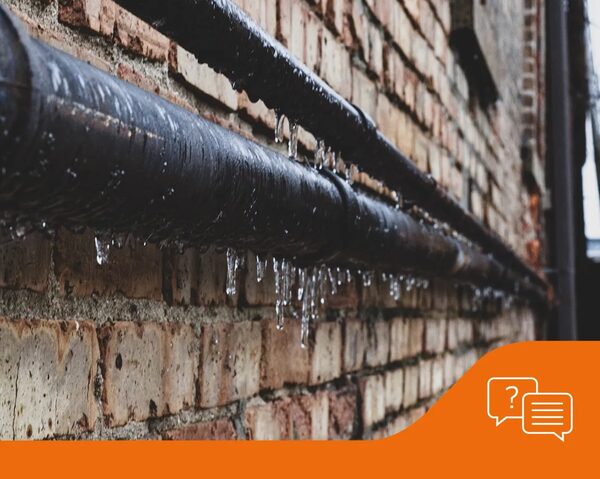
Control wiring is mains powered, and so is the boiler. Gas boilers and heating, electrical appliances and a home's internet and landline connections all stop working in a power cut9. Even gas and oil boilers rely on electricity to start up and tend to have safety mechanisms in place to stop them functioning without power33. This is a stop, not damage: a boiler should begin to work again when electricity is restored. The free power cut line is 10534.
That single dependency is the most important thing to understand about heating independence in a home with a boiler. Stored oil or LPG in the garden does not keep radiators warm without the pump and valves being energised. Households comparing options on that point will find more under heating controls and energy independence.
The second seasonal stoppage is the condensate pipe. A condensing boiler discharges acidic condensate through a small pipe, and if that pipe becomes blocked with ice the boiler will automatically shut down as a safety measure35. Vaillant notes that condensate flow is slow and can freeze in colder months, causing the appliance to stop operating, and that this is easily avoided by insulating the pipe36.
- Identify the external condensate pipe, usually a plastic pipe running from the boiler to a drain.
- Warm it gently with tepid water. Ideal Heating is explicit that boiling water should not be used37.
- Reset the boiler. If the pipe has defrosted, the boiler should start to work38.
- If it still will not fire, contact a Gas Safe registered engineer to check the boiler38.
- Insulate the pipe to help prevent it freezing again37.
Clearance and siting in a cupboard
Most UK boilers live in a cupboard, and the clearance around them is set by the manufacturer's instructions rather than by a single national number. Ideal Heating says one of the most important considerations is ensuring there is clearance between the boiler and the top, bottom and edges of the inside of the cupboard, and that the area around the cupboard should be free of obstructions so the door opens easily39. Uswitch suggests at least 60 mm clearance if the boiler is housed in a cupboard6.
Manufacturer specification sheets give the detail, and the two numbers they quote work together: a very small static clearance to the door, and a much larger figure needed only when an engineer opens it.
Clearance for a boiler built into a cupboard is set by the maker's own installation instructions for the specific model, and it differs between appliances, so the figure to work to is the one published for the unit being fitted. Two distinct dimensions matter: the gap that must be left permanently around the case once the door is closed, and the larger space an engineer needs in front of the boiler with the door open to remove the casing and reach the internal components. The second of these governs whether the annual service can be carried out at all, because servicing is required every 12 months6 and a boiler that cannot be opened cannot be serviced or repaired in place.
Siting also affects the wiring run. Planning permission is not normally required for installation or replacement of a boiler or heating system if all the work is internal27, which removes one obstacle from relocating an appliance, though the cost of new flue, gas, water and control wiring runs remains.
Where the boiler and its controls sit in a home's energy use
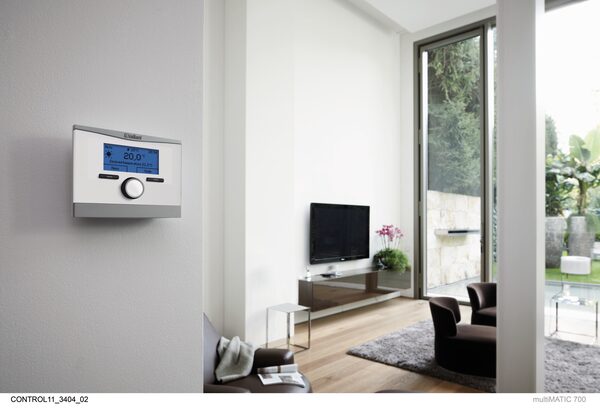
Heating and hot water account for over half of what a household spends in a year on energy bills8. That is the reason the control wiring repays attention out of proportion to its cost: the valves and the thermostat decide how much of that half is spent, and when.
Two things follow for a household weighing independence. The first is that the fuel is only part of the dependency. Even with a full oil tank or a mains gas supply, the heating stops when the electricity does9, and the boiler itself is a manufactured product with a service life of roughly 10 to 15 years7 after which maker-backed protection may no longer be available28. The second is that the controls are the part a household can change without touching the appliance15, and the part where a badly matched setting, such as a flow temperature left at the factory default of 75 to 80 degrees Celsius5, quietly costs money every day of the heating season.
What the wiring plan cannot do is make a boiler independent of the grid, of a fuel supplier, or of the manufacturer that supports it. It can make the heat that is produced go where it is wanted, at a temperature the appliance can deliver efficiently, and no further than that.
Sources39 cited
- SAP 10.3 full specification, BRE Group, 13 January 2026
- 4 Series wireless programmable room thermostat, ESI Controls, 2026
- Why does my boiler keep losing pressure, Intergas Heating, 11 June 2026
- Testing boiler efficiency advice with households, Nesta, 2026
- One simple way to adjust your boiler to lower your heating bill, Which?, 29 September 2025
- Boiler maintenance guide, Uswitch, 3 September 2026
- Why does my boiler keep losing pressure: boiler lifespan, Intergas Heating, 17 September 2026
- Boilers advice, Energy Saving Trust, 20 May 2026
- Storms and bad weather, Energy Networks Association, 17 September 2026
- Upgrading and replacing your boiler, Centre for Sustainable Energy, June 2026
- Smart heating controls: what they do and why they matter, BEAMA, 7 April 2025
- Should I turn my boiler's flow temperature down?, Energy Saving Trust, 20 May 2026
- Y Plan Kit, ESI Controls, 2026
- Practical advice on helping customers cut their energy bills, Intergas Heating, 23 May 2022
- Thermostats and heating controls, Home Energy Scotland, 20 September 2026
- Low temperature heating guidance, Product Characteristics Database, 17 September 2026
- Boiler energy efficiency, Which?, 19 September 2025
- Boiler fault codes, Vaillant, 17 September 2026
- Boiler pressure: everything you need to know, EDF, 17 September 2026
- Getting the best boiler service, Which?, 17 September 2025
- Domestic oil installation and boiler servicing, nidirect, 27 August 2024
- 5 simple ways to cut your heating bills this winter, Warmflow, 14 September 2026
- How to choose the best boiler cover, Which?, 30 September 2025
- Gas Safety Week 2025: why annual servicing matters, Heating and Hotwater Industry Council, 8 September 2025
- How long does a boiler last?, Uswitch, 13 November 2024
- How long do boilers last?, Vaillant, 2026
- Planning permission for boilers and heating, Welsh Government, 17 September 2026
- How long will a combi boiler last, Ideal Heating, 2026
- Take control of your heating at home, Energy Saving Trust, 11 September 2026
- Gas safety and carbon monoxide, nidirect, 24 November 2025
- Make sure your home is energy efficient, Citizens Advice, 19 September 2026
- Who is responsible for repairs, Citizens Advice, 20 September 2026
- Preparing for a power cut, Centre for Sustainable Energy, August 2026
- Can a smart meter cut off power?, Smart Energy GB, 24 April 2026
- How to thaw a frozen boiler condensate pipe, Which?, 16 September 2025
- What is a condensing boiler?, Vaillant, 2026
- Boiler not working: find out why and how to fix it, Ideal Heating, 17 September 2026
- My boiler isn't working, SGN, 2026
- Does a boiler cupboard require ventilation?, Ideal Heating, 17 September 2026
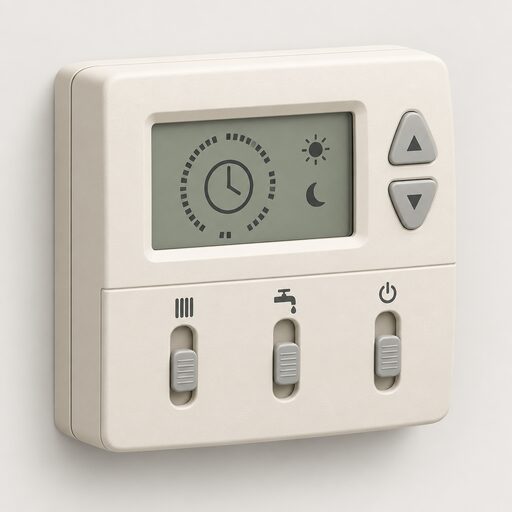 Controls, Thermostats and TRVsWhich heating controls actually cut your bills, and what does each one do?
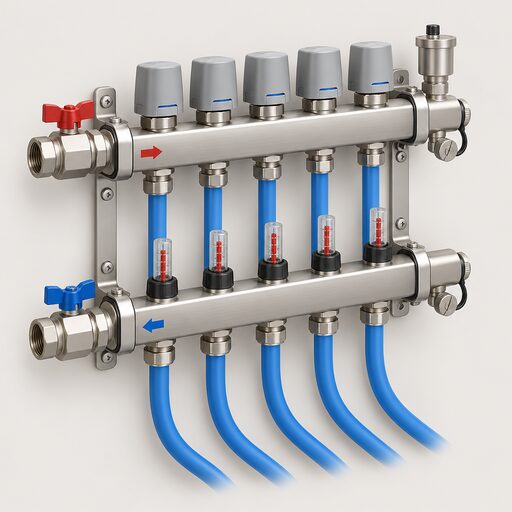 Underfloor Heating ControlsHow do you set different room temperatures with underfloor heating, and stop the floor getting too hot?
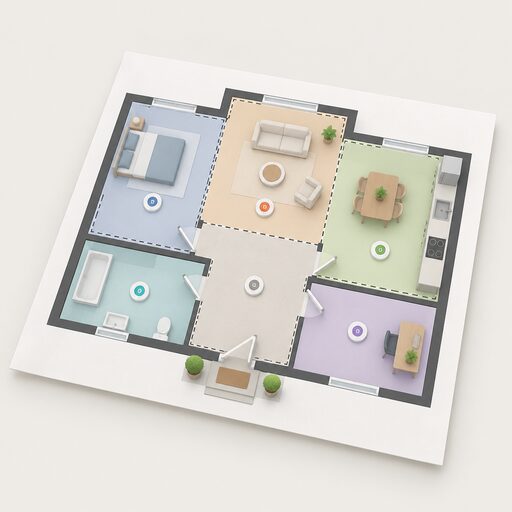 Heating Controls by Home TypeCompares the control arrangements that suit flats, terraces, open-plan conversions, large detached houses, solid-wall period homes and new builds.
 The Full Heating Controls GuideA room thermostat, a programmer and valves on your radiators are the basics.
 Programmers, Timers and SwitchesWhat a heating programmer does, how single, twin and three-channel units differ, how programmers fit alongside room thermostats and TRVs, and how time control relates to smart meters, time-of-use tariffs and smart controls.
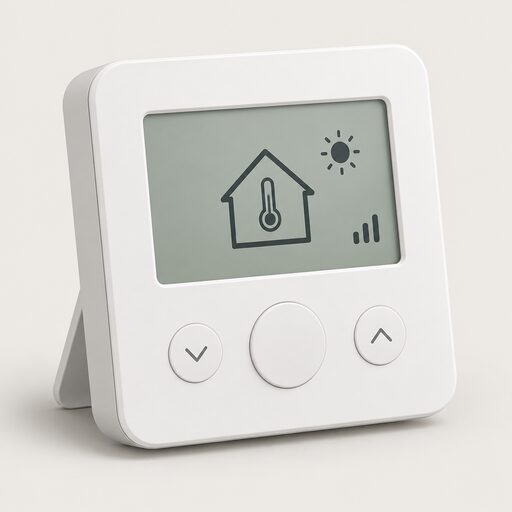 Room Thermostats ExplainedExplains mechanical, digital, programmable, wired, wireless and smart room thermostats, how they call for heat and switch it off, where to site them, how many zones a home needs under the building regulations, and what one degree on the dial is worth.