
In this comparison
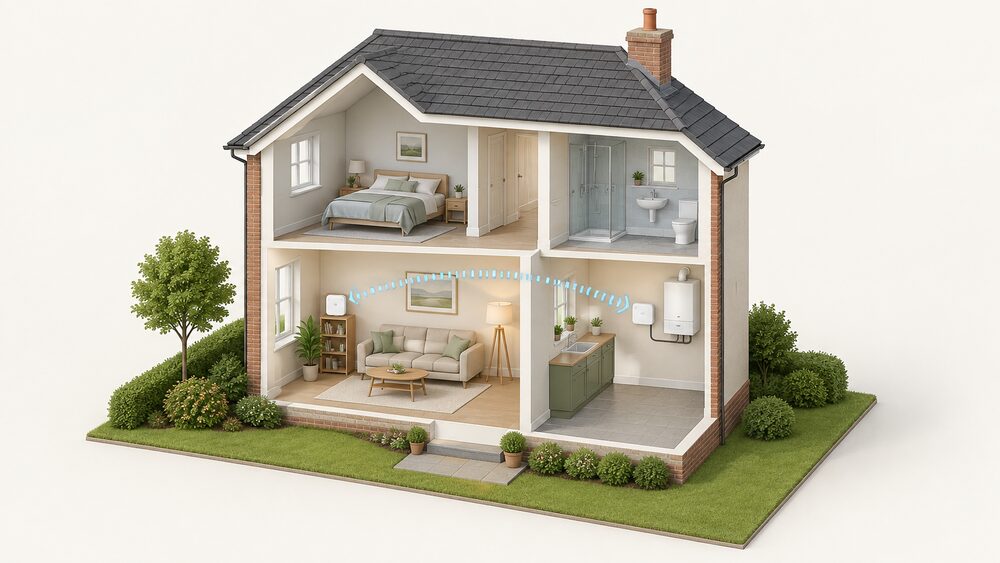
A wired room thermostat is connected to the boiler by physical cable and takes its power from the mains. A wireless thermostat is a battery or mains powered room unit that sends a radio signal to a receiver wired to the boiler, which does the switching. That single difference drives everything else: where the thermostat can sit, whether it can be moved, what installation involves, and what still has to be wired.
The practical trade is straightforward. Wireless controls are easier to site and easier to reposition, and the room unit needs no cable run through the walls. In exchange, the household takes on batteries, a radio link, and a receiver at the boiler that is itself a wired component. Many boilers are not Wi-Fi enabled, so many smart or wireless thermostat systems still include a wired element1.
Cost follows the same split. A wired boiler thermostat will cost less than a wireless boiler thermostat, according to Ideal Heating's guidance2, and Netatmo states that no additional installation costs are involved with wireless boiler thermostats, unlike with wired boiler thermostats3. Prices are installer-quoted in practice, and no published UK price is given here.
Wired thermostats: how they work and where they fit
A wired thermostat connects directly to the boiler with physical wires7. That gives a reliable connection with no signal interference, and it needs no batteries, because the unit draws its power from the installation. The cost of that reliability is the cable: the thermostat has to be wired into the walls of the home, which makes the installation process more complex than a wireless equivalent4.
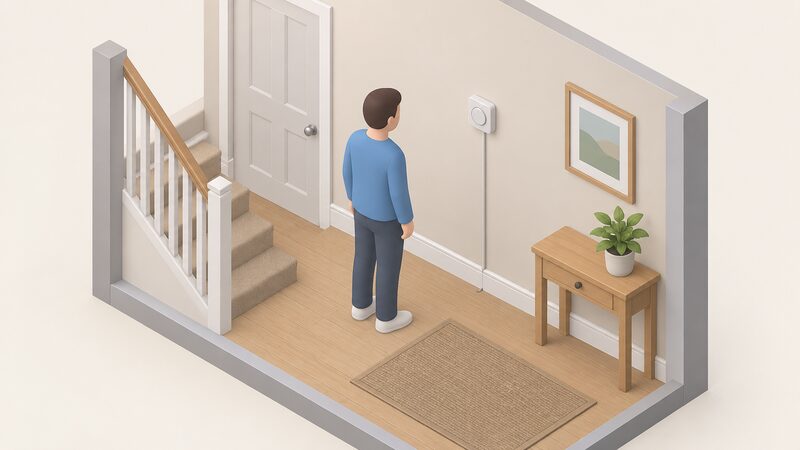
Where a wired thermostat already exists, the position is fixed by the cable that is already there. That is usually in a hallway or living room, chosen when the heating was first installed rather than for how the household uses the house now. Moving it means new wiring, which is the point at which many households consider wireless instead.
Wired controls also have a visual advantage that is easy to overlook. With a wired thermostat connection, no cable is visible and no power socket is being used8. A wireless unit sitting on a shelf or a wall bracket is a separate object with its own power arrangement, and a mains-powered wireless unit needs a socket or a fused connection where it stands.
For a household's energy independence, a wired thermostat is the most self-contained option on the market. There is no radio link to fail, no battery to replace, no receiver pairing to lose, and no manufacturer account involved in the basic on/off function. The dependence it carries is the ordinary one: the boiler, the gas or electricity supply, and the wiring that connects them. Where the thermostat is a wired smart model, it takes the place of the existing wired room thermostat and regulates the temperature in the room9, and any app or cloud features sit on top of a control loop that still works at the wall.
Wireless thermostats: how they work and where they fit
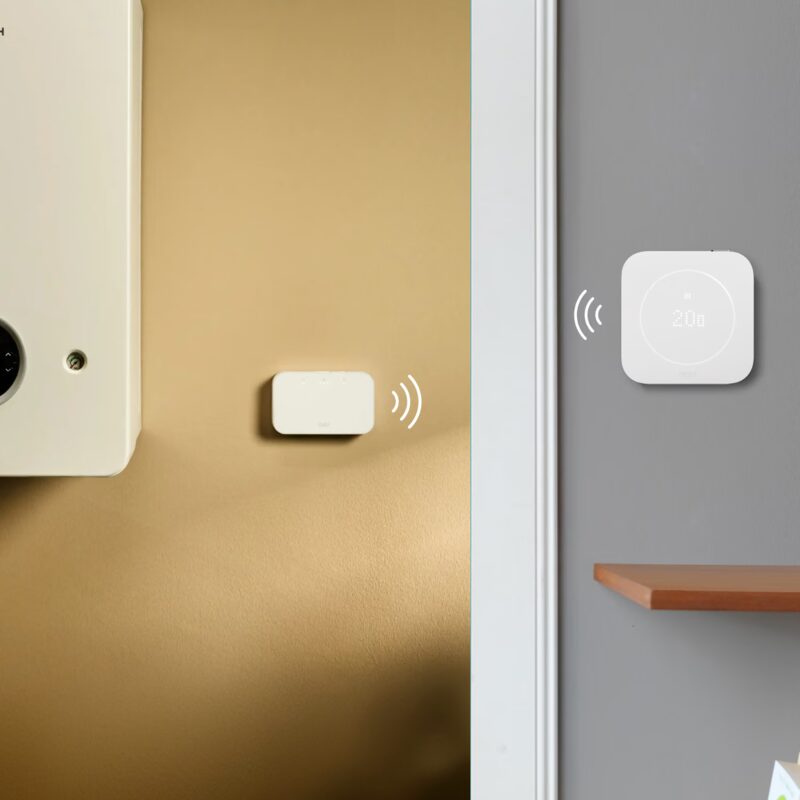
A wireless thermostat communicates with the boiler by signal rather than by cable. The room unit can be battery-powered or plugged into the mains, and a separate receiver unit connects to the boiler7. The thermostat itself is placed within a room of the home, with only the wireless receiver connected to the boiler3. Netatmo describes the arrangement in the same terms: a wireless boiler thermostat is placed within a room of the home rather than on the boiler itself, and it just works with the receiver3.
That separation is what makes wireless controls attractive in retrofit. The room unit can be positioned anywhere within range, and installation involves no wiring work at the thermostat7. Viessmann notes that the thermostat itself will replace the old one, a receiver box may need to be connected to the boiler, and a hub may be connected to the home router6. The connection method between thermostat and receiver varies by manufacturer: some connect automatically, others require pressing multiple buttons together and holding them for a few seconds6.
Wireless controls also support room-by-room intent more naturally than a single fixed wired unit. Fischer Future Heat describes the capability as setting a precise temperature and timing room-by-room, so the heating comes on when it is needed10. Genius Hub's wireless room thermostat provides both an accurate temperature for the room it is placed in and manual control of temperature11. Viessmann states that the thermostats can keep the room within less than one degree of the preset temperature6.
The dependence a wireless thermostat adds is the radio link and the receiver. The receiver is a powered device at the boiler, and it is the part that actually switches the heating. Where the thermostat is also smart, the household adds a hub, a router and usually a manufacturer's app, and with them an account and a cloud service. The heating still runs if the internet drops, because the thermostat-to-receiver link is local radio, but app control and remote scheduling do not.
Power sources: battery or wired
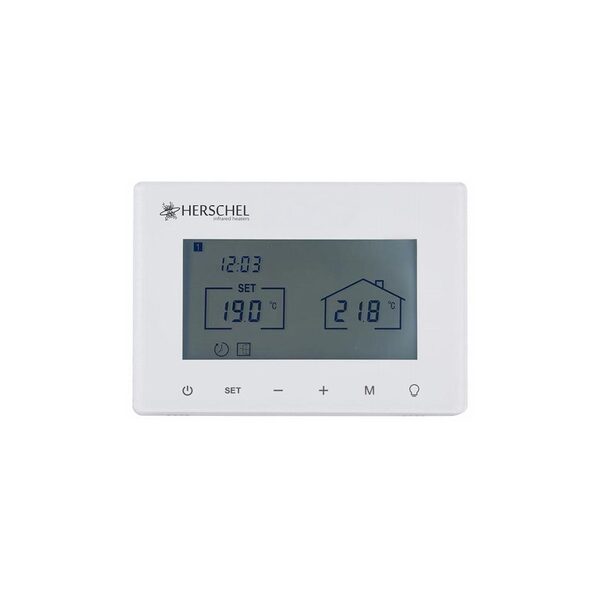
Wireless thermostats require recharging or replacement batteries from time to time2. That is the routine maintenance cost of cable-free siting, and it is the single most common practical difference a household notices after switching.
The arrangements vary widely across the products sold in the UK. Warmup's Wireless Thermostat is battery powered by four AAA cells, so no wired thermostat position is needed12. The Passiv Thermostat in its wireless version has a built-in rechargeable battery that can be recharged with a USB-C cable in under an hour13. Alpha's Comfort wireless thermostat and timer is battery-operated with no hard-wiring necessary14. Herschel's battery thermostat and its SmartLED controls are battery powered wireless thermostats15, and Sundirect's Smart Lux is described as a battery-powered wireless thermostat18.
Not every wireless thermostat is battery powered. Viessmann notes that the thermostat will require a power source, battery or wired6, and Salus lists a wireless digital thermostat with a 230 V power supply19. Heatmiser's underfloor range makes the choice explicit: a wired neoStat or a wireless, battery-powered neoAir thermostat, with the option to upgrade to smart control20. The neoAir is battery-powered and wireless, while the neoStat is hard-wired21.
For energy independence, battery operation is a genuine advantage: the thermostat keeps working through a power cut, and it needs no socket, no fused spur and no electrician for the room unit. The trade is consumable batteries and, on rechargeable models, a charging routine. A mains-powered wireless thermostat gives up that independence in exchange for never thinking about cells again.
| Product | Power source | Source |
|---|---|---|
| Warmup Wireless Thermostat | Four AAA cells | 12 |
| Passiv Thermostat (wireless) | Built-in rechargeable battery, USB-C, under an hour | 13 |
| Alpha Comfort wireless thermostat and timer | Battery-operated, no hard-wiring | 14 |
| Salus VS10BRF Wireless Digital Thermostat | 230 V | 19 |
| Heatmiser neoAir | Battery-powered, wireless | 20 |
| Heatmiser neoStat | Hard-wired | 21 |
Portability and room-to-room flexibility
Wireless thermostats do not need to be wired into the walls, and they can be carried from room to room2. That is the clearest functional difference from a wired unit, and it changes how a household can use a single thermostat across a house with uneven occupancy.
Portability is not the same as indifference to position. Viessmann advises that a wireless thermostat should be positioned away from any radiators and from direct sunlight that could make the room temperature reading inaccurate6. Which? makes the same point from the occupancy side: with a portable or wireless thermostat, make sure it is in the room that is in most frequent use22. Where a secondary heater is used in one room, the thermostat should not be in that room, because local heat will disrupt control23.
The Konekt Wireless Thermostat illustrates the design logic: due to its battery operation and the radio communication, it can be positioned freely in the room24. That freedom is what allows a household to follow the occupied room through the day rather than heating to a fixed sensor's position.
The limit is that one portable thermostat still controls one heating circuit. Carrying it to a colder room does not create a separate zone; it moves the sensor that the whole circuit responds to. Households wanting genuinely independent room control need multiple thermostats or zoning, which is a different design question from wired versus wireless. Where more than one wireless thermostat is used on a Grant Aerona system, the thermostat selected for the next circuit must be different from the thermostat paired to the first circuit25.
Wireless vs smart: not the same thing
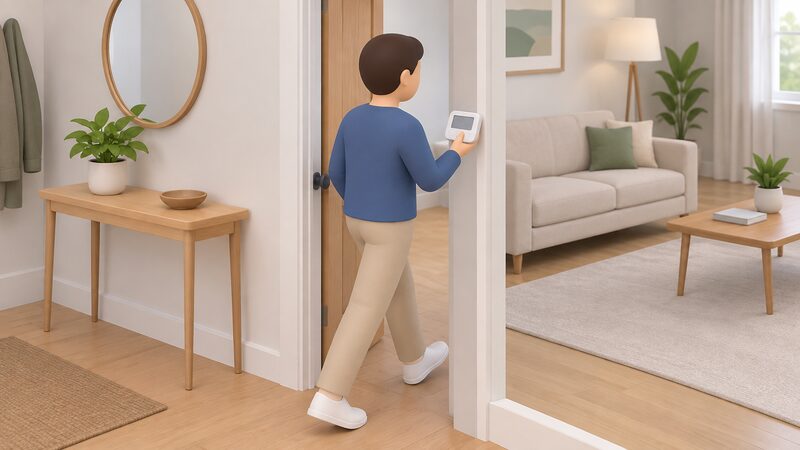
Wireless describes the link between thermostat and boiler. Smart describes what the thermostat can do with that link. A wireless thermostat is not always smart1, and the distinction matters when comparing products and prices.
A smart thermostat connects to Wi-Fi, which allows it to form part of a more connected home heating system1. Smart thermostats such as Hive and Nest connect to wifi so heating and hot water can be controlled through a smartphone, tablet or desktop26. Once a smart wireless thermostat is linked to the boiler and an internet connection, it adapts heating to lifestyle and temperature preferences27. Netatmo notes that while smart wireless thermostats are more expensive up front, they allow the most detailed control over home temperature settings27.
At the simple end, a non-programmable wireless thermostat has no digital screen or programming options, and offers manual control only via a receiver communicating with the boiler27. That is a wireless thermostat in the strict sense and nothing more. A wireless room thermostat from Genius Hub sits in the middle: accurate room temperature plus manual control, without the full connected feature set11.
The independence question splits along the same line. A plain wireless thermostat depends on a radio link and a receiver, both local. A smart wireless thermostat adds Wi-Fi, a router, a manufacturer's app and usually a cloud account, and with them a dependence on a company's servers and continued product support. Connectivity is not always Wi-Fi either: Ofgem's ECO4 innovation list records a smart thermostat using GSM connectivity rather than Wi-Fi28.
"a wireless thermostat is not always smart"
Compatibility with your heating system
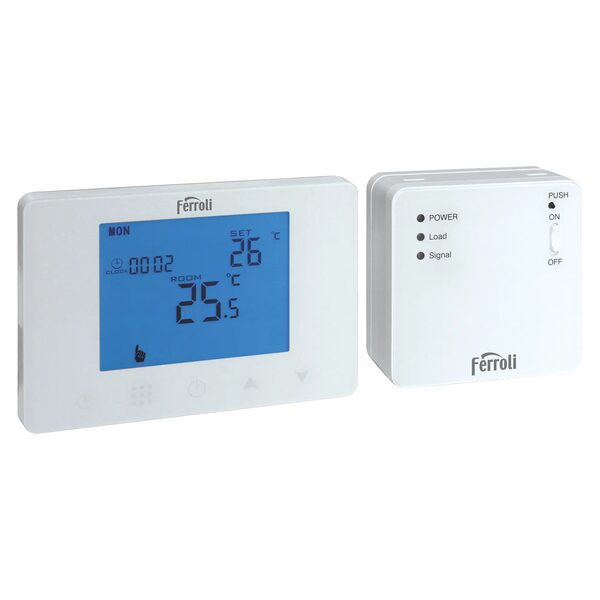
In most cases, wireless thermostats are compatible with most modern boilers, including combi, system and heat-only boilers6. That is the general position, and it holds because the thermostat does not talk to the boiler directly: it talks to a receiver, and the receiver is what interfaces with the boiler's control terminals.
The receiver is therefore the compatibility point. A wireless thermostat sends a signal to a receiver connected to the boiler, which then tells the boiler when to turn the heating on or off1. Netatmo states that wireless thermostats just need to have their wireless receiver connected up to the home boiler29. Tado's Wireless Smart Thermostat X Starter Kit is described as compatible with most gas boilers and heat pumps on Relay or OpenTherm, and can be added to a boiler not wired to a thermostat yet or replace an existing wireless thermostat7. Tado also offers its thermostat in wired and wireless versions, with a wireless booster available30.
Retrofit is usually feasible. Ideal Heating states that it is often possible to convert an existing boiler to wireless technology with a simple kit2, and Nu-Heat states that in most situations wired thermostats can be easily upgraded to neoStats without the need for any additional wiring21. Heat pumps are covered too: the Grant Aerona Smart Heat Pump System Controller is compatible with wireless thermostats in conjunction with an installed wireless receiver25.
There are hard limits. Some products are tied to one maker's appliances: the Elnur CTM20 connects wirelessly to the boiler but is only functional with that company's electric boilers31. Underfloor heating compatibility lists also rule some wireless controls out for particular wiring centres, with Heatmiser's UH1-W and Warmup's WHS-C-D-MASTER01 both listed as not compatible with the electric switch thermostat32. Warmup's own wireless range is built around a battery powered wireless thermostat for each room, an 8-zone wireless wiring centre beside the manifold, and an optional hub connecting the system to a phone12.
| System | Wireless compatibility | Source |
|---|---|---|
| Most modern boilers (combi, system, heat-only) | Compatible in most cases | 6 |
| Tado Wireless Smart Thermostat X Starter Kit | Most gas boilers and heat pumps, Relay or OpenTherm | 7 |
| Grant Aerona Smart Heat Pump System Controller | With an installed wireless receiver | 25 |
| Elnur CTM20 | Only with that maker's electric boilers | 31 |
| Heatmiser UH1-W, Warmup WHS-C-D-MASTER01 | Not compatible with the electric switch thermostat | 32 |
Installation: what still has to be wired
The room unit is the easy part. Wireless thermostats require no wired installation, so they are easier to set up in the home5, and a wall thermostat can be installed without wiring, through battery operation and radio communication33. A plug-in thermostat can be set up easily and quickly without hiring an electrician, and an infrared heater can be removed from the wall easily because no wiring has been done8.
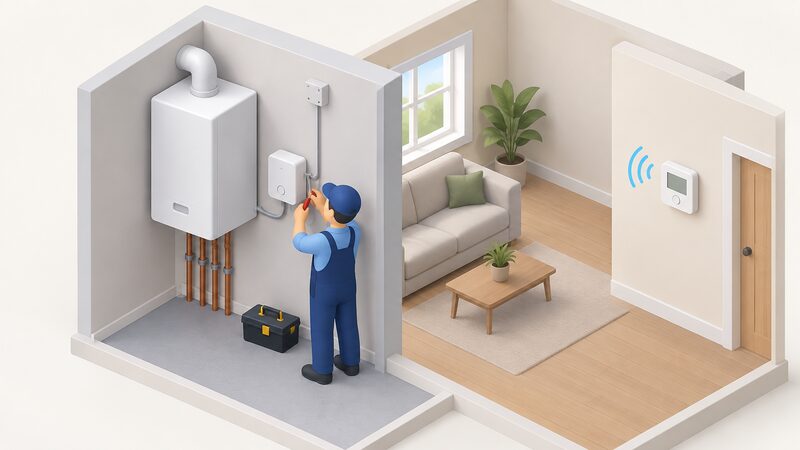
The receiver is the part that keeps an electrician in the picture. A lot of boilers are not Wi-Fi-enabled, so many smart or wireless thermostat systems still include a wired element, and that wiring should be done by a trained professional1. Hive's guidance is explicit that most wired thermostats require electrical work for the installation, while some wireless thermostats and TRVs are DIY-friendly34. The distinction is between the thermostat, which is usually a battery device placed on a wall or shelf, and the receiver, which is a mains-powered switch at the boiler.
The sequence for a typical wireless installation runs through three components: the thermostat, a receiver box connected to the boiler, and a hub connected to the home router6. Where the household already has a wired thermostat, the old cable run can often be reused or left in place, and the upgrade path is described by Nu-Heat as usually needing no additional wiring21.
For energy independence, this is the honest accounting. A wireless thermostat removes the cable from the living space and gives the household a control it can move, power from a battery and, on non-smart models, run without any account or internet service. What remains is a receiver wired to the boiler, a radio link between the two, and the boiler's own dependence on gas or electricity from a supplier. A smart wireless thermostat adds a hub, a router and a manufacturer's cloud service on top, and that is the layer most likely to change or be withdrawn over the life of the product.
Sources34 cited
- What is a smart thermostat?, Smart Energy GB, 2026-08-19
- Boiler thermostats: a complete guide, Ideal Heating, 2026-09-17
- Boiler thermostat guide (UK), Netatmo, 2026-09-20
- Heating controller guide, Netatmo, 2026-09-20
- Heating controller guide (EU), Netatmo, 2026-09-20
- Connecting a wireless thermostat to a boiler, Viessmann, 2022-04-03
- Heating thermostat guide, tado°, 2026-08-03
- Infrared panel heaters with thermostat: what to pay attention to before buying, Sundirect, 2019-05-15
- Central heating guide, tado°, 2026-07-07
- All-electric homes: start your green lifestyle, Fischer Future Heat, 2025-09-09
- Genius Hub shop, Genius Hub, 2026-07-17
- Warmup Wireless thermostat, Warmup, 2026-09-20
- Passiv Smart Thermostat, PassivUK, 2026-06-03
- Create the perfect climate with Total Control 2, Alpha Innovation, 2012-03-12
- Select XLS LED front-lit infrared panel heater, Herschel Infrared, 2026-08-26
- XLS controls product range, Herschel Infrared, 2026
- Select XLS LED infrared panel heater, outdoor, Herschel Infrared, 2026-09-16
- Infrared panel heater Lux Plus, Sundirect, 2026-09-20
- VS10BRF wireless digital thermostat 230V, Salus Controls, 2026-09-20
- Screed underfloor heating kit, one zone, Nu-Heat, 2026-05-15
- Smart controls, Nu-Heat, 2025-03-24
- Central heating wars: have you switched off yours yet?, Which?, 2020-03-27
- Heat the whole house or one room, Uswitch, 2026-08-20
- Konekt Wireless thermostat, Warmup, 2026-09-20
- Pairing wireless thermostats with the Aerona Smart Controller, Grant UK, 2026-09-17
- Ultimate energy saving tips guide, Smart Energy GB, 2026-04-24
- Wireless thermostat guide, Netatmo, 2026-09-20
- ECO4 approved innovation measures, Ofgem, 2026-02
- Boiler thermostat guide, Netatmo, 2026-09-20
- tado vs Hive: which smart thermostat is best, Energy Helpline, 2026-09-20
- CTM20 boiler WiFi controllable room thermostat, Elnur, 2024-06-27
- Underfloor heating compatibility check, Genius Hub, 2026-02-05
- Wall thermostat basic, Homematic IP, 2026
- How to buy the best smart thermostat, Hive, 2026-05-14
 Room Thermostats ExplainedExplains mechanical, digital, programmable, wired, wireless and smart room thermostats, how they call for heat and switch it off, where to site them, how many zones a home needs under the building regulations, and what one degree on the dial is worth.
 The Full Heating Controls GuideA room thermostat, a programmer and valves on your radiators are the basics.
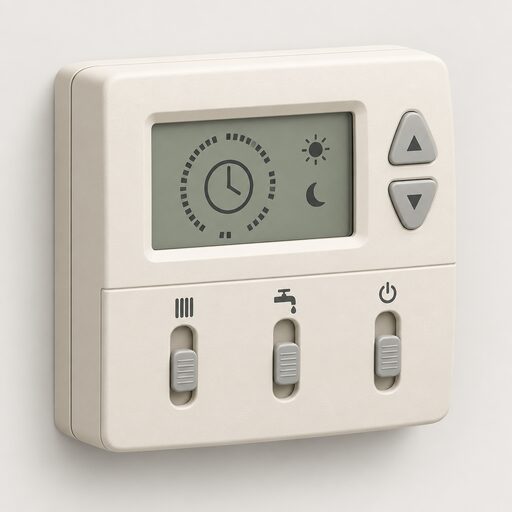 Controls, Thermostats and TRVsWhich heating controls actually cut your bills, and what does each one do?
 Controls and Wi-FiWhich air conditioning controls work without the internet, and which need Wi-Fi?
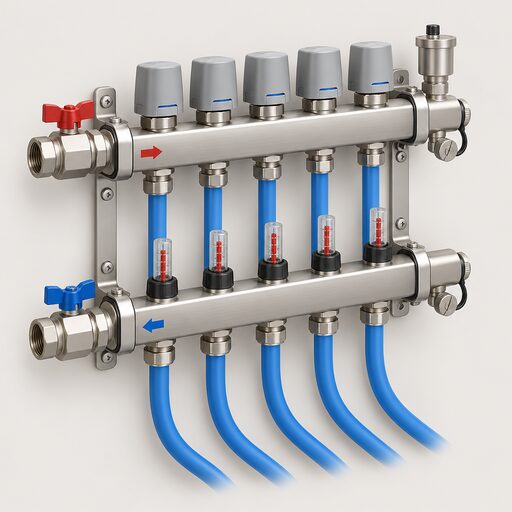 Underfloor Heating ControlsHow do you set different room temperatures with underfloor heating, and stop the floor getting too hot?
 OpenTherm Protocol ExplainedOpenTherm lets a smart thermostat and a boiler from different makers work together properly, so the boiler can run gently instead of switching on and off.