
In this guide
A Nu-Heat warm water underfloor heating system runs from the same heat source as a radiator system, and Nu-Heat states plainly that its warm water systems "can be fed from any boiler system"1. The controls are the part most householders end up searching for: hard-wired neoStat V2 thermostats, a neoHub+ gateway for app and HomeKit control, and a manifold that blends the water down to the temperature a floor can take2.
The design flow temperature is the number that decides how the system performs. Where a Nu-Heat system is paired with a boiler, the company says it would typically incorporate a flow temperature of around 55°C into the design4. That is well below the 75 to 80°C many combi boilers are set to by default5, and it is the reason underfloor heating can let a condensing boiler do what it was bought for.
On running cost, Nu-Heat puts underfloor heating efficiency at around 25% more than radiators, and up to 40% more efficient when paired with a heat pump6. Independent testing gives a figure for a single room: roughly 26p per hour to run water underfloor heating in a 25m² room, or around £140 in total across three hours a day for roughly six months7.
What a Nu-Heat water system is and how it works
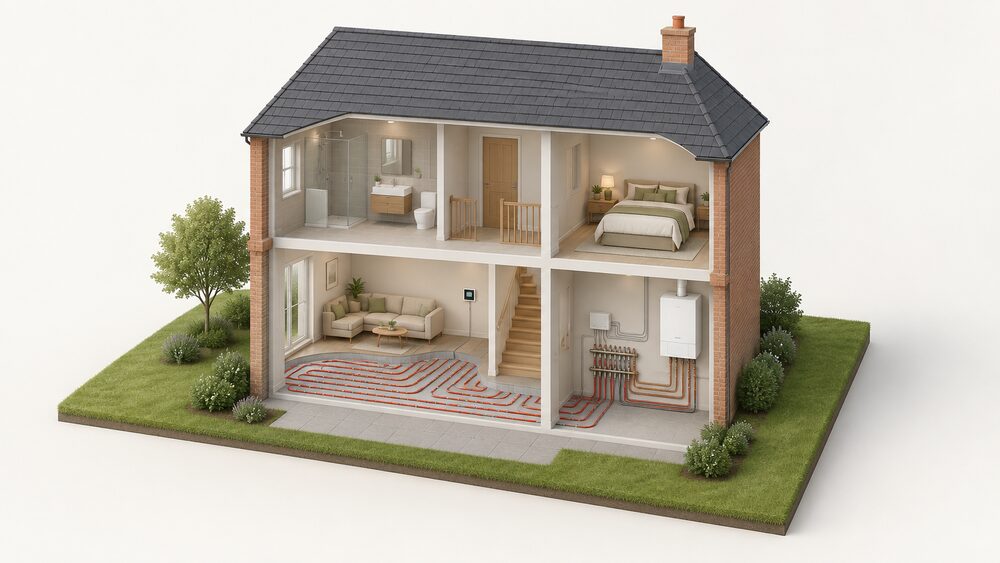
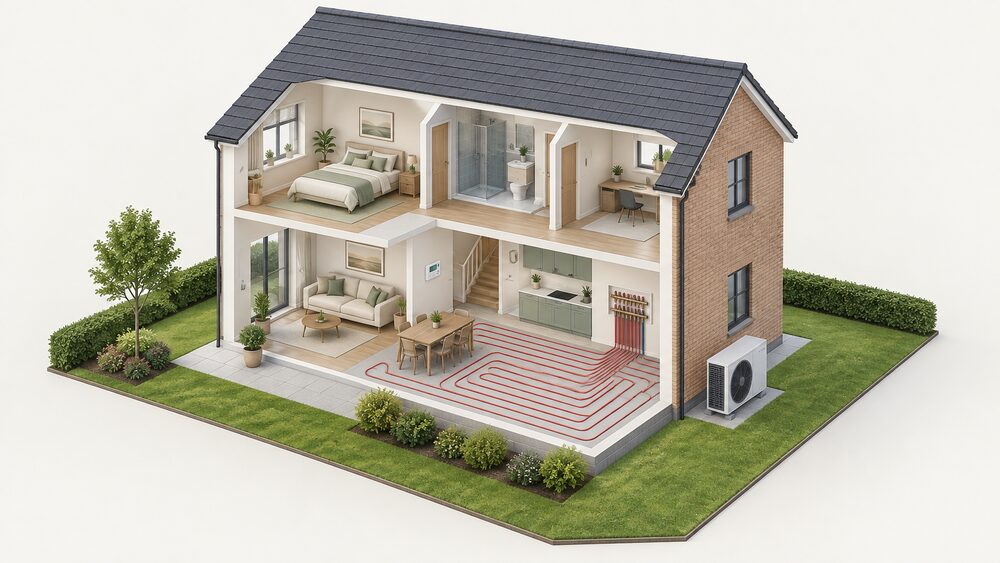
A water underfloor heating system circulates warm water through pipework set within the floor, rather than through radiators on the walls. Nu-Heat supplies its systems as kits aimed at single room or one zone installations, with a choice of water screed, water overlay or electric versions1. When a system is ordered, the company says everything arrives ready to go: pre-cut pipework, room thermostats, and a detailed handover pack with clear layouts based on bespoke heat loss calculations11.
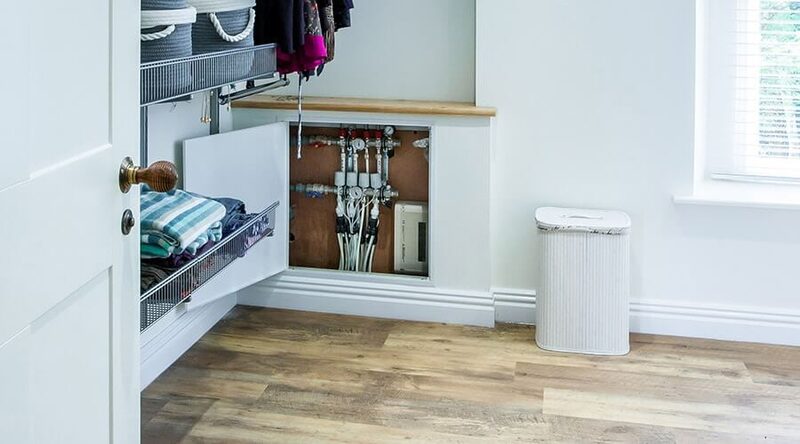
All Nu-Heat systems are sealed, pressurised systems, which the company describes as extremely reliable provided they are properly pressure tested11. That matters for controls because a sealed system holds its pressure independently of the boiler, and the manifold does the work of mixing the hot water from the heat source down to a temperature the floor can accept.
The design process is where the control behaviour is set. Nu-Heat's design service looks at floor construction, heat source, pipe spacing, water flow temperature and flow rates to balance the heat output of each room12. Pipe spacing and flow temperature are the two variables that decide whether a floor delivers enough heat at a low enough water temperature, and both are fixed once the pipe is in the floor.
"Once underfloor heating is installed, it's nearly impossible to make any changes to the system as it's within the floor."
That is the central limitation of the technology, and it applies to the controls as much as the pipework: the zoning, the thermostat positions and the manifold layout are all decided before the screed goes down.
Controls: neoStat thermostats and the neoHub+ gateway
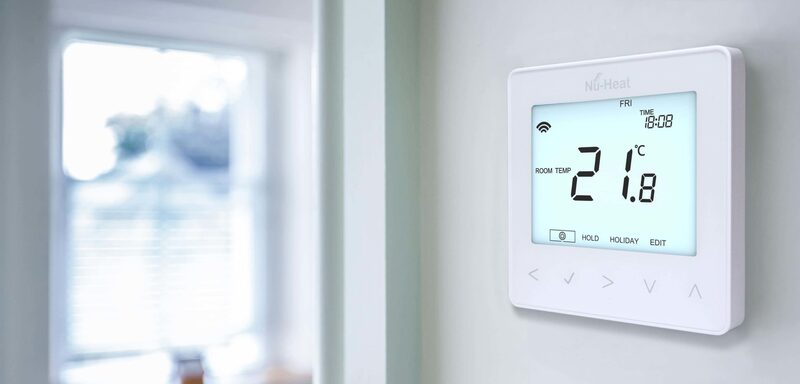
The thermostat Nu-Heat's own troubleshooting pages name is the hard-wired neoStat V22. Hard-wired means a cable run back to the manifold or wiring centre rather than a radio link, which is a design decision made at first fix: a hard-wired thermostat cannot be moved later without lifting the floor or chasing a new cable.
For app and voice control, Nu-Heat sells the neo smart underfloor heating system with a neoHub+ gateway. The company states that the combination of Apple HomeKit technology and the neoHub+ allows separate control of as many as 32 heating zones, and that HomeKit automations can remotely control heating settings without touching the thermostats3. That is a large zone count, and it is aimed at whole-house installations rather than a single wet room.
The dependence this creates is worth stating plainly. Local control at the thermostat and at the manifold continues without a broadband connection, but scheduling from outside the home, remote adjustment and any app-based monitoring depend on the home network, the gateway and the manufacturer's platform. A household that wants to keep control entirely local can run the system on the hard-wired thermostats alone.
Flow temperature: 25 to 55°C with a heat pump, up to 75°C with a boiler
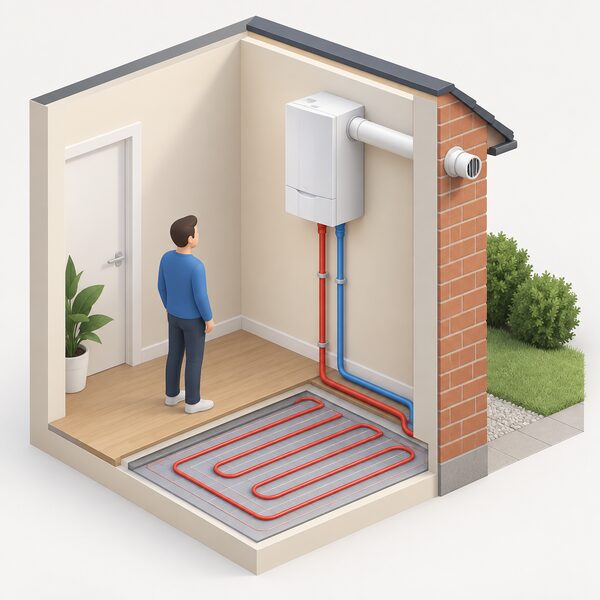
The flow temperature a system runs at is the single biggest influence on how efficiently it heats, and the sources give a spread rather than one number. On the heat pump side, the Standard Assessment Procedure default is a flow temperature of 55°C13, while independent guidance describes heat pumps as usually heating water to a lower temperature, typically around 45°C, against around 60°C from a traditional boiler14. Those two figures are not reconciled in the documents, and the difference reflects design choices rather than a dispute.
On the boiler side, the gap is wider. Many combi boilers are set by default to heat water to 75 to 80°C5, and existing modern condensing boiler systems tend to deliver space heating circulation at higher flow temperatures, typically up to 75°C15. A water underfloor heating system, by contrast, can run with water as cool as 35°C10, and Warmup gives a standard heat source flow temperature range of 55 to 75°C for the primary circuit16.
Nu-Heat's own design position sits at the low end of the boiler range: around 55°C where a system is paired with a boiler4. The practical consequence is that a boiler feeding underfloor heating runs cooler than one feeding radiators, which is what allows it to condense and recover heat from the flue gases. A household should expect the design flow temperature to be set by the installer at commissioning, and to be lower than whatever the boiler was previously set to.
Efficiency: around 25% more than radiators, up to 40% with a heat pump
Nu-Heat states that underfloor heating efficiency is around 25% more than radiators, and up to 40% more efficient when paired with a heat pump6. The same figures appear in the company's product guide17. These are maker figures for the maker's own systems, and they describe a comparison against a radiator system rather than an absolute efficiency.
The mechanism behind the claim is the flow temperature. Water underfloor heating uses water at a lower heat than a radiator, which the independent guidance says ensures the boiler is more efficient9. Radiators typically need water at 55 to 65°C or higher, against a floor system that can run much cooler10. A condensing boiler only recovers latent heat from its flue gases when the return water is cool enough, so a lower flow temperature is what turns the efficiency rating on the boiler into a real saving.
On the heat pump side, the wider context is that heat pumps are up to three times more efficient than other heating systems, according to Welsh Government guidance18. A heat pump running at a low flow temperature into a large floor area is the combination the 40% figure describes, and it is why underfloor heating and heat pumps are so often specified together.
The limits are worth stating. The 25% and 40% figures are comparisons, not guarantees, and they assume the floor is properly insulated beneath and the pipe spacing is right for the room's heat loss. A poorly insulated floor, or one covered with a thick carpet and underlay, will not deliver the output the design assumed.
Cost: £10,000 to £11,000 for a new build, and what drives it
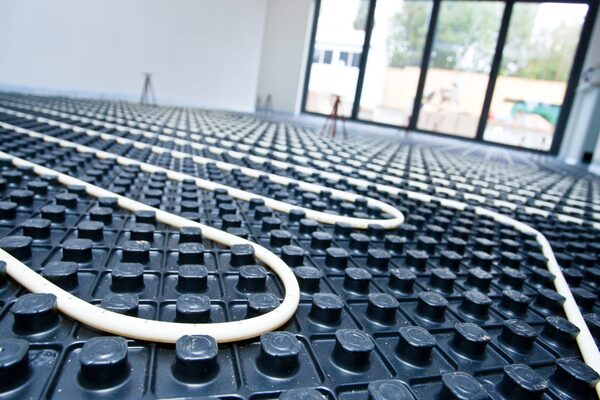
There is no published Nu-Heat list price for a whole-house installation, and quotes come from the design service after a heat loss calculation. The figures that exist elsewhere are indicative. Independent guidance puts a typical air source heat pump installation at around £14,00019, and a case study gives about £10,500 to buy and install a heat pump, with a range from £8,000 to £15,00020. A separate comparison gives heat pumps at £7,000 to £14,00021. These are heat pump costs, not underfloor heating costs, and they are included because the two are frequently quoted together.
For the floor itself, the independent position is that water-based systems cost significantly more, with total costs after installation running into thousands of pounds9. Water underfloor heating is around 25% more expensive to install per m² than electric underfloor heating10, and it is more expensive than radiators to install, though cheaper to run7.
What drives the price is mostly the floor, not the controls. The system is around 130mm thick, or thicker again if it is being retrofitted under an existing floor10, so a build that needs the floor raised pays for that work. Pipe spacing, the number of zones, the manifold size and whether the heat source is being replaced all move the total. Prices are installer-quoted, and the figures above should be read as quoted rather than as confirmed VAT-inclusive prices.
Where water underfloor heating fits: new builds, large zones and retrofits
Warm water underfloor heating is suitable for a wide range of applications, including new builds, extensions, renovations and conversion projects, according to BEAMA22. A separate BEAMA piece gives the same list: new builds, renovations, extensions and conversions23. Independent guidance agrees, describing it as best suited to adding to multiple rooms during home renovations10.
The maker's own guidance is more specific about size: water underfloor heating is ideal for larger zones over 25m²16. That is a practical threshold rather than a rule, and it reflects the fact that a wet system carries a fixed cost for the manifold, pump and controls that is hard to justify in a single small room.
Retrofit is the harder case. Independent guidance states that retrofitting is not normally possible10, and the reason is floor height: pipes are thicker than wires, so there needs to be enough room in the floor for the system, or the ground floor needs to be raised9. Water systems can be around 130mm thick, thicker if retrofitted8. Overlay systems reduce that depth for some renovations, but the floor build-up still has to be resolved.
Pairing with boilers, heat pumps and solar thermal
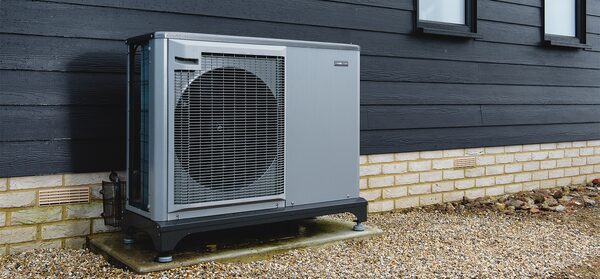
The heat source is the household's main decision, and the controls follow from it. Nu-Heat states that its warm water systems can be fed from any boiler system1, and the design flow temperature of around 55°C where a boiler is used is the figure that makes the pairing work4.
Heat pumps are the natural partner for a low-temperature floor. Welsh Government guidance describes heat pumps as up to three times more efficient than other heating systems18, and most heat pumps will heat hot water to 50 to 55°C very efficiently before a sterilisation cycle raises the temperature further24. The Boiler Upgrade Scheme is open to heat pumps that integrate with solar photovoltaic systems25, which matters for a household planning panels alongside a heat pump.
Solar thermal is the more awkward pairing. Water underfloor heating can be connected to a solar water heating system, or an air or ground source heat pump10, and coupling a solar collector with a heat pump is an established arrangement26. The complication is the boiler: few combi boiler models are compatible with solar thermal systems, because they are not designed to heat water in a cylinder, so a household would likely need to add a solar hot water cylinder and replace the boiler with a conventional boiler or a heat pump27.
For energy independence, the position is mixed. A water underfloor heating system can run from a boiler, a heat pump or a solar thermal array, so the fuel choice stays with the household rather than being fixed by the floor. What it cannot do is remove the dependence on a heat source, a circulating pump and mains electricity, and the neoHub+ route adds a dependence on broadband and the manufacturer's platform for remote control3.
Technical support: free for the lifetime of the system
Nu-Heat offers lifetime technical support, described as available for the full lifetime of the system17, and the design team says it is there to support customers throughout the lifetime of the system4. The technical support line is 014045407458, and the team troubleshoots and resolves issues with a Nu-Heat system8.
The hours are consistent across the company's pages: Monday to Friday, 8am to 5pm12. There is no weekend or evening cover stated. The same team handles design queries, so a household with a question about flow temperature or zoning can reach the people who set the original design.
For faults, the starting points differ by system type. On the electrical side, the checks are whether the system is switched on, whether everything is wired correctly, whether any components are overloaded, and whether there is an electrical supply28. For water underfloor heating, faults can be identified using a thermal camera or a moisture tester8. A thermal camera shows where heat is and is not reaching across the floor, which points to a particular circuit; a moisture tester picks up a leak.
Sources29 cited
- How effective it is to retrofit underfloor heating, Nu-Heat, 2026
- Thermostat troubleshooting, Nu-Heat, 2026
- neo smart underfloor heating with HomeKit, Nu-Heat, 2024
- Underfloor heating design, Nu-Heat, 2026
- One simple way to adjust your boiler to lower your heating bill, Which?, 2025
- Add 270mm of loft insulation to your home, Nu-Heat, 2026
- Underfloor heating costs, Which?, 2026
- Omnie home wiring centre wireless 230V user manual, Omnie, 2026
- Underfloor heating, Energy Saving Trust, 2025
- Electric vs water underfloor heating compared, Which?, 2026
- Installing underfloor heating, Nu-Heat, 2025
- System design, Omnie, 2026
- Low temperature heating, NCM PCDB, 2026
- Heat pumps help and advice, Plymouth Energy Community, 2026
- Controls guide for air to water heat pump systems, BEAMA, 2024
- Water underfloor heating buying guide, Warmup, 2026
- Product guide 2024, Omnie, 2026
- Your essential guide to heat pumps, Welsh Government, 2025
- How to retrofit, ChangeWorks, 2026
- Heat pumps as an employee benefit, Nesta, 2026
- Heat pumps vs boilers, CPA, 2025
- Warm water underfloor heating: the key benefits and where it works best, BEAMA, 2025
- Underfloor heating FAQs: floor coverings, controls and acoustic systems, BEAMA, 2025
- Heat pump myths, Energy Saving Trust, 2025
- Boiler Upgrade Scheme guidance for installers, Ofgem, 2026
- Coupling a solar collector with a heat pump, Solar Heat Europe, 2019
- Solar water heating, Energy Saving Trust, 2026
- What should I check if there is an electrical fault reported on a UFH system, Grant UK, 2026
- Immersion heater advice from the Electrical Safety Council, Electrical Safety First, 2026
 Nu-Heat underfloor heating systemsNu-Heat underfloor heating is designed room by room, so is it worth it compared with radiators, and can it run with a heat pump?