
In this answer
Short answer
A boiler's own thermostat does not do the job of a room thermostat. It controls the temperature of the water flowing through the heating system, not the temperature inside rooms1. A home that relies on it alone has no automatic way of switching the boiler off when the living room reaches the temperature the household actually wants.
The controls a home needs are a set, not a single device. Guidance for homes with a boiler lists a room thermostat, a timer or programmer, boiler and cylinder thermostats and thermostatic radiator valves (TRVs)2. A full set is described elsewhere as a programmer, thermostatic radiator valves and a room thermostat3. The room thermostat is the part that turns the boiler on and off automatically when the room reaches the level chosen4.
So the answer to the question in the title is that the boiler's built-in control covers the water temperature in the circuit, and separate room controls cover the temperature in the rooms and when the heating runs. The two work together. What follows sets out what each part does, what the building regulations require, and how controls are added to an existing boiler.
What the built-in thermostat does and does not cover
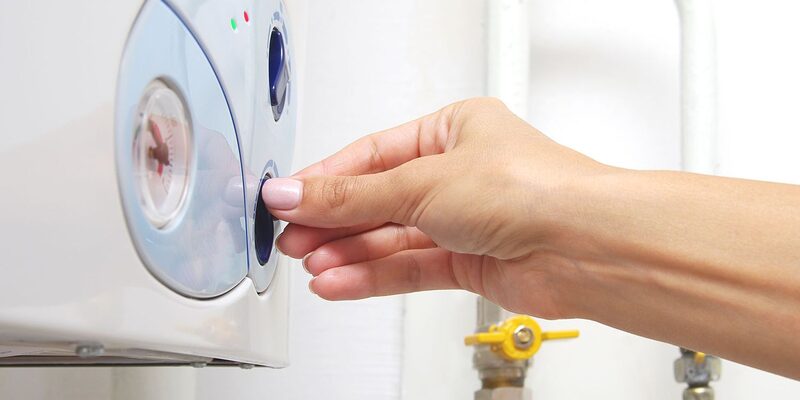
The thermostat on a boiler controls the temperature of the water flowing through the heating system. It does not control the temperature inside rooms1. That distinction is the whole answer to the question. A boiler thermostat set to a given flow temperature will keep the water in the circuit at roughly that level whenever the boiler is firing, and it has no view of the room at all: a room thermostat is the device reacting to the temperature in the room, not in the radiators or the boiler2.
A maker's guidance puts the same point from the other direction: when a room thermostat is doing its work, the thermostat is reacting to the temperature in the room, not in the radiators or the boiler7. The two devices measure different things in different places.
There is a further distinction between levels of control. A non-programmable boiler thermostat offers manual control with the lowest level of efficiency and control precision, and the lowest price tag8. A non-programmable wireless thermostat has no digital screen or programming options, with manual control only via a receiver communicating with the boiler9. These are the entry points of the market, and they are honest about what they do: they switch the boiler, they do not schedule it or sense the room.
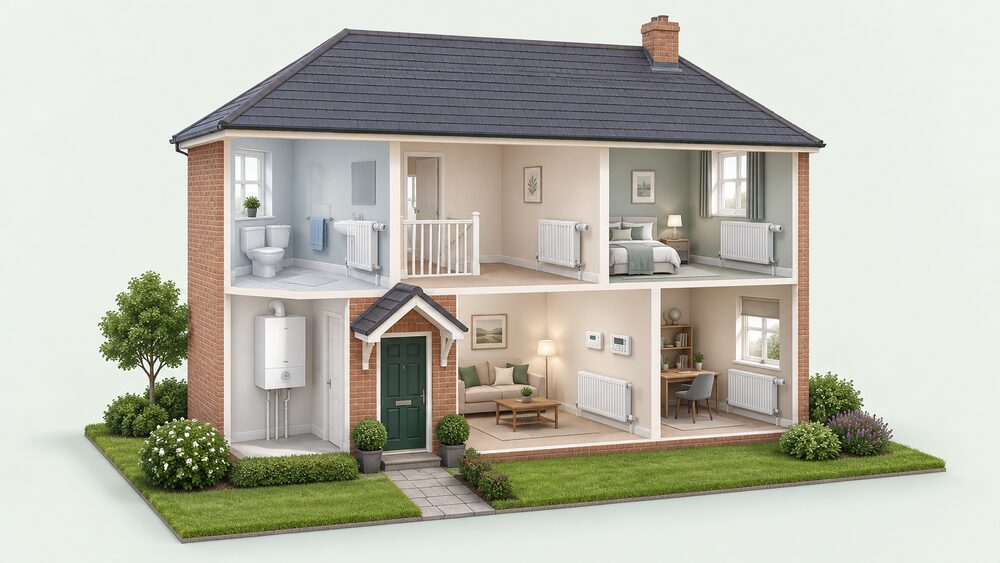
What the boiler's own control cannot do, then, is three things. It cannot sense room temperature, so it cannot stop firing when a room is warm enough. It cannot run to a schedule, so it cannot be set to come on before a household wakes and go off when the house is empty. And it cannot differentiate between rooms, because it has one sensor in one place on the appliance. Those three gaps are what room controls fill.
The full set of boiler heating controls a home needs
The recognised set is consistent across official, independent and supplier guidance, though the wording varies. A full set of heating controls includes a programmer, thermostatic radiator valves and a room thermostat3. For homes with a boiler, the list is a room thermostat, timer or programmer, boiler and cylinder thermostats and thermostatic radiator valves2. Independent guidance for central heating systems such as boilers gives the minimum core as a programmer for time control, at least one room thermostat, and TRVs10.
The building regulations take a firmer line on new work. For heating systems in new dwellings, or when a heat generator such as a boiler is replaced in an existing dwelling, each room should be provided with thermostatic room controls able to separately adapt the heating output in each room served6. The same requirement appears in Approved Document L Volume 1 for England and in the Welsh volume6. Where work is carried out on a system that includes a boiler, a boiler interlock should be installed11. A boiler interlock is the arrangement by which the controls can actually stop the boiler firing when there is no demand, and it is covered in more detail on boiler interlock.
For a new boiler, the stated minimum is a room thermostat and a programmer, or a programmable room thermostat5. Boiler Plus requires time and temperature control for all installations12. One change is worth noting for households looking at grant-funded work: the requirement for a full set of heating controls in the property following a boiler installation was removed from ECO413.
| Control | What it does | Where it is required |
|---|---|---|
| Boiler thermostat | Sets the water temperature in the heating circuit1 | Fitted to the appliance |
| Room thermostat | Turns the boiler on and off when the room reaches the chosen temperature4 | Minimum for a new boiler5 |
| Programmer or timer | Sets when the heating runs10 | Minimum for a new boiler5 |
| Programmable room thermostat | Combines time and temperature control in one unit10 | Accepted alternative to the two above5 |
| TRVs | Control the temperature of each room individually14 | Each room, on boiler replacement or new build6 |
| Cylinder thermostat | Controls stored hot water temperature | Only where a hot water cylinder is present2 |
Room thermostat, timer and TRVs: how they work together
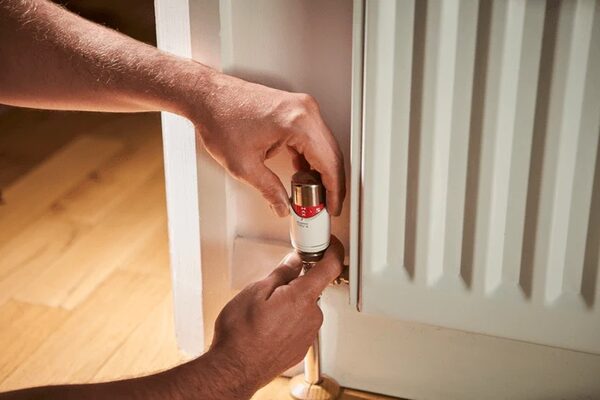
The three parts divide the work. The programmer decides when the heating is allowed to run. The room thermostat decides whether the boiler fires while the programme is active, turning it on and off automatically when the room temperature reaches the level chosen4. The TRVs decide how much heat each radiator releases, controlling the temperature of each room individually by regulating the flow of hot water to the radiator based on the room's temperature14.
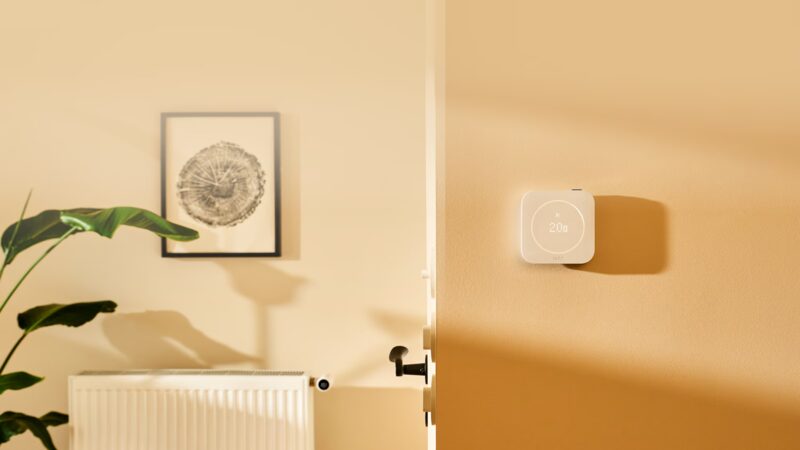
A programmable room thermostat collapses the first two into one unit, combining time and temperature controls and setting different temperatures for different times of the day10. That is why it is accepted as an alternative to a separate programmer and thermostat5.
TRVs are the room-by-room layer. They control the temperature of each room by opening and closing automatically to control the flow of hot water through the radiator they are fitted to13. A TRV gives better control over individual room temperatures15. Programmable TRVs go further, adding timing control so each radiator can come on at different times and heat each room to its own schedule10. The practical pattern is to adjust TRVs in different rooms based on usage, turning them down in unused rooms16. A maker's guidance describes the best approach as a combination of a central room thermostat, which controls the boiler directly, and TRVs on each radiator17.
One rule governs the relationship between the two layers. TRVs should not be used in the same room as the thermostat, because the two will compete18. Approved Document L states it as a requirement: thermostatic radiator valves should not be used in the same room as the thermostat, and heat emitters in the same room as the thermostat should have manual controls6. The reason is straightforward: if a TRV shuts the radiator in the room where the thermostat sits, the thermostat never reaches its setpoint, and the boiler keeps running for the rest of the house. Siting is covered further on room thermostats.
When the boiler's own control is enough
There is no case in the guidance for relying on the boiler thermostat alone in a home with radiators. The minimum for a new boiler installation is a room thermostat and a programmer, or a programmable room thermostat5, and Boiler Plus requires time and temperature control for all installations12. The building regulations require thermostatic room controls in each room when a boiler is replaced6.
The evidence for why this matters is in how boilers run. Boilers in homes with effective individual room temperature controls operated in highly efficient condensing mode for more than 80% of their running time1. That figure is about the share of running time spent condensing, and it depends on the controls being effective, not merely present.
The boiler's own control remains useful, and adjusting it is part of running a system well. Turning the flow temperature down is a recognised measure, but it interacts with the rest of the controls: if the heating controls are not set correctly when the boiler thermostat is adjusted, the expected results may not follow19. That is the practical argument for treating the boiler thermostat and the room controls as one system rather than alternatives.
Where a home has a combi boiler, the picture is simpler in one respect. The combi is controlled by a room thermostat20, and because it heats water on demand there is no stored hot water to control. A household wanting a cylinder would need to install one to heat and store hot water21. That is a change of system, not a change of control.
Adding separate room controls to an existing boiler
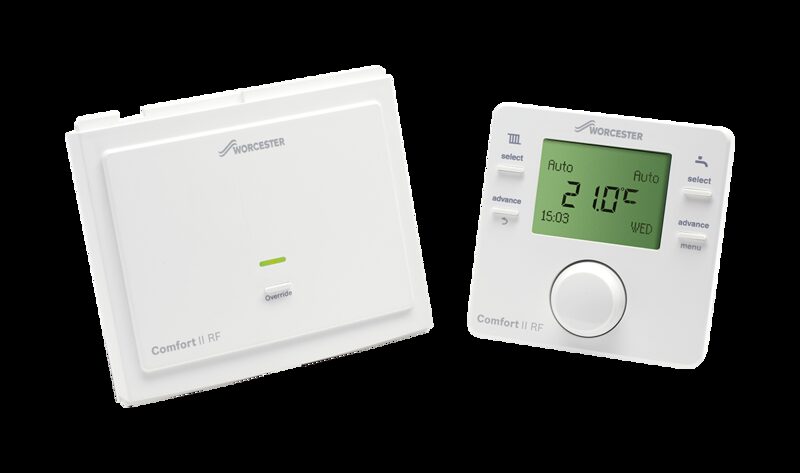
Controls can be added to an existing boiler, and the route depends on what is already there. A wireless thermostat sends a wireless signal to a receiver connected to the boiler, which tells the boiler when to turn the heating on or off, without a direct wired connection between thermostat and boiler22. Some wireless models are designed to replace existing wireless room thermostats, controlling the boiler23. Others can be added to a boiler that is not yet connected to a room thermostat23.
The wiring does not disappear. Many boilers are not Wi-Fi-enabled, so smart or wireless thermostat systems often include a receiver or hub that must be wired to the boiler, and that wiring should be done by a trained professional22. A wireless thermostat itself needs no complex installation and links to a wireless thermostat receiver rather than being wired to the boiler9. The receiver is the part that connects to the appliance.
Compatibility is the check to make before buying. Before buying a smart thermostat, check that it is compatible with your boiler and heating system, usually in the product description or on the thermostat manufacturer's website22. Boiler makers publish their own compatibility: the Vaillant ecoTEC sustain combi boiler range is compatible with the wide range of Vaillant room thermostats, wired and wireless controls24. Compatibility is covered in more depth on smart thermostat boiler compatibility.
On the value of the upgrade, one independent view is that upgrading thermostats and radiator controls, which enable different temperatures for each room, can be an additional selling point25. For a household, the gain is control: a schedule, a room setpoint, and per-room trimming. The dependence that remains is on the boiler itself, on the gas or oil supply that feeds it, and, where a smart thermostat is used, on the manufacturer's app and cloud service for remote features. Local control at the wall continues to work if the cloud does not.
Sources25 cited
- Smart heating controls: what they do and why they matter, BEAMA, 2025-04-07
- Thermostats and heating controls, CAT, 2025-06-27
- Energy efficiency advice, Cadent Gas, 2026-09-20
- How to use your heating controls, Age UK, 2026-03-23
- Upgrading and replacing your boiler, Centre for Sustainable Energy, 2026-06
- Building Regulations Approved Document L Volume 1 2026, Welsh Government, 2026-04
- Boiler thermostats: a complete guide, Ideal Heating, 2026-09-17
- Boiler thermostat, Netatmo, 2026-09-20
- Wireless thermostat, Netatmo, 2026-09-20
- Thermostats and heating controls, Energy Saving Trust, 2026-02-10
- Approved Document L Volume 1, 2021 edition incorporating 2023 amendments, HM Government, 2026-09-17
- Boiler Plus, Baxi, 2026-09-17
- ECO4 new measures and products guidance v3.0, Ofgem, 2025-08-07
- Radiator valves, Smart Energy GB, 2026-04-22
- Energy efficiency, Welsh Government, 2026-09-17
- The best way to run your central heating to save money, ivie, 2026-09-20
- Central heating controls, tado°, 2026-07-07
- Best smart radiator valves, Which?, 2026-09
- Should I turn my boiler's flow temperature down?, Energy Saving Trust, 2026-05-20
- What is a combi boiler?, Worcester Bosch, 2026-09-17
- Deciding if a heat pump is right for you, Citizens Advice, 2025-12-08
- What is a smart thermostat?, Smart Energy GB, 2026-08-19
- Boilers and underfloor heating, tado°, 2026
- Vaillant ecoTEC sustain combi boilers, Quiet Mark, 2026-09-17
- 5 important heating checks for oil households, OFTEC, 2026-08-13
 Hot Water Cylinder ControlsWhat temperature should a hot water cylinder thermostat be set to, and does it need its own timer apart from the heating?
 Controls, Thermostats and TRVsWhich heating controls actually cut your bills, and what does each one do?
 Thermostat and Room TemperaturesWhat temperature should a thermostat be set to, and does it differ from room to room?
 Controls and Smart OperationWhy does a heat pump need different controls from a boiler, and what does weather compensation actually do?
 Underfloor Heating ControlsHow do you set different room temperatures with underfloor heating, and stop the floor getting too hot?
 Boiler SizingWhat size boiler does your home actually need, and does the number of bedrooms or radiators decide it?