
In this answer
Short answer
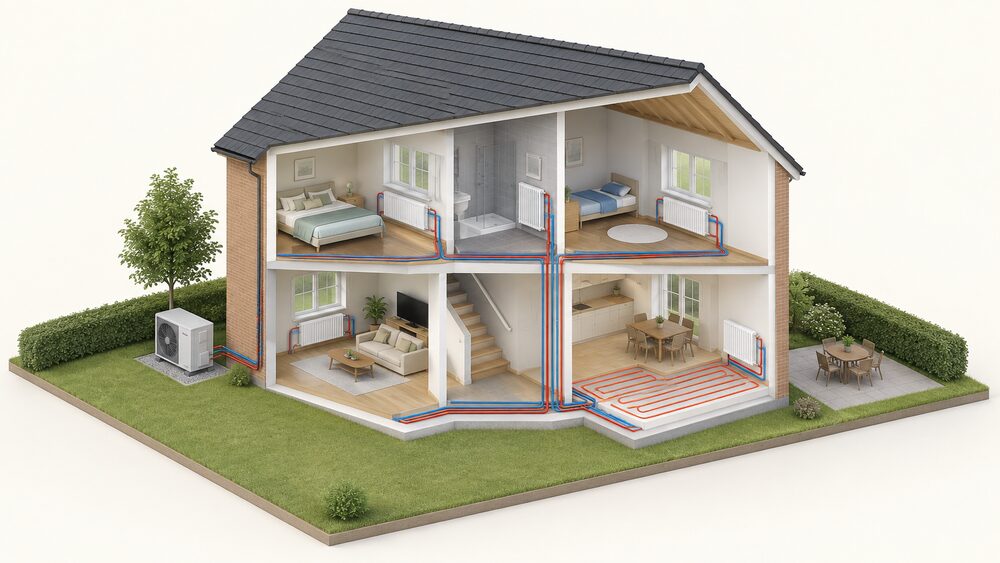
Yes, a heat pump needs hydraulic balancing. It is the process of optimising how water is distributed around a building's heating system, and its goal is to ensure that every radiator or underfloor heating loop receives exactly the right amount of heated water to reach the desired room temperature1. Without it, the heat pump may short-cycle and lose efficiency2.
The reason it matters more with a heat pump than with a boiler is the way efficiency is won. Heat pumps operate more efficiently when the source temperature is higher and the sink temperature is lower, and the key factor is the temperature difference between the source temperature entering the heat pump and the distribution temperature leaving it: the smaller that difference, the more efficient the system3. Balancing is what allows the distribution temperature to be set as low as the emitters will actually support, rather than as high as the worst-performing radiator demands.
Balancing is not a separate product or an optional extra. It is a commissioning step, carried out when the system is first set running and rechecked whenever the system changes1. The Building Regulations require heat pumps and their dedicated ancillary products, such as integrated hot water storage vessels, to be commissioned in accordance with both the manufacturer's instructions and the appropriate system design parameters4.
What hydraulic balancing is, and why a heat pump needs it
Hydraulic balancing, often called hydronic balancing, is the process of optimising the distribution of water throughout a building's heating or cooling system1. In a domestic heating system that means setting the flow through each emitter so that the whole house reaches its target temperature at the same time, rather than the nearest radiators taking the bulk of the water and the furthest ones running cool.
The goal is specific: to ensure that every radiator or underfloor heating loop receives exactly the right amount of heated water to reach the desired room temperature1. That is a design condition, not a comfort preference. A heat pump is sized against a calculated heat loss for the property, and the emitters are specified to deliver that heat at a chosen flow temperature. If the water does not divide as designed, some rooms are under-served and the system as a whole cannot meet the design condition at the intended temperature.
The efficiency consequence is direct. Heat pumps operate more efficiently when the source temperature is higher and the sink temperature is lower3. The sink temperature here is the water leaving the heat pump for the heating circuit. A balanced system lets that distribution temperature sit lower, because no single emitter needs a higher temperature to compensate for a shortage of flow. The key factor influencing the efficiency of a heat pump system is the temperature difference between the source temperature entering the heat pump and the distribution temperature exiting it, and the smaller this difference the more efficient the system7.
This is also why balancing sits alongside the other design variables rather than replacing them. Heat pump efficiency depends on system design, operating temperatures, building fabric performance, emitter sizing, controls strategy and commissioning quality8. Balancing is the commissioning part of that list, and it is the part that makes the emitter sizing and the controls strategy actually work as intended.
For a household's energy independence, balancing is what converts a correctly specified heat pump into a system that runs at its design efficiency on electricity the household buys, rather than at a compromised efficiency that erodes the running-cost case. It does not remove dependence on the grid or on a supplier; it determines how much electricity the system draws to deliver the same warmth.
When balancing is done: at commissioning and after system changes
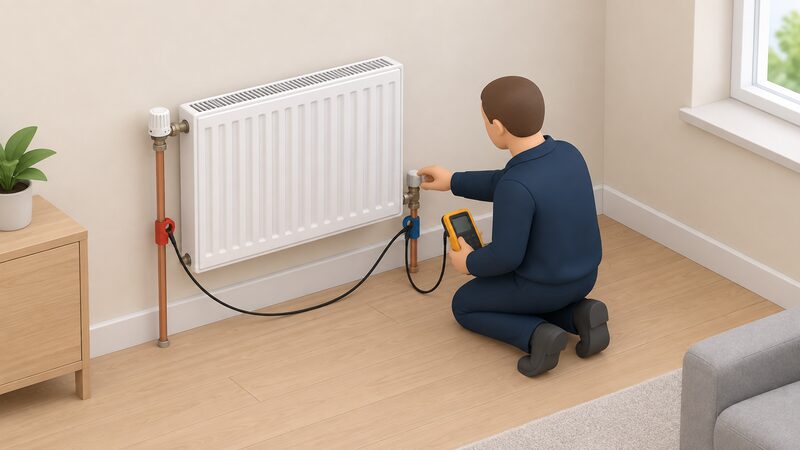
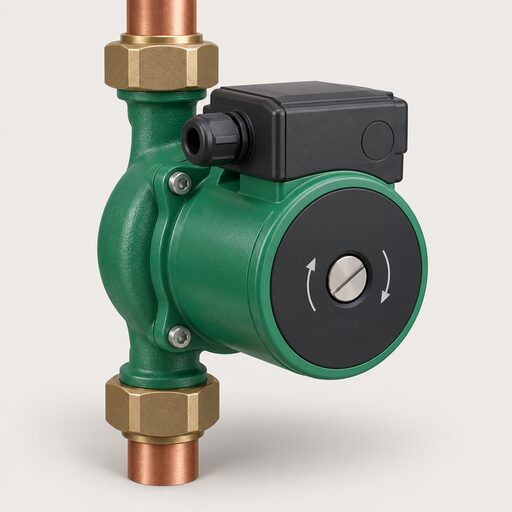
Hydraulic balancing is typically done during commissioning of a new heat pump system, and should be rechecked after changes such as replacing radiators or valves, adding or modifying underfloor heating circuits, changing pump settings, or a major renovation affecting heat demand1. Balancing should be completed during commissioning2.
Commissioning itself is a regulatory requirement, not a courtesy. Heat pumps and any dedicated ancillary products such as integrated hot water storage vessels should be commissioned in accordance with both the manufacturer's instructions and the appropriate system design parameters4. The Approved Document L guidance for dwellings also expects that heat pump systems have been sized appropriately and that the system has adequate controls9. Heat pumps should be selected to meet the full space heating requirement at the design condition chosen for heat loss calculations4.
The practical sequence for a household is:
- Heat loss calculation and system design, which set the flow temperature and emitter sizes.
- Installation of the heat pump, cylinder and any emitter changes.
- Commissioning, including balancing, with the system run and adjusted under real conditions.
- Handover, with controls set up and the household shown how the system runs.
The installation itself typically takes around three days, but may take longer5. Balancing sits inside that window rather than adding a separate visit.
The recheck point is the one households most often miss. A system balanced at commissioning drifts out of balance when the hardware around it changes. A radiator swapped for a different size, a valve replaced, an underfloor circuit added, or pump settings altered all change how water divides through the circuit. A major renovation that changes heat demand does the same. None of these is a fault; each is a reason to have the system rebalanced.
What happens if a system is left unbalanced

The documented consequence is short cycling. If a system is left unbalanced, the heat pump may short-cycle and lose efficiency2. Short cycling is the repeated stopping and starting of the compressor as the system satisfies and then immediately loses its heat load, and it can reduce efficiency, place unnecessary strain on the system and make temperatures less consistent10.
There is a second route to the same behaviour that is worth separating out, because it is not a balancing fault. Variable capacity control heat pumps cycle on and off below a certain capacity limit3. That is a characteristic of the equipment at very low loads, not a symptom of poor water distribution. The two can look similar from the outside, which is one reason diagnosis belongs with someone who can measure the system rather than guess at it.
The consequences of sustained short cycling are set out plainly in guidance on common heat pump mistakes: narrow bandwidths and fast switching result in short cycling, higher energy costs, and a significantly shorter lifespan for the equipment11. That last point connects balancing to the household's capital, not just its bills. A well-maintained heat pump should last for 20 years or longer6, and a system that cycles hard for years works against that expectation.
There is also a harder failure mode recorded in official research. In a study of heat pump performance in real homes, some participants reported how their heat pumps had developed major system faults, leading to significant discomfort, with no effective pathway to resolve the issue12. That is the extreme end, and it is not attributed to balancing alone, but it shows what a household is exposed to when a system is not performing as designed and the cause is not identified.
For energy independence, an unbalanced system is a quiet tax. The household still buys the same electricity from the same supplier, but each unit of heat delivered costs more of it, and the equipment carrying the load is worked harder than the design intended.
Is balancing required in the UK, and what do subsidy rules say?
There is no single UK regulation that says "hydraulic balancing must be certified". What exists is a chain of requirements that balancing satisfies in practice.
The Building Regulations require heat pumps and their dedicated ancillary products to be commissioned in accordance with both the manufacturer's instructions and the appropriate system design parameters4. Approved Document L expects heat pump systems to have been sized appropriately and to have adequate controls9. In Wales, installation of either a ground source or air source heat pump will have to comply with the Building Regulations13. A system that has not been balanced has not been commissioned to its design parameters, so the requirement bites even though the word "balancing" does not appear in it.
On certification, heat pumps sit under the MCS 007 standard14. MCS certification is the route by which installations are recognised for grant purposes, and the standard covers the installation rather than naming balancing as a separate deliverable.
On grants, the position is more limited than some marketing suggests. Many government heat pump grants require proof of hydraulic balancing to ensure the installed system meets energy-saving targets1. That statement comes from a manufacturer and is framed generally rather than as a UK rule. No UK grant condition requiring a balancing certificate is set out in the published guidance reviewed here, so households should treat claims of a mandatory balancing certificate with caution and check the specific scheme rules.
What is clear is the direction of UK policy on where heat pumps can go. Amendments to permitted development rights in England include the removal of the rule that a heat pump must be installed at least one metre from the property boundary15. Air source heat pump installation is permitted development in England, though listed buildings require planning permission and listed building consent16. None of this changes the commissioning requirement.
"Heat pumps and any dedicated ancillary products such as integrated hot water storage vessels should be commissioned in accordance with both the manufacturer's instructions and the appropriate system design parameters."
How balancing fits with efficiency and running costs

Balancing is one of several variables that decide what a heat pump costs to run, and it is the one that is fixed at commissioning and then forgotten.
The efficiency chain runs like this. Heat pumps operate more efficiently when the source temperature is higher and the sink temperature is lower3. The key factor is the temperature difference between the source temperature entering the heat pump and the distribution temperature exiting it, and the smaller this difference the more efficient the system7. Balancing allows a lower distribution temperature by making sure no emitter is starved of flow. Heat pump efficiency depends on system design, operating temperatures, building fabric performance, emitter sizing, controls strategy and commissioning quality8.
At current energy prices, running costs for heat pumps are around the same as for a new gas boiler17. That comparison assumes a system performing as designed. A system that short-cycles because it is unbalanced is not performing as designed, and the running-cost comparison no longer describes it.
Where a hybrid system is fitted, the control logic adds a further layer. A hybrid heat pump is a system that uses a standard heat pump with another heat source, usually a gas, oil or LPG boiler18. The boiler can provide additional support when demand is higher, such as during colder weather or when extra hot water is needed19. Having the hybrid system react to fuel prices should mean the boiler only turns on when it is cheaper to run than the heat pump, lowering overall operating costs compared to running either on its own18. Official methodology sets the rule for when that switch is worthwhile: the ratio of the heat pump COP to the boiler efficiency must be greater than the ratio of the unit costs of the heat pump's energy source and the boiler's energy source3. A hybrid system will have a dedicated controller controlling all heat sources20.
For a household, the independence picture is mixed and worth stating plainly. A well-balanced heat pump runs at its design efficiency on electricity, which a household can increasingly generate or buy on a tariff of its choosing, and it removes gas from the space heating and hot water load. What remains is dependence on the electricity grid and a supplier, and on the manufacturer for parts and controls. A hybrid system keeps a gas or oil boiler in the property, so it retains a fuel dependence as well. Balancing does not change any of that; it determines whether the equipment bought delivers the efficiency it was specified for.
Radiators, underfloor heating and who does the work
The principle of balancing is identical whatever the emitter: every radiator or underfloor heating loop should receive exactly the right amount of heated water to reach the desired room temperature1. What differs is the flow temperature the emitter type supports, and therefore how much efficiency is available.
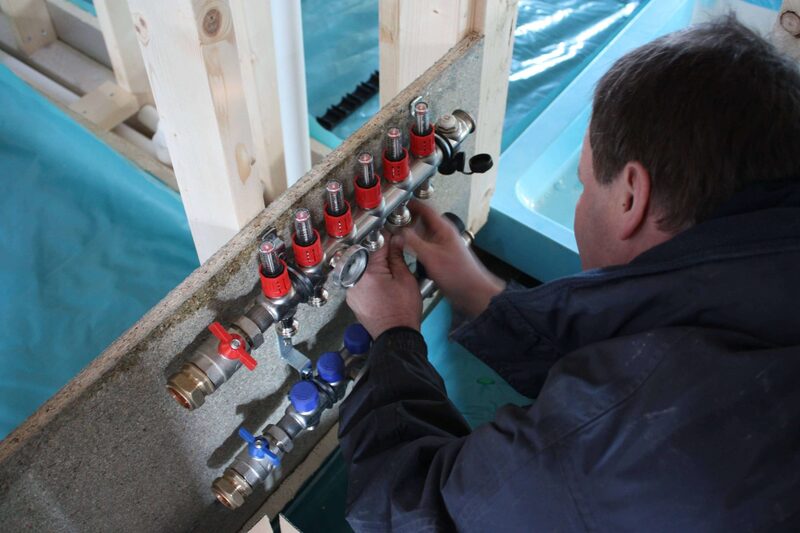
With underfloor heating, the flow temperature could be lower compared with radiators, and this should result in the heat pump running much more efficiently21. Underfloor heating systems work particularly well with heat pumps because they provide consistent warmth at lower temperatures22. Having underfloor heating usually works well for heat pumps23, and underfloor heating is often installed in combination with a heat pump and works with all types of heating systems24.
Heat pumps can work with radiators or underfloor heating, but some types can work without either25. Where radiators are retained, existing radiators may need upgrading or resizing22. Heat pumps distribute heat through radiators, underfloor heating, or a hot water tank, depending on the setup26.
| Emitter type | Balancing point | Flow temperature implication |
|---|---|---|
| Radiators | Lockshield valve at each radiator | Higher flow temperature than underfloor, so less efficiency available21 |
| Underfloor heating | Manifold loop valves | Lower flow temperature possible, so the heat pump runs more efficiently21 |
| Mixed systems | Both, as separate circuits | Each circuit balanced to its own design condition1 |
On who carries it out, the requirement is competence rather than a named trade. The person carrying out the work should be suitably competent9. Heat pumps must be commissioned in accordance with both the manufacturer's instructions and the appropriate system design parameters4. In practice the installer also helps with heating controls and performance and helps set up the system to run on the household's preferred schedule27. Where a hybrid system is installed, installers will also require skills for both heat pumps and condensing gas boilers28.
Sources28 cited
- Hydraulic balancing and its effect, iDM Energie, 2026-07-06
- How important is balancing a heat pump system, Alpha Innovation, 2026-08-03
- HEM heat pump methodology, UK Government, 2026-01
- Approved Document L, Conservation of fuel and power, Volume 1: Dwellings, UK Government, 2026-09-17
- Heat pump installation: a step by step guide, Energy Saving Trust, 2026-07-15
- Heat pumps, Home Energy Scotland, 2026-09-20
- Introduction to water source heat pumps, Renewables First, 2026-04-08
- Heat pumps campaign, CIBSE, 2026-09-17
- Approved Document L, Volume 1: Dwellings, UK Government, 2026
- Heat pump heat loss calculation explained, Aira, 2026-08-19
- Common heat pump mistakes and how to prevent them, Homey, 2026-09-20
- Heat pump transition report, UK Government, 2026-05
- Building regulations: heat pumps, Welsh Government, 2026-09-17
- MCS microgeneration certification, BSI, 2026-09-17
- Amendments to the Boiler Upgrade Scheme: government response, UK Government, 2025-11
- Air and ground source heat pumps, Croydon Council, 2026-09-17
- Heat pump fact check, Energy Saving Trust, 2026-07-01
- Hybrid heat pumps, Energy Saving Trust, 2026-07-16
- Hybrid heat pumps, SGN, 2026
- Domestic heat pump guide, MCS Certified, 2024-04-02
- Underfloor heating, Energy Saving Trust, 2025-10-02
- Is your home suitable for a heat pump?, The CPA, 2026-02-18
- In-depth guide to heat pumps, Energy Saving Trust, 2026-07-16
- Underfloor heating systems, NICEIC, 2026-09-17
- Renewable Heat Incentive: right your home, Energy Saving Trust, 2026-05-19
- How heat pumps work: a guide for homeowners, NICEIC, 2025-09-17
- How smart meters work with heat pumps, Smart Energy GB, 2026-04-24
- Hybrid heat pumps, HHIC, 2026-09-17
 System Design and BalancingWhy do some radiators stay cold while others get too hot, and what does balancing actually do?
 Radiators and EmittersWill your radiators still heat the house properly with a heat pump?
 Heat Pump Electricity TariffsA heat pump tariff gives you cheaper electricity for part of the day, so running your heating costs less than on a standard rate.
 Controls and Smart OperationWhy does a heat pump need different controls from a boiler, and what does weather compensation actually do?
 Servicing and MaintenanceHow often does a heat pump need servicing, and what actually happens during the visit?
 Using a Heat Pump for CoolingCan a heat pump cool your home in summer as well as heat it in winter?