
In this answer
Short answer
New radiators are not mandatory for a heat pump, but bigger ones often help. The Energy Saving Trust puts it plainly: it is not mandatory, but bigger radiators could hugely improve how well a heat pump can heat your home1. The reason is temperature. A boiler typically runs at 75°C, while 45°C is usual in heat pumps, so a radiator that was fine on the boiler may not be big enough at the lower figure2.
Where a heat pump replaces a gas or liquid fuel system, it will usually need more or larger heat emitters, or substantially improved building insulation, to be at its most efficient3. OFTEC notes that it is probable the radiators will have to be changed for larger ones to produce an equivalent heat output, unless a high temperature output heat pump is installed4. The Renewable Energy Consumer Code is blunter: if you use radiators, they need to be large ones since the heat produced will be low in temperature5.
The practical answer is that a heat loss survey decides it, room by room. Some homes keep every existing radiator; others change a few; others add emitters or move to underfloor heating. This page sets out what drives the decision, what the upgrade options are, and how cost and VAT work.
Why heat pumps run cooler than a boiler
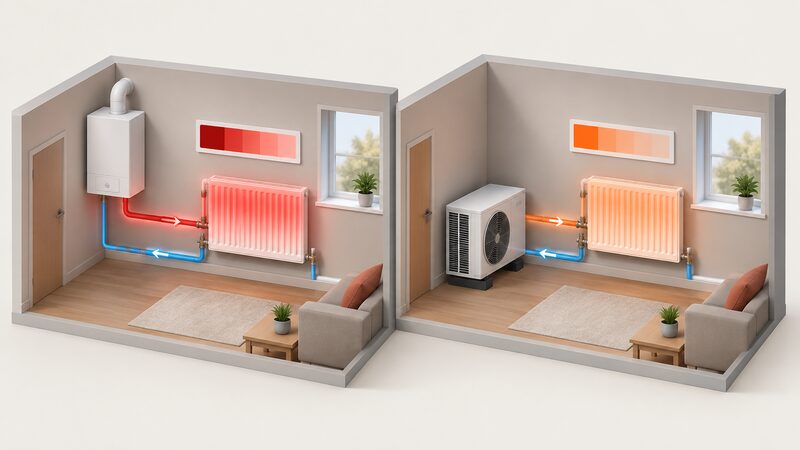
Heat pumps send water to pipes and radiators at a lower temperature than traditional gas or oil boilers10. They run at lower temperatures than gas or oil boilers, so they need longer run times and often larger radiators to deliver the same warmth11. The Energy Saving Trust's installation guide gives the working range: heat pumps typically send hot water to radiators at a lower temperature than an equivalent fossil fuel central heating system, often between 35 and 45°C6. Energy UK gives 55°C as an example in line with Building Regulations12.
The consequence for an existing system is arithmetic. Your radiators might have been fine when connected to a boiler, which typically runs at 75°C, but if the temperature of the water in the system drops to 45°C, which is usual in heat pumps, your radiators won't be big enough2. Output from a radiator falls as the water in it gets cooler, so the same panel that heated a room at 75°C may leave it short at 45°C.
Lower flow temperatures are not a defect. They are what makes a heat pump efficient, and the effect is largest where the emitter is designed for it. With underfloor heating, the flow temperature could be lower compared with radiators, and this should result in the heat pump running much more efficiently10. The trade-off is that the emitter has to be able to give the room its heat at that lower temperature, which is a question of surface area and insulation rather than of the heat pump itself.
What decides whether your radiators are big enough
Three things decide it: the heat loss of the room, the surface area of the emitter, and the insulation of the building. Radiator sizing depends on the area of the room, the amount of doors and windows, and the insulation levels of your home13. A large, draughty room with a single glazed bay needs more emitter output than a small, well insulated one, and the same radiator can be adequate in one and not the other.
Insulation and emitters are alternatives to a degree. To be at their most efficient, heat pumps will usually need more or larger heat emitters, or substantially improved building insulation, when installed as a replacement for gas or liquid fuel heating3. UKIFDA makes the same point from the off-grid side: as heat pumps are most efficient when producing heat at lower temperatures than conventional boilers, more radiators are often needed or improved building insulation is required when installed in place of a liquid fuel or gas heating system14.
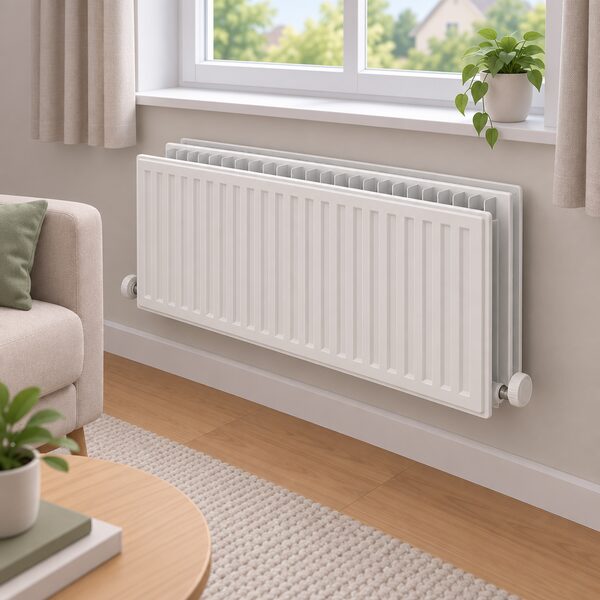
Surface area is the lever a household controls most directly. Bigger means more surface area, which could mean using a double or triple panel radiator1. There are also radiators that do not take up extra wall space: these are double or triple panel radiators2. Where wall space is tight, adding panels to an existing radiator position is often the route, rather than a longer radiator.
The assessment itself is a heat loss calculation, done room by room before installation. A survey will identify what is necessary before installation, and not all systems require radiator replacement15. That survey is also where pipework is judged, since narrow old pipework can limit what a new emitter can deliver.
Upgrade options: panels, extra radiators, pipework, underfloor
The upgrade is not a single product. It might include upgrading pipework, installing underfloor heating, putting in larger radiators16. A household case study from the Energy Saving Trust describes the same set: you don't need underfloor heating with a heat pump, but you might need larger radiators and some new pipework17.
Heat pumps can work with radiators or underfloor heating, but some types can work without either18. Where radiators stay, the industry guidance is that heat pumps benefit from the use of larger radiators or underfloor heating19. NICEIC describes the distribution side simply: warming your radiators, underfloor heating, or hot water tank, depending on your setup20.
Underfloor heating is the emitter that suits low flow temperatures best. Underfloor heating systems work particularly well with heat pumps because they provide consistent warmth at lower temperatures21. It is often installed in combination with a heat pump, and works with all types of heating systems22. It is not a requirement, and it is not always practical: retrofitting it into an existing ground floor is a bigger job than changing a radiator.
| Option | What it does | Where it fits |
|---|---|---|
| Larger panel radiator | More surface area at the same wall position | Rooms with limited wall space1 |
| Double or triple panel | Extra panels without extra wall space | Tight rooms needing more output2 |
| Extra radiators | More emitter area across the room | Larger or extended rooms16 |
| New pipework | Lets emitters receive the flow they need | Older systems with narrow pipe runs17 |
| Underfloor heating | Consistent warmth at lower temperatures | Retrofit or new floors, often with a heat pump21 |
Cost and VAT when radiators change with a heat pump
Radiator replacement can increase upfront costs, but not all systems require radiator replacement15. Where it is needed, the cost sits inside the wider installation. Cost modelling for heat pumps includes one-off installation costs including some home retrofit costs such as replacing radiators23. The Energy Saving Trust's assumptions for heat pump costs include the unit price, materials and labour for installation, and may include any associated necessary upgrades to heating systems such as hot water tanks, new radiators and pipework, including VAT, while excluding simultaneous insulation works14.
The overall installation cost depends on the size of your property, whether you live in a new build or an existing house, and how much work is needed to adapt your existing heating system24. One modelled figure puts the cost to switch to a heat pump at £500, factoring in the government grant and not needing to replace the old boiler25. That figure is a model, not a quotation, and it assumes no boiler replacement; radiator work is one of the variables that moves it.
VAT is the part households most often miss. Radiators are currently zero-rated in terms of VAT if installed alongside a heat pump7, and heat pump installations benefit from being exempt from VAT8. The zero rating attaches to the installation, so a radiator swapped in as part of that job is treated differently from a standalone radiator purchase.
Where a radiator upgrade falls short
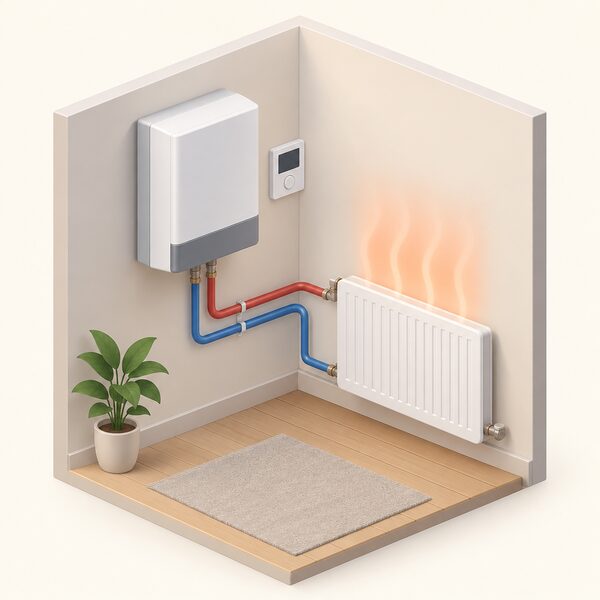
Bigger emitters do not fix a fabric problem. Where a home is poorly insulated, the choice is between more emitter area and improved insulation, and the guidance treats them as alternatives: more or larger heat emitters, or substantially improved building insulation3. Adding radiators without addressing heat loss raises the emitter area needed for the same rooms.
There is also a policy question about whether upgrades should be compulsory. Regulation could accelerate this shift by requiring low-temperature suitable radiators and pipework at boiler replacement or during major renovations, but such an approach risks adding unnecessary cost, especially if high-temperature heat pumps become the norm7. That is a proposal under discussion, not a current requirement, and it is the reason the answer to the headline question is conditional rather than fixed.
For a household, the dependence that remains is the same as for any wet heat pump system: the electricity supply, the installer's design, and the manufacturer behind the controls and any app. A radiator upgrade changes how well the heat pump performs in the home; it does not change where the heat comes from. The wider picture is set out in radiators and emitters for heat pumps and in the full UK heat pump guide.
Bleeding, sludge and radiator condition
Radiator condition matters as much as size. Many existing radiators can work with a heat pump, but it depends on their size, condition, and how your current heating system is set up15. A system carrying sludge will not perform, whatever the emitter size.
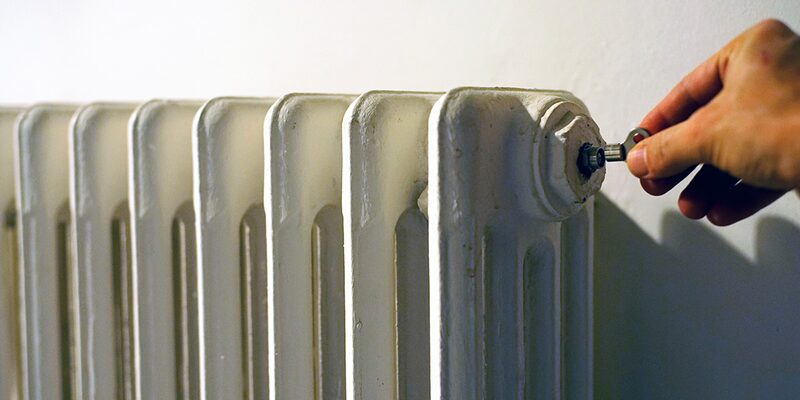
The clearest signs that your radiators need bleeding are a radiator that is cold at the top, slow to warm up or making gurgling noises9. Bleeding usually only takes a few minutes per radiator9. As a general rule, about once a year, ideally before winter when you start using the heating more regularly9. USwitch advises checking radiators at least once a year to see if they need bleeding30, and suggests bleeding at least once a year, but preferably every few months31.
A different symptom points elsewhere. If the top of the radiator is cool, or much colder than the bottom of the radiator, it is a sign your radiators need bleeding32. But if a radiator is hot at the top and cold at the bottom, the problem might be sludge or debris in the system, which can be flushed out by a professional9. USwitch states that if radiators are hot at the top and cold at the bottom, they'll need a power flush30.
Sources32 cited
- Heat pump fact check, Energy Saving Trust, 2026-07-01
- How to ensure a heat pump runs efficiently, Energy Saving Trust, 2026-05-19
- What heating options are available off the grid?, OFTEC, 2026-09-20
- Your home guide to heat pumps, OFTEC, 2026-09-17
- Consumers, RECC, 2026-09-17
- Heat pump installation: a step by step guide, Energy Saving Trust, 2026-07-15
- How to get homes more ready for heat pumps, part 2, Nesta, 2026-02-12
- Heat pump, UK Government, 2026-09-10
- How to bleed a radiator, Smart Energy GB, 2026-08-17
- Underfloor heating, Energy Saving Trust, 2025-10-02
- Heat pump guide UK: air source vs ground source explained, IAA, 2026-09-20
- Home heating, Energy UK, 2025-04-04
- Essential guide to home heating, Joule, 2026-09-17
- How to make heat pumps more affordable: assumptions and methods, Nesta, 2024-06-13
- Do I have to change my radiators if I get a heat pump?, Mastertherm, 2026-02-11
- Heat pump inheritance, Energy Saving Trust, 2025-07-04
- Russell and Kate's story: solar panels and a heat pump, Energy Saving Trust, 2026-08-13
- Heating your home, Energy Saving Trust, 2026-05-19
- Heat pumps, REA, 2026-09-17
- How heat pumps work: a guide for homeowners, NICEIC, 2025-09-17
- Is your home suitable for a heat pump?, CPA, 2026-02-18
- Underfloor heating system, NICEIC, 2026-09-17
- HFC phasedown reform de minimis assessment, Defra, 2025-09-02
- In-depth guide to heat pumps, Energy Saving Trust, 2026-07-16
- Flexible futures: integrating smart tariffs with low-carbon home technologies, Energy Saving Trust, 2026-07-10
- Building regulations: energy efficiency, Planning Portal, 2026
- Building regulations extensions: energy efficiency, Welsh Government, 2026-09-17
- Building regulations: energy efficiency, Planning Portal, 2026
- ECO4 new measures and products guidance v3.0, Ofgem, 2026-03-26
- Boiler maintenance, USwitch, 2026-09-03
- How to bleed a radiator, USwitch, 2026-09-04
- How to bleed your radiators, Which?, 2025-09-16
 Radiators and Heat EmittersA radiator's real heat output depends on how hot the water inside it is compared with the room, so the figure in a catalogue often overstates what you will actually get.
 Radiators and EmittersWill your radiators still heat the house properly with a heat pump?
 Heat Pumps vs BoilersWill a heat pump actually cost less to run than my boiler, and does it heat the house as well?
 Sizing and Heat LossHow do installers work out what size heat pump your home needs, and why can a unit that is too big cost more to run than one that is slightly small?
 Boiler SizingWhat size boiler does your home actually need, and does the number of bedrooms or radiators decide it?
 Replacing a Gas or Oil BoilerSwapping a gas, oil or LPG boiler for a heat pump changes how your home is heated and how much it costs.