

In this guide
A domestic heat pump installation is a designed project, not a swap. It begins with a survey that calculates the home's heat demand, moves through a quotation and grant stage, and ends with commissioning, a compliance certificate and a handover pack. The fitting itself typically takes around three days, though it may take longer depending on the property, and one documented case study reports a full week during which the household stayed in the home1.
The sequence matters because most of the risk sits before the first pipe is cut. A heat pump must be sized to the building's actual heat loss, the emitters and cylinder must match the design flow temperature, and the electrical supply must be checked against the connection rules. Most heat pump retrofit installations with government funding are required to have MCS certification, and the Boiler Upgrade Scheme is installer-led, so the installer applies for the grant on the property owner's behalf3.
What a household gains is a heating system that runs on electricity rather than a delivered fuel, with no gas or oil supply to the property. What remains is a dependence on the electricity grid and a supplier, on the installer's competence for the design, and on the manufacturer for parts and warranty. The sections below set out each stage, the figures attached to it, and the paperwork that proves the work was done to the rules.
What happens during a heat pump installation, and how long it takes
The installation itself typically takes around three days, but may take longer depending on the property and the work required1. During that period the heating system is turned off for most of the time, which is the practical fact a household plans around: hot water and space heating are unavailable while the old system is disconnected and the new one is connected, filled and commissioned1.
A documented case study puts the upper end higher. One household reports that the installation took a week, during which they were able to stay in their home2. The difference between three days and a week is not a contradiction so much as a difference in scope: a straight replacement of an existing wet system with a new outdoor unit, cylinder and controls is a shorter job than one that also involves new pipework runs, radiator changes, groundworks or an electrical supply upgrade.
The work divides into recognisable stages. The outdoor unit is sited and fixed, either on the ground adjacent to the building or mounted on an external wall7. The hydraulic side is connected: pipework between the outdoor unit and the cylinder or thermal store, the emitter circuit, and any buffer or volumiser the design calls for. The electrical side is connected and the controls are wired and configured. Then the system is filled, pressure tested, commissioned and set to the design flow temperature.
Waiting time sits in front of all of this. Because of the increasing demand for heat pumps, the wait time for a heat pump can be several months1. That waiting period is separate from the fitting days and separate again from the survey and quotation stage, so a household working to a deadline should treat the whole sequence, not the installation window, as the planning horizon.
For the household's independence, the installation is the point at which the property stops needing a delivered fuel. It does not remove dependence on the grid: the heat pump runs on electricity, and the home remains connected to a supplier. What changes is the fuel, and with it the exposure to gas or oil prices and to a boiler that must be replaced on a schedule set by the boiler, not the household.
Why MCS certification matters for your installer and your grant

MCS is an independent certification scheme for microgeneration installation companies and products, aiming to ensure consistent standards and provide confidence to consumers3. It is the gate through which grant-funded work passes. Most heat pump retrofit installations with Government funding are required to have MCS certification3. Installers taking part in the Boiler Upgrade Scheme must be MCS certified and be certified to install heat pumps or biomass boilers8.
The certification requirement is not new. To qualify for government incentive schemes such as the Renewable Heat Incentive or Green Homes Grant, installation contractors must be certified by MCS and install MCS certified products10. That continuity matters for a household because it means the certificate is the common currency of every funded scheme, and an installer without it cannot deliver a grant-funded job.
MCS also carries a consumer-protection function beyond the grant. MCS is the contact for issues with the installation process, the installer, or the MCS certificate or product, and can be reached at mcscertified.com or on 0333 103 813011. MCS may contact property owners for a short, routine verification on behalf of Ofgem, by email or on 0333 103 8198, and owners should aim to respond within seven days12.
There are limits to what the scheme guarantees, and they are worth stating plainly. MCS requires installers to provide a design-stage prediction of system efficiency, not verify actual performance, and MCS does not require remediation of systems that are underperforming relative to their design13. In other words, the certificate evidences that the design and installation followed the standard; it is not a performance guarantee. Third party non-modulating controls are not prohibited under the scheme13.
"MCS requires installers to provide a design-stage prediction of system efficiency, not verify actual performance."
For a household, the practical reading is this: MCS certification is necessary for the grant and useful as a route to redress, but the quality of the outcome still rests on the survey and design being done properly for the specific building.
The survey and heat loss assessment: what happens before you get a quote
The survey is where the design is decided, and it is more involved than a boiler quotation. After an initial free quote, the installer visits the home to conduct a lengthy on-site survey14. During that visit they calculate the home's heat demand and gather other information to inform their recommendations1.
That heat demand calculation is the number everything else hangs from. It sets the size of the heat pump, the flow temperature the system can run at, and therefore whether the existing radiators can stay or must be enlarged. A design that assumes a higher flow temperature than the emitters can deliver at the required output will not perform as predicted, which is why the survey is the stage that most determines the outcome.
The survey also covers the practical constraints: where the outdoor unit can go and what clearances it needs, the route for pipework and cable, the position and size of the hot water cylinder, and the condition of the existing electrical supply. For a ground source system the survey extends to the ground itself, because the collector or borehole is part of the design rather than an accessory to it.
The output of the survey is a specification and a fixed quotation, and it is the document a household should read closely. It should state the calculated heat loss, the design flow temperature, the proposed heat pump model and output, the cylinder volume, any emitter changes, and the electrical work. Where a property is in a conservation area, is listed, or has an unusual construction, the survey is also where the planning position is established.
Nothing in the survey stage commits a household to proceed, and the free initial quote is the point at which the installer's approach can be judged. A survey that produces a heat loss figure and a design flow temperature is doing the work the standard requires; one that produces only a price is not.
Getting quotes: why three MCS-certified installers is the benchmark

The published benchmark is to get quotes from at least three MCS-certified heat pump installers to find the best value1. Three quotes is not a formality: because the design decisions are made at survey, three surveys produce three designs, and comparing them shows where an installer has made an assumption about the building that another has not.
Comparing quotes means comparing specifications, not just totals. The heat loss figure, the design flow temperature, the heat pump output, the cylinder size and the emitter schedule should all be visible. Where one quote proposes a larger unit or a higher flow temperature than another for the same house, that difference is the thing to understand before choosing.
The grant mechanics are the same whichever installer is chosen, because the application is installer-led. The installer applies for the grant on the property owner's behalf, discounts the grant from the invoice, applies to Ofgem for a grant voucher, and redeems the voucher after installation and commissioning5. A quote can be sourced through the MCS find a heat pump installer tool or by contacting an energy supplier6.
Because the installer holds the grant process, the choice of installer is also the choice of who manages the paperwork. That includes the voucher application, the commissioning record and the Building Regulations notification. A household that changes installer mid-project risks the voucher, so the decision is best made before any work is booked.
There is no ranking of installers here, and no recommendation of one over another. What the evidence supports is the process: three MCS-certified quotes, compared on specification, with the grant handled by whichever installer is appointed.
Cost: what you pay, VAT exemption and the Boiler Upgrade Scheme grant
The headline support is a grant, not a price. The Boiler Upgrade Scheme offers £7,500 off the cost and installation of air-to-water heat pumps, ground source heat pumps and water source heat pumps, and £2,500 off the cost and installation of air-to-air heat pumps for residential properties only4. For eligible off-gas grid properties, the support rises to £9,000 off the cost and installation of air-to-water or ground source heat pumps, available until 31 March 20274.
| Property and technology | Grant | Notes |
|---|---|---|
| Air-to-water, ground source or water source heat pump | £7,500 | Standard rate4 |
| Air-to-air heat pump, residential only | £2,500 | Residential properties only4 |
| Air-to-water or ground source, eligible off-gas grid property | £9,000 | Available until 31 March 20274 |
| Ground source heat pump | £7,500 | Confirmed in grant guidance5 |
The scheme provides upfront capital grants to support the installation of heat pumps and biomass boilers in homes and non-domestic buildings, and grants are available for heat pump installations across England and Wales15. Installer guidance published in March 2026 states £7,500 for air-to-water heat pumps and ground source heat pumps12, and official statistics published in August 2026 describe £9,000 towards an air-to-water or ground source heat pump for eligible off-grid properties heated by LPG or oil17.
On VAT, heat pump installations benefit from being exempt from VAT, charged at 0%5. The relief extends to preparatory work: from 1 February 2024, certain preparatory work necessary for the installation of ground and water source heat pumps was brought into the relief18, and preparatory groundworks necessary for the installation of ground and water source heat pumps are reduced rated19. The legislation defines installing energy-saving materials as including carrying out groundworks, or dredging a body of water, in order to install pipework or other equipment necessary for the operation of a ground source heat pump or a water source heat pump20.
Published prices for a complete installation are not consistent across the documents available, and where a figure is quoted it is installer-specific. Prices are installer-quoted, and the grant is discounted from the invoice by the installer rather than paid to the household5.
Ground source or air source: how the installation differs
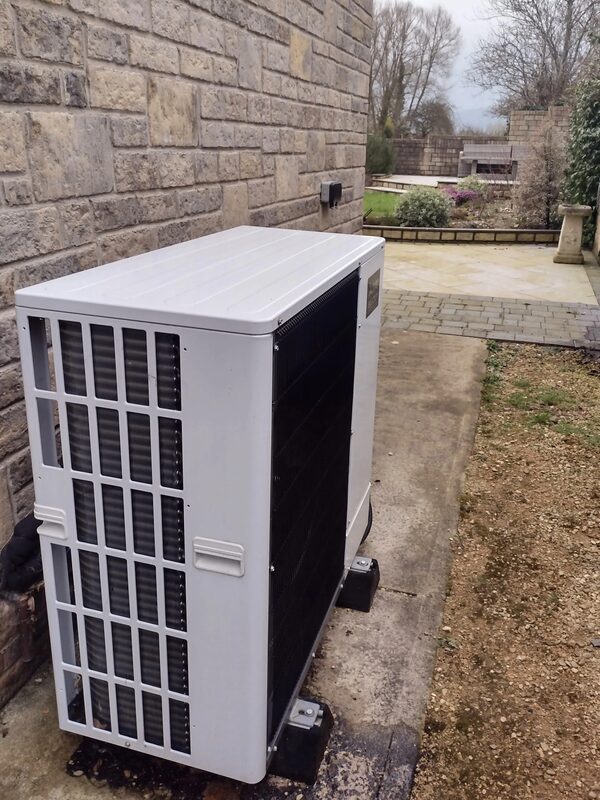
The two technologies share a control system and a wet emitter circuit, but the installation work is different in kind. An air source heat pump is easier and cheaper to install than a ground source heat pump because it does not use buried pipes22. Air source units are typically installed on the ground adjacent to a building, or mounted on an external wall7.
A ground source heat pump transfers energy from the natural heat stored in the earth to heat the home and domestic hot water23. That requires a ground collector, borehole or water source, which is why the groundworks are part of the installation rather than an enabling work. The VAT treatment reflects this: groundworks and dredging to install the necessary pipework fall within the definition of installing energy-saving materials20.
| Aspect | Air source | Ground source |
|---|---|---|
| Outdoor equipment | Unit on the ground or on an external wall7 | Buried collector, borehole or water source23 |
| Relative installation cost | Easier and cheaper, no buried pipes22 | Higher, because of groundworks22 |
| Grant rate | £7,500 standard, £9,000 off-gas grid4 | £7,500 standard, £9,000 off-gas grid4 |
| VAT on preparatory work | Not applicable | Groundworks and dredging within the relief20 |
Both technologies must comply with the Building Regulations, and the installation of either a ground source or air source heat pump will have to comply24. For a household, the choice turns on the ground available, the disruption acceptable during the works, and the space for the outdoor equipment. The ground source route trades a larger, slower installation for a collector that is out of sight and unaffected by outdoor air temperature.
The independence picture differs slightly. An air source unit depends on the electricity supply and on the manufacturer for parts; a ground source unit adds a dependence on the ground loop remaining intact and on the installer having designed the collector correctly, since a poorly sized loop is expensive to correct after the ground has been reinstated.
Planning permission, noise limits and where the unit can go
Most air source installations fall under permitted development, but the conditions are specific. Permitted development applies where the unit is located within the property and meets the permitted development size and location limits7. Planning permission is required where the installation does not meet permitted development rules, where the property is a listed building, where a conservation area imposes restrictions, where the unit would be in a prominent position such as the front of the property, or where there would be an unacceptable impact on neighbours such as noise or visual impact7.
Noise is the condition most likely to be breached. If the noise level is exceeded, planning permission approval is needed6. You cannot install an air source heat pump in a listed building or scheduled monument without planning permission25, and for listed buildings planning permission and listed building consent are required26.
Ground source installations are treated differently. Installation within the curtilage, meaning the garden or grounds, of a house or block of flats does not require planning permission, but listed building consent may be required if the property is listed27. That is a significant practical difference: the ground loop is largely invisible and largely outside the planning system, while the air source unit is visible, audible and subject to conditions.
The rules differ across the four nations, and the planning pages for England, Scotland, Wales and Northern Ireland set out the position in each. Noise assessment method is covered in MCS 020, and siting clearances in where a heat pump outdoor unit can go.
What to expect on installation day: heating off, groundworks and commissioning
The heating system is turned off for most of the installation period, which is the single most disruptive fact for a household1. In practice that means no space heating and no hot water from the old system while the new one is being connected, so timing the work outside cold spells is a practical consideration rather than a technical one.
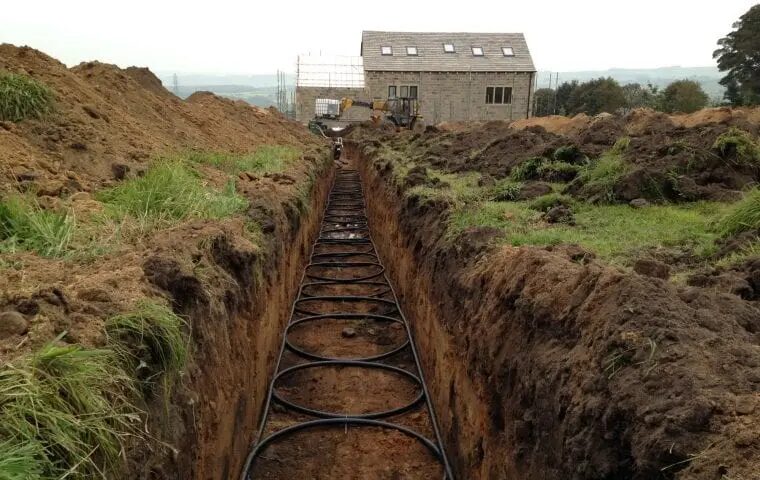
For a ground source system, the groundworks come first. The collector or borehole is installed, and the pipework connecting it to the heat pump is laid before the internal work is completed. The legislation treats this as part of the installation: installing energy-saving materials includes carrying out groundworks, or dredging a body of water, in order to install pipework or other equipment necessary for the operation of a ground source heat pump or a water source heat pump20.
Commissioning is the stage that turns a connected system into a working one. The system is filled, air is removed, pressures are set, the controls are configured to the design flow temperature, and the heat pump is run and checked. For ground source systems, the commissioning record should include details of the fluids used and their commissioned concentrations28.
The electrical connection is part of the same sequence. The Distribution Network Operator must be notified either before installation through apply to connect, or within 28 days once the installation is complete through connect and notify, completed by the installer6. The connect and notify route applies to properties with a new Maximum Demand of 60A or less meeting all other relevant requirements, with the DNO notified via the heat pump connection form within 28 days of the installation6.
Handover, registration and the 28-day notification

Handover is a documented process with deadlines attached. The installer or the installer's registration body must give a copy of the Building Regulations compliance certificate to the occupier, and give the certificate, or a copy of the information on it, to the building control authority, within 30 days of the work being completed6. Where the installer is not a registered competent person, an appropriate building control body must be notified before work begins6.
The operating and maintenance information provided to the dwelling owner should include the heat loss calculation, the design flow temperature, competent person scheme confirmation, the size of the emitter circuit and the minimum set back temperatures29. For ground source systems, the record should also include details of the fluids used and their commissioned concentrations28.
Registration of the installation itself matters where metering applies. A heat pump must be metered for performance if it was installed on or after 22 May 2018, and the metering information must be added to the MCS certificate30. Under the domestic Renewable Heat Incentive, participants must let Ofgem know within 28 days of a repair or replacement taking place31.
The 28-day figure appears in two distinct contexts and should not be confused. The DNO notification deadline is 28 days after installation under the connect and notify route6. The RHI repair or replacement notification deadline is 28 days from the repair or replacement31. The Building Regulations certificate deadline is 30 days from completion6.
Aftercare: annual servicing, settings and what MCS consumer protection covers
Servicing is annual. One documented household reports that they get the heat pump serviced once a year2. Servicing covers the refrigerant circuit checks, the hydraulic side, the filters and the controls, and it is also the point at which settings can be reviewed against the design. Whether servicing is a condition of the manufacturer's warranty is a separate question, covered in does servicing a heat pump affect the warranty, with the wider schedule in heat pump servicing and maintenance.
Settings are where the design meets reality. The design flow temperature set at commissioning determines how the system runs, and weather compensation adjusts it with outdoor temperature. Controls are covered in heat pump controls, weather compensation and smart operation, and the flow temperature question in what flow temperature do heat pumps use.
If something goes wrong, the route depends on what it is. MCS is the contact for issues with the installation process, the installer, or the MCS certificate or product11. For technical advice, it is advisable to contact an installer who can provide the necessary advice, preferably one who belongs to either the Microgeneration Certification Scheme or the relevant Competent Person Scheme24. Under the domestic Renewable Heat Incentive, Ofgem must be told within 28 days of a repair or replacement31.
The limits of the scheme's protection are worth restating. MCS requires a design-stage prediction of system efficiency, not verification of actual performance, and does not require remediation of systems that are underperforming relative to their design13. A household whose system underperforms its prediction has a design question, not automatically a scheme remedy.
For independence, aftercare is where the household's control sits. A serviced system running at the right flow temperature on a well-designed emitter circuit is doing what the survey predicted. The remaining dependencies are the electricity supply, the supplier, and the manufacturer for parts and warranty support over the life of the unit.
Sources31 cited
- Heat pump installation: a step by step guide, Energy Saving Trust, 2026-07-15
- Russell and Kate's story: solar panels and a heat pump, Energy Saving Trust, 2026-08-13
- Heat pump deployment tables, Q2 2026, Department for Energy Security and Net Zero, 2026-09-10
- Boiler Upgrade Scheme, Ofgem, 2026-09-17
- Boiler Upgrade Scheme, Find government grants service, 2026-09-18
- Approved Document L Volume 1: Dwellings, Department for Levelling Up, Housing and Communities, 2026
- Air source heat pumps fact sheet, Pendle Borough Council, 2026-09-17
- Boiler Upgrade Scheme guidance for installers v5.1, Ofgem, 2026-07-02
- Boiler Upgrade Scheme guidance for installers v5, Ofgem, 2026-04-28
- Register energy devices in homes or small businesses: guidance for device owners and installation contractors, GOV.UK, 2021-03-31
- Domestic Renewable Heat Incentive: who to contact, Ofgem, 2026-09-17
- Boiler Upgrade Scheme guidance for property owners, Ofgem, 2026-03-25
- Committee on Fuel Poverty report: heat pump transition, Committee on Fuel Poverty, 2026-05
- Five top tips from Which? to cut your energy bills, Welsh Government, 2026-03-18
- Boiler Upgrade Scheme quarterly report, issue 8, Ofgem, 2024-05-31
- £5 million to help Welsh households invest in greener homes, Welsh Government, 2026-03-05
- Boiler Upgrade Scheme statistics, July 2026, Department for Energy Security and Net Zero, 2026-08-27
- Value Added Tax (Installation of Energy-Saving Materials) Order 2024, legislation.gov.uk, 2024-01-10
- VAT on energy saving materials and grant funded heating supplies: VENSAV3080, HM Revenue and Customs, 2026-09-17
- Value Added Tax Act 1994, Schedule 7A, Part 2, Chapter 2, legislation.gov.uk, 2026-09-17
- Value Added Tax Act 1994, Schedule 8, Part II, Chapter 23, legislation.gov.uk, 2024-02-01
- Building regulations and renewables guidance, Bedford Borough Council, 2026-09-17
- VAT on energy saving materials and grant funded heating supplies: VENSAV3037, HM Revenue and Customs, 2026-09-17
- Heat pumps: Building Regulations, Planning Portal, 2026-09-17
- Air and ground source heat pumps, Croydon Council, 2026-09-17
- Air source heat pumps, Westmorland and Furness Council, 2026-09-17
- Heat pumps, New Forest District Council, 2026-09-17
- Approved Document L Volume 1: Conservation of fuel and power, 2021 edition incorporating 2023 amendments, Department for Levelling Up, Housing and Communities, 2026-09-17
- Approved Document L Volume 1, consultation version, Welsh Government, 2026-09-17
- Domestic Renewable Heat Incentive: eligible heating systems, Ofgem, 2026-09-17
- Domestic Renewable Heat Incentive: participants, Ofgem, 2026-09-17
 Installation ProcessA home battery installation usually starts with a survey, then the fitting itself, then a handover.
 Solar Panel InstallationHow long will the panels actually take to fit, and what happens on the day?
 Installer QualificationsWhat training and qualifications should a heat pump installer actually have?
 Air Conditioning InstallationHow long does air conditioning installation take, and what happens on the day?
 Building Regulations EnglandAdding a heat pump, solar panels or an extension usually needs building regulations approval, and it is separate from planning permission.
 Selling a Home With Energy KitCovers the paperwork a sale requires when a home has solar panels, a heat pump, insulation or a leased roof, and how warranties, export payments and guarantees transfer.