

In this answer
Short answer
An MCS handover pack is the bundle of documents an MCS certified installer must leave with a household once a renewables installation is complete. MCS sets out the minimum contents: a list of the system's key parts, health and safety guidance, a recommended servicing and maintenance schedule, the manufacturer's instruction manual or manuals, all relevant guarantees and warranties, and a copy of the MCS Customer Commitment1. Handover documents must also include the MCS certificate, the compliance certificate and the invoice for payments received, where relevant2.
The handover pack is the household's record of what was fitted, how to run and service it, and what is guaranteed. It is not a performance guarantee. MCS requires installers to provide a design-stage prediction of system efficiency, not to verify actual performance, and it does not require remediation of systems that underperform relative to their design3. That distinction matters for anyone reading predicted savings against a first winter's bills.
MCS itself is an independent certification scheme for microgeneration installation companies and products, covering small-scale renewable electricity technologies such as solar photovoltaic panels, biomass, wind, heat pumps and heat products4. Its role includes setting and maintaining technical standards, certifying installers and products against them, issuing MCS certificates for completed eligible installations, and assisting certification bodies to review cases and consumer issues5.
What the handover pack must contain
The minimum contents are set by the MCS Customer Commitment, which certified installers sign up to. The commitment requires an installer to provide a handover pack once the installation is complete, containing at least a list of the system's key parts, health and safety guidance, a recommended servicing and maintenance schedule, the manufacturer's instruction manual or manuals, and all relevant guarantees and warranties9. MCS repeats the same list for individual technologies, including small wind turbines10, micro CHP11, battery storage12 and biomass13.
The handover documents required under the Renewable Energy Consumer Code go further in one respect: where relevant they must also include the MCS certificate, the compliance certificate and the invoice for payments received2. NAPIT's consumer advice states plainly that following any work done under the MCS, a household should be left with a handover pack with a number of specific contents14.
In practice the handover pack is the only durable record of the design decisions behind the installation. The key parts list identifies the make and model of the main components, which is what a service engineer or a warranty claim will ask for. The servicing schedule sets out what the manufacturer expects and when, and the guarantees and warranties section carries both the product warranties and the workmanship warranty. For solar heating, MCS notes that the handover pack includes a copy of the MCS Customer Commitment itself1.

What MCS does not cover: verbal explanation and follow-up
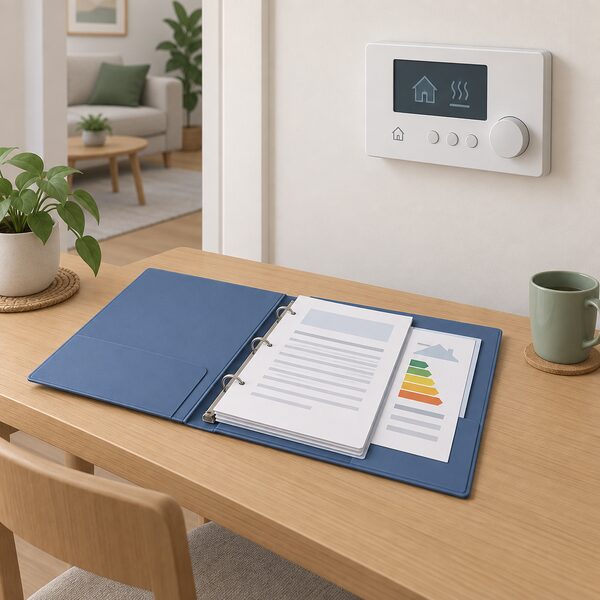
MCS specifies handover documentation but not the quality of verbal explanation, household understanding, structured follow-up or ongoing support3. That is the clearest limit on what handover documents can do. A folder of correct documents does not guarantee that anyone explained how the controls work, when the first service is due, or what a fault code means.
There are two further scope limits worth knowing. MCS does not cover heat pumps installed with a thermal output larger than 45kW, nor the majority of installations in new-build properties15. Households in those categories sit outside the scheme's consumer protection route, whatever paperwork they hold.
MCS is also not accredited to offer dispute resolution, and states that it will not be able to help directly once a complaint reaches that point17. Its role is to investigate complaints about certified installers and installations and to work with certification bodies; where a dispute needs a formal decision, that sits with the certification body or the Consumer Code.
The practical consequence is that the handover documents are a starting point, not a substitute for asking questions at handover. The MCS Customer Commitment requires installers to provide realistic estimates showing how a system is likely to perform, before a contract is entered, that are truthful, accurate and complete9. Those estimates belong with the handover documents, and they are the figures to compare against later.
Performance predictions: design-stage figures, not verified results
The performance figures in a handover pack are design-stage predictions. MCS requires installers to provide a design-stage prediction of system efficiency, not verify actual performance, and it does not require remediation of systems that are underperforming relative to their design3. A predicted seasonal performance figure is therefore a modelling output based on the property, the emitter sizes and the expected demand, not a measurement.
What MCS does do is check installations. MCS undertakes its own checks on installations completed by MCS certified installers, separate from Ofgem's audit programme, and may contact owners directly or arrange a visit18. Under the Boiler Upgrade Scheme, Ofgem's guidance notes that MCS may contact a household for a short, routine verification on behalf of Ofgem either by email or by phone on 0333 103 81988. These checks are about whether the installation meets the scheme's requirements, not about whether the system hits its predicted efficiency.
Product certification works differently again. The MCS product standards, developed by technical working groups, outline the performance test methods and the criteria that a certified product must meet19. That is a test of the product on a test rig, not of the installation in a particular house. MCS describes product certification as a mark of quality20.
For a household, the honest reading is this: the handover documents record what was designed and fitted, and the certificate records that it was done by a certified installer using certified products. Neither states what a household's bills will be. Where a predicted figure and a first year of metered data diverge, the design-stage nature of the prediction is the explanation, and the complaint routes below are about workmanship and conduct rather than about the size of the gap.
After handover: servicing, maintenance and warranty records
The handover documents earn their keep after the installers have gone. The recommended servicing and maintenance schedule is the document that tells a household what the manufacturer expects and when, and the manufacturer's instruction manual carries the conditions attached to the product warranty. Both are minimum contents under the Customer Commitment9.
The guarantees and warranties section is where a claim starts. MCS states that a handover pack is provided upon completion including key information such as product details and workmanship warranty, and repeats that wording for solar heating1, micro CHP11, battery storage12 and air source heat pumps21. The workmanship warranty is the installer's own undertaking; the product warranties come from the manufacturers. Keeping both, with the invoice, is what makes a later claim straightforward.
The MCS certificate is issued within 10 working days of completion6. It is a record that the installation was done by a certified installer using certified products, and it is required for some grants and incentives13. It is one document among the handover contents, not the whole set.
MCS publishes installation and contractor data freely on its Data Dashboard, which anyone can view and use23. That is useful for checking an installer's record, though it does not replace the installation's own documents. MCS also uses industry data to track growth20.

If something is missing or wrong: how MCS handles complaints

MCS is the single point of contact for complaints about MCS certified installers or installations, after an issue is raised with the installer first17. The first step is therefore always the installer. If that does not resolve it, MCS will consider complaints about system performance and design, quality of work, incomplete installation, delayed installation, commissioning and handover, installer conduct, damage to property, mis-selling, contractual issues, issues with the product, and breach of the Customer Commitment17. Commissioning and handover is explicitly listed as a complaint category24.
To investigate, MCS needs details of what went wrong, photographic evidence, supporting documents, and a willingness to engage and allow installer access to remediate25. Complaints from a third party acting on a household's behalf are accepted if verified with the complainant25. Details of the complaint are shared with the installer, the certification body and the Consumer Code where applicable24. MCS states that it keeps complainants fully informed along the way, and that an outcome is sent once the complaint has been fully investigated and concluded26.
There is a time limit. For MCS certified installations, a complaint must be made no more than two years after the date that the system was commissioned7. That window applies to the MCS route; other routes, including the Consumer Code and the certification body, may have their own terms.
MCS also provides alternative formats for MCS information and certification documentation to support effective communications, giving large font as an example28. Where a member of the MCS team believes a consumer is at immediate risk of harm, they will immediately alert their line manager to support them in the consumer engagement28. The published complaints policy sets out the detail17.
Checking the installer and the certificate
Certification is free to check. MCS provides a Find an Installer online search and a Helpdesk on 0333 103 8130 for checking that an installer is certified29. The same tool is used to find a certified installer near you6, and MCS notes that the Find an Installer tool will be usable for air-to-air heat pumps once they are ready under the Scheme22.
A requirement of companies wanting to gain MCS certification is that they are members of a CTSI Approved Consumer Code of Practice scheme in the first instance30. That is why a complaint can be shared with a Consumer Code as well as a certification body24. The codes themselves, such as the Renewable Energy Consumer Code, carry their own handover document requirements2.
MCS describes itself as an independent certification scheme for microgeneration installation companies and products, aiming to ensure consistent standards and provide confidence to consumers7. Its stated roles include setting and maintaining technical standards for installations and products, certifying installers and products against those standards, issuing MCS certificates for completed eligible installations, and assisting certification bodies to review and address cases and consumer issues relating to installers or products5.
For a household, the handover documents and the certificate together are the evidence trail. The certificate records that the installation was done within the scheme; the handover documents record what was fitted and what is guaranteed. Neither removes the dependence on the installer's own workmanship warranty, on the manufacturers behind the products, or on the certification body and Consumer Code if something goes wrong. MCS is a certification and complaints route, not an insurer and not a dispute resolution service17.
Sources30 cited
- Solar heating, MCS Certified, 2026-08-17
- Renewable Energy Consumer Code, RECC, 2026-07-01
- Clean heat market mechanism: heat pump transition report, GOV.UK, 2026-05
- ECO4 and GBIS Flex information document, Ceredigion County Council, 2025-11
- Boiler Upgrade Scheme, Ofgem, 2026-09-17
- Solar photovoltaic (PV), MCS Certified, 2026-06-11
- Who to contact, Ofgem, 2026-09-17
- Boiler Upgrade Scheme guidance for property owners, v5 draft, Ofgem, 2026-03-25
- MCS Customer Commitment, issue 1.0, MCS Certified, 2025-01-01
- Small wind turbines, MCS Certified, 2026-08-18
- Micro CHP, MCS Certified, 2026-08-17
- Battery storage, MCS Certified, 2026-09-17
- Biomass, MCS Certified, 2026-08-17
- Consumer advice, NAPIT, 2026-09-17
- Heat pump deployment tables, Q2 2026, GOV.UK, 2026-09-10
- Heat pump deployment quarterly statistics, United Kingdom 2026 Q1, GOV.UK, 2026-06-11
- Consumer complaints, MCS Certified, 2026-09-07
- Boiler Upgrade Scheme guidance for property owners, v5.1, Ofgem, 2026-07
- Product requirements, MCS Certified, 2026-05-21
- Why data quality matters, MCS Certified, 2026-05-21
- Air source heat pumps, MCS Certified, 2026-07-24
- Air-to-air heat pumps, MCS Certified, 2026-07-24
- MCS Data Dashboard, MCS Certified, 2026-05-21
- Complaints handling, MCS Certified, 2026-05-13
- What to do if things go wrong, MCS Certified, 2026-09-07
- Make a complaint, MCS Certified, 2026-08-18
- Be scam aware, MCS Certified, 2026-06-09
- Our approach to supporting customers, MCS Certified, 2026-09-07
- Renewable Energy Consumer Code approval, Chartered Trading Standards Institute, 2026-07-30
- Boiler Upgrade Scheme guidance for installers, v5.1, Ofgem, 2026-07-02
 MCS ExplainedMCS is the quality mark for solar panels, heat pumps and other home renewables.
 MCS Data by Local AuthorityHow many solar panels, heat pumps or batteries have gone into homes in your council area?
 MCS Installation StatisticsHow many homes have had solar panels, heat pumps or batteries fitted by certified installers, and is that number still rising?
 Certificates You Should ReceiveAfter work like solar panels or a new boiler, what paperwork should you actually be handed, and by when?
 Solar Panel InstallationHow long will the panels actually take to fit, and what happens on the day?
 MCS CertificationWhy do so many installers and tariff schemes ask about MCS certification when you get solar panels?