

In this guide
A heat pump's published performance figures are only as good as the test behind them, and the marks on a quotation are the household's way of checking which test was run. In the UK the mark that matters most is MCS, the Microgeneration Certification Scheme, an independent certification scheme for microgeneration installation companies and products1. It is the scheme that the Boiler Upgrade Scheme, permitted development rights and the government's own installation statistics are built around.
The European counterpart is Heat Pump Keymark, a voluntary certification mark based on independent third-party testing, with certificates granted by independent Certification Bodies and testing carried out by registered Test Centres2. It covers more than 10,000 certified heat pump models from over 180 brands, and CEN Heat Pump Keymark is recognised as equivalent by MCS3.
What follows is what each scheme tests, what it certifies, what it does not guarantee, and where the rules are heading. The distinction that matters throughout is between certification of a product, certification of an installer, and certification of an installation: three different things, often confused in a single sales conversation.

What certification means for a heat pump: the schemes that matter
Certification is a claim made by a body other than the manufacturer that a product or an installation meets a defined standard. Three schemes do that work in the UK market, and they operate at different levels.
MCS certifies installation companies and products. Its stated purpose is to ensure consistent standards and provide confidence to consumers, and its roles include setting and maintaining technical standards for installations and products, certifying installers and products against those standards, issuing MCS certificates for completed eligible installations, and assisting certification bodies to review and address cases and consumer issues relating to installers or products5. The scheme's scope is not limited to heat pumps: it includes clear standards to support the installation of wind turbines and air source heat pumps7.
Heat Pump Keymark certifies products only, and does so through independent third-party testing. The certification covers key performance indicators including quality, reliability, durability and efficiency, and the process is intended to ensure harmonisation across Europe, benefiting both manufacturers and end-users3. A manufacturer applies to an empowered Certification Body, which provides testing, inspection, assessment procedures and costs; a factory inspection and product sampling follow, carried out by an authorised inspector, with testing by a recognised institute and conformity assessment by the Certification Body2.
Building control sits underneath both. Installation work on a heat pump must be certified by one of two procedures: self-certification by a registered competent person, or certification by a building control body8. Where the registered competent person route is used, the Building Regulations compliance certificate, or a copy of the information on it, must be given to the building control authority, and a copy must also be given to the occupier9. That certificate must be delivered within 30 days of the work being completed8.
The practical consequence for a household is that certification is not one document but a chain: a certified product, fitted by a certified installer, notified to building control, and recorded on an MCS certificate. Break any link and the grant, the permitted development position and the complaint route can all be affected.
| Level of certification | What is certified | Who checks it |
|---|---|---|
| Product | The heat pump model, against MCS 007 or Keymark | Certification body, testing laboratory |
| Installer | The company, against MCS installation standards | MCS |
| Installation | The completed work, notified to building control | Registered competent person or building control body |
MCS: the UK quality mark for heat pumps and installers
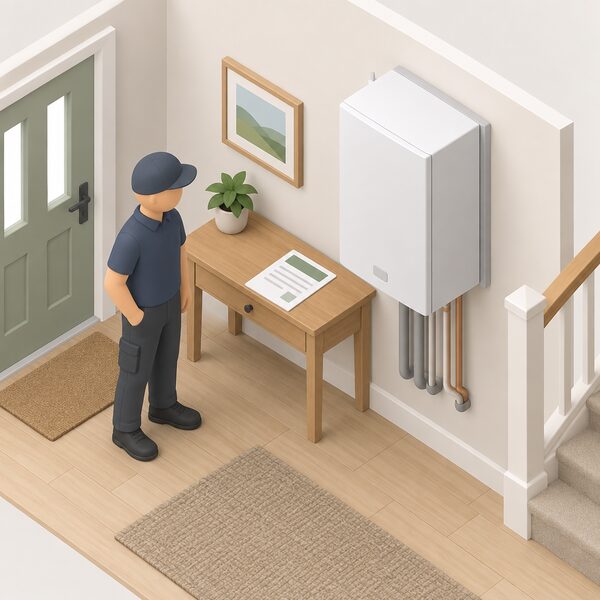
MCS is described in the Boiler Upgrade Scheme's own guidance as a certification scheme for microgeneration installation companies and products10. Its function in the heat pump market is to make two separate promises: that the product has been certified against the scheme's product standards, and that the company fitting it has been certified to do so.
The installer side is the one households meet first. Government scheme guidance is explicit that heat pump installers must be certified by the Microgeneration Certification Scheme or equivalent11. The Boiler Upgrade Scheme repeats the requirement in its installer guidance: installers must be MCS certified and be certified to install heat pumps and/or biomass boilers10. The Clean Heat Market Mechanism, the obligation scheme that sits alongside the grant, treats MCS as an approved certification scheme13.
The product side is what makes an installation eligible in the first place. MCS certified installations are those carried out by MCS certified installers who are using certified products13. That phrase is the whole architecture in one line: the installer's certification and the product's certification are both required, and neither substitutes for the other.
MCS also has a role after the work is done. It issues MCS certificates for completed eligible installations, and it assists certification bodies to review and address cases and consumer issues relating to installers or products5. The MCS certificate is not a decorative document: for the Domestic Renewable Heat Incentive, all heat pumps accredited to the scheme from 22 May 2018 had to be fitted with metering for performance before applying, confirmed on the MCS certificate14. Metering information must be added to the MCS certificate where it applies5.
The scheme's reach is visible in the official statistics. The quarterly heat pump deployment statistics are sourced from the MCS Installation Database, which means the government's own count of UK heat pump installations is a count of MCS certified work15. Installations outside MCS are, by definition, outside that count.
MCS 007: the heat pump product and installation standard
The document that defines what a certified heat pump has to meet is MCS 007 Product Certification Scheme Requirements: Heat Pumps. Version 7 of that document was published on 24 April 2025, and the Boiler Upgrade Scheme's approved standards notice lists it as Version 7 Regulation 4(1)(b)17.
MCS 007 is a product certification scheme requirement, which places it on the product side of the chain rather than the installer side. It sets out what a heat pump must demonstrate to be listed, and it is the reference the grant regulations point to when they define which products are eligible.
The scope of MCS product certification is bounded. It covers heat pumps up to 45kW for heating1. Above that output, and for the majority of installations in new-build properties, the work falls outside MCS: the official statistics state plainly that the installations that would not be covered by MCS are heat pumps installed with a thermal output larger than 45kW and the majority of installations in new-build properties15. A large commercial-scale unit or a new-build site is therefore not represented in the MCS database, and the certification marks a household reads about do not describe it.
For a domestic installation, the practical reading is straightforward. A certified product is one listed against MCS 007 version 7. A certified installation is one where that product was fitted by an MCS certified installer and recorded on an MCS certificate. The standard is the anchor for both.
What MCS does and does not guarantee about performance

This is the part of certification most often misread, and the government's own heat pump transition report is unusually direct about it. MCS requires installers to provide a design-stage prediction of system efficiency, not verify actual performance19. The scheme does not require remediation of systems that are underperforming relative to their design19.
In other words, the certificate records what the system was designed and predicted to do. It does not record what it subsequently did in the house. A household holding an MCS certificate holds evidence of a certified design and a certified installation, not a guarantee of a measured seasonal performance figure.
Several specific requirements sit outside the scheme:
- Weather compensation is not mandatory under current requirements of the Microgeneration Certification Scheme19.
- Third party non-modulating controls are not prohibited19.
- On handover, MCS specifies handover documentation but not the quality of verbal explanation, household understanding, structured follow-up or ongoing support19.
Each of those gaps is a place where a well-certified installation can still leave a household without the knowledge to run it well.
Where performance is written into a scheme, it is written in as a threshold rather than a promise. Under the Domestic Renewable Heat Incentive, a replacement MCS-certified product had to be MCS certified, use the same source of energy as the product it replaces, and have a Seasonal Performance Factor of at least 2.5, a requirement relating to heat pumps only20. That is a floor for eligibility, not a forecast.
The honest summary is that MCS certification tells a household that defined standards were met at design and installation. It does not tell them how the system will perform in their house, and it does not oblige anyone to fix a system that underperforms its own design prediction. For what the measured figures look like in practice, see how heat pumps actually perform in UK homes and heat pump efficiency: COP, SCOP and SPF explained.
Heat Pump Keymark: independent third-party testing to EN 14825 and EN 14511
Heat Pump Keymark is a voluntary certification mark that supports the quality and performance of heat pumps on the European market2. Its distinguishing feature is that the testing is not done by the manufacturer: the certification is based on independent third-party testing and is compliant with efficiency requirements as set by Ecodesign2. The certificate is granted by independent Certification Bodies and the testing is carried out by registered Test Centres2. The testing itself is conducted by laboratories accredited under ISO 170253.
The test standards behind the published figures are EN 14825 and EN 14511. The government's own heat pump methodology for the Home Energy Model is written for heat pumps that have been tested to EN 14825:20184. EN 14825 is the standard that produces seasonal performance figures; EN 14511 covers the capacity and performance testing of the unit itself. Both feed the numbers a household sees on a product sheet.
The scale of the scheme is substantial. Keymark now covers more than 10,000 certified heat pump models from over 180 renowned brands3. The purpose stated by the scheme is harmonisation across Europe, benefiting both manufacturers and end-users3.
For a UK household, the practical question is what a Keymark certificate does and does not do. It can be used for access to public subsidies in most European countries, while creating trust in the market2. In the UK, the grant schemes and permitted development rights are built around MCS, and CEN Heat Pump Keymark is recognised as equivalent by MCS4. That equivalence is the bridge: a Keymark certificate is not itself the route into the Boiler Upgrade Scheme, but the equivalence recognition means the testing behind it is not disregarded.
"The certification is based on independent third-party testing and is compliant with efficiency requirements as set by Ecodesign"
Safety standards: IEC 60335-2-40 and flammable refrigerants
The safety standard that governs heat pump construction is IEC 60335-2-40, the part of the household appliance safety series that deals with electrical heat pumps, air conditioners and dehumidifiers. It is the standard that sets the rules for how much refrigerant may be present in an occupied space and how a unit containing a flammable refrigerant must be built and installed.
That matters more each year, because the refrigerant transition is pushing the market towards flammable refrigerants. The F-gas rules are the driver: from 1 January 2035, F-gases are generally prohibited for split systems up to and including 12 kW21. The Kigali Amendment requires HFC consumption to be phased down by 85% by 2036, and the EU's general quota schedule reaches zero in 205021. The direction of travel is towards natural refrigerants, principally propane, which is flammable.
IEC 60335-2-40 is the standard that makes a flammable charge safe in a domestic setting. It sets charge limits by room volume, requires specific construction and labelling, and governs where a unit may be sited. For a household, the visible consequences are practical: a monobloc unit with a propane charge has to be sited with clearances that satisfy the standard, and the installation instructions carry the charge limit for the room. The wider picture is covered in heat pump refrigerants: R290, R32 and the F-gas rules.
Certification bodies test against the standard rather than interpret it. Eurovent Certita Certification lists heat pumps among the technologies it certifies, which places independent verification of the declared performance alongside the safety compliance1. The two are separate questions: a unit can be safe and still underperform its declared figures, and the certification marks address them through different routes.

Quiet Mark and noise certification
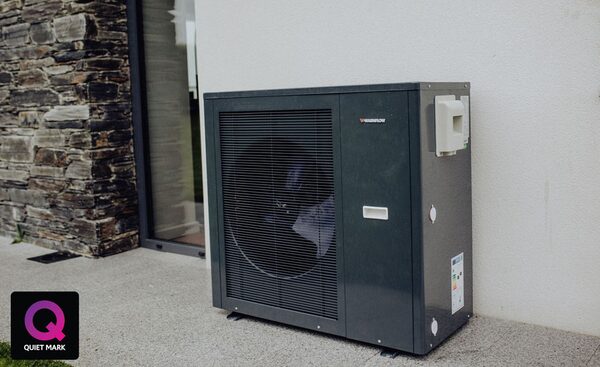
Quiet Mark is a noise certification mark, and its listings name the certified model numbers for the products it covers22. A heat pump listed as Quiet Mark certified has been assessed for its acoustic performance and carries the mark on that basis.
What Quiet Mark does not do is publish the decibel figure. Its own product pages state why they do not publish decibel levels22. A household looking for a sound power number therefore has to go elsewhere: the manufacturer's technical documentation, or the noise assessment carried out for the specific installation.
That second route is the one that governs whether the installation is permitted. In England, an air source heat pump must comply with Microgeneration Certification Scheme Planning Standards or equivalent standards23. The MCS Planning Standards are defined in legislation as the product and installation standards for air source heat pumps specified in the Microgeneration Certification Scheme MCS 02024. Scotland applies the same requirement through its permitted development order: the air source heat pump must comply with MCS Planning Standards or equivalent standards26. The Scottish Government has consulted on linking the noise prediction to the UK established microgeneration certification scheme23.
The practical point is that noise certification and noise compliance are different things. Quiet Mark tells a household that a unit is quiet relative to its class. MCS 020 tells them whether the specific unit, at the specific distance from the specific neighbour's window, is permitted. The assessment is covered in MCS 020: the heat pump noise assessment and how noisy is a heat pump.
How certification links to UK grants and government schemes
Certification is the gate to public money, and the gate is MCS. The Boiler Upgrade Scheme requires installers to be MCS certified and certified to install heat pumps and/or biomass boilers10. The Clean Heat Market Mechanism treats MCS as an approved certification scheme13. The government's investment roadmap describes delivering world leading standards for heat pump installations through the industry led Microgeneration Certification Scheme across the UK27.
The scale of the link is visible in the statistics. Of government-supported heat pump installations in the year ending June 2025, 60% were funded through the Boiler Upgrade Scheme28. In the year ending March 2025, 36% were funded through the Energy Company Obligation, with 56% through the Boiler Upgrade Scheme29. In the year ending September 2024, 46% of government-supported installations were funded through the Energy Company Obligation30. The documents give different shares for overlapping periods and the figures are not reconciled here.
| Period | Share funded through the Boiler Upgrade Scheme | Share funded through the Energy Company Obligation |
|---|---|---|
| Year ending June 2025 | 60%28 | Not stated in this figure |
| Year ending March 2025 | 56%29 | 36%29 |
| Year ending September 2024 | Not stated in this figure | 46%30 |
The devolved picture differs. In Wales, Green Homes Wales can be used alongside the UK Government's Boiler Upgrade Scheme, which provides grants for heat pump installations across England and Wales31. In Scotland, the Heat Pump Sector Deal Expert Advisory Group recommended requiring appropriate certification for any installer working on installations supported by public money, under standards such as the Microgeneration Certification Scheme, and recommended that industry and government work together to ensure the necessary certification and quality assurance standards are met32. The Scottish Government launched the Heat Pump Skills Fund during 2025-26, a grant to upskill existing heating and plumbing businesses on heat pump installation32.
Northern Ireland has its own permitted development provisions for air source heat pumps, which also reference MCS Planning Standards24. The grant landscape across the four nations is set out in heat pump grants and funding across the UK.
Checking an installer's certification and what to do if something goes wrong

The check itself is simple in principle. An installer working on a grant-funded job must be MCS certified and certified to install heat pumps and/or biomass boilers10. MCS maintains the certification records, and the certificate issued after the work records the installer and the product.
After the installation, the paperwork has a deadline. The Building Regulations compliance certificate, or a copy of the information on it, must be given to the building control authority, and a copy must be given to the occupier, within 30 days of the work being completed9. Where metering applies, the metering information must be added to the MCS certificate5.
If something goes wrong, the route is MCS. It is the contact for issues with the installation process, the installer, or the MCS certificate or product5. MCS can be reached through its website or by calling 0333 103 813034. Separately, MCS may contact a household for a short, routine verification on behalf of Ofgem, by email or on 0333 103 8198, and property owners contacted this way should aim to respond within seven days35.
The complaint window is finite. For MCS certified installations, a complaint must be made no more than two years after the date that the system was commissioned5. That runs from commissioning, not from the date the problem appeared, which is why the handover date matters.
Where the schemes are heading: reform, air-to-air coverage and new standards
The most concrete change on the horizon concerns air-to-air heat pumps. Under the Warm Homes: Social Housing Fund, air-to-air heat pumps are not eligible until they are able to be certified by MCS, which the scheme guidance expects to happen in 20266. That is a certification gap rather than a policy refusal: the units exist and are installed, but the certification route that the grant schemes depend on has not covered them.
The Scottish consultation on permitted development rights proposes to link the noise prediction to the UK established microgeneration certification scheme23, which would tighten the connection between the certification standard and the planning position. The Heat Pump Sector Deal Expert Advisory Group's recommendation that industry and government work together to ensure the necessary certification and quality assurance standards are met points the same way33.
The wider policy context is a phase-out of fossil heating. The Heat and Buildings Strategy set a target for phasing out gas boilers from 2035 in favour of low-carbon alternatives, with the phase-out intended to run in line with replacement cycle timelines so that almost all heating systems in 2050 are low-carbon36. Scotland has committed to prohibiting the use of polluting heating systems across all homes and business premises by the end of 204537. Certification is the mechanism by which those targets become checkable at the level of an individual house.
For a household, the direction of travel means the marks on a quotation are likely to matter more, not less. The schemes are the way a government counts, funds and regulates installations, and the certificate is the record that a given house is inside that count. The broader policy picture is set out in UK heat pump policy, targets and the rules coming.
Sources37 cited
- Certifying your product, MCS Certified, 2026
- Heat Pump Keymark, European Heat Pump Association, 2026
- Testing for trust: the journey to Heat Pump Keymark certification, European Heat Pump Association, 2025
- Home Energy Model: heat pump methodology, GOV.UK, 2026
- Domestic RHI: who to contact, Ofgem, 2026
- Warm Homes: Social Housing Fund wave 3 scheme guidance addendum, GOV.UK, 2026
- The Microgeneration Certification Scheme, Planning Portal, 2026
- Approved Document L, Volume 1: consultation version, Welsh Government, 2025
- Approved Document L, Volume 1: Dwellings, GOV.UK, 2026
- Boiler Upgrade Scheme guidance for installers v5.1, Ofgem, 2026
- Heat pump installers and government schemes, UK Parliament, 2022
- Boiler Upgrade Scheme guidance for installers v5, Ofgem, 2026
- Permitted development rights: impact assessments, Scottish Government, 2026
- Domestic RHI essential guide, Ofgem, 2022
- Heat pump deployment tables Q2 2026, GOV.UK, 2026
- Heat pump deployment quarterly statistics, United Kingdom 2026 Q1, GOV.UK, 2026
- Notice of standards, GOV.UK, 2026
- Boiler Upgrade Scheme regulations: approved standards, grant categories and grant levels, GOV.UK, 2025
- Carbon footprint report: heat pump transition, GOV.UK, 2026
- Domestic RHI: eligible heating systems, Ofgem, 2022
- Heat pumps investment roadmap, GOV.UK, 2023
- Samsung EHS Mono HT heat pump, Quiet Mark, 2026
- Heat pump sector deal final report, Scottish Government, 2021
- The Town and Country Planning (General Permitted Development) (Northern Ireland) Order 1993, schedules, legislation.gov.uk, 2015
- The Planning (General Permitted Development) Order (Northern Ireland) 2015, legislation.gov.uk, 2023
- The Town and Country Planning (General Permitted Development) (Scotland) Order 1992, article 3, legislation.gov.uk, 2016
- Clean Heat Market Mechanism, MCS Certified, 2026
- Heat pump deployment quarterly statistics, United Kingdom 2025 Q2, GOV.UK, 2025
- Heat pump deployment quarterly statistics, United Kingdom 2025 Q1, GOV.UK, 2025
- Heat pump deployment quarterly statistics, United Kingdom 2024 Q3, GOV.UK, 2024
- £5 million to help Welsh households invest in greener homes, Welsh Government, 2026
- Heat in buildings progress report 2025, Scottish Government, 2025
- Heat Pump Sector Deal Expert Advisory Group interim report, Scottish Government, 2021
- Boiler Upgrade Scheme, Ofgem, 2026
- Boiler Upgrade Scheme guidance for property owners, Ofgem, 2026
- Heat and Buildings Strategy, GOV.UK, 2021
- Heat in buildings: plans and the Scotland Bill explanatory notes, Scottish Government, 2025
 Certification and ApprovalsWhich certificates actually matter when you are choosing solar panels or a heat pump?
 Standards for Emerging ProductsIf a heat pump or solar product is new, who checks it is safe and works properly?
 Appliance Standards and MarkingWhich marks should a boiler, heat pump or cylinder have before you buy, and what do they actually prove?
 MCS ExplainedMCS is the quality mark for solar panels, heat pumps and other home renewables.
 Installer QualificationsWhat training and qualifications should a heat pump installer actually have?
 Efficiency COP SCOP and SPFA heat pump can give out three or four times more heat than the electricity it uses, so what do the efficiency numbers on a quote actually mean?