
In this guide
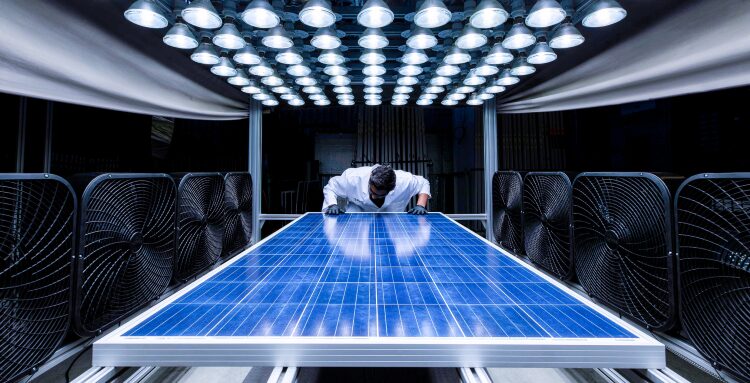
A datasheet is not a description of a product. It is a summary of a test regime, and the numbers on it mean only what the standards behind them allow. For solar modules, the baseline is IEC 61215 for design qualification and type approval, supported by IEC 61730 for safety and EN 50380 for the datasheet information itself. Independent testing programmes build on the same foundations: Which? uses tests based on EN50380:2003 and IEC61215:2005, and tests between 10 and 20 solar panels annually in an independent lab1.
The headline figure on any module datasheet, its rated power, is measured under Standard Test Conditions in a laboratory. That is a fixed reference point, not a prediction for a UK roof. Independent testers run two phases: a laboratory evaluation of new modules under standard lab conditions, then a second evaluation after real direct exposure to the sun1. The gap between those two phases is where the interesting information lives.
For heat pumps the equivalent framework is different in kind. Space heating performance is established from EN 14825:2018 test data combined with calculations from BS EN 15316-4-2:2017, while heat pumps providing water heating only are tested to EN 16147:20172. The standards do not measure a house. They measure a product under defined conditions, and the household's job is to understand which conditions.
What a datasheet certification actually tells you
A certification mark on a datasheet is a claim about a test, not a claim about your installation. It says a sample of that design was subjected to a defined sequence and met defined criteria. It does not say the module will produce its rated figure on a shaded roof in February, and it does not say the installation will be safe: that is a separate matter governed by BS 7671, the British Standard for electrical installations, which sets out requirements that solar panel installations must meet to be considered safe and compliant5.
The datasheet also carries information that matters after the sale. Expected degradation is found on the panel datasheet, searchable by make and model on the MCS certificate6. That is the practical link between a test regime and a household's long-term expectations: the degradation figure is a datasheet entry, and the MCS certificate ties the installed product back to the make and model it describes.
Before a contract is awarded, MCS rules require the customer to be given the manufacturer's datasheet for the proposed solar modules, inverter and, if applicable, the Module Level Power Electronics Device and the energy storage system, along with a proposed module layout drawing and, where the shading factor is below 1.0 and the MCS methodology is used, a Sunpath diagram7. The datasheet is therefore not optional paperwork. It is a required disclosure, and it is the document against which the installed system can later be checked.
What this means for independence is narrow but real. A certified module with a published degradation figure is a component a household can plan around for decades. It is still a component that depends on an inverter, a mounting system, an installer and a grid connection, and none of those dependencies are removed by a certification mark on the panel.
The standards behind the label: IEC 61215, IEC 61730 and EN 50380
Three standards do most of the work on a solar module datasheet, and they answer different questions.
| Standard | What it covers | Structure |
|---|---|---|
| IEC 61215 | Design qualification and type approval | Part 1-1 crystalline silicon, Part 1-5 flexible modules, Part 2 test procedures3 |
| IEC 61730 | Safety qualification | Part 2 sets out the requirements for testing3 |
| EN 50380 | Datasheet information | Used alongside IEC 61215:2005 in independent testing1 |
| BS 7671 | The electrical installation itself | Requirements for an installation to be safe and compliant5 |
IEC 61215 is the design qualification and type approval standard. It is published in parts: Part 1-1 sets out special requirements for testing crystalline silicon modules, Part 1-5 covers flexible modules with a non-glass superstrate, and Part 2 sets out the test procedures themselves3. The structure matters because a claim of "IEC 61215 certified" is incomplete without knowing which part applies to the module type.
IEC 61730 is the safety qualification standard, and Part 2 sets out the requirements for testing3. It is a separate document with a separate purpose. A module can be qualified for performance and separately qualified for safety, and both are normally listed.
EN 50380 governs the datasheet itself. Which? uses tests based on EN50380:2003 and IEC61215:2005 in its module testing programme1. The pairing is instructive: one standard defines what the manufacturer must publish, the other defines how the product was qualified.
There is a fourth layer that applies to the installation rather than the product. BS 7671 sets the requirements for the electrical installation to be considered safe and compliant5. A household comparing products is comparing the first three layers; the fourth is the installer's responsibility and is where the certification of the person doing the work, not the panel, becomes the deciding factor.
What IEC 61215 covers: performance and durability
IEC 61215 is a qualification standard, which means it is trying to establish that a design will survive and continue to perform, not merely that it works on the day it is tested. The test procedures in Part 2 are the mechanism, and the special requirements in Part 1-1 for crystalline silicon and Part 1-5 for flexible modules adapt the sequence to the module type3.
The scope of the standard is best understood through what independent testers actually run. Which? describes a programme including an initial solar radiation exposure, a maximum power determination test, an outdoor exposure test, a test for current leakage in wet conditions, defect and crack imaging, and repeat tests for degradation8. Those are the categories IEC 61215 is built around: performance measurement, environmental exposure, electrical safety in wet conditions, physical inspection and degradation over the sequence.
The performance side is more granular than a single power figure. The programme includes:
- power stabilisation with solar radiation exposure of 25 kWh/m2
- determination of maximum overall production performance
- nominal efficiency
- performance decline after sun exposure
- power output
- power exposure with an external solar radiation exposure of 60 kWh/m2
- determination of maximum power generation
- electroluminescence
- current leakage due to humidity1
Each of those produces a number or an image that a manufacturer may or may not publish.
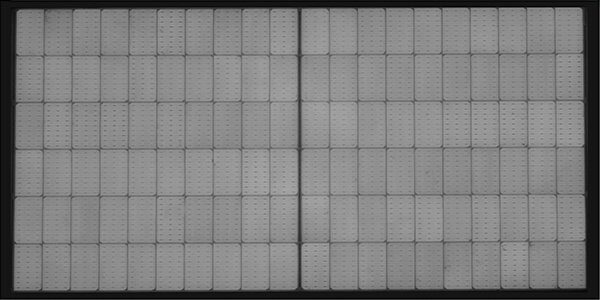
Electroluminescence is worth singling out because it is the test that finds what the eye cannot. Which? conducts an initial inspection called an electroluminescence inspection, in which a photograph is taken of each panel after a current equal to the model's short-circuit current is injected1. Cracks and defects that would not be visible in a photograph of the front of the module show up in that image.
For a household, the practical consequence is that two modules with the same rated power may have passed the same standard with very different internal quality. The standard sets a floor. It does not set a ranking.
The test sequence: thermal cycling, humidity-freeze and mechanical load
The IEC 61215 sequence is a progression, and the order is part of the design. Modules are exposed, measured, stressed and measured again, so that degradation caused by the stress can be attributed rather than assumed.
Thermal cycling is one of the stress categories, and it has its own dedicated standards for particular technologies. IEC 62925 covers thermal cycling testing for concentrator photovoltaic modules, to differentiate increased thermal fatigue durability3. IEC/TS 62782 covers dynamic mechanical load testing for photovoltaic modules3. These sit alongside the main sequence rather than replacing it.
Mechanical load is where the standard meets the roof. The load a module must withstand is not only its own weight: official guidance for England is that the roof must be checked to support the additional wind, snow and static load imposed by the solar panels, and that it complies with Part A: Structure9. In Wales the requirement is expressed as checking and proving the adequacy of the existing roof to carry the load from the panel10. The module is tested to survive a mechanical load; the roof is assessed separately to carry it.
Retesting is a defined activity in its own right. IEC/TS 62915 covers retesting for type approval, design and safety qualification3. That matters because a module design can change, and the question of whether a change requires retesting is answered by a standard rather than by the manufacturer's judgement.
There is also a production-level layer. For plug-in solar devices, routine tests are required to be carried out by the manufacturer on production units to verify correct assembly and packaging, correct marking and documentation, correct disconnection function and capacitor discharge12. That is a different kind of test from type approval: it applies to every unit rather than to a sample of a design.
The hail test: a 25 mm ice ball at 23 m/s
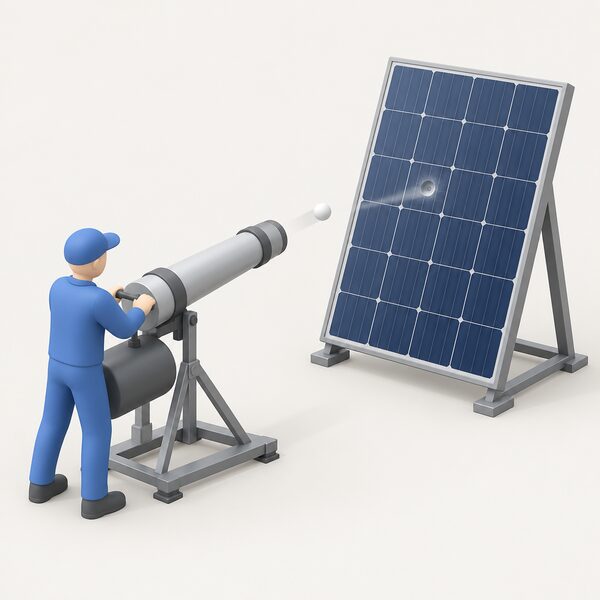
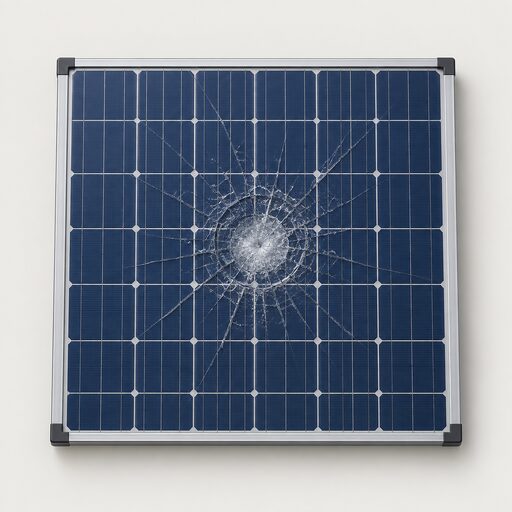
The hail test is the most quotable part of IEC 61215 and one of the easiest to misread. It requires a hail test performed with a 25 mm ice ball fired at 23 m/s at 11 specified locations in the module glass4. The pass criterion is a power limit: the power loss cannot be more than 5% from the original measurement4.
Two things follow. First, the test is a simulation of a specific hail size and speed, not a guarantee against all hail. Second, the tolerance is real. A module that passes may have lost up to 5% of its original measured power, and that loss is permitted by the standard.
For a UK household, the hail test is a useful illustration of how to read any test claim on a datasheet. The number in the standard is not "hail resistant". It is a ball diameter, a velocity, a number of impact locations and a permitted power loss. When a datasheet or a sales conversation reduces that to a single word, the specifics are what have been removed.
The same discipline applies to the other stress tests. A module that has passed thermal cycling has passed a defined cycle count and temperature range, not an infinite number of winters. A module that has passed mechanical load testing has passed a defined load, not the load of a particular roof in a particular snow year.
Hot spots and what the standard's tests can miss
Hot spots are the clearest example of a failure mode that needs its own test method rather than being covered incidentally. ASTM E2481-12 is the Standard Test Method for Hot Spot Protection Testing of Photovoltaic Modules3. It exists as a separate method because hot spot behaviour is a specific electrical and thermal phenomenon, and a general qualification sequence is not the same thing as a targeted hot spot assessment.
Degradation mechanisms are the other area where the core standard has limits. Light induced degradation and light and elevated temperature induced degradation are not the same as the performance and durability tests in the main sequence, and some makers run additional reliability tests beyond the standard. Qcells states that additional reliability tests, including PID and LeTID testing, are also carried out13. That is a maker's own statement about its own modules, and it is the kind of claim that distinguishes one product from another within the same certification baseline.
Qcells also states that its testing includes testing based on IEC TS 63209, the Extended Stress Test for PV Modules13. Again, this is a maker's statement about its own products, and it describes testing beyond the qualification standard rather than a different certification.
The general lesson is that a certification list tells you which floors a product has cleared. It does not tell you which additional tests a maker has chosen to run, and it does not tell you which failure modes those additional tests were designed to expose. Where a maker publishes that information, it is worth reading; where it does not, the absence is not evidence of a problem, only an absence of evidence.
Who awards the certification: TÜV Rheinland and independent testing
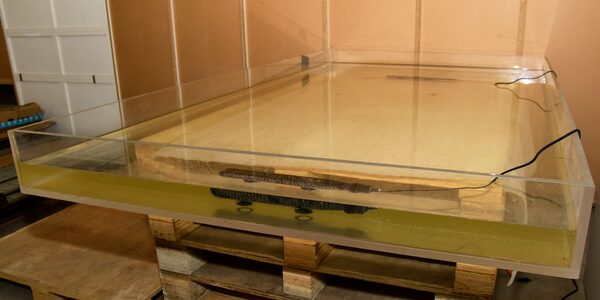
Certification is issued by bodies whose own competence is assessed. TÜV Rheinland was accredited as an MCS certification body for renewable energy in the UK, initially focusing on the certification of solar panel products, with a stated intention to expand into other areas14. That expansion has happened: TÜV Rheinland has since extended its scope to include heat pumps and solar mounting, as well as solar PV15. TÜV Rheinland (China) Ltd holds MCS product certification scope for solar mounting systems16.
The methods used go beyond the minimum. TÜV Rheinland focuses on destructive testing, which deliberately subjects solar PV products to extreme conditions to identify weaknesses and vulnerabilities in the product15. It also operates a mobile lab for in-situ testing of large-scale solar PV15. Destructive testing is a different proposition from qualification testing: the point is to find the failure, not to confirm the pass.
Accreditation of the testing bodies themselves is a separate layer. UKAS accreditation underpins the competence of organisations performing conformity assessment, and the European Marine Energy Centre holds ISO/IEC 17020:2012 accreditation for the operation of bodies performing inspection17. That standard is about how an inspection body operates, not about any particular product.
For heat pumps, the UK testing capacity is described in official guidance: BRE has test facilities for heat pumps and is accredited to EN14511 for air source heat pump testing, including HARP conditions in Ireland, and can test to EN14825 and EN1614718. BSRIA holds UKAS accreditation to test heat pumps up to about 30 kW capacity according to EN14511, and was seeking accreditation for part load testing to EN1482518. The capacity limit is worth noting: a domestic air source heat pump falls within it, and the accreditation route for part load testing was still being pursued at the time of that guidance.
Beyond panels: how heat pumps are tested (EN 14825)
Heat pumps are tested under a different framework from solar modules, and the framework distinguishes between what the appliance does.
| Application | Test basis |
|---|---|
| Space heating | EN 14825:2018 test data with BS EN 15316-4-2:2017 calculations2 |
| Water heating only | EN 16147:20172 |
| Rated performance (all types) | BS EN 14511, in four parts covering terms and definitions, test conditions, test methods and requirements19 |
| Hybrid heat pumps | Rated performance to BS EN 14511, which covers the heat pump, not the whole hybrid system18 |
For space heating, the methodology applies to heat pumps tested to EN 14825:2018, and the EN 14825 test data is used in combination with calculations from BS EN 15316-4-2:2017 to calculate performance2. For heat pumps providing water heating only, the applicable standard is EN 16147:20172. A single appliance that does both is therefore assessed through more than one route.
The standards themselves are broader than a single performance figure. BS EN 14511 covers air conditioners, liquid chilling packages and heat pumps with electrically driven compressors for space heating and cooling, in four parts covering terms and definitions, test conditions, test methods and requirements19. It is the reference for rated performance, and it is not the same as the seasonal calculation.
Hybrid heat pumps expose the boundary clearly. The rated performance of hybrid heat pumps is tested according to BS EN14511, but that standard only covers the performance of the heat pump, not the whole hybrid system18. A household looking at a hybrid product is therefore looking at a certified heat pump inside a system whose combined performance is not covered by the same standard.
There is also a live disagreement in the documents about which edition applies. One independent product page lists EN 14825:2022 as the testing basis20, while official guidance dated January 2026 refers to EN 14825:20182. A Heat Pump KEYMARK certificate lists EN 14825:2013-12 alongside EN 14511:2013-1221. The editions differ, and the documents do not resolve which is current for every product. Where a certificate names an edition, that edition is the one the certificate was issued against.
Noise is tested separately from performance. In Welsh research on air source heat pump noise and permitted development rights, listening tests used 5-second long sound samples, and a low setting produced up to about 6 dB lower sound power level compared with other conditions22. That is a different measurement exercise from the efficiency testing, and it produces a different kind of number.
How to read a panel's certification list when comparing products
A certification list is a set of claims, and reading it well means knowing what each claim covers and what it does not.
- Check the two core standards. A module datasheet listing IEC61215 and IEC61730 certified products is stating both design qualification and safety qualification23. If only one appears, the other question has not been answered on that document.
- Check the datasheet standard. EN 50380 governs what the manufacturer publishes, and independent testing programmes use it alongside IEC 612151. A datasheet that follows the standard gives figures in a form that can be compared with another maker's.
- Look for the additional tests. A maker that states it runs PID and LeTID testing, or testing based on IEC TS 63209, is telling you something beyond the baseline13. That is a maker's own claim about its own products, and it should be read as such, but it is information a household can weigh.
- Check the installer, not just the product. Energy Saving Trust advises finding out whether the system has a certificate from the Microgeneration Certification Scheme, and getting the system checked by a certified installer24.
In Wales, installers under the Barcud Solar Panel Installation Scheme Specification must carry a current and valid MCS Certificate issued by one of a defined list of certification bodies: Certsure LLP trading as NICEIC, Napit Certification Ltd, Simply Certification, The IAA (Installation Assurance Authority), or Amtivo Group trading as British Assessment Bureau25. The certification of the installer is a separate document from the certification of the panel.
For solar thermal rather than PV, the standards are different again. New solar hot water collectors should be independently certified as complying with all tests required by BS EN 12975 and BS EN ISO 9806 for thermal performance, reporting and identification26. BS EN ISO 9806:2025 specifies test methods for assessing the durability, reliability, safety and thermal performance of fluid heating solar collectors27, and the earlier ISO 9806:2017 had the same stated purpose28. Solar Keymark provides confirmation that products are fully tested according to the relevant standards29.
"confirmation that products are fully tested according to the relevant standards"
The wider point for a household's energy independence is that certification is what makes a product's claims checkable by someone other than the seller. It does not make the household independent of the grid, the inverter, the installer or the manufacturer. It makes the performance claim auditable, which is the part a buyer can actually act on. For how certification sits alongside brand and warranty questions, the guide to manufacturer certification and approvals covers the schemes in more detail, and comparing manufacturer specifications deals with reading figures like for like.
Sources29 cited
- How we test solar panels, Which?, 2026-08-12
- HEM TP 12: heat pump methodology, GOV.UK, 2026-01
- Fire and solar PV systems: literature review, GOV.UK, 2017-07-17
- What pH levels should be considered when washing panels, Canadian Solar, 2026-09-17
- Solar panel installation, maintenance and repair, NICEIC, 2026-09-17
- Solar panel problems and how to solve them, Which?, 2026-03-26
- MCS 032 Solar PV Standard, MCS Certified, 2025-01-01
- SolarEdge solar panels, Which?, 2026-08-12
- Solar panels planning and building guidance, East Herts Council, 2026-09-17
- Building regulations: solar panels, Welsh Government, 2026-09-17
- Building regulations: extensions and energy efficiency, Welsh Government, 2026-09-17
- Plug-in solar interim product specification, GOV.UK, 2026-07
- Quality at Qcells, Qcells, 2026-09-17
- TÜV Rheinland accredited as MCS certification body, MCS Certified, 2023-08-07
- Setting the standard: product certification and the future of UK solar, MCS Certified, 2025-12-08
- TÜV Rheinland expands certification scope to include heat pumps and solar mounting systems, MCS Certified, 2025-11-11
- Accreditation and net zero policies, UKAS, 2023-07-11
- Domestic hybrid heat pumps, GOV.UK, 2016-11
- Ground source and water source heat pumps guidance, Scottish Government, 2010-03
- Heat Pump KEYMARK certificate, Heat Pump KEYMARK, 2026-07-31
- RISE accreditation certificate scope, Solar Heat Europe, 2018-06-29
- Air source heat pump noise and permitted development rights in Wales: phase 1 report, Welsh Government, 2023-12-13
- EAGLE G6X module datasheet, JinkoSolar, 2026-09-17
- Moving house energy checklist, Energy Saving Trust, 2026-05-01
- Solar Keymark for consumers, Solar Keymark, 2026-09-17
- Approved Document L, Volume 1: Dwellings, GOV.UK, 2026
- Solar energy: solar thermal collectors test methods, BSI, 2026-02-28
- New ISO standard published for solar thermal collectors, Solar Heat Europe, 2024-05-23
- Solar 101 guide, IVIE, 2024-01
 Standards and TestingWhat do the certificates on a solar panel datasheet actually prove, and which ones should you look for in the UK?
 Comparing Specs Like for LikeTwo solar panels or heat pumps can look different on paper even when they do the same job.
 Panel SpecificationsA panel's quoted wattage comes from lab conditions, not a cloudy British roof, so what will it really produce at home?
 Where Energy Products Are MadeWhere are solar panels and heat pumps actually made, and does it matter where yours comes from?
 Sizing a System With DataWhat does your smart meter data actually show about how your home uses power?
 Paid and Restricted Energy DataWhere can you actually read the numbers behind a news story about heat pumps or solar?