
In this guide
A manufacturer's warranty or guarantee should still be valid after the company that issued it closes, according to independent consumer guidance1. That is the legal position. The practical position is harder: a guarantee is only worth what the entity behind it can pay, and when a maker enters administration, exits the UK or discontinues a product line, the household is left holding a document with no obvious counterparty.
What survives a collapse is narrower than most owners expect. The product itself keeps its CE marking, because marking attaches to the product placed on the market rather than to the company's continued existence, and the government has confirmed it will extend CE marking recognition to energy related products regulated under ESPR, continuing when those regulations come into force from 20272. What does not survive is the support layer: firmware updates, monitoring apps, cloud portals, spare parts and the technical helpline that made a fault a phone call rather than a project.
The exposure is uneven across a home energy system. A solar mounting rail that loses certification has a dated window attached to it. An inverter that stops receiving firmware updates keeps generating but loses its ability to respond to changing grid requirements. A battery tied to a manufacturer's controller may have its warranty period cut short by the way it is operated. This page sets out what each of those means, and what a household can do without a manufacturer behind it.
What happens to a warranty when the manufacturer fails
The starting point is that a guarantee does not evaporate because the issuer has stopped trading. Independent guidance is explicit: if you have a manufacturer's warranty or guarantee, it should still be valid1. What changes is who can be pursued. A guarantee is a contractual promise, and a company in administration or liquidation cannot honour promises it can no longer fund. The promise does not become void; it becomes unenforceable in practice unless someone else has taken it on.
That "someone else" is usually the buyer of the brand. When a manufacturer's assets are acquired, the acquirer may take on the warranty book as part of the deal, or may buy only the name and intellectual property and leave the liabilities behind. The distinction matters enormously to an owner and is rarely visible from the outside. It is worth checking whether the brand now sits within a larger group, because ownership changes are the single most common route by which an orphaned product finds a new support path. Our guide to brand ownership and parent groups sets out how the UK names connect.
Where no successor exists, the household's options narrow to the installer, the retailer and, in some circumstances, an ombudsman route. The Energy Ombudsman accepts a dispute once a complaint to the energy company has produced a final decision or deadlock letter, or eight weeks have passed without resolution6. That route is designed for disputes with energy suppliers rather than equipment makers, so it does not cover every failure, but it does cover cases where the supplier and the equipment are bound together in one contract.
Parliamentary scrutiny has looked directly at the gap. A 2026 debate on energy market consumer protection examined support in cases where the installer that fitted the faulty installation is no longer trading and the guarantee is missing, fraudulent or cancelled7. That is the precise shape of the orphaned product problem: not a maker that has failed in isolation, but a maker and an installer failing together, leaving the household with neither a counterparty nor a remedy.
Guarantees: what a 5-year extended promise is worth after a collapse

Extended guarantees are marketing as much as contract, and their value depends entirely on the issuer's survival. A five-year workmanship warranty, of the kind offered on installation work, is a promise from the installing business rather than from a manufacturer, which means it fails when that business fails8. A manufacturer's five-year product warranty fails when the manufacturer does. Neither is insured by default.
The distinction between a workmanship warranty and a product warranty is the one that matters most when a company collapses. Workmanship covers the quality of the fitting: the roof penetration, the cable routing, the commissioning. Product cover addresses the equipment itself. When an installer stops trading, the workmanship element disappears immediately, because there is no one to send back to the roof. The product element may survive if the manufacturer is still trading, even if the installer is not.
| What the guarantee covers | Who stands behind it | What happens when that party fails |
|---|---|---|
| Workmanship on the installation | The installing business | Cover ends at once; no one to return to the roof8 |
| The product itself | The manufacturer | Cover may pass to a brand buyer, or lapse |
| Insurance-backed home improvement work | An insurer | Cover survives the trader's collapse1 |
Some guarantees are insurance-backed, and independent guidance notes this is more likely where the guarantee or warranty is for home improvement work, giving solar panels as the example1. An insurance-backed guarantee is a different instrument: the risk sits with an insurer rather than with the trader, so the collapse of the trader does not extinguish it. Households with such a policy should read what it actually covers, because the trigger is usually a failure of the installer to remedy defective work, not a failure of the equipment.
Registration is the quiet killer of guarantee claims. Independent guidance warns that if a guarantee was not registered, it may not be valid, and suggests looking for a contact number on the guarantee and getting in touch1. Many extended warranties require registration within a set period of installation, and a household that never completed the form has, in effect, an unenforceable promise even against a solvent maker. Our page on registering a warranty and keeping it valid covers the mechanics.
Service history is the other condition that outlives the company. Independent guidance on boilers states that if a boiler is still under its manufacturer's warranty, not getting it serviced every year might invalidate its protection9. That condition is written into the warranty terms, so it binds the owner regardless of whether the maker later fails. A household that has kept up annual servicing has a stronger position if a successor takes on the warranty book, and a weaker one if it has not.
Grace periods: the window that closes when a product is affected
A grace period is a defined window during which products that no longer meet an updated standard can still be used. For solar mounting products that lost certification on 10 May, the window was extended by a further nine months to 10 August 2026, described as the final extension of the grace period3. On that date product listings were expired, and most affected products were no longer available for installers to select when creating an MCS certificate3.
The purpose of a grace period is to avoid stranding stock and half-finished projects, not to keep non-compliant products in circulation indefinitely. Certification bodies have been clear that a grace period should not be regarded as an opportunity for manufacturers to continue producing or bringing affected products into the market10. It is a run-down window, not a reprieve. For the MCS 005 solar PV products affected by updated standards, the grace period will not be extended10.
For a household, the practical consequence is a deadline that has already passed for most affected mounting products. An installation completed before the expiry date sits on a valid footing. An installation that was specified with an affected product but not completed in time may need a substitution, and the installer rather than the manufacturer carries that problem. Where a mounting supplier has disappeared entirely, the roof fixings become the part of the system with the least support and the most weather exposure.
Firmware and grid-connection settings: why thresholds matter after support ends
An inverter that no longer receives firmware updates does not stop working, but it stops adapting. Grid-connection parameters are set through a country data set that fulfils the EU grid-connection requirements, and changes of that kind apply from a defined firmware version. Once a manufacturer has gone, the inverter holds whatever settings it was last given. That is usually fine for a domestic installation, because the connection agreement was set at commissioning, but it removes the ability to respond to a later change in requirements.
The temptation to adjust settings manually is worth resisting. Grid-connection parameters govern how the inverter behaves during a fault or a frequency excursion, and they are not a household adjustment. Where support has ended, the workable route is an installer who understands the remaining settings and can confirm that the inverter still complies with the terms on which it was connected. Our page on firmware updates and product support life covers how support windows are defined.
Warranty terms can also be tied to how the equipment is operated, which matters when the manufacturer's controller is part of the system. One maker's warranty states that if a battery is connected to a third-party system or manually operated outside the maker's controller, the warranty period expires when a maximum of 3MWh per kWh usable capacity has been reached, and five years for the hybrid inverter and controller5. That is a warranty limit triggered by configuration rather than by time, and it applies whether or not the maker is still trading.
The wider point is that a manufacturer's cloud service is a dependency, not a feature. Monitoring portals, app-based control and remote diagnostics all sit on infrastructure the household does not own. When the company fails, the app may keep working for a period, then stop. The equipment continues to generate or store, but the household loses visibility of it, which makes faults harder to spot and performance harder to verify. That is a real reduction in independence even where the hardware is unaffected.
Repowering: replacing old panels with new production instead of waiting on a warranty

Repowering is the alternative to a warranty claim that will never be paid. It means replacing the generating equipment rather than the whole system, keeping the mounting, cabling and inverter where those remain serviceable. Guidance for existing dwellings states that the new system should have a kWp output that is at least that of the original installation4. That condition preserves the array's capacity rather than allowing a downgrade.
The economics of repowering depend on what is being replaced. A panel with a long power warranty is a different proposition from one whose maker has gone. One maker's current terms offer a 20-year product warranty plus a 25-year power warranty, with the product element covering panel defects11. Those terms are only as good as the company behind them, which is why the maker's own status is part of the calculation rather than a footnote to it.
There is a boundary to what repowering can restore. Under the Feed-in Tariffs arrangements, if all plant is removed up to the point of grid connection, the accredited installation has been decommissioned and accreditation ends12. Removing panels to replace them is not the same as removing the whole generating station, but the distinction is worth understanding before any work begins, because accreditation is not automatically reinstated. Our page on solar panel manufacturers covers which makers currently supply the UK.
For a household, repowering is a way of converting an unenforceable warranty into a working asset. It does not recover the money spent on the failed product, and it does not restore a lost accreditation. What it does is return the roof to production, which is the outcome the original warranty was meant to protect.
Mounting products and roofs: the parts of an installation most exposed when a supplier disappears
Mounting is the least glamorous part of a solar installation and the most exposed when a supplier vanishes. It is structural, it is outdoors, and it is the component most likely to be specified by an installer rather than chosen by a household. When a mounting manufacturer fails, the household may not even know which system is on the roof, because the brand name is on a rail rather than on a datasheet handed over at completion.
Planning rules add a layer. Where panels are proposed on a roof slope facing the highway and rear-facing panels are not feasible, official guidance expects technical evidence that no other location could successfully support the solar equipment, either in terms of structural integrity or receiving adequate sunlight, and that any visual impacts are minimised13. That evidence is produced at the design stage, and it depends on the mounting system's specification. If the manufacturer has gone and the specification cannot be confirmed, a later alteration becomes harder to justify.
The consumer protection position is that an insurance-backed guarantee is more likely where the guarantee or warranty is for home improvement work, with solar panels given as the example1. That is the instrument that covers a mounting failure when the supplier has disappeared, and it is worth establishing at the outset whether one exists. Where it does not, the household carries the structural risk directly.

CE recognition and ESPR: why certification can outlive the company that made the product
Certification attaches to the product, not to the company, which is why a failed manufacturer does not automatically invalidate the marking on equipment already installed. The government has confirmed it will proceed with extending CE marking recognition to energy related products regulated under ESPR, broadly as consulted upon, and all responses to the main policy question agreed that recognition should be extended to cover those products2. The Ecodesign for Energy Related Products Regulations 2010 will be amended to extend the existing CE recognition mechanism to cover products regulated under ESPR2.
The timing matters for anyone buying now. CE recognition will continue to apply when ESPR regulations come into force from 20272. That gives a degree of continuity across the transition, and it means a product placed on the market under the current arrangements is not stranded by the change of regime. For a household, the practical reading is that certification is the most durable part of the package: it survives the maker, the installer and the distributor.
What certification does not do is provide support. A CE mark is a declaration that the product met the applicable requirements when it was placed on the market. It is not a promise of spare parts, firmware or a helpline. Households sometimes treat the two as the same thing, and the gap between them is exactly where orphaned products sit. Our page on manufacturer certification and approvals explains what each mark covers.
There is also a security dimension to connected equipment. Regulations on consumer connectable product security exist, but smart meter products are not covered by them14. That exclusion is worth knowing when a manufacturer's app or hub is part of the system, because the security obligations that apply to some connected devices do not apply to all of them.
Calculating your own heating requirements: taking over what the manufacturer's guidance used to do
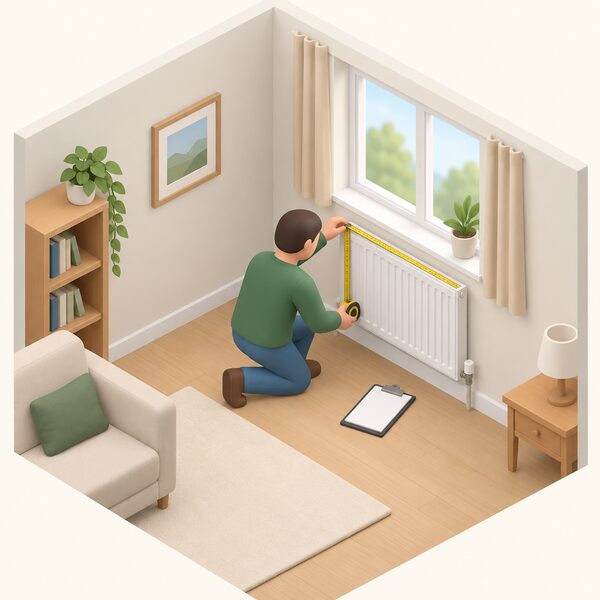
When a manufacturer's sizing tool disappears, the household is left with the calculation rather than the answer. The standard method is a room-by-room heat loss assessment, and it is not the same as the low-temperature domestic heating systems calculation tool, which is explicitly not for determining the required power output of a boiler or heat pump15. That tool serves a different purpose, and using it to size a heat pump would produce the wrong figure.
Independent advice is the sensible substitute for a maker's guidance. In Northern Ireland, homeowners are directed to seek independent advice on solar panels, heat pumps and other energy efficiency measures from organisations that provide it16. That is a funded advice route rather than a sales channel, which matters when the manufacturer who would once have sized the system is no longer available to do so.
Commissioning standards are the other half of the picture. Official guidance recommends that Warm Homes Plan programmes specify and verify minimum commissioning standards focusing on the correct calibration of weather compensation, no non-modulating room thermostats, and optimised hot water settings17. Those are the settings that determine whether a correctly sized system performs as intended, and they are set by the installer rather than the manufacturer.
Cost is part of the calculation too. Heating equipment that is not funded through an energy efficiency grant attracts 20% VAT8. That is the default position, and it applies to a replacement or an upgrade as much as to a first installation. Our page on heat pump manufacturers covers the equipment side.
Load ratings in practice: what a 10,000 Pa specification means once you cannot claim on it
A load rating is a test result, and its value depends on how the product is installed. One panel allows loads of up to 10,000 Pa when installed using 6-point clamping. That figure is conditional: it holds for that mounting arrangement and not for others. Once a manufacturer has gone, the condition attached to the rating becomes harder to verify, because the person who could confirm the clamping arrangement is no longer available.
The practical consequence is that a specification on a datasheet is not a guarantee of performance in a particular installation. A 10,000 Pa rating achieved with six clamping points tells a household what the panel can withstand when fitted that way. If the mounting system is later changed, or if the original installer's records are lost, the rating no longer describes what is on the roof. That is a support problem rather than a product problem, and it is the kind that emerges years after the manufacturer has failed.
For a household, the response is documentation. The load rating, the clamping arrangement and the mounting system should all be recorded at installation, because they are the facts that a future engineer, insurer or buyer will need. Where a manufacturer has failed and the mounting supplier has also gone, that record is the only remaining evidence of how the system was designed.
Sources17 cited
- Claim using a warranty or guarantee, Citizens Advice, 2026-09-17
- Extended CE marking recognition for Ecodesign regulations, GOV.UK, 2026-07-06
- Grace period extension for solar mounting products that lost certification on 10 May, MCS Certified, 2025-10-17
- Approved Document L Volume 1 consultation version, Welsh Government, 2026-09-17
- Myenergi Ltd Product Warranty v2.0, Myenergi, 2026-09-17
- Our process, Energy Ombudsman, 2026-09-19
- Energy Market Consumer Protection, Hansard, 2026-06-17
- Tax on shopping: energy saving products, GOV.UK, 2026-09-17
- Getting the best boiler service, Which?, 2025-09-17
- Grace period for solar PV products announced ahead of implementation of four updated product standards, MCS Certified, 2026-07-30
- Empowering warranty, REC Group, 2026-09-17
- Feed-in Tariffs: treatment of replacement generating equipment, Ofgem, 2021-12-13
- Solar panels planning permission checklist, Islington Council, 2026-09-17
- Regulations: consumer connectable product security, GOV.UK, 2024-01-08
- Low temperature heating, NCM PCDB, 2026-09-17
- Support to generate your own electricity, nidirect, 2025-09-22
- Heat pump transition report, GOV.UK, 2026-05
 Energy Tech Company FailuresRecords UK and overseas home energy technology firms that have failed or withdrawn products, and what happened to installed equipment, warranties and apps.
 When Your Installer Goes BustWhat happens to deposits, part-completed work, workmanship guarantees and complaints when a home energy installation company fails, and how to claim on deposit protection, an insurance-backed guarantee, card or finance cover, and who honours the manufacturer's warranty.
 Energy Independence and MakersWhich brands let you keep control of your heating, solar or car charging, and which tie you to their app and their cloud?
 Warranties and DegradationHow long do solar panels actually last, and what do the warranties really cover?
 EV Charger WarrantiesCovers typical warranty lengths on UK home charge points, what parts and labour are included, registration conditions and extended warranty options.
 Local Control vs the CloudCan your solar, battery or charger still work if the maker's app or servers disappear?