
In this guide
The electrical components behind a home energy system are the parts a household rarely chooses by name: the consumer unit, the circuit breakers and RCBOs inside it, the isolators that let an installer work safely, the surge protection device, the meter, and the cable and accessories that tie solar, battery and EV charging equipment into the fixed wiring. They are made by a small group of specialist manufacturers, most of them represented in UK policy work by BEAMA, the trade body for the electrotechnical and allied manufacturing industries. BEAMA represents directly some 200 companies, and the sector it speaks for is worth £14 billion a year, employs 90,000 people and exports £5 billion of goods1.
The rules these parts must meet are split between two marking regimes. Independent guidance records 1 January 2023 as the date from which products placed on the UK market, excluding Northern Ireland, must meet the UKCA regime, and the date after which the CE mark is no longer recognised in the UK2. In practice the position is more mixed than that headline suggests: Energy Related Products carrying the CE Mark can currently be sold in Great Britain if they comply with GB ecodesign standards, without a UK Conformity Assessment marking also being affixed, and CE recognition is set to continue when ESPR regulations come into force from 20273. Under the Measuring Instruments Regulations 2016, both CE and UKCA marked meters can continue to be placed on the market in GB4.
For a household, the component layer is where energy independence is either protected or quietly lost. A consumer unit and its protective devices decide whether a solar inverter, a battery or an EV charger can be added safely, and whether a fault in one circuit takes down the rest. The components themselves are grid-tied by design: they distribute and protect, they do not generate. Independence comes from what they allow a household to connect, and from whether those connections can be isolated, monitored and upgraded without replacing the whole installation.
What counts as an electrical component in a home energy system
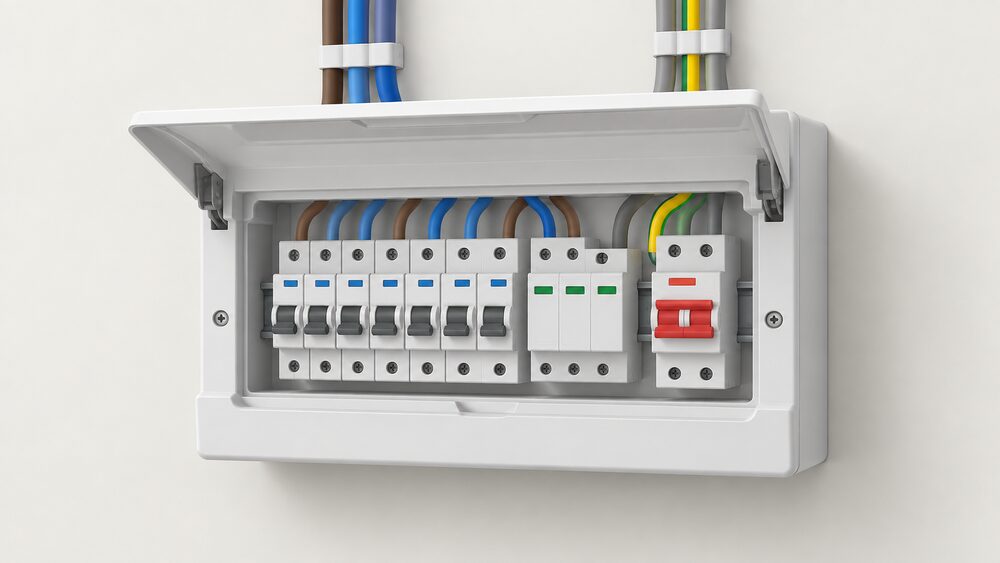
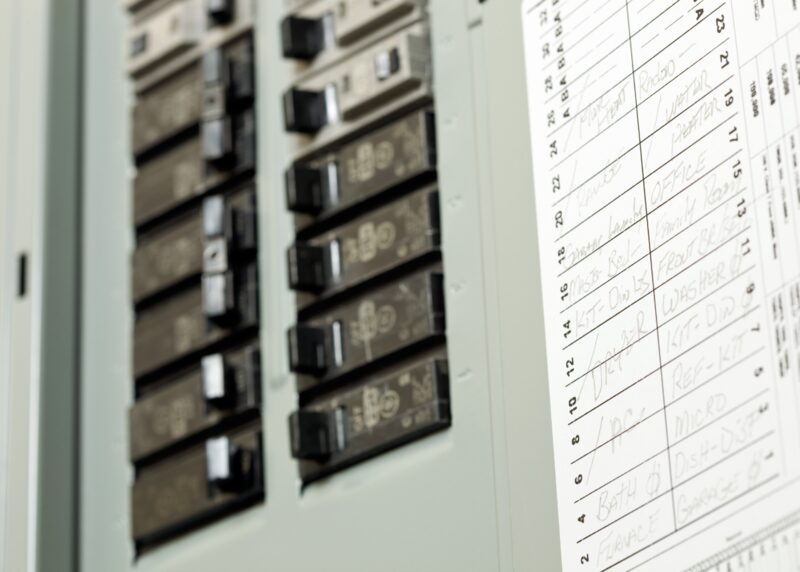
Official guidance on electrical safety standards in the private and social rented sectors sets out what the fixed electrical installation actually includes: the wiring, the socket-outlets (plug sockets), the light fittings and the consumer unit, sometimes called the fuse box6. That list is the clearest definition available here of the component layer in a home. Everything upstream of the appliances, and everything that connects generation and storage equipment to the house, sits within it.
The manufacturers in this field therefore make several distinct families of product:
- Distribution and protection: consumer units, miniature circuit breakers, RCBOs (residual current breakers with overcurrent protection), residual current devices and isolators
- Surge protection: devices that sit in the same enclosure and guard the installation against voltage transients
- Metering: gas and electricity meters, which carry their own marking rules
- Cable and containment: cable, conduit, trunking and accessories
- Consumer connectable products: the smart and networked devices that increasingly attach to the same circuits
The scale of household interest in this area is not small. Just under half, 43%, of homeowners were recorded as actively considering installing energy-efficiency measures in their homes7. Ofgem's 2021 consumer survey found 5% of GB energy consumers using electric heaters as their main heating system and 3% using electric storage heaters, and found that 23% of those who do not consistently monitor their energy use said the barrier was not having the right equipment, such as a smart meter or in-home display8. Each of those households depends on the component layer to make the change safely.
The trade body behind the manufacturers: BEAMA
BEAMA is the UK trade association for manufacturers and providers of energy infrastructure technologies and systems1. Its Underfloor group is the UK's national trade association for underfloor heating2, and BEAMA Ltd was a lead contributor to PAS 1878 and 1879, the international and UK standards for the smart buildings sector3. The association also publishes heating controls buyer's guides, compiled on the basis of declarations made by the manufacturers of the products listed, with all tests and other assurances carried out by or on behalf of the manufacturers themselves4.
The trade body's role in policy is visible in its published recommendations to government, which is where its positions on the rules that govern components are set out. That matters to a household because the standards a consumer unit, an RCBO or an isolator must meet are not set by the household or the installer; they are set through a process in which manufacturers, through bodies such as BEAMA, are active participants. The same is true of the marking regimes described below, where the practical detail of what a manufacturer must do to place a product on the UK market is shaped by consultation.
Alongside the trade body, the UK product safety framework consultation names the supply chain actors it proposes to define: producers, onward suppliers and online marketplaces9. That framing matters because a component bought online may reach a household through a route with no manufacturer presence in the UK at all. The consultation also records that businesses and other organisations who purchase products for their own use, such as products for use in the workplace, will receive protection under the proposed framework9.
For a household, the significance is indirect but real. A trade body with 200 member companies and a £14 billion sector behind it has the standing to argue about marking rules, conformity assessment and enforcement. Whether those arguments produce rules that make it easier or harder to add generation and storage equipment to a home is a question the household never sees, but always lives with.
The UK electrotechnical sector: £14 billion and 90,000 jobs
The headline figures for the sector come from BEAMA's own policy document: a sector currently worth £14 billion, employing 90,000, with exports worth £5 billion1. Those three numbers describe an industry that is both domestically significant and export-facing, which is unusual among the trades that serve UK households. Component manufacturing is not a purely local business.
The wider energy economy around it is larger still. Official statistics for the UK low carbon and renewable energy economy record 453,900 FTEs of total employment in 2024, of which 149,900 FTEs were indirect employment10. The UK solar sector alone is estimated at 17,000 diverse businesses11. Government has committed capital funding for home insulation and clean technologies bringing total investment to almost £15 billion8. These are different measures of different things, and they should not be added together, but they show the scale of activity that depends on a functioning component supply chain.
The domestic consumption context is worth holding alongside them. On a temperature corrected basis, domestic consumption in 2024 was 36.7 mtoe5. That is the demand the component layer exists to distribute, protect and increasingly to manage. Every smart meter, every isolator, every protective device in a consumer unit is part of the apparatus that stands between that consumption and the household's ability to control it.
| Measure | Figure | Period |
|---|---|---|
| Electrotechnical sector value | £14 billion | BEAMA policy document1 |
| Sector employment | 90,000 people | BEAMA policy document1 |
| Sector exports | £5 billion | BEAMA policy document1 |
| Low carbon economy employment | 453,900 FTEs, of which 149,900 indirect | 202410 |
| Solar sector businesses | an estimated 17,000 | UK Solar Roadmap11 |
| Home insulation and clean technologies investment | almost £15 billion | Government commitment8 |
| Domestic consumption, temperature corrected | 36.7 mtoe | 20245 |
CE and UKCA marking: what each means and when each applies
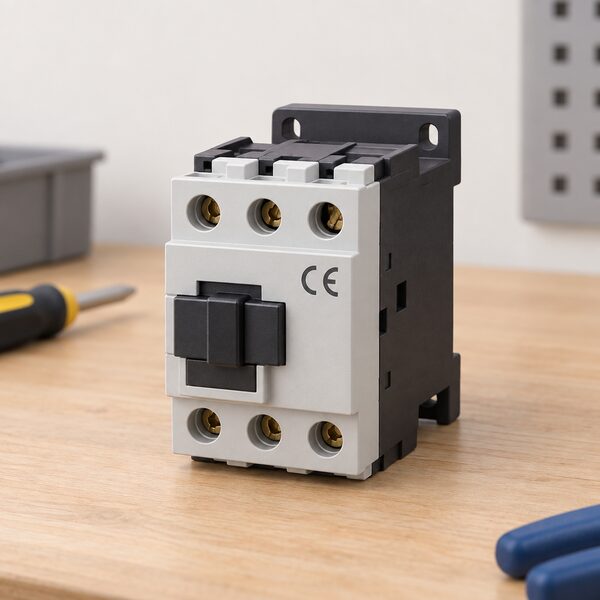
The two marks do different jobs and, for the moment, both can be valid in Great Britain depending on the product. Independent guidance describes the CE mark under the Construction Products Regulation as an EU regulation requiring the appropriate testing and subsequent affixing of the recognised CE mark, a self-declaration by the manufacturer that the product meets the standards of the regulation2. That is the key point about CE: it is the manufacturer's own declaration, made after testing, not an independent approval of suitability for a particular installation.
The UKCA mark works on a similar principle but with a different assessment route. Independent guidance records that any product placed on the market after the implementation date will need to have its conformity assessment undertaken by a UK recognised notified institute listed on the UK notified laboratory database2. That is a substantive change: the body doing the assessment has to be recognised in the UK.
For Energy Related Products, the position has been extended. Energy Related Products which have the CE Mark can currently be sold in Great Britain if they are compliant with GB's ecodesign standards, without the need to also affix a UK Conformity Assessment marking, and CE recognition continues to apply when ESPR regulations come into force from 20273. For meters, official guidance states that both CE and UKCA marked meters can continue to be placed on the market in GB4. MID approved meters carry the CE marking, the MID marking made up of the letter M and the year of manufacture, for example M11 for 2011, and a four-digit code identifying the EU Notified Body4.
"An EU regulation requiring the appropriate testing and subsequent affixing of the recognised "CE mark" a self-declaration by the manufacturer that the product meets the standards of the regulation"
The practical consequence for a household is that a CE mark on a component is not, by itself, evidence that the part is suitable for a UK installation, and a UKCA mark is not a guarantee of quality. Both are conformity statements against a standard. The standard, and the installer's judgement about whether the part suits the circuit, are separate matters.
UKCA marking: the rules for Great Britain and the separate regime for Northern Ireland
The UKCA regime applies to Great Britain, and Northern Ireland operates separately. Independent guidance states that the changes do not include a sale of goods within Northern Ireland, which operates under a different regime, UK(NI)2. That territorial split runs through the whole marking question and is the first thing to establish when a component's paperwork is being checked.
The dates are recorded clearly. From 1 January 2023, all products placed on the UK market for sale, excluding Northern Ireland, must meet the UKCA regime, and from the same date the CE mark is no longer recognised within the UK2. The UKCA mark could be applied as early as 1 January 2021 by products already tested by a UK recognised authority, in line with the 12-month transition period allowed for by government2. During that transition period both CE and UKCA marks could be affixed, but the guidance adds a condition: the transition period is only valid in circumstances whereby the CE and UKCA rules remain the same2.
Two further requirements bear on manufacturers. Authorised representatives based within the EU are no longer recognised within the UK after the implementation date, and for any products imported from within the EU, any authorised representative appointed to deal with the marketing and sale of UK products must be based and have a business address situated within the UK2. Declarations of Performance must now make reference against the new UKCA legislation document, superseding (EU) 305/2011, and must continue to be made available to market surveillance authorities, making reference against UK designated standards rather than existing EU standards referenced in the Official Journal2.
Surge protection devices: the component that guards your consumer unit and isolator circuits
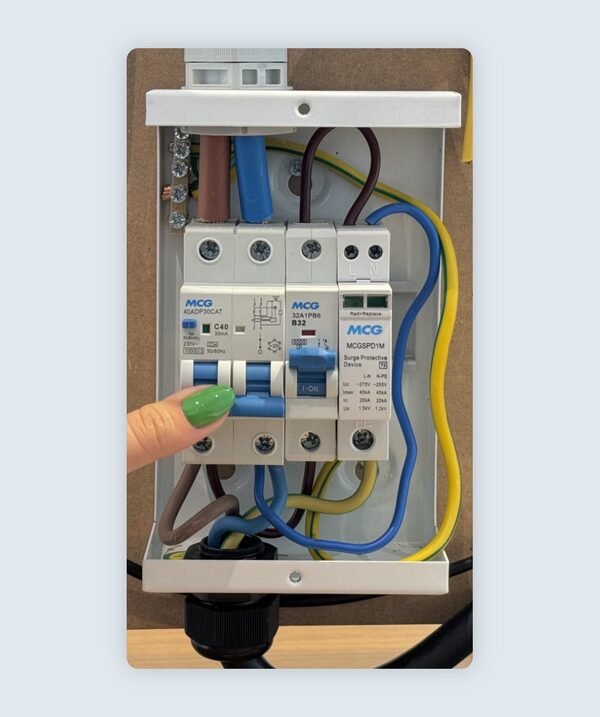
Surge protection devices are the components that sit inside or beside a consumer unit and divert transient overvoltages away from the installation. The documents here do not set out a domestic requirement for a particular type, and no Type 2 device specification appears in them. What they do establish is the context in which such a device would be fitted: the consumer unit is named as part of the fixed electrical installation, alongside the wiring, socket-outlets and light fittings6.
The clearest recent example of component-level rules arriving for households comes from plug-in solar. The GB Plug-in Solar Device Interim Product Specification sets out technical and safety requirements for plug-in solar photovoltaic devices, and the consultation records that it covers both electrical design, British plug requirements, mounting systems and fire protection12. The specification requires that the product be supplied with a durable label intended to be affixed at or near the consumer unit, indicating the presence of a plug-in generation device13. That is a component-layer rule in the literal sense: the label goes on the enclosure.
The same specification places duties on the manufacturer at the production stage. Routine tests shall be carried out by the manufacturer on production units to verify correct assembly and packaging, correct marking and documentation, correct disconnection function and capacitor discharge14. Those are the checks that stand behind a device reaching a household, and they are the kind of requirement that applies to protection equipment generally.
The lesson for a household is that the component layer is where safety regulation actually bites. A cable, a plug, a protective device or an isolator that fails to meet the regulations is not a marginal inconvenience; it is the point at which the installation's protection is defeated. Checking that a part carries the correct marking, and that it has not been recalled, is part of the same discipline as checking the installer's registration.
Smart and flexible appliances: what manufacturers are being asked to build
The direction of travel for components is towards connectivity. The Product Security and Telecommunications Infrastructure Act 2022 mandates that manufacturers of consumer connectable products who sell to UK consumers comply with baseline security requirements16. That is a legal duty, not a voluntary code, and it applies to the networked devices that increasingly attach to a home's electrical installation.
The definition of a manufacturer under that regime is broad:
- Manufacturer: any person who manufactures a product or has a product designed or manufactured and markets that product under that person's name or trademark16
- Importer: any person who imports the product from a country outside the UK to the UK and is not a manufacturer of the product16
- Distributor: any person who distributes, meaning makes the product available, in the UK and is not the manufacturer or importer of the product16
The duty therefore follows the product through the chain rather than resting only at the factory.
Smart metering is the largest connected component programme in UK homes. Energy suppliers aim to provide every home and business in England, Scotland, and Wales with free smart meters17. Northern Ireland is not included in that statement, which is a territorial difference worth noting. Ofgem's consumer research found that 45% of heat pump owners, 37% of solar PV owners and 35% of those with smart appliances had taken up a green tariff, which suggests the connected household is also the tariff-engaged household8.
The policy pressure on manufacturers is to build appliances that can respond to signals, shift load and report consumption. The component layer is where that capability is either present or absent. A consumer unit with no monitoring, no isolation for a battery and no capacity for a charger limits what a household can do later, regardless of what the appliances can do.
How manufacturers' positions shape the rules your components must meet
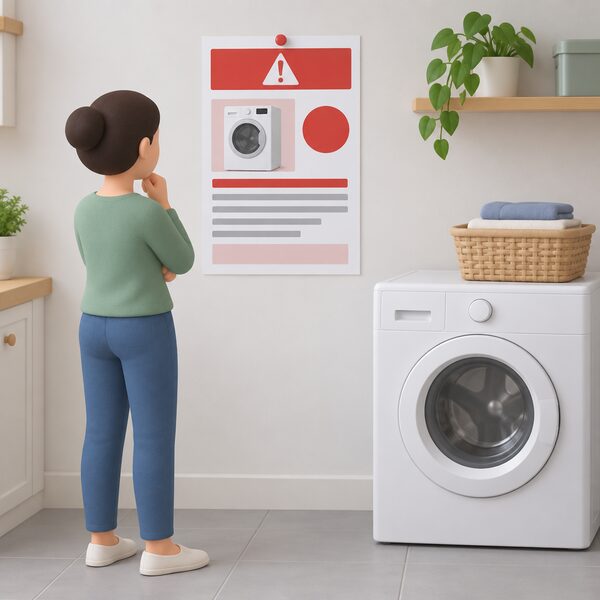
Manufacturers carry legal duties that reach back to the products they have already sold. Regulation 12 provides that a manufacturer who considers, or has reason to believe, that electrical equipment which that manufacturer has placed on the market is not in conformity with Part 2 must immediately take the corrective measures necessary18. That applies in England, Wales and Scotland. It is the mechanism behind recalls and safety notices, and it is why a manufacturer's identity matters to a household long after purchase.
The consultation landscape shows how actively these rules are being reshaped. The UK product safety framework consultation proposes to define producers, onward suppliers and online marketplaces as the supply chain actors in scope9. A separate consultation on reforming consumer protection for home upgrade schemes proposes creating a single end-to-end consumer protection service, accountable to government and responsible for system oversight and performance, as well as providing advice, case management and support for consumers19. That consultation is aimed at the home upgrade sector, including those involved in the installation of solar panels, insulation, batteries, and heat pumps, as well as consumers and groups representing consumer interests19.
Consumer law guidance for the green heating and insulation sector was produced as part of the CMA's work looking at consumer protection in that sector, and provides illustrative examples of how consumer principles can be applied to different marketing claims20. A consumer guide was produced as part of the same CMA work21. In Scotland, the Energy Performance of Buildings (Scotland) Regulations 2025 record that consumers are further protected by the development of an effective audit regime22.
Territorial differences matter here. Competition law and consumer protection law are reserved to the UK Government, and the UK Internal Market Act contains requirements to ensure market access and prevent discrimination in the provision of goods and services23. The regulation of consumer protection, including for pricing, transparency and quality of service, is reserved, with the UK Parliament retaining the power to make these laws24. Ofgem describes itself as Great Britain's independent energy regulator, which excludes Northern Ireland25.
What component choice means for household energy independence
The component layer is where a household's energy independence is physically possible or physically blocked. A consumer unit with spare ways, correct protective devices and a clear isolation point is what allows a battery, an inverter or a charger to be added later without reworking the installation. A unit that is full, or that was specified without regard to future additions, closes those options regardless of what the household wants to do.
The dependence that remains is structural. These components are grid-tied: they distribute and protect a supply that comes from a network, and they are made by manufacturers whose businesses, supply chains and support arrangements sit outside the household's control. A component's conformity marking tells a household that a manufacturer has declared it meets a standard, not that the manufacturer will still exist in ten years. The recall mechanism under Regulation 12 exists precisely because that risk is real18.
For households in Northern Ireland, the position differs in two ways at once. The marking regime is UK(NI) rather than UKCA2, and the smart meter programme described by Energy Suppliers covers England, Scotland and Wales17. Northern Ireland's own advice service funds independent advice on solar panels, heat pumps, and other energy efficiency measures, and directs homeowners to seek that advice from organisations independent of the supply chain26.
The practical position is that component choice is a decision about optionality. The parts themselves generate nothing and store nothing. What they determine is whether the generation and storage equipment a household may want in future can be connected safely, isolated properly and monitored usefully. That is a modest form of independence, but it is the form the component layer can actually deliver.
Sources27 cited
- BEAMA Policy Recommendations for the next UK Government, BEAMA, 2024
- All you need to know about UKCA marking, HETAS, 2025-11-17
- Extended CE marking recognition for ecodesign regulations, GOV.UK, 2025-12-09
- MIR approved gas and electricity meters, GOV.UK, 2025-11-06
- Energy consumption in the UK 2025, GOV.UK, 2024
- Electrical safety standards in the private and social rented sectors: guidance, GOV.UK, 2025-11-01
- Energy efficiency pledges undermined by lack of consumer confidence, Chartered Trading Standards Institute, 2024-05
- Warm Home Discount cost recovery: government response, GOV.UK, 2026-04-02
- The UK's new product safety framework, GOV.UK, 2026-03-31
- DESNZ annual report and accounts 2025 to 2026: performance report, GOV.UK, 2024
- UK Solar Roadmap, GOV.UK, 2025-06
- Plug-in solar consultation document, GOV.UK, 2026-06-16
- Plug-in solar interim product specification (withdrawn), GOV.UK, 2026-06
- Plug-in solar final interim product specification, GOV.UK, 2026-07
- WAI EVCUK216WC Type 2 Female to UK Plug Electric Vehicle Charging Cable recall, Electrical Safety First, 2026-09-17
- Regulations: consumer connectable product security, GOV.UK, 2024-01-08
- How to get a smart meter, Smart DCC, 2026
- Electrical Equipment (Safety) Regulations 2016, Regulation 12, legislation.gov.uk, 2026-09-17
- Reforming consumer protection for home upgrade schemes, GOV.UK, 2026-06-17
- Marketing green heating and insulation products, GOV.UK, 2024-07-16
- Buying green heating and insulation products: consumer guide, GOV.UK, 2023-05-31
- Energy Performance of Buildings (Scotland) Regulations 2025: BRIA, Scottish Government, 2026-08-24
- Energy Performance Certificate reform consultation: government response, Scottish Government, 2025-01
- Heat networks, Scottish Government, 2026-09-17
- Call for input: exercising consumer choice, a review of the gas disconnections framework, Ofgem, 2025-01-13
- Support to generate your own electricity, nidirect, 2025-09-22
- Great British Insulation Scheme: supply chain, Ofgem, 2026-09-17
 Product Markings and StandardsExplains what conformity markings and voluntary quality marks on home energy products actually mean, who issues them and what testing sits behind each.
 The Full Brands GuideWhich boiler, heat pump or solar brand can you trust, and who actually owns it?
 The Full Energy Suppliers GuideWho the UK's domestic gas and electricity suppliers are, how the market is structured across Great Britain and Northern Ireland, what a supplier is licensed and obliged to do, how the price cap limits bills, what happens when a supplier fails, and who regulates it all.
 Who Publishes Home Energy DataA directory of the organisations producing household energy numbers, from government departments and regulators to certification bodies, trade associations and charities.
 Where Energy Products Are MadeWhere are solar panels and heat pumps actually made, and does it matter where yours comes from?
 Who Owns Which Energy BrandMaps the corporate groups that sit behind familiar UK boiler, cylinder, heating and renewables brands, and which names are badges rather than separate factories.