
In this answer
Short answer
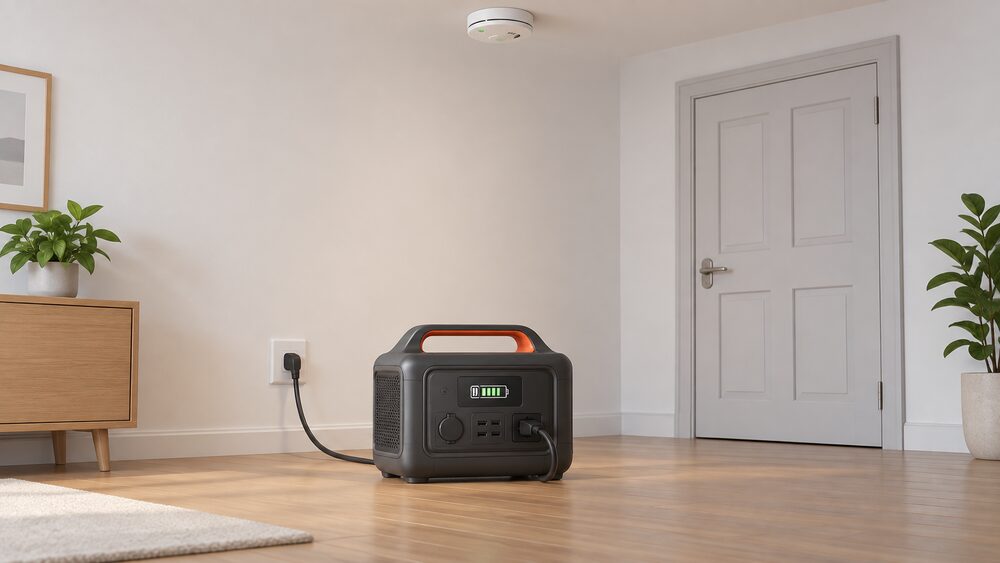
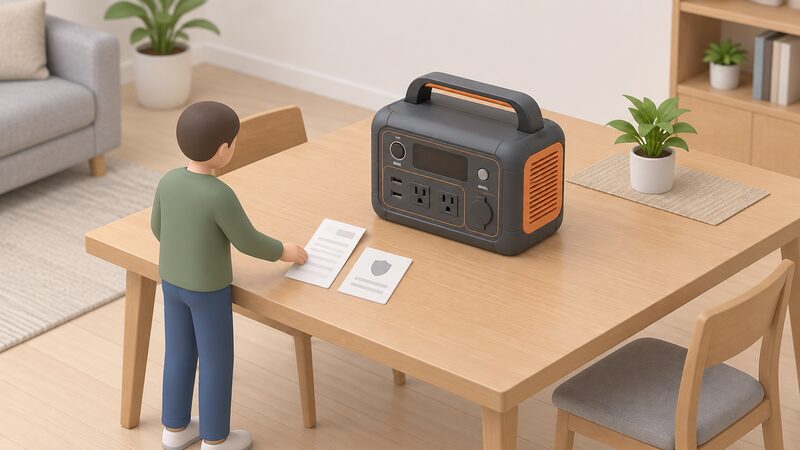
Yes, a battery portable power station can be used indoors. It does not burn petrol, diesel or LPG, so it produces no combustion exhaust and no carbon monoxide during normal operation. That is the whole of the safety case, and it is the reason a power station sits in a different category from a fuel generator, which must never be operated indoors, in a garage, shed or other enclosed area connected to the home1.
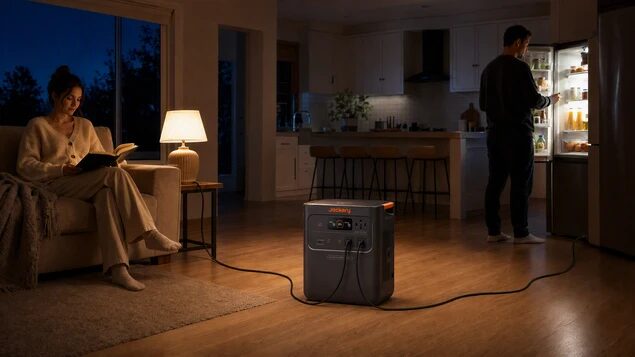
The distinction matters most in winter, when outages and cold arrive together. Maker guidance for winter storm backup states plainly that no fumes make indoor use safe during winter power outages2. A unit can sit in a living room, hallway or kitchen and run lighting, internet equipment, phones and a fridge without any flue, ventilation or outdoor siting.
What follows is not a blanket clearance. The lithium-ion cells inside the unit carry their own fire guidance, which is about charging and placement rather than exhaust. Certification, sizing and warranty terms each shape whether a particular unit suits a particular household.
Zero emissions: why a power station can go indoors
The safety difference between a power station and a generator is chemical, not electrical. A fuel generator burns a hydrocarbon and vents the products of that combustion, including carbon monoxide, into whatever space surrounds it. A battery power station stores and releases charge with no combustion step at all. Maker guidance states that battery power stations do not burn petrol or diesel, so they do not produce combustion exhaust such as carbon monoxide during normal operation, and can be used indoors when the manufacturer allows it1. A rival maker's guidance puts it the same way: a portable power station is safe to use indoors or outdoors as there are no emissions of any kind, including carbon monoxide gas5.
That is why the indoor prohibition attaches to the generator and not to the battery. The same guidance is explicit that a fuel generator must never be operated indoors, in a garage, shed or other enclosed area connected to the home1. A garage or shed is not a safe compromise for a generator, because both are enclosed spaces connected to the home.
Carbon monoxide risk from portable devices is not zero in general, but it belongs to fuel-burning appliances. Official guidance notes that the risk of exposure to carbon monoxide from portable devices may also be higher in caravans, boats and mobile homes6. That is a warning about where fuel appliances are used, not about battery units.
For a household, the practical consequence is that indoor backup becomes possible at all. A unit kept indoors is available the moment the lights go out, with no trip outside in the dark and no door left open in cold weather. That is the independence a power station offers: it removes the fuel supply, the exhaust and the outdoor siting requirement in one step. What it does not remove is the grid itself, or the need to recharge the unit from somewhere.
What safety certification and testing tell you
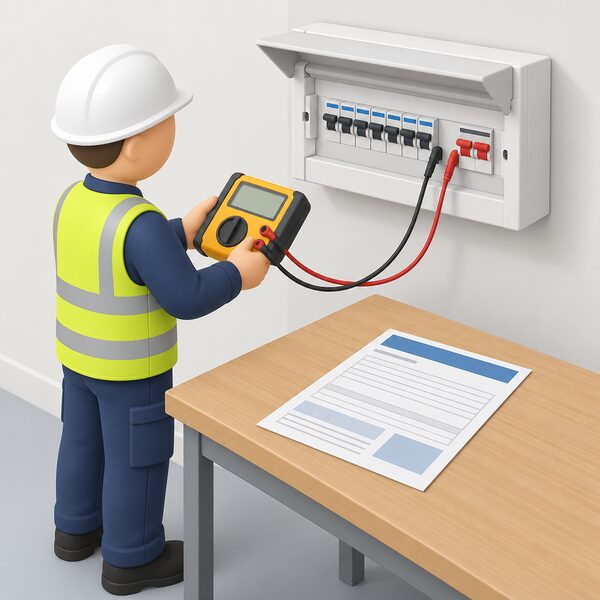
Certification is the part of the safety case a householder cannot verify by looking at the box, so it is worth knowing what the marks refer to. They cover the cells, the enclosure and the electronics, and they are issued by testing bodies rather than by the maker.
For home energy storage, one maker describes a four-level protection system comprising thermal control, an adaptive algorithm, IEC62619-certified cells and an internal fire suppression system7. The same maker's storage product is described as accredited by TüV Rheinland for the strictest safety standards8. A large home backup unit from another maker is listed with UL 9540 certification, 5VA-grade fireproofing and a dedicated EPO emergency stop9. These are maker statements about their own products, and they name the standard rather than a general claim of safety.
Where a unit is wired into a property rather than plugged in, the certification picture changes. Registered electricians in the UK issue a safety certificate confirming their work has been designed, inspected and tested in line with the standard and in compliance with building regulations10. In Wales, the competent person should also provide a completed Electrical Installation Certificate showing that the work was tested for safety11. For an EV charge point, one product is described as designed to exceed the safety requirements for EV charging stations from SAE J1772, NEC, UL and CE12.
The practical reading is this: a plug-in power station needs no electrical certificate because no fixed wiring is altered. A unit connected to a consumer unit, a transfer switch or a dedicated circuit does, and that certificate is the document that shows the work was tested. Anything that touches the fixed installation moves the job into the territory covered by backup power safety and standards.
Heat, charging and placement indoors
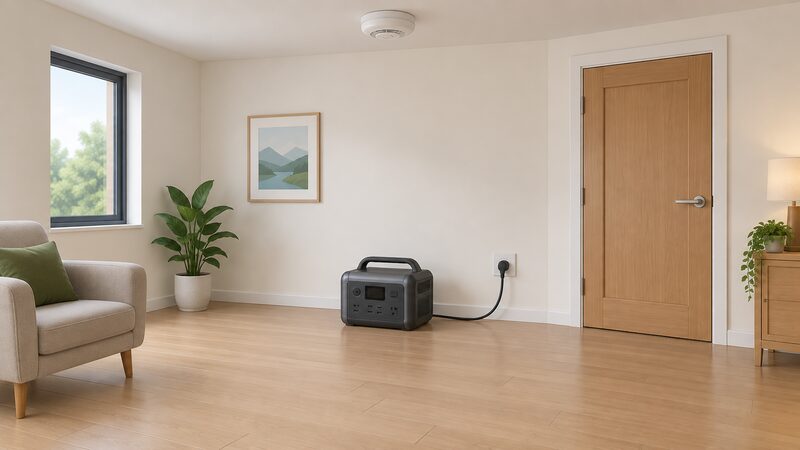
Indoor use is safe from an exhaust standpoint; the cautions that remain are about heat and about charging. Official fire guidance for lithium-ion batteries in household devices sets out the routine: charge the device in a room that has a working smoke alarm, which does not compromise your escape route, keeping the door closed while it is charging and away from any heat source3. The same guidance says not to charge devices overnight when anyone is asleep or leave them on charge when you have left the home3.
Those two rules do most of the work. They are about the charging phase, when the cells are under load and generating heat, rather than about discharge. A unit powering a lamp or a router is not charging.
Placement follows the same logic. Independent guidance on portable electric heaters says to use smoke alarms or heat detectors nearby13, and never to leave a heater unattended while in use or while asleep13. A power station is not a heater, but the principle of not stacking heat sources in an unmonitored room applies to anything with a battery in it. Guidance on portable bottled gas heaters goes further and says to avoid using them in rooms that contain flammable or combustible materials, like bedrooms and bathrooms14; a battery unit has no flame, but keeping it clear of stored flammables is consistent with the fire guidance.
Two further points belong here. Surge protective devices are usually installed within the consumer unit to protect the electrical installation15, which is relevant if a power station is ever connected to fixed wiring rather than used as a standalone appliance. And where a shed or outbuilding is used for higher power demands, an electrician may need to install a small, dedicated consumer unit inside the shed16. Neither is required for a plug-in unit used indoors.
Sizing a unit for indoor backup use
Indoor use raises a sizing question that outdoor generator use does not, because a unit kept inside is usually expected to carry the essentials rather than the whole house. Home backup sizing guidance sets out bands: 1 to 2 kWh is suitable for shorter outages and essential devices such as refrigeration, internet, lighting, phones and laptops; 3 to 4 kWh suits overnight outages and more reserve; expandable systems cover extended outages1.
The same guidance gives a planning method: multiply battery energy by about 0.85 to 0.9, then divide by average load1. That derating accounts for inverter losses and standby consumption, and it is the difference between the number printed on the unit and the energy actually delivered to appliances. The documents give slightly different headroom figures, around 15 to 20% in one place and roughly 10 to 20% when sizing for essential loads in another, and that conflict is not resolved.
At the small end, 300 to 700 Wh is described as suitable for phones, tablets, cameras, laptops, LED lights and other low-power gear on day trips or short overnights2. That band will not carry a fridge through a night, but it covers communications and lighting comfortably.
| Use case | Guidance band | Typical loads |
|---|---|---|
| Short outages, essentials | 1 to 2 kWh | Refrigeration, internet, lighting, phones, laptops1 |
| Overnight outages, more reserve | 3 to 4 kWh | Same loads held for longer1 |
| Low-power gear, short overnights | 300 to 700 Wh | Phones, tablets, cameras, laptops, LED lights2 |
For a fridge specifically, the runtime question is separate from the safety question. Food safety guidance cited by a network operator states that a fridge will keep food safe for up to four hours during a power outage provided the door is kept closed as much as possible15. A power station sized in the 1 to 2 kWh band is intended to cover exactly that kind of load. More detail on matching capacity to appliances sits in what size portable power station you need.
Warranty and what owning one means for household independence
A power station's warranty is a maker's promise, not a statutory scheme, and the terms vary by range and by where the unit was bought. Jackery states that the warranty period for Jackery power products is 24 months4. The same document sets the start date: the sales receipt from the first consumer purchase, or other reasonable documentary proof, is required in order to establish the start date of the warranty period, and in each case the warranty period is measured starting on the date of purchase by the original consumer purchaser4.
Other terms sit alongside that headline figure. A 3+2 or 5+2 year warranty is advertised as applying only at www.jackery.com17, and refurbished units carry a 6-month warranty17. The documents also give a 2-year or 3-year warranty with an additional 1 or 2 years if purchased directly from uk.jackery.com in one place, and a 3-year warranty with an additional 2 years if purchased directly from Jackery.com in another17. Those figures disagree and the conflict is not resolved, so the terms supplied with a specific unit are the ones that govern. Registration is a receipt-keeping exercise rather than a form-filling one: the proof of purchase establishes the start date4.
On independence, the honest position is mixed. A power station removes dependence on a fuel supply, on an outdoor siting spot and on the exhaust risk that comes with a generator. It does not remove dependence on the grid to recharge it, on a supplier for electricity, or on the manufacturer for cells, firmware and warranty service. A unit charged from a wall socket is a buffer against an outage, not a source of energy. Charging it from solar panels changes that calculation, and the Energy Saving Trust notes that plug-in solar panels are portable devices so you can take them with you if you move home18. Home batteries serve a related but different purpose: combining solar panels with a home battery lets you store free, renewable electricity to power your heat pump, making you less reliant on grid electricity19. For a household weighing the two approaches, home battery vs portable power station sets out the trade-offs.
Warranty protection in the wider backup and retrofit market is often backed by insurance rather than by the maker alone. For domestic installations an insurance backed guarantee is required20, and independent warranty products list battery storage among the technologies they cover21. Those schemes exist because a maker's promise is only as durable as the maker. A power station bought outright carries no such backstop; the receipt and the stated term are what a household holds.
Jackery: the company behind the units
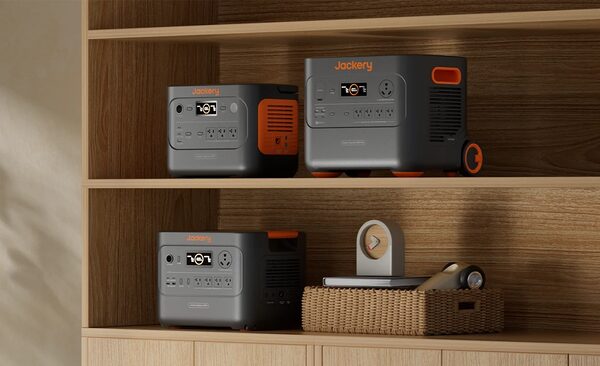
Jackery is one of the makers whose guidance appears throughout this page, and its own product pages describe the features it offers on UK units. The company advertises 30dB quiet power and ChargeShield, described as 62-layer protection, on its portable power stations22. It also lists a 4-year stand by capability22. These are maker statements about its own products.
The range spans small portable units through to large home backup systems. A HomePower 3600 Pro Max unit is listed with UL 9540 certification, 5VA-grade fireproofing and a dedicated EPO emergency stop9. The company's buying guide covers the range and the warranty terms that attach to each tier17.
Two things are worth separating. The first is that a maker's own safety and feature claims are the appropriate source for that maker's products, and nothing more; they are not independent verification. The second is that warranty terms differ between the company's own store and other retailers, which is why the 3+2 and 5+2 year terms are described as applying only at www.jackery.com17. A household comparing units across brands will find the same pattern elsewhere, and portable power stations covers how the category works as a whole.
Where indoor use still has limits
Indoor use is safe from exhaust, but it is not unlimited. The charging rules are the main constraint: not overnight while anyone is asleep, not unattended when the home is empty, and not in a room without a working smoke alarm3. A unit that is expected to run through the night is therefore usually charged during the day and discharged overnight, which is a routine rather than a restriction on the appliance itself.
Heat is the second limit. Keeping the unit away from heat sources is part of the same official guidance3, and the general principle that heat sources should not be left unattended applies across household electricals13. A power station in a cupboard next to a boiler, or on a floor in direct sun through a window, is not the placement the guidance describes.
The third limit is capacity, not safety. A unit sized at 1 to 2 kWh will carry essentials through a shorter outage; a unit sized at 3 to 4 kWh is intended for overnight outages and more reserve1. Neither is a whole-house supply, and neither removes the need to know what the household's essential loads actually are. Working that out in advance is covered in essential loads and backup circuits.
Finally, the dependence that remains is on recharge. A power station indoors is a store, not a generator. It is refilled from the grid, from solar or from a vehicle, and each of those is a separate arrangement. For a household thinking about what a power station contributes to energy independence overall, backup power and energy independence sets out the wider picture, and the backup power pillar covers the full range of options for UK homes.
Sources22 cited
- Best generator for home backup power UK, BLUETTI, 2026-08-31
- Best portable power stations, BLUETTI, 2026-08-31
- Lithium-ion batteries, North Wales Fire and Rescue Service, 2026
- Warranty and return, Jackery UK, 2026-09-20
- Inverter generators vs portable power stations, EcoFlow, 2025-06-16
- Carbon monoxide poisoning, nidirect, 2026-09-17
- How solar panels work: photovoltaic guide, SunPower Global, 2026-07-14
- Storage battery, SunPower Global, 2026-09-17
- Solar Generator HomePower 3600 Pro Max, Jackery, 2026-09-19
- Plug-in solar consumer guide, Electrical Safety First, 2026-08
- Building regulations: electrics, Welsh Government, 2026-09-17
- EmonEVSE overview, OpenEnergyMonitor, 2026-09-17
- Portable heaters, Electrical Safety First, 2026-09-17
- Energy efficient heaters, Uswitch, 2026-07-01
- Standards of performance, National Grid, 2026-09-17
- Wiring a shed: a guide for homeowners, NICEIC, 2026-09-17
- Jackery buying guide, Jackery, 2026-09-19
- Plug-in solar panels, Energy Saving Trust, 2026-09-17
- How to ensure a heat pump runs efficiently, Energy Saving Trust, 2026-05-19
- Insurance backed guarantee products, MCS Certified, 2026-05-13
- MCS approved financial protection products, MCS Certified, 2026-09-17
- Portable chargers, Jackery, 2026-09-19
 Portable Power StationsWhat can a portable power station actually keep going in a power cut, and for how long?
 Siting and LocationWhere can a home battery actually go?
 Power Station BatteriesWhat kind of battery is inside a portable power station, and does it matter?
 Backup Power Safety RulesWho signs off a battery or backup circuit, and can you legally plug in a power station or a plug-in solar panel in the UK?
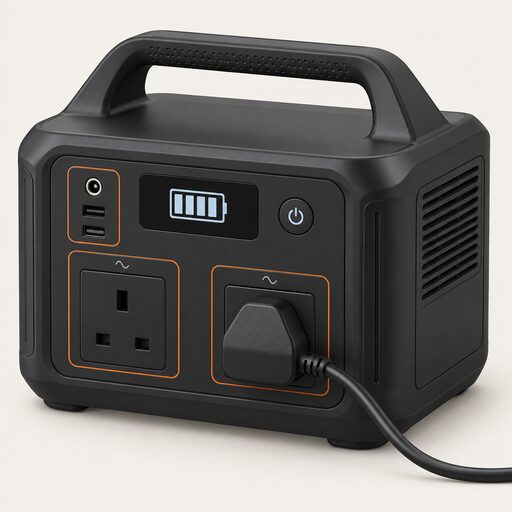 Backup Power for HeatingWhy gas boilers, heat pumps and storage heaters stop in a power cut, what a portable power station can and cannot carry, how to size one, and what home battery systems do when the mains fails.
 Home Battery Fire SafetyHow likely is a home battery to catch fire, and what keeps it safe if it does?