In this guide
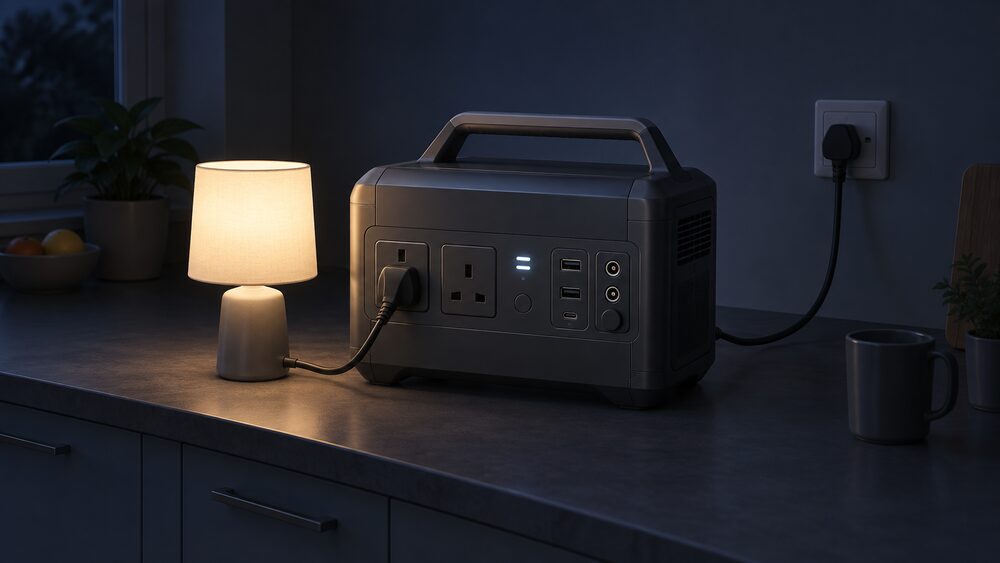
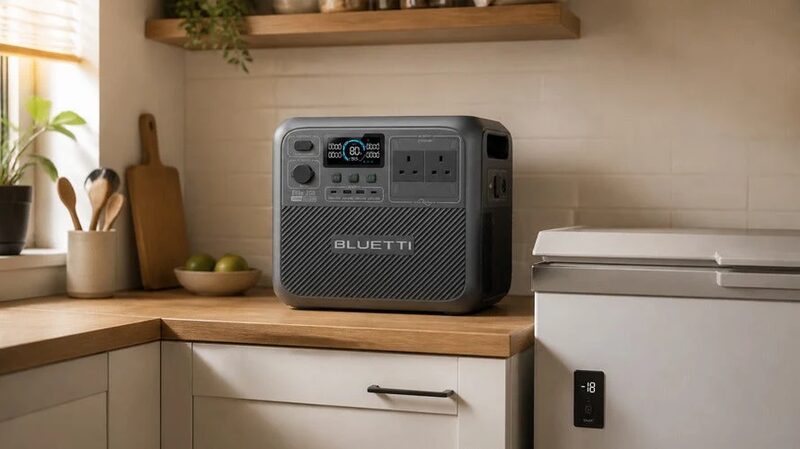
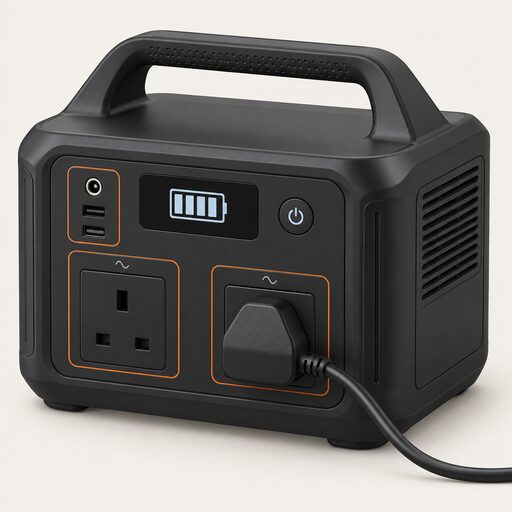
A portable power station is a large rechargeable battery in a case, fitted with ordinary three-pin AC sockets, USB ports and DC outlets. It stores energy taken from the wall, a car or solar panels and releases it later; it does not generate electricity the way a petrol generator does. In a power cut it can run whatever is plugged into it until the battery is empty, silently and without exhaust fumes1. Makers describe them as portable battery packs equipped with various outlets and charging options2.
What one can run comes down to two numbers: capacity in watt-hours (Wh), which sets how long, and inverter output in watts, which sets how much at once. Buying guidance groups units by capacity: 300 to 700Wh for phones, laptops and LED lights on day trips, 800 to 1,200Wh for weekend camping with a compressor fridge, 1,500 to 2,500Wh for caravans or short household outages, and 2,500Wh and above for heavier home backup3. Anker states that a 2kWh unit runs a 1,000W device for roughly 1.5 to 2 hours and a 500W appliance for about 3 to 4 hours4.
For household energy independence, a power station covers the gap in a cut for a limited set of essentials. It does not replace the grid: it is refilled from the grid, a car or the sun, and once empty it needs one of them again.
A battery with sockets, not a generator
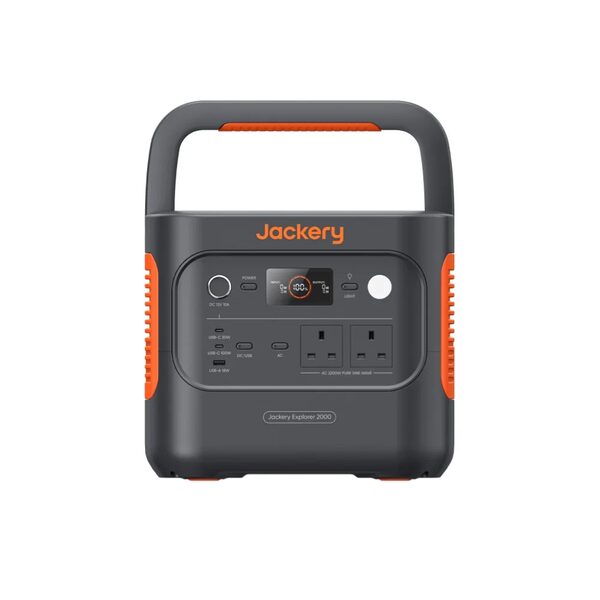
The simplest way to picture a portable power station is as a big battery that stores energy taken from a wall plug or a car and gives it back through a choice of ports. It holds energy but makes none of its own1. Physically, units are described as about the size of a small drink cooler, and many have handles or wheels1.
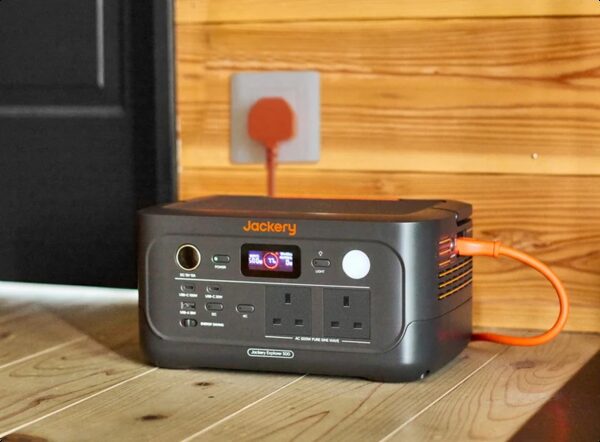
The outlets are what separate a power station from a phone power bank. Typical units carry AC outlets for mains appliances, USB ports for phones and tablets, and DC outlets for 12V equipment2. Jackery describes its range as running devices "via AC, DC, or USB ports"7. Most can also take solar charging, so they do not have to be plugged into a socket to recharge8.
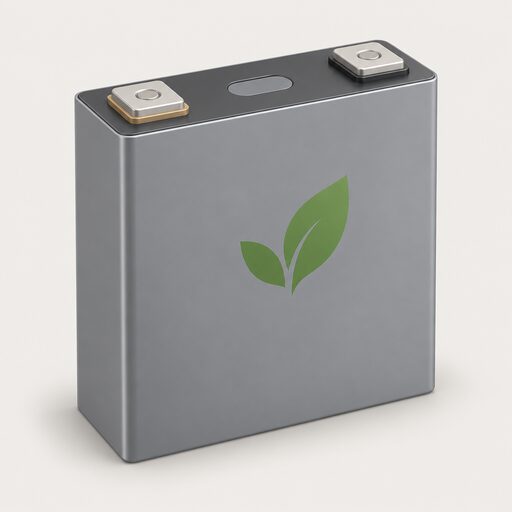
The battery chemistry has shifted. Newer stations use lithium batteries, which are lighter, more efficient and safe to discharge to a lower voltage without damage8. Which? notes that an Anker unit it examined uses lithium iron phosphate (LiFePO4) cells9. The chemistry matters for cycle life and safety, covered in portable power station batteries.
Makers pitch the same units for camping, vans and travel as well as home backup2. That dual use is part of their appeal: a unit bought for a power cut is also useful the rest of the year, which keeps it charged and tested. The comparison with fuel machines is set out in portable power station vs generator, and with a fixed installation in home battery vs portable power station.
Battery, inverter and charge controller: how it works
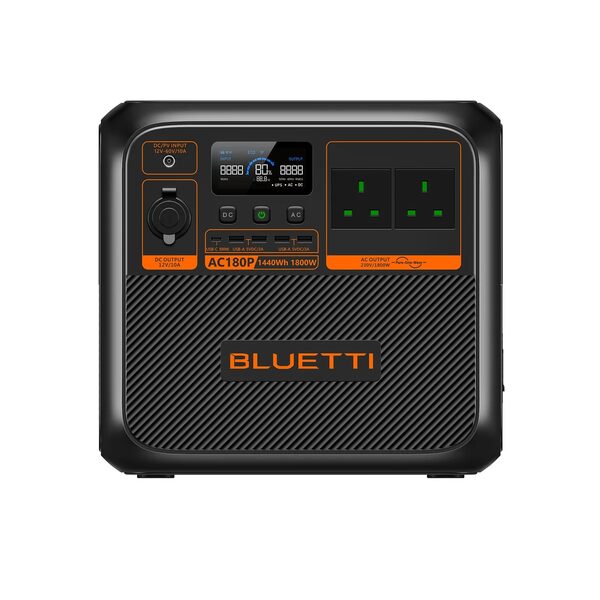
A power station has three main working parts: a battery, an inverter and a charge controller8. The same idea applies to fixed home storage, which Home Energy Scotland describes as "a battery, charger and controls"10.
- The battery stores energy as direct current (DC). Its capacity in Wh is the headline figure on every unit.
- The inverter converts that DC into alternating current (AC) at mains voltage, so an ordinary appliance can plug in. Its continuous rating in watts limits the total load at any moment.
- The charge controller manages power coming in. Solar input needs one that tracks the panel's best operating point, known as MPPT (Maximum Power Point Tracking).
Anker states that all its SOLIX portable power stations have a built-in MPPT controller11. Jackery states the same for all its units12, and the Goal Zero Yeti 1500X pairs an NMC lithium battery with a built-in MPPT controller5.
Around these sits a battery management system. Jackery states its system protects against overcharging, over-discharging, overheating, overcurrent and short circuits6. This is what stops a fault from becoming a fire, and it is one reason a power station behaves differently from a bare leisure battery wired to a separate inverter, the approach covered in inverters and inverter-chargers.
The conversion step costs energy. Anker's run-time formula allows 20% for it: run time equals capacity multiplied by 0.8, divided by the device's wattage, for the AC ports11. USB and DC outputs skip most of that conversion, which is why low-voltage devices tend to run longer from the same battery.
Capacity and run times: from 300Wh day-trip units to 100kWh expandable systems
Capacity bands in buying guidance run from small to whole-home3:
| Capacity | Suited to |
|---|---|
| 300 to 700Wh | Phones, tablets, cameras, laptops, LED lights on day trips or short overnights |
| 800 to 1,200Wh | Weekend camping with a compressor fridge, electronics, lighting |
| 1,500 to 2,500Wh | Caravans, work equipment, short household outages with several essentials running together |
| 2,500Wh and above | Heavier home backup and longer off-grid stays |
For caravans and campervans the same guide gives 1 to 2kWh as a practical starting range for longer stays, with solar extending autonomy3. These bands come from a maker's guide, so they are a sensible starting point rather than an independent standard.
Run time follows from capacity and load. Using Anker's formula, capacity times 0.8 divided by wattage11, a household can estimate any appliance. Anker's own worked figures for a 2kWh model are about 3 to 4 hours at 500W and roughly 1.5 to 2 hours at 1,000W4. At the small end, Jackery states its Explorer 500 v2 runs a 60W portable fridge for 4.5 hours13.
At the top, the line between portable and fixed storage blurs. BLUETTI describes its AC200L as "Scalable up to 100 kWh for whole-home or small business backup"14, using add-on expansion batteries. Expansion packs let a household start small and add capacity, though the inverter's wattage limit does not grow with them. How to match capacity to a home's essentials is covered in what size portable power station you need.
What you can run in a blackout: kettle, heater, fridge, freezer
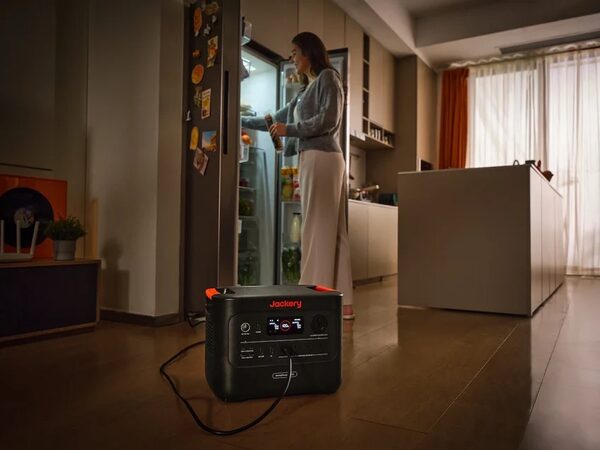
The fridge and freezer are usually the first concern, and they have more slack than many assume. NIE Networks states that food should keep for 4 to 6 hours in the fridge and 15 to 24 hours in the freezer if unopened15. The Centre for Sustainable Energy, in guidance reviewed in August 2026, gives up to four hours in the fridge and 48 hours frozen with the doors closed16. National Grid cites the Food Standards Agency figure of up to four hours for a fridge17. The freezer figures differ between the two documents (15 to 24 hours against 48 hours) and are not reconciled. The practical point is that a power station does not need to run a freezer continuously; periodic top-ups can extend safe storage. More detail is in power cut food safety.
Heating is the harder case. Gas boilers and hobs, heat pumps, internet and phones won't work without power18. A boiler's controls and pump need electricity even though the fuel is gas; running a whole heating system from a power station is a different job from running a lamp, covered in keeping heating running in a power cut.
High-draw appliances test the inverter rather than the battery. A kettle or a portable electric heater can draw close to or above what smaller units can deliver, and even on a large unit they drain capacity fast. Before planned emergency cuts, NIE Networks asks households to refrain from extra electricity use such as boiling kettles for flasks, because the system is struggling with demand19. Some equipment, such as satellite and digital TV recorders and the fridge and freezer, is meant to stay powered permanently20.
A makers' winter emergency kit list places "a fully recharged portable power station" alongside bottled water, non-perishable food, a battery-powered radio, medication, warm clothes and blankets21. That framing is realistic: the power station is one item in a kit, not the whole plan. For vulnerable customers during gas outages, SGN states it has portable electric appliances available for cooking and heating22, which shows the network companies themselves plan around small, local power.
Charging from the wall, a car and solar
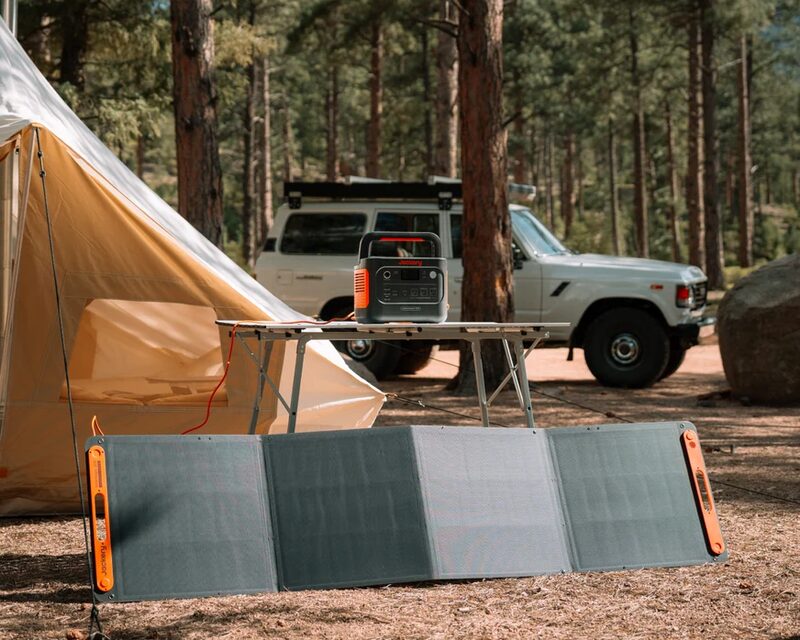
Power stations recharge in several ways: solar panels, a wall plug and a car charge adaptor1. BLUETTI adds generator charging to that list for its home backup systems23.
Wall charging is the fastest routine route. The best current 2000W-class models can recharge fully in two hours or less from the wall5. That makes it realistic to keep a unit full and top it up during a short restoration between rota cuts, described in rota power cuts.
Car charging from a 12V socket is slow, since the socket delivers far less power than a wall outlet. It is useful for keeping a unit topped up on the move rather than for filling a large one.
Solar charging is what gives a power station independence from the grid during a longer cut, weather permitting. The built-in MPPT controller handles the panel input11. Anker publishes connection instructions for its own panels: some of its PowerHouse models connect via a connector and solar cable, others via a solar cable alone11. Solar setup is covered in charging a portable power station from solar panels.
Combining inputs has limits set by each maker. Jackery states that simultaneous AC and solar charging is supported in most cases, but most of its models do not support car and solar charging at the same time12. On the Explorer 500 v2 page:
"(Please note: Solar panel charging and car charging cannot be performed at the same time.)"
Some models also offer USB-C fast charging12. Charging speed in practice depends on the input limit the maker sets, the charger supplied and, for solar, the panel size and the weather.
Indoor safety: no fumes, low noise and what not to back up
The clearest safety difference from a generator is exhaust. Buying guidance states that battery power stations do not burn petrol or diesel, so they produce no combustion exhaust such as carbon monoxide during normal operation, and that they can be used indoors when the manufacturer allows it3. BLUETTI describes its units as "fully electric" with no fuel, no fumes and no carbon monoxide risk24, and Jackery describes its Explorer 240 v2 as safe for a UK flat or house for the same reason25. BLUETTI states its LiFePO4 cells are "fume-free and stable for indoor use"23. Generators remain a separate risk, set out in generator safety.
Noise is low. Jackery quotes 30dB for its range7, and describes power stations generally as staying below 30 to 45dB with cooling fans running25. That is maker testing, not independent measurement.
The absence of fumes does not remove every risk:
- Temperature. Jackery gives a recommended charging range of 0 to 45°C and a discharging range of minus 10 to 45°C12. A cold garage in winter may be outside the charging range.
- Lithium fire risk. A battery management system guards against faults, but lithium cells remain a fire hazard if damaged. See lithium battery safety and recalls.
- What is plugged in. A heater run from a power station is still a heater. Electrical Safety First states: "It is recommended not to use a portable heater overnight."26
What not to back up is set by the makers themselves:
For electrically dependent medical equipment, the route is the network operator's priority support, described in help if you rely on medical equipment. Continuous switchover for computers is the job of a UPS, compared in UPS vs portable power station. More on indoor use is in are portable power stations safe indoors.
Choosing a unit: capacity, ports, inverter, weight and price
Five things separate one unit from another.
- Capacity (Wh): how long it lasts. Match it to the band above.
- Inverter output (W): the most it can supply at once. A unit with plenty of capacity but a small inverter still cannot start a high-draw appliance.
- Ports: guidance states the unit should have "the right types and number of output ports" for the devices in question2.
- Weight and portability: handles or wheels are common8, but larger units are heavy to move.
- Price: rises steeply with capacity.
UK list prices from the makers in September 2026 show the spread; VAT position is not stated on these listings, and prices change with promotions27:
| Model | Price (GBP) |
|---|---|
| BLUETTI Elite 30 V2 | £199.00 (£219.00 for Green variant) |
| BLUETTI EB3A | £219.00 |
| BLUETTI Premium 30 V2 | £269.00 |
| Jackery Explorer 500 v2 | £329.00 (listed before discount at £449.00) |
| BLUETTI Premium 200 V2 | £1,319.00 |
| BLUETTI Elite 300 (described as smallest 3kWh unit) | £1,399 (was £1,599) |
| BLUETTI Elite 400 | £1,799.00 |
Expansion is part of the price question: a unit that accepts add-on batteries, such as the AC200L scalable up to 100kWh14, lets capacity be bought in stages. Costs are covered in full in how much a portable power station costs and set against generators and fixed batteries in backup power costs compared.
Jackery, Anker SOLIX and BLUETTI: the main UK ranges
Three brands dominate UK listings. What follows is each maker's own description, not a ranking.
Jackery sells its Explorer range of power stations and "Solar Generator" bundles that pair a unit with panels. It states its units use LiFePO4 or NMC lithium batteries depending on model12, all carry an MPPT controller12, run at a quoted 30dB7 and are sold in Standard, Plus and Pro series with different warranty terms6. See Jackery and the Jackery Explorer 2000 Plus.
Anker SOLIX uses LiFePO4 across its portable power stations and fits a built-in MPPT controller to all models11. Its range includes 2000W-class units4 and PowerHouse models. See Anker SOLIX and the Anker SOLIX F3800 Plus.
BLUETTI sells from small units such as the Elite 30 V2 and EB3A up to 3kWh-class units and expandable home backup systems27. It states its LiFePO4 batteries last 2,500 to 6,000 or more cycles24 and that the AC200L scales to 100kWh14. See BLUETTI and the BLUETTI Elite 200 V2.
| Brand | Battery chemistry (maker) | Charge controller | Stated cycle life |
|---|---|---|---|
| Jackery | LiFePO4 or NMC | MPPT on all units | 4,000 cycles |
| Anker SOLIX | LiFePO4 | Built-in MPPT, all models | Not stated |
| BLUETTI | LiFePO4 | Not stated | 2,500 to 6,000+ cycles |
Figures in this table are the makers' own12. Head-to-head pages cover Jackery vs Anker SOLIX, BLUETTI vs Jackery and EcoFlow vs BLUETTI.
Warranty and battery lifespan: years and thousands of cycles
Warranty terms vary by series and by where the unit is bought. Jackery states6:
- Most Pro and Plus series: 3+2 years extended warranty
- Standard series: 2+1 years extended warranty
- Refurbished units: 6-month warranty
- The extended 3+2 or 5+2 year terms apply only to purchases from jackery.com
A warranty is only as good as the company behind it; that is a continuing dependence on the maker for the life of the unit.
Battery life is measured in cycles, one full charge and discharge. Buying guidance states many current LiFePO4 stations are rated for roughly 3,000 to 6,000 cycles before falling to about 80% of original capacity3. Makers' own claims12:
| Maker claim | Figure |
|---|---|
| Jackery | 4,000 cycles, over 10 years at about one use every three days (approximately 120 cycles a year) |
| BLUETTI LiFePO4 range | 2,500 to 6,000+ cycles, roughly 7 to 17 years of daily use |
| BLUETTI AC200L | 4,000+ cycles, over 10 years |
Years depend on how hard a unit is worked. A worked example for a battery rated at 1,000 cycles gives about 2.7 years at one full cycle a day, 5 to 6 years at half a cycle a day and 9 to 10 years at two cycles a week29. A unit kept for occasional power cuts will cycle rarely, so calendar ageing and storage habits matter more than the cycle rating. The 80% point is not the end of life: the unit still works, with less capacity.
Owning one: storage, maintenance and independence
Storage advice differs between makers, and the differences are real rather than contradictory in effect.
- Anker SOLIX: recharge to 100% after every use; turn on Power Saving Mode and turn off all buttons; recharge to 100% every month11. It adds that AC and car socket buttons left on cause no-load power drain11.
- LiFePO4 guidance generally: these batteries prefer staying between roughly 20 and 80% state of charge most of the time5.
- Jackery: units can be left on standby for 6 to 12 months, depending on capacity and battery health12.
The shared thread is that an unused unit drifts down, and one found flat at the start of a power cut is no use. A monthly check fits the routine in maintaining and testing backup power equipment.
On independence, a power station gives a household a pocket of stored electricity under its own control, with no fuel, no installer and no connection to the house wiring. Which? describes home storage generally as making a household's energy system "more independent from the National Grid"30. The limits are firm. Capacity is finite; refilling needs the grid, a car or sunshine; the maker's warranty and, for app-connected models, its software stay as dependencies. Even fixed home batteries often cannot deliver power in a cut: not all are suitable30, and some storage can provide backup only in some cases31.
A power station also sits alongside simpler steps. Portable power banks can charge a mobile several times32; keeping a phone charged and a torch to hand remain basic advice33. In a cut, 105 is the free power cut line34, explained in the 105 power cut number. For medically dependent customers, network operators run their own schemes: UK Power Networks loans portable battery packs, which it states can power a standard feed pump for over 17 hours, during cuts over four hours35. See network operator support schemes, the Priority Services Register and backup power and energy independence, or return to the backup power overview.
Sources35 cited
- Inverter generators vs portable power stations, EcoFlow, 2025-06-16
- Portable power station: power at your fingertips, AlphaESS, 2023-08-25
- Best portable power stations buying guide, BLUETTI, 2026-08-31
- 2000W portable power stations, Anker SOLIX
- 2000W portable power station guide, EcoFlow, 2025-10-24
- Jackery buying guide, Jackery
- Portable power stations, Jackery
- Portable power station vs power bank, EcoFlow, 2025-06-16
- How to buy the best generator, Which?, 2026-01-20
- Battery storage, Home Energy Scotland
- Solar generators, Anker SOLIX
- Jackery buying guide (UK), Jackery
- Solar Generator 500 v2, Jackery
- Limited-time deals, BLUETTI
- Emergency power cuts, NIE Networks
- Preparing for a power cut, Centre for Sustainable Energy, 2026-08
- Standards of performance, National Grid
- Powercut 105, Energy Networks Association
- Preparing for emergency power cuts, NIE Networks
- Switching appliances off standby, Smart Energy GB, 2026-04-22
- Prepare for a winter power outage, EcoFlow, 2025-06-16
- Incident hub, SGN, 2026
- Home battery backup, BLUETTI
- RV test, BLUETTI
- Jackery Explorer 240 v2 guide, Jackery, 2026-04-29
- Portable heaters safety advice, Electrical Safety First
- Coupon products, BLUETTI
- Power stations under 1kWh, BLUETTI
- Battery throughput and life cycle, SolaX Power, 2026-07-15
- Solar panel battery storage, Which?, 2026-05-14
- Storage, Electricity North West
- What to do in a power cut, Which?, 2026-06-04
- What happens in an energy shortage, Energy Networks Association
- Can a smart meter cut off power?, Smart Energy GB, 2026-04-24
- Extra support for people reliant on electricity for medical reasons, UK Power Networks, 2024-01-09
 Portable Power Station SizeHow big a portable power station does a home actually need, and how long will it keep things running in a power cut?
 Power Station BatteriesWhat kind of battery is inside a portable power station, and does it matter?
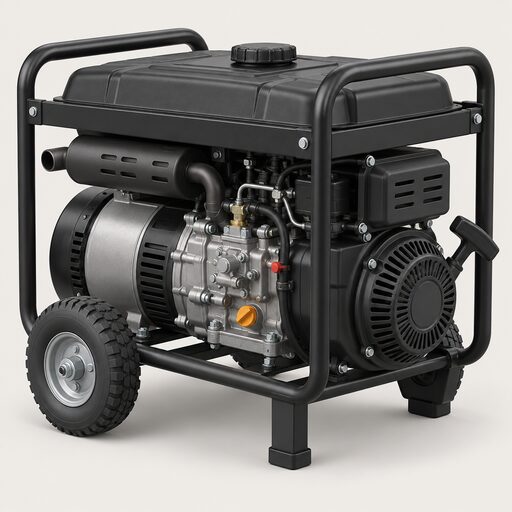 Portable Generators for HomesWhat can a portable generator actually run in a power cut, and for how long?
 Backup Power for HeatingWhy gas boilers, heat pumps and storage heaters stop in a power cut, what a portable power station can and cannot carry, how to size one, and what home battery systems do when the mains fails.
 Portable Power Station CostHow much does a portable power station cost in the UK, and what does the money actually buy?
 Backup Power and EPSWill your lights stay on when the power goes out?