In this guide
A generator can be connected to a home's fixed wiring, but only through a changeover or transfer switch that isolates the property from the grid before the generator is brought on load. The alternative, feeding a generator into a socket or straight into the consumer unit, is prohibited: BS 1363 does not permit plugs and sockets to be used to connect electricity-generating equipment1, and the safety regulations contain a provision that prohibits or restricts the use of a plug for connecting an electricity-generating device to a socket-outlet2.
The reason is not bureaucratic. A generator pushing current back up the service cable energises wiring that the network operator and anyone working on it believes is dead. Properly installed generation equipment does the opposite: network guidance states that it switches itself off during a power cut until after the mains supply has been restored3. A transfer switch reproduces that behaviour by hand or automatically, and it is the only route by which a generator can legally and safely supply a home's existing circuits.
The work itself is notifiable electrical installation work in England and Wales, must comply with BS 7671, and should be carried out by an electrician registered with a competent person scheme, or notified to building control in advance4. This page sets out the connection methods, what the Wiring Regulations require, the earthing question, sizing thresholds and who may do the work.
Why you must not plug a generator straight into a socket or the consumer unit
The prohibition is written into the standards themselves, not left to interpretation. BS 1363, the standard for the familiar three-pin plug, does not permit plugs and sockets to be used to connect electricity-generating equipment1. The Plugs and Sockets etc. (Safety) Regulations 1994 carry the same constraint: BS 1363 contains a provision which prohibits or restricts the use of plugs for connecting electricity-generating devices to socket-outlets2. A plug of that type therefore does not conform to BS 1363 when used to feed a generator into a socket7.
There is a second layer of difficulty. The Electricity Safety, Quality and Continuity Regulations 2002 and the associated standards are designed for fixed installations and do not readily accommodate plug-in generation devices1. That is why the emerging plug-in solar category needed its own product specification and legislative change rather than simply being allowed under existing rules: a plug-in microgenerator is defined as equipment intended for connection to a low voltage consumer's installation by means of a standard plug and socket8, and the specification requires that such devices use plugs designed to BS 1363-19. Even then, the definition excludes devices designed to import electrical energy from a low voltage consumer's installation for the purpose of storing energy for later supply, other than for control or auxiliary functions7.
For a generator, none of that applies. There is no equivalent product specification, and the socket route remains closed. The consumer unit route is worse: connecting a generator to a spare way or a main switch without isolation puts the generator in parallel with the incoming supply, so it can energise the whole installation and the network beyond it. The only compliant arrangement is a device that breaks the grid connection before making the generator connection.
The three ways to connect a generator: extension leads, a transfer switch or a changeover switch
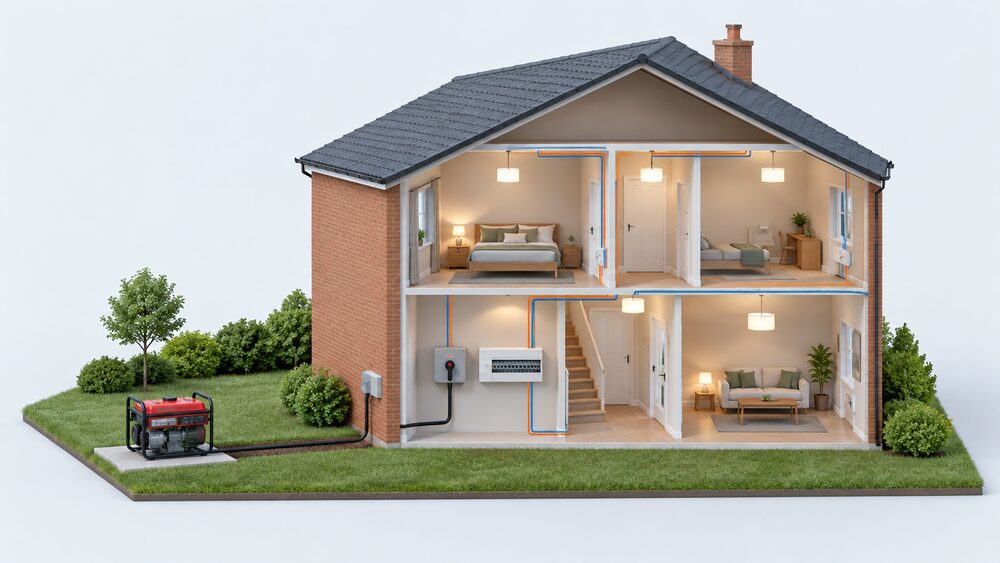
There are three practical arrangements, and they differ in what they can supply and what they require.
Extension leads from the generator. The generator stays entirely separate from the fixed wiring. Appliances are plugged into the generator or into leads run from it. Nothing is connected to the installation, so no isolation device is needed and no notifiable work arises. The limits are physical: leads must be sized for the load, run without creating a trip hazard, and the generator must be sited outdoors because of exhaust gases. This arrangement cannot power fixed equipment such as a boiler, a hard-wired extractor or the lighting circuits.
A changeover switch on a sub-circuit or a dedicated backup board. A changeover switch is fitted so that selected circuits can be supplied either from the grid or from the generator, never both. This is the arrangement that lets a household keep the lighting, the boiler and a socket circuit alive while the rest of the installation stays on the grid supply. It is fixed wiring work and is notifiable.
A changeover or transfer switch on the whole installation. The main switch position is replaced or supplemented by a device that isolates the entire installation from the network and connects the generator instead. This supplies everything, but only within the generator's capacity, and it requires the household to manage load deliberately.
The choice is not about preference but about what the household needs to keep running and how much generator capacity is available. A switched fused connection unit is the standard way of connecting a fixed appliance to a circuit10, and the same principle of a fixed, isolatable connection applies to a generator supply: the connection is made once, properly, rather than improvised at the moment of a power cut.
What a transfer switch actually does, and manual versus automatic
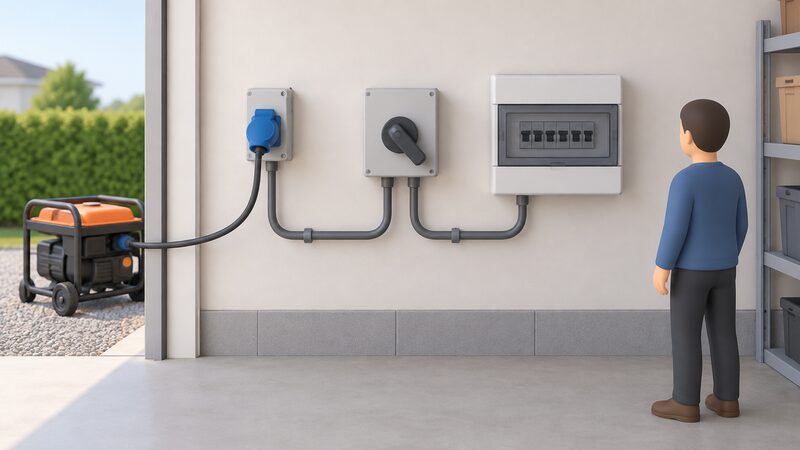
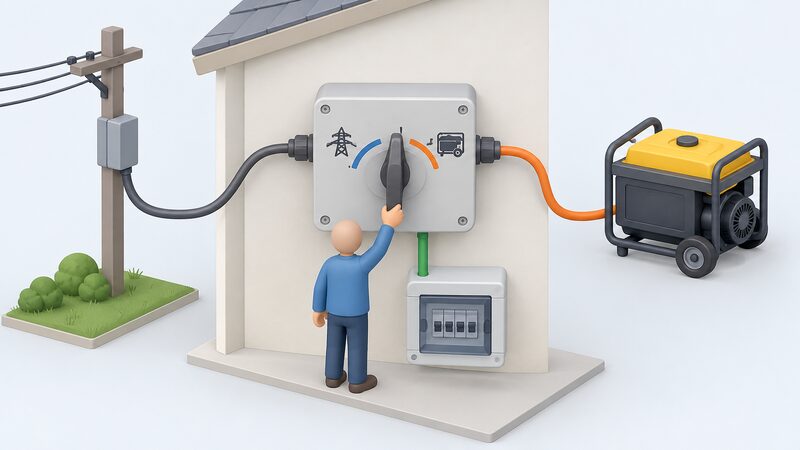
A transfer switch performs one function: it ensures the two supplies can never be connected at the same time. In a manual changeover switch, the household operates the switch, which first breaks the grid connection and then makes the generator connection. In an automatic transfer switch, a sensing circuit detects the loss of the mains supply and performs the same sequence without intervention, and switches back when the supply returns.
The distinction matters for how the installation behaves during a cut. Network guidance describes the behaviour of installed generation: to protect itself, it switches itself off until after the mains supply has been restored3. An automatic transfer switch reproduces that logic for a generator, and it is the arrangement that suits a household that is not present when a cut begins. A manual switch is simpler, cheaper to install and entirely adequate where someone is at home to operate it, but it depends on that person being there and knowing the sequence.
Both types share the same underlying requirement: the neutral and the earthing arrangement must be handled correctly, and the switch must be rated for the generator's output and for the load it will carry. A transfer switch that is undersized, or that switches the live conductor without breaking the neutral where the design requires it, does not provide the isolation the installation depends on.
There is a further consideration that is easy to overlook. A transfer switch installed on the whole installation means the generator is asked to supply everything that happens to be switched on when the supply changes over. Immersion heaters, electric showers, ovens and tumble dryers will all attempt to draw at once. A dedicated backup board, fed through the changeover device, limits the generator to the circuits that were chosen deliberately, which is why the two decisions, what to back up and how to switch, are made together.
The rules: BS 7671 and what the Wiring Regulations require of a generator connection
BS 7671, also known as the IET Wiring Regulations, is the UK's national standard for the design, erection and verification of electrical installations5. It is the standard that should be met for electrical safety11, and it applies to all electrical installations, no matter where they are in the UK10. A generator connection to a home's fixed wiring is an electrical installation, so it falls within scope.
The current edition is BS 7671:2018+A4:2026, published on 15 April 2026, which supersedes BS 7671:2018+A2:2022+A3:20245. The standard is a copyrighted publication and is not available free of charge; it is bought from BSI or consulted in reference libraries and trade premises.
Alongside BS 7671 sits the network connection framework. The EU Network Code Requirements for Generators was incorporated into UK law6, and it governs the technical conditions under which generation is connected to the distribution network. For a generator above the threshold discussed below, that framework applies in addition to the wiring standard.
The building regulations add a further layer in England and Wales. Electrical work in homes and gardens must follow the building regulations12, and the standards that should be met are set out in British Standard 767111. In Wales the same requirement is expressed as a duty to comply with the building regulations for electrical installation work in a home or garden13. Scotland and Northern Ireland operate their own building standards regimes, and the Scottish Government publishes its building standards policy separately14.
The practical consequence is that a generator connection is designed, not assembled. The electrician must establish the supply characteristics, decide the earthing arrangement, select the switching device, and verify the result. That is the same process as any other notifiable circuit, applied to a source that can be live when the grid is not.
BS 7671 amendments: which version applies to your installation
The Wiring Regulations are amended periodically, and the amendment in force determines what an installation must comply with at the time the work is done. The current edition is BS 7671:2018+A4:2026, published on 15 April 2026, which supersedes BS 7671:2018+A2:2022+A3:20245. An installation designed and certified against the current edition is certified against the standard as it stands.
For an existing installation, the position is more nuanced. Earlier editions and amendments remain relevant to what was installed and certified at the time, and a new generator connection added to an older installation is designed to the current standard while taking account of the existing arrangement. The electrician carrying out the work determines which version applies and records it on the certificate.
The wider regulatory picture also moves. The Boiler Upgrade Scheme (England and Wales) (Amendment) Regulations 2024 amended Regulation 7 of the 2022 Regulations, which deals with requirements for new-build properties, and Regulation 17, which sets obligations on installers15. Those amendments concern heat pump grants rather than generator connections, but they illustrate the pattern: scheme rules and standards are revised, and the version that applies depends on the date of the work.
For a household, the practical point is to ask which edition and amendment the certificate references, and to keep the certificate. It is the document that shows what standard the installation was verified against, and it matters if the property is sold or let. Electrical safety standards guidance for the private and social rented sectors sets out what landlords must be able to demonstrate11, and the same paperwork discipline serves an owner occupier.
Isolating from the grid: why backfeeding is dangerous and illegal
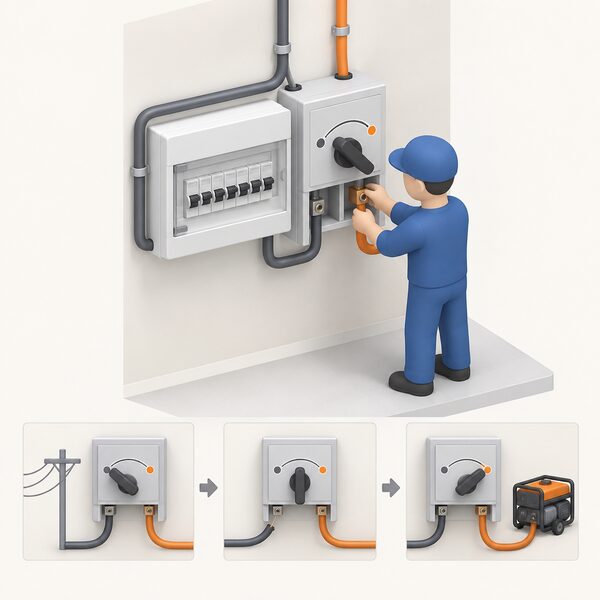
Backfeeding is the condition in which a generator supplies current into the network rather than into the home's own circuits. It arises whenever a generator is connected to the installation without a device that first breaks the grid connection, whether through a socket, a modified lead or a direct connection at the consumer unit.
The danger is straightforward. Network engineers, and anyone else working on the line, treat it as dead once it has been isolated at the substation. A generator feeding current back up the service cable makes that assumption false. The same applies to neighbours supplied from the same phase, whose wiring can be energised from a source they have no knowledge of and no way to isolate.
The illegality follows from the standards. BS 1363 does not permit plugs and sockets to be used to connect electricity-generating equipment1, and the safety regulations prohibit or restrict the use of a plug for connecting an electricity-generating device to a socket-outlet2. The connection standards are designed for fixed installations and do not readily accommodate plug-in generation devices1. A backfeed arrangement therefore breaches both the wiring standard and the connection rules, and it is notifiable work that has not been notified.
The correct behaviour is the opposite of backfeeding. Installed generation switches itself off during a power cut until after the mains supply has been restored3. A transfer switch achieves the same result for a generator by construction: the grid connection is broken before the generator connection is made, so there is no path for current to flow towards the network.
"BS 1363 does not permit plugs and sockets to be used to connect electricity-generating equipment"
Earthing and neutral bonding on a generator supply
Earthing is the part of a generator connection that is most often assumed rather than designed, and it is the part where the arrangement genuinely depends on the installation. BS 7671 sets out the requirements, and the electrician designing the connection determines which arrangement applies.
The variables are these. A generator may be a separately derived source, in which case its neutral and earth relationship is its own and must be established at the point of connection. It may be connected so that the installation's existing earthing arrangement is retained, in which case the generator's own earthing terminal is treated differently. The switching device may or may not break the neutral, and that decision follows from the earthing arrangement chosen. None of these can be settled by rule of thumb. A Protective Multiple Earth (PME) system is wired in many UK homes, with the home's earth wiring connected to the neutral conductor at the mains supply connection point1.
What can be said firmly is that the earthing arrangement is part of the design, not an afterthought, and that it is verified as part of the certification. A generator connected to a home's fixed wiring without a considered earthing and bonding arrangement is not a compliant installation, whatever the switching device does.
The territorial position on the wider building regulations is clear where it matters. Electrical work in homes and gardens in England and Wales must follow the building regulations12, and the requirement to comply applies to electrical installation work in a home or garden in England and Wales13. Scotland and Northern Ireland have their own building standards frameworks14. The wiring standard itself, BS 7671, applies across the UK10.
Sizing the generator and the circuits you can realistically run
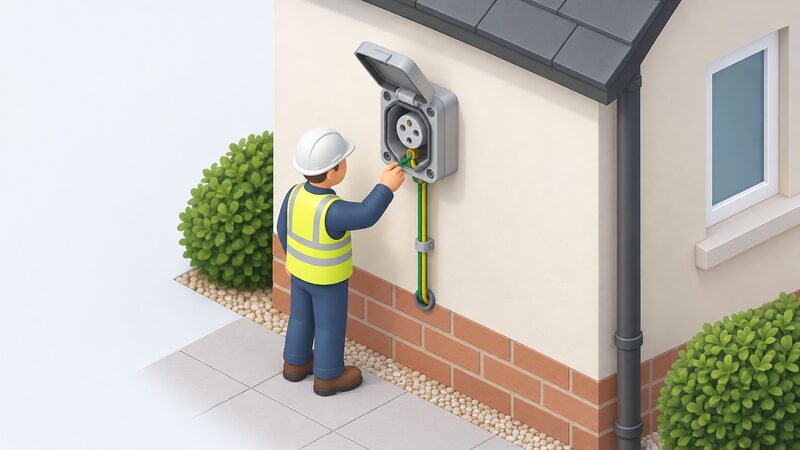
Sizing has two separate dimensions: what the generator can supply continuously, and what the network operator requires to be told. The second has a clear threshold. A generator with a capacity greater than 3.68kW per phase falls under EREC G996, and the connection application route for larger installations exceeding 3.68kWp requires a G99 application16. Below that threshold, the position is different, and the network operator's guidance on connecting generation sets out the process6.
The first dimension depends on the loads chosen. A backup board approach makes the arithmetic manageable, because the circuits on the board are known and their simultaneous demand can be assessed. A whole-installation approach does not, because the load at the moment of changeover is whatever happens to be switched on. The difference between the two is the difference between a generator that holds its frequency and one that trips on overload.
There is no single figure for a fridge, a boiler and lighting, because the starting current of a compressor and the standing demand of a boiler pump and controls vary by appliance. What is fixed is the regulatory threshold: a generator with a capacity greater than 3.68kW/phase brings EREC G99 into play2, and the circuits to be backed up are chosen deliberately rather than left to chance.
The wider context is that generation at home is now normal rather than exceptional. Smart meters are now installed in half of UK properties17, and the rollout is replacing analogue gas and electricity meters as part of the national infrastructure upgrade to improve and modernise Great Britain's energy system17. A household adding a generator connection is joining an installation landscape that already assumes some form of local generation and monitoring.
Smart meters and monitoring: where devices like the Anker SOLIX Smart Meter fit in
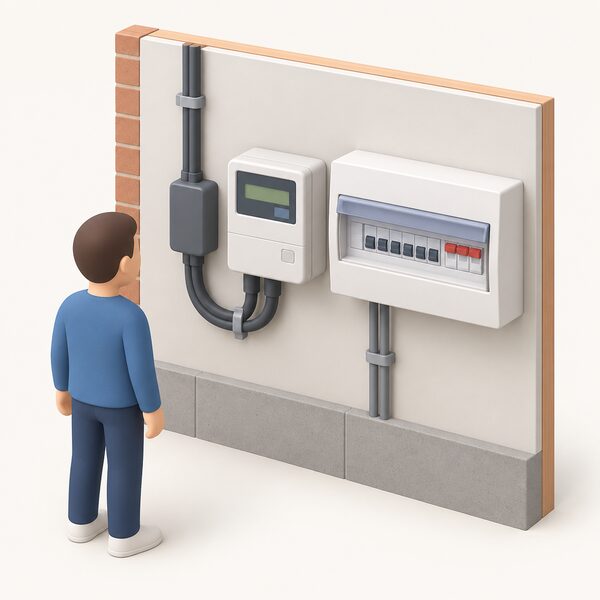
Monitoring sits alongside the connection rather than replacing any part of it. A smart meter records import and export at the supply point, and the rollout has reached half of UK properties17, replacing analogue meters as part of the national infrastructure upgrade17. That gives a household a record of what the installation is doing, but it does not isolate anything and it does not make a generator connection compliant.
Consumer devices that clamp onto the supply and report consumption, such as the Anker SOLIX Smart Meter, serve a different purpose again: they show what is being drawn, which helps a household understand which circuits matter and how much a generator would need to carry. They are monitoring instruments, not switching devices. A monitoring device does not break the grid connection, does not provide isolation, and does not substitute for a changeover or transfer switch.
The distinction is worth stating plainly because the two are sometimes conflated. A transfer switch is part of the installation and is subject to BS 7671 and to notification. A monitoring device is an accessory that observes the installation. One is a safety function; the other is information.
Where monitoring earns its place is in the planning that precedes the installation. Knowing the standing load of a house, and which circuits carry it, is what allows a realistic decision about what a generator should supply and how large it needs to be. That information is also what an electrician needs in order to design a backup board rather than a whole-installation changeover.
Who can do the work: electrician sign-off and notification
Connecting a generator to a home's fixed wiring is notifiable electrical installation work in England and Wales. Most work requires using an installer registered with a competent person scheme or seeking approval from a Building Control body13. Where the work is done through a competent person scheme, the electrician must be registered by an organisation authorised by the Secretary of State and able to certify the work as safe without notifying Building Control13.
Where that route is not used, the alternative is notification. If the work is not done by a person registered with the competent person scheme, then the relevant building control authority must be notified of the work18. The same principle applies to boiler work by a non-registered installer: the installer cannot self-certify, and the firm or householder must give notice to the local authority of the intention to carry out the work in advance and pay a notification fee19. Electrical work in new dwellings and extensions is notifiable to the local authority unless the installer is a member of a Competent Persons Self Certification Scheme20.
In England only, there is a further route: an electrician registered with a third-party certification scheme, a registered third-party certifier, can certify the work4. In England and Wales, notifiable work is commonly completed by an electrician registered on a competent person scheme10.
The practical sequence is therefore:
- Decide what the generator will supply, and whether that is a set of backed-up circuits or the whole installation.
- Establish the generator's capacity and whether it exceeds 3.68kW per phase, which brings EREC G99 into play6.
- Have the connection designed and installed by an electrician registered with a competent person scheme, or notify building control in advance13.
- Obtain and keep the certificate, which records the standard the installation was verified against.
Sources20 cited
- Plug-in Solar consultation document, GOV.UK, 2026-06-16
- Plugs and Sockets etc. (Safety) Regulations: plug-in solar consultation, GOV.UK, 2026-06-16
- What is domestic distributed generation, UK Power Networks, 2026-09-17
- Building regulations for electrics, Planning Portal, 2026
- BS 7671:2018+A4:2026 Requirements for Electrical Installations, BSI, 2026-04-15
- Connecting generation to the electricity networks, Energy Networks Association, 2026-09-17
- The Electricity and Gas (Energy Company Obligation) etc. Regulations: regulation 2, legislation.gov.uk, 2026
- The Electricity and Gas (Energy Company Obligation) etc. Regulations, legislation.gov.uk, 2026-07-16
- Plug-in solar interim product specification, Department for Energy Security and Net Zero, 2026-06
- Wiring a shed: a guide for homeowners, NICEIC, 2026-09-17
- Electrical safety standards in the private and social rented sectors: guidance, GOV.UK, 2025-11-01
- Do I need building regulations approval for alterations to or installation of electrics, Planning Portal, 2026
- Building regulations: electrics, Welsh Government, 2026-09-17
- Building standards, Scottish Government, 2026-09-17
- The Boiler Upgrade Scheme (England and Wales) (Amendment) Regulations 2024, legislation.gov.uk, 2026-09-17
- Building regulations renewables guidance, Bedford Borough Council, 2026-09-17
- Smart meters: your rights and expectations, GOV.UK, 2026-06-07
- Electric vehicle chargers: building regulations, Planning Portal, 2026
- Boilers and heating: building regulations, Planning Portal, 2026
- Electrical safety: apply for building regulations, Cumberland Council, 2026-09-17
 Telling the Network OperatorFitting a generator, solar panels or a battery that works alongside the grid usually means telling your network operator.
 Generator SafetyCovers the main hazards of running a generator at a home: exhaust fumes and carbon monoxide, hot surfaces and refuelling fires, electric shock and earthing.
 Maintaining Backup PowerWill your generator actually start when the power goes off?
 Backup Power Safety RulesWho signs off a battery or backup circuit, and can you legally plug in a power station or a plug-in solar panel in the UK?
 Grid Connection Rules for V2GCan your charger send power back to the grid?
 Grid Connection in NIConnecting a generator at home in Northern Ireland means different rules depending on its size.