
In this answer
Short answer
A generator can be connected to a home supply, but not by the householder and not through a plug. Electricity North West states that connecting your own generation must be done by a qualified professional, and NIE Networks states that in an emergency power cut scenario it will not be possible to connect generators at all1. The connection itself is a fixed wiring job: a changeover arrangement that isolates the house from the network before the generator is energised.
The reason is backfeed. A generator pushed into a socket energises the wiring and the service cable beyond it, which is dangerous to anyone working on the network and is prohibited by the plug standard. BS 1363 prohibits the use of plugs for connecting electricity-generating devices to socket-outlets3. The work also falls under Building Regulations, so it needs an installer registered with a competent person scheme or approval from a Building Control body4.
What follows is who may do the work, why the socket route is closed, the connection options, the certification involved, how the rules differ by equipment type, and the notification duty that sits with the Distribution Network Operator.
Who is allowed to connect a generator to your house supply
The dividing line is between the householder's own equipment and the network. Everything on the network side of the meter belongs to the operator. UK Power Networks states that moving the electricity cable coming in from the road has to be done by its qualified engineers, and that electricians are not trained to work on the electricity supply or the electricity meter7. A generator connection stops at the consumer unit, but it has to be designed so that it can never energise the cable on the other side of that boundary.
On the installation side, Electricity North West's position is direct: if you do choose to connect your own generation, this must be done by a qualified professional1. NIE Networks goes further for its own area, stating that in an emergency power cut scenario it won't be possible to connect generators2. That is a statement about the practicalities of a live fault, not a permanent bar on having a connection installed in advance.
The legal backdrop is the Electricity Safety, Quality and Continuity Regulations. Clause 7 provides that a generator or distributor shall not introduce or retain any protective device in any supply neutral conductor or any earthing connection of a low voltage network which they own or operate8. The clause exists because of the historic practice of fusing within the neutral chamber of a cutout, and it sets the principle that the neutral and earth path must stay continuous. A generator connection that interrupts or reconfigures that path is not compliant.
For a household, this means the connection is a planned, certified job carried out before it is needed, not something assembled during an outage. The independence it buys is real but partial: the house can run its own circuits, while the network connection remains the operator's property and the generator remains dependent on fuel or stored charge.
Why you cannot simply plug a generator into a socket
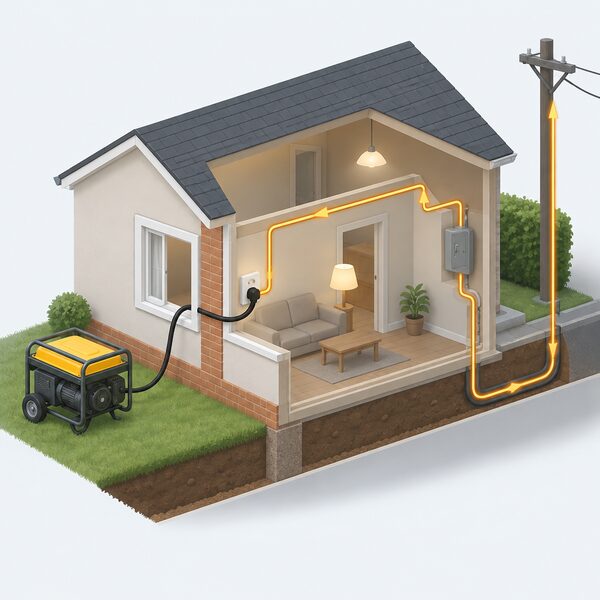
The socket route fails on two counts: it endangers people working on the network, and it is prohibited by the standard that governs plugs.
"BS 1363 prohibits the use of plugs for connecting electricity-generating devices to socket-outlets"
Backfeeding means current flows from the generator, through the socket, into the fixed wiring and out along the service cable. Anyone treating that cable as dead, which it would be in a normal outage, is exposed to a live conductor. The risk is not confined to the household.
There is a second hazard on three-phase supplies. Guidance on three-phase power notes the principal danger of the higher voltage that exists between lines, around 400 V, and the higher probability of lethal shock, adding that socket outlets from different phases should not be in the same room9. A generator plugged into one socket while another circuit sits on a different phase creates exactly that condition.
The plug standard is not the only constraint. Storage heaters need a connection to the correct circuit in your home and are hard-wired to the circuit, which shows the normal expectation for fixed high-load equipment10. A generator feeding a house is a larger version of the same problem. Product recalls reinforce how badly connected wiring behaves: one ground source heat pump was recalled because it posed a risk of fire and electric shock because two cables are electrically overloaded and because of badly connected wires11.
The safe arrangement is a fixed connection with a changeover device that makes it impossible for the generator and the network to be connected at the same time. That is what the electrician designs and certifies.
Manual transfer switch, changeover switch or inlet box: the connection options
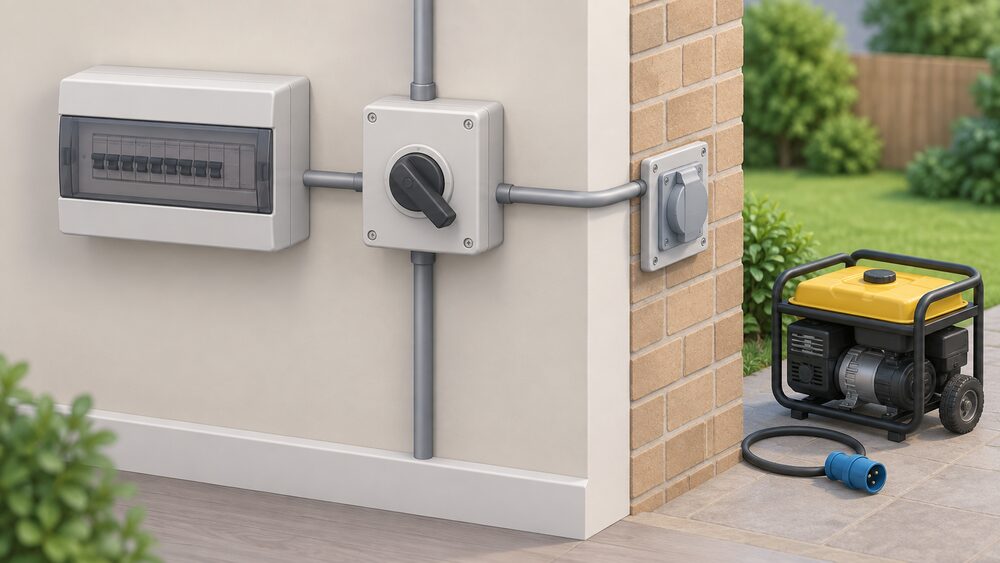
The connection is built from three elements: an inlet point where the generator cable lands, a changeover device that selects between the network and the generator, and the circuits that will be carried.
The inlet is external. Meter boxes give an indication of how such equipment is mounted: a built-in or flush mounted meter box fits flush against the outside wall, and to fit it a cavity needs to be created in your property wall then the box fits into the cavity, a method commonly used for new house builds12. An inlet box follows the same logic, mounted where the generator can be run safely outside and the cable run kept short.
The changeover device is the safety-critical part. It can be manual, requiring the householder to move the switch before starting the generator, or automatic, starting the machine and transferring the load without intervention. Hospitals show what the automatic end of the range looks like: critical sites such as hospitals may have their own standby generators that start automatically if the public power supply fails13. Domestic installations sit well below that scale.
Where the generator feeds an inverter-based system, the power path runs through conversion stages. In a solar installation the direct electrical current (DC) travels to the inverter, which converts it for household use14. A generator paired with a battery or inverter-charger follows a comparable route, which is why the changeover has to be designed around the whole system rather than the generator alone.
| Element | What it does | Who specifies it |
|---|---|---|
| Inlet box | External landing point for the generator cable | Electrician, with the householder's siting preference |
| Changeover switch | Selects network or generator, never both | Electrician |
| Backup circuits | The circuits the generator will carry | Electrician and householder together |
| Certification | Confirms the work is safe and compliant | Registered electrician or Building Control |
The role of a qualified electrician and what certification is needed
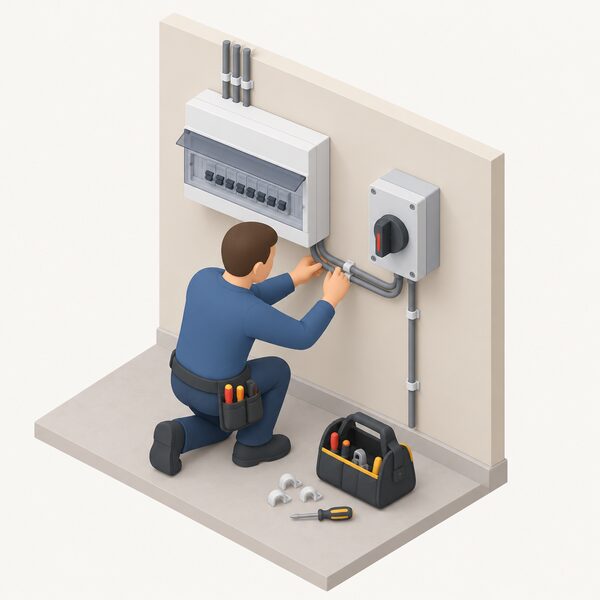
The certification requirement comes from Building Regulations. Most work requires using an installer registered with a competent person scheme or seeking approval from a Building Control body4. The scheme route means an electrician who is registered by an organisation authorised by the Secretary of State and is able to certify the work as safe without notifying Building Control4. Wales publishes its own building regulations guidance for electrics, so the administrative route differs by nation even where the technical standard does not4.
Trade bodies matter to the choice of contractor. NICEIC describes rewiring a house as a significant project that should only be carried out by a qualified, competent electrician, such as one registered with NICEIC15. NIE Networks uses the same framing for generator connection, stating that for safety reasons it is essential that it is connected by an NICEIC approved electrician16.
The practical sequence is:
- The electrician surveys the supply and identifies the circuits to be backed up.
- The changeover device and inlet are specified and, where required, the network operator is notified or an application made.
- The fixed wiring is installed and the installation certified.
- The generator is tested against the installation before it is relied on.
How connection requirements differ for portable generators, standby generators and battery systems
The rules scale with the equipment. A portable generator feeding a few circuits through a manual changeover is a small job. A permanently installed standby machine is a fixed installation. A battery system is a generation and storage asset in its own right.
For battery storage, the guidance is to notify your local Distribution Network Operator, and you may also need to inform your local council17. Behind-the-meter energy systems follow the same pattern: small systems usually only need the electricity network operator to be notified6. The threshold that changes the process is size. Installations of 50kW or greater need a G99 A1-1 application in advance of installation so that network planners can conduct a full study and quote to connect5.
Supply capacity is the other variable. Some homes share one electricity cable with a neighbour, which means the supply isn't strong enough for an EV charger, and in that case you'll need your own dedicated cable installed before the charger can go ahead18. A generator connection on a looped supply raises the same question about whether the existing cable can carry what is being added.
For larger installations, or where your installer identifies potential issues with the current electrical supply to the property, you or your installer need to let the network operator know or make an application to connect your system to the electricity grid20. Emergency planning guidance adds a practical check: verify that a backup generator meets the power needs and connections you might have to support in an emergency21.
| Equipment | Connection route | Notification |
|---|---|---|
| Portable generator | Manual changeover, inlet box | Via the installer |
| Standby generator | Fixed installation, often automatic transfer | Via the installer; application if large |
| Battery storage | Fixed installation with inverter | DNO notified; council may also need informing17 |
| 50kW or greater | Full application | G99 A1-1 in advance5 |
Notifying your Distribution Network Operator before connecting
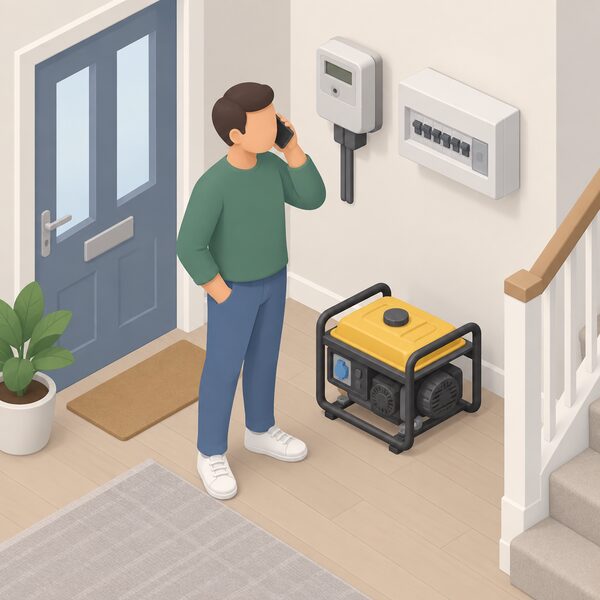
The notification duty sits with the network operator, not the energy supplier. A domestic customer who needs to know how their property is connected, or how to change it, is directed to contact their local distribution network, the DNO22. For solar, the installer must also contact the Distribution Network Operator via connect and notify or apply to connect23. Plug-in solar follows the same principle: the local Distribution Network Operator must be notified when installing plug-in solar panels24.
In Northern Ireland the requirement is tighter at the point of connection. NIE Networks states that all generation details must be provided before the new supply can be energised25. That means generation is not an afterthought on a new connection there; it is part of the application.
The distinction between notifying and applying matters. Small systems usually only need the electricity network operator to be notified6, while larger installations or those where the installer identifies a supply problem require an application20. The network operator's own installation guidance sets out the same split for renewable systems20.
What this means for a household's energy independence
A properly installed generator connection gives a home the ability to run selected circuits from its own machine, which is genuine independence during an outage. What it does not give is independence from the network itself. The connection is designed to sit alongside the grid, not replace it, and the changeover device exists precisely to keep the two apart.
The remaining dependencies are worth naming. The generator needs fuel, and fuel storage is a separate safety question. A battery system needs charging, whether from the grid or from solar. Solar PV draws energy from the national grid in the same way as when there was no solar PV when consumption is more than the solar generated electricity, so a solar household is still a grid household14. Solar itself uses energy from the sun to create electricity to run appliances and lighting, which is the generation side of the same arrangement27.
For homes with no mains connection at all, the calculation is different. For houses with no mains connection but with access to a micro hydro site, a good hydro system can generate a steady, more reliable electricity supply than other renewable technologies at a lower cost28. Those technologies may offer an attractive payback to homeowners without grant support29. Off-grid properties are covered in more detail in backup power by home type.
For most households the realistic position is a certified connection, a defined set of backed-up circuits, and a clear understanding that the grid remains the primary supply. The rules on generator grid connection notification and generator safety set out the rest of the picture, and the backup power pillar covers the wider options.
Sources29 cited
- Emergency power cuts, Electricity North West
- Emergency power cuts, NIE Networks
- Plug-in solar consultation, GOV.UK, 2026-06-16
- Building regulations: electrics, Welsh Government
- Generation connections, SSEN
- Behind-meter energy systems guidance, Welsh Government, 2026-06-29
- Moving your electricity supply: cost and time, UK Power Networks
- Looped services, NIE Networks
- Three-phase power, OpenEnergyMonitor
- Electric storage heaters, Energy Saving Trust, 2026-05-20
- Ground source heat pump recall, Electrical Safety First
- Electricity meter boxes, UK Power Networks
- Why do you use generators, UK Power Networks
- Solar panels, Oxfordshire County Council
- Rewiring your house: an essential guide for homeowners, NICEIC
- Planned work, NIE Networks
- Solar panel battery storage, Which?, 2026-05-14
- If your electricity supply can't cope with the new equipment, NIE Networks
- EVs and heat pumps, NIE Networks
- Renewable energy installation, Electricity North West
- Care and assisted living providers, Energy Networks Association
- Domestic and homeowners connections help, NESO
- Building regulations renewables guidance, Bedford Borough Council
- Plug-in solar consumer guide, Electrical Safety First, 2026-08
- Single house connection application help, NIE Networks
- Restoration following a power cut, Electricity North West
- Solar electricity photovoltaics, Planning Portal
- Hydro electricity, Planning Portal
- Support to generate your own electricity, nidirect, 2025-09-22
 Generator Transfer SwitchesA generator can only be wired into your home's circuits through a proper changeover switch, never by plugging it into a socket.
 Backup Power Safety RulesWho signs off a battery or backup circuit, and can you legally plug in a power station or a plug-in solar panel in the UK?
 Electrical Safety for GenerationWho signs off the wiring when you fit solar panels or a small wind turbine, and how do you know it is safe?
 Charger Cybersecurity and DataWho can control your home charger, and how do you keep it secure?
 Generator SafetyCovers the main hazards of running a generator at a home: exhaust fumes and carbon monoxide, hot surfaces and refuelling fires, electric shock and earthing.
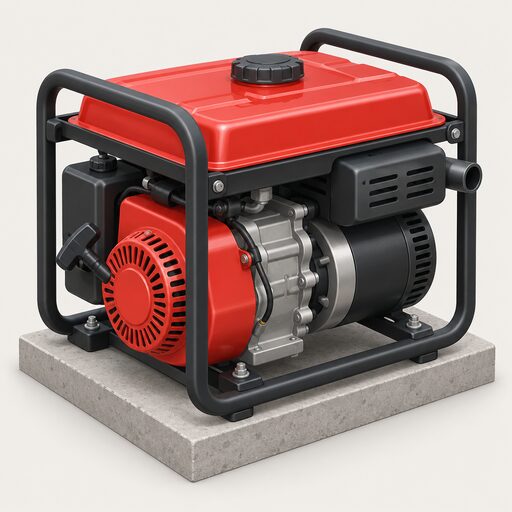 Grid Connection in NIConnecting a generator at home in Northern Ireland means different rules depending on its size.