
In this guide
Backup power in a UK home is governed by two separate bodies of rules, and the split matters more than any single standard. Anything wired into the fixed installation, a changeover switch, a battery inverter, a dedicated backup circuit, falls under the building regulations and the wiring regulations, and in England and Wales that work must comply with the building regulations and is normally notified to a building control body, either the local authority or a private registered building control approver1. Anything that plugs in, a portable power station or a plug-in solar panel, sits outside that regime and is governed instead by product safety law.
The single most important current restriction concerns plug-in solar. Government guidance states that UK regulations do not allow plug-in solar to be used in the UK2. A later interim product specification sets out what such a device would have to meet if the route opened, including compliance with Engineering Recommendation G98 for connection and parallel operation with low-voltage distribution networks in Great Britain3. That specification describes a future market, not a present permission.
For fixed battery storage, PAS 63100:2024 is the specification that sits alongside the wiring regulations, and its classification is recorded under two different headings, fire protection and electrical engineering, with the documents not resolving which governs. The practical reading is that a domestic battery installation is assessed for both fire safety and electrical design. Everything below sets out which rule applies to which kind of equipment, and what remains outside a household's control.
What the standards actually cover
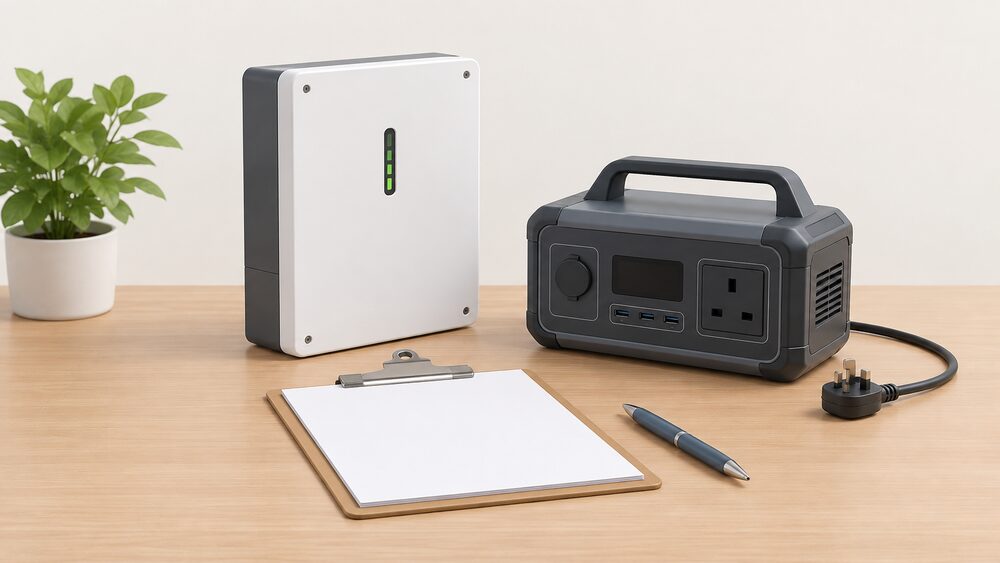
The rules divide by how equipment connects, not by what it does. A battery that is wired into a consumer unit and can push power back into the installation is part of the fixed electrical installation. A portable power station that charges from a wall socket and feeds appliances through its own outlets is a product. The same lithium cells can sit on either side of that line, and the obligations change completely when they cross it.
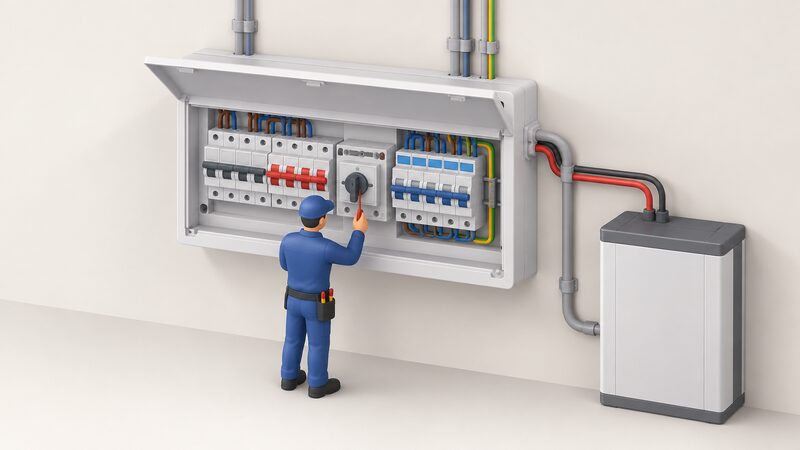
For fixed work, the building regulations apply to electrical installation work in a home or garden in England and Wales, and compliance is demonstrated through a building control body1. Approved Document P is the building regulation in England covering electrical safety in dwellings6. Scotland and Northern Ireland operate their own building standards systems, so the notification route and the approved document do not carry across unchanged.
For equipment that connects to the network, the governing document is a distribution code engineering recommendation rather than a building regulation. Plug-in solar guidance names Engineering Recommendation G98 Issue 2 Amendment 1 for connection and parallel operation with low-voltage distribution networks in Great Britain7, and the later interim specification repeats G98 as the requirement3. That standard exists because any device operating in parallel with the network has to behave in a way the network can tolerate.
Product safety law sits underneath both. Regulation 12 provides for the recall of electrical equipment across England, Wales and Scotland4, and recalls are used in practice: plug-in devices purporting to save energy or stabilise electrical current have been recalled from end users8. A recall is a legal measure that removes a product from use, and it applies to plug-in goods that never touch the wiring regulations at all. Electrical Safety First recommends that anyone who discovers they have an electrical item that has been recalled should stop using it until it has been checked by the manufacturer8.
The figures behind the rules
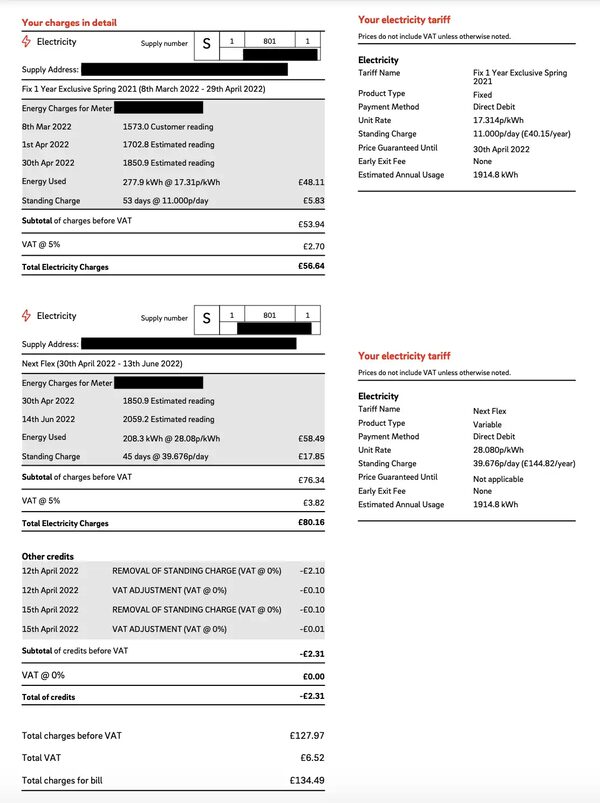
The regulatory figures that bear on backup power are mostly about what a household pays and what it can claim, because those are the numbers the standards are meant to protect. The electricity price cap for 1 July to 30 September 2026 sets benchmark maximum charges that vary by region: Eastern at £187.52 standing charge and £815.65 annual bill at 2,500 kWh single-rate, and £188.24 standing charge with £987.76 at 3,400 kWh multi-rate9. The South East runs £189.27 and £824.22 at 2,500 kWh, and £190.23 with £996.63 at 3,400 kWh9. The Southern region is lower at £172.77 and £801.74, and £172.65 with £973.289. The Midlands sits at £207.57 and £810.72, and £206.15 with £977.099. The Northern region is the highest of these at £223.48 and £824.03, and £220.70 with £986.449. London runs £181.21 and £843.39, and £181.03 with £1,020.959.
The earlier cap period, 1 October to 31 December 2025, gives the comparison. Eastern stood at £196.61 nil consumption and £1,023.11 at 3,100 kWh single-rate, with £196.45 and £1,267.03 multi-register10. North Wales and Mersey was £272.95 and £1,136.66, with £272.72 and £1,386.9310. Southern was £183.50 and £1,008.32, with £183.36 and £1,252.3810. Yorkshire was £232.91 and £1,022.14, with £232.68 and £1,261.4510. Northern was £237.50 and £1,029.76, with £237.27 and £1,267.0310. South East was £194.39 and £1,033.02, with £194.23 and £1,277.6610.
On the network side, the Guaranteed Standards of Performance provide an extra £100 if power has gone off more than 4 times between 1 April and 31 March the following year, for each cut of at least 3 hours, and a claim is required11. The carbon intensity of GB electricity supplied was 104 gCO2e/kWh in 2025, provisional5. Energy Consumption in the UK 2025 is accredited official statistics12, and Energy Trends: UK renewables carries the same accreditation13.
| Region | Standing charge | Annual bill, 2,500 kWh single-rate | Annual bill, 3,400 kWh multi-rate |
|---|---|---|---|
| Eastern | £187.52 | £815.65 | £987.76 |
| South East | £189.27 | £824.22 | £996.63 |
| Southern | £172.77 | £801.74 | £973.28 |
| Midlands | £207.57 | £810.72 | £977.09 |
| Northern | £223.48 | £824.03 | £986.44 |
| London | £181.21 | £843.39 | £1,020.95 |
Benchmark maximum charges, 1 July to 30 September 20269.
What drives the cost and the rules
The price cap exists because the market it regulates is volatile. The energy price cap protects consumers from the rapid changes observed in the wholesale energy market in the short term14, and the UK is a net energy importer with a high dependence on gas and oil14. That import position is the reason energy security is treated as a national question rather than a household one: energy security is core to the government's national security plans15, and the British energy security strategy sets out how Great Britain will accelerate homegrown power for greater energy independence16.
Demand is the other driver. The Climate Change Committee has factored in a 50% increase in demand on electricity, to reflect the expected increase in transport, industry and buildings decarbonisation17. Ofgem attributes part of the cap movement to increases to parts of the costs of transporting energy in Great Britain and costs towards government schemes and essential support18. Those are the costs a household cannot avoid by changing supplier, and they are the reason a backup supply is judged on resilience rather than on tariff arbitrage.
The rules themselves are being extended. The Energy Act 2023 will bring new consumer protections for heat network consumers across Great Britain19, and the back-billing authorisation condition applies across Great Britain, limiting back billing to 12 months across all heat networks unless there are conflicts with existing housing legislation20. Schedule 1 of the Energy Act 2023 allows GB non-domestic relief regulations to provide for civil penalties and for obligations to be enforceable as relevant requirements under section 25 of the Electricity Act 1989 or section 28 of the Gas Act 198621. The direction of travel is toward more enforceable standards, not fewer.
How the rules differ across the UK nations

The building regulations regime is not uniform, and the guidance is explicit about it. Building regulations for electrics apply in England and Wales1, and Approved Document P is the building regulation in England covering electrical safety in dwellings6. Scotland has its own building standards, and the Scottish Government has consulted on proposals under a Heat in Buildings Bill19, which is a separate legislative track from the electrical safety regime.
Planning guidance carries the same caveat repeatedly. The Microgeneration Certification Scheme guidance relates to the planning regime for England, and the policy in Wales may differ22. Heat pumps guidance relates to the planning regime for England, with policy in Wales possibly different23. Planning guidance on wind turbines is for England, with policy in Wales possibly different24. A household in Wales therefore cannot read an England planning page as its own rule.
Northern Ireland is separate again. The Energy Price Guarantee Northern Ireland scheme exists because there is a different regulator, the Utility Regulator for Northern Ireland, no price cap and an entirely different set of suppliers from Great Britain. Storm compensation rules, by contrast, are framed around the companies responsible for linking up homes and businesses to the electricity network in Great Britain25, which does not include Northern Ireland. The Energy Price Guarantee scheme documents cover households across the UK26, and the GB scheme document for domestic electricity consumers was updated in November 202326.
| Nation | Building regulations route | Network and price protection |
|---|---|---|
| England | Building control body; Approved Document P for dwellings1 | GB price cap and Guaranteed Standards9 |
| Wales | Building control body; planning policy may differ from England1 | GB price cap and Guaranteed Standards9 |
| Scotland | Own building standards; Heat in Buildings Bill consultation19 | GB price cap and Guaranteed Standards9 |
| Northern Ireland | Separate building control system | Utility Regulator, no price cap, different suppliers |
The rules that bind a backup installation
The wiring regulations govern how a backup supply is connected, and the building regulations govern whether that work is notified. In England and Wales, electrical installation work in a home or garden must comply with the building regulations, and the compliance route runs through a building control body, either the local authority or a private registered building control approver1. Approved Document P sets the electrical safety requirements for dwellings in England6. The practical consequence is that a wired-in battery, a changeover switch or a new backup circuit is not a DIY job in the way a plug-in device is.
For anything that can operate in parallel with the network, the connection standard applies. Plug-in solar guidance names Engineering Recommendation G98 Issue 2 Amendment 1 for connection and parallel operation with low-voltage distribution networks in Great Britain7, and the interim product specification repeats G98 as the requirement3. The UK safety specification for plug-in solar is described as more stringent than that of Germany, where the technology is already widely used27. That stringency is the reason the route is not yet open: the specification exists, but the permission does not.
Product safety law catches what the wiring regulations do not. Regulation 12 provides for the recall of electrical equipment across England, Wales and Scotland4, and plug-in devices purporting to save energy or stabilise electrical current have been recalled from end users8. A recall removes a product from use regardless of how it was connected, which is the backstop for plug-in equipment that never enters the fixed installation.
What this means for energy independence
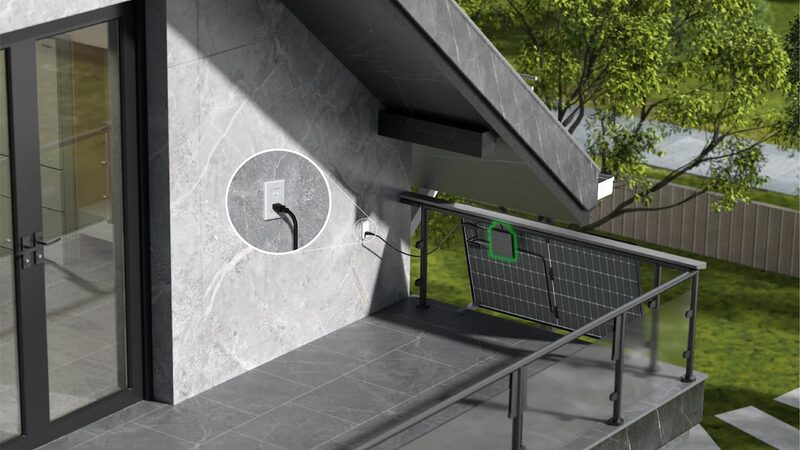
The standards do two things for a household, and they pull in opposite directions. They make a fixed backup supply safer and more durable, because a wired-in battery or changeover switch installed under the building regulations and the wiring regulations is inspected and notified rather than improvised. They also set the boundary of what a household can do alone. A plug-in solar panel, the cheapest route to generating your own power, is not permitted in the UK2, so the entry point to self-generation is a fixed installation with the cost and the notification that carries.
The dependence that remains is structural. The UK is a net energy importer with a high dependence on gas and oil14, and the price cap exists to protect consumers from the rapid changes observed in the wholesale energy market in the short term14. A backup supply changes what a household can do during an outage, and the Guaranteed Standards of Performance provide an extra £100 if power has gone off more than 4 times between 1 April and 31 March the following year, for cuts of at least 3 hours, on claim11. It does not change where the energy comes from on an ordinary day.
The direction of policy is toward homegrown power. The British energy security strategy sets out how Great Britain will accelerate homegrown power for greater energy independence16, and it is framed as central to weaning Britain off expensive fossil fuels, which are subject to volatile gas prices set by international markets16. Energy security is core to the government's national security plans15. For a household, the standards are the mechanism by which that national aim is delivered safely at the consumer unit, and the plug-in solar restriction is the clearest example of the gap between the ambition and the current rule.
For the wider picture of what backup equipment does and how it is chosen, see Backup Power for UK Homes. The connection rules for generators specifically are covered in Connecting a Generator to a House, and the notification question in Do You Need to Tell the Network Operator About a Generator?. Battery fire risk and recalls are set out in Lithium Battery Safety, and surge protection in Surge Protection Devices and Lightning Protection.
Sources27 cited
- Building regulations: general information, Planning Portal, 2026
- UK Solar Roadmap, DESNZ, 2025
- Plug-in solar final interim product specification, GOV.UK, 2026
- The Electrical Equipment (Safety) Regulations 2016, Regulation 12, legislation.gov.uk, 2026
- DESNZ annual report and accounts 2025 to 2026, DESNZ, 2025
- Electrical safety: Approved Document P, GOV.UK, 2013
- Plug-in solar interim product specification (withdrawn), GOV.UK, 2026
- Product safety report: 2Pcs 90V-250V Electricity Saving Box, GOV.UK, 2022
- Energy price cap levels, 1 July to 30 September 2026, Ofgem, 2026
- Energy price cap levels, 1 October to 31 December 2025, Ofgem, 2025
- Check if you can get payment for a power cut, Ofgem, 2026
- Energy Consumption in the UK 2025, GOV.UK, 2026
- Energy Trends: UK renewables, GOV.UK, 2013
- Spring Statement 2022, HM Treasury, 2022
- Spending Review 2025, GOV.UK, 2025
- British energy security strategy, GOV.UK, 2022
- A reliable, secure and decarbonised power system by 2035, Climate Change Committee, 2023
- Changes to the energy price cap between 1 October and 31 December 2025, Ofgem, 2025
- Delivering net zero for Scotland's buildings, Scottish Government, 2023
- Heat networks consumer protection guidance decision, Ofgem, 2026
- Energy Act 2023, legislation.gov.uk, 2022
- The Microgeneration Certification Scheme, Planning Portal, 2026
- Heat pumps: planning guidance, Planning Portal, 2026
- Wind turbines: planning guidance, Planning Portal, 2026
- Ofgem announces rise in storm compensation cap, Ofgem, 2023
- Energy Price Guarantee scheme documents, GOV.UK, 2022
- Households can save as plug-in solar panels come to market, GOV.UK, 2026
 DIY Home Battery BuildsBuilding your own home battery?
 Electrical Safety for GenerationWho signs off the wiring when you fit solar panels or a small wind turbine, and how do you know it is safe?
 Electrical Safety RegulationElectrical work at home raises real questions about who can do it, what needs signing off, and what paperwork you should keep.
 Building Regulations EnglandAdding a heat pump, solar panels or an extension usually needs building regulations approval, and it is separate from planning permission.
 Installation StandardsWhich rules must an installer follow when fitting a home battery?
 Plug-In Battery StoragePlug-in batteries are not legal in a grid-connected British home, even though plug-in solar panels are.