In this guide
Plug-in battery storage, a battery in a case that a householder unpacks and pushes into a standard socket, is not legal to use in a grid-connected British home. The regulatory change that opened the market on 27 August 2026 covered plug-in solar panels only: plug-in batteries were not included in the new regulations and remain illegal for use in the UK1. Electrical Safety First states the position for householders in one line: "DON'T INSTALL PLUG-IN BATTERY SYSTEMS IN YOUR HOME."2 The Centre for Sustainable Energy adds that plug-in solar panels with integrated battery storage are not currently compliant with UK regulations either3.
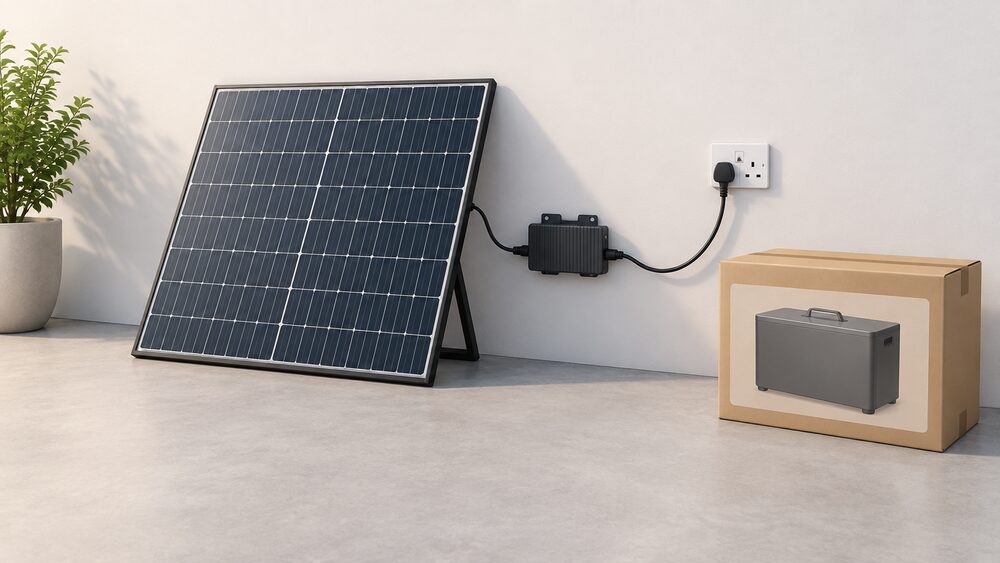
What is legal, and now widely sold, is plug-in solar: a panel or pair of panels with a microinverter and a mains plug, limited to a maximum output of around 800W4. The amending legislation defines a plug-in microgenerator as a device that "is not designed to import electrical energy from a low voltage consumer's installation for the purpose of storing energy for later supply, other than for control or auxiliary functions permitted by the Plug-in Solar Device Interim Product Specification"5. That clause is the reason a balcony battery cannot ride in on the back of the solar rules: storing imported electricity for later supply is exactly what a plug-in battery does.
Storage for a household therefore still means a hard-wired system. Battery storage systems must generally be hard-wired into the home's circuits by a qualified electrician3, and a typical home system might be 10 kWh, costing from £1,500 to £10,000 with a 5 kWh system around £4,6006. This page sets out what the plug-in route does deliver, where the legal line sits, and what remains outside a householder's control.
What plug-in and balcony storage actually is
A plug-in system inverts panel output to mains AC at the panel and feeds it into the house through an ordinary socket, so the household's own consumption absorbs it first. The format is long established elsewhere: the kits are common in places such as Germany, where people already hang them on balconies, in gardens or on terraces7. The pitch, as put to the Commons, was to "make plug-in solar available for the first time in Britain so that families can buy a low-cost panel straight from a supermarket and set it up on a balcony or in a garden"8, with government stating the panels would be available in shops within months and save people money on bills9.
A plug-in battery extends the same idea to storage: a self-contained unit that a consumer plugs in, charges when electricity is cheap or solar is abundant, and discharges later. The Electricity Storage Association describes the distinction plainly: plug-in battery products "may be purchased, connected and relocated by consumers without direct professional involvement", unlike traditional battery systems installed by competent professionals10. It notes they have the potential to make energy storage more accessible, lower installation barriers and help consumers maximise the value of renewable electricity10. That potential is not in dispute; the permission is what is missing.
Plug-in solar batteries are already being developed for the UK market11, and the honest summary for a household today is that a compliant, socket-connected home battery is not something that can be bought and used lawfully in a grid-connected property.
Who the plug-in route suits
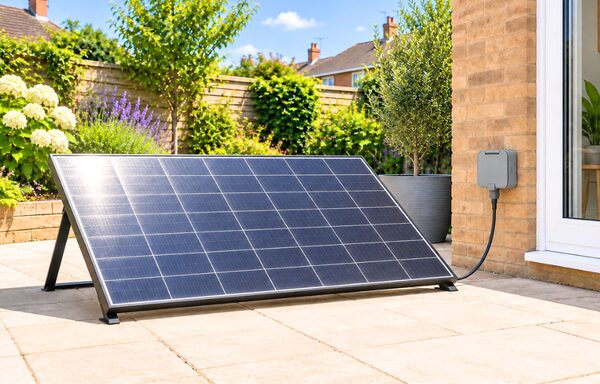
Plug-in solar exists for households that cannot get at a roof. Uswitch lists renters first among those who should strongly consider it, alongside people in smaller homes such as flats and those unable to meet the cost of a full roof system12. Solar Energy UK describes the UKSOL Plug-In Solar Pro range as aimed at renters and households with balconies, terraces, gardens or other suitable outdoor areas who cannot install a conventional rooftop system13. The portability matters: the kits plug into a standard UK socket, power everyday appliances, and can be taken on a move14.
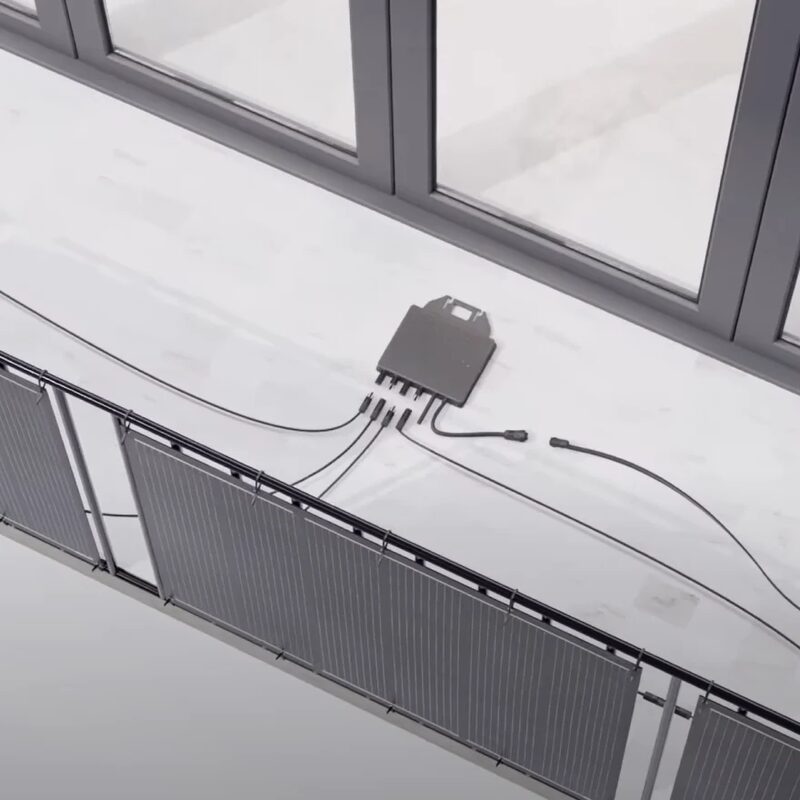
There is a caution attached to the balcony framing. Home Energy Scotland states that current devices available in the UK are generally more suitable for garden locations than balconies15, and the Energy Saving Trust says the same, adding that permission and an appropriate frame, fixing or anchors are needed16. For a flat, that turns a purchase into a conversation with a landlord, a freeholder or a managing agent before anything is mounted.
For storage, the same households are the least well served. A hard-wired battery can be installed in garages, on external walls or in utility rooms depending on the unit6, all of which a flat may lack, and the installation is a fixed alteration to the property's wiring. Batteries installed in residential accommodation fall within the VAT relief for energy-saving materials17. The result is that the households plug-in storage would most obviously help are the ones for whom the compliant alternative is hardest to arrange. Where a home does have space and consent, the choice is between the main types of hard-wired system rather than anything socket-connected.
What a plug-in system can and cannot power
The Energy Saving Trust answers the whole-house question directly: probably not. Compliant devices are limited to a maximum output of around 800W, which is enough for everyday appliances, while higher-use appliances will still need grid electricity16. In practice the output offsets background load, a fridge, a router, standby draw, lighting, during daylight; it does not run an electric shower, an oven or a heat pump.
A plug-in system also gives nothing in a power cut. The microinverter includes anti-islanding protection and shuts down automatically if the grid supply fails18. That is a safety requirement, not a defect, and it applies to hard-wired solar too. Hard-wired batteries differ: some, but not all, battery storage systems can be set up to provide electricity during a power cut, and must be specifically set up to do so19. The Centre for Sustainable Energy puts it the same way, that not all batteries can deliver electricity during a power cut20. Anyone treating storage as resilience needs to read the backup and EPS question separately from the savings question.
Storage changes the arithmetic of solar because it moves generation into the evening. Parliamentary analysis puts the effect of adding storage to solar as increasing annual savings from around £150 to £450 a year4. MCS cites a third-party prediction that a three-bedroom home with a solar panel and battery system will save around £582 every year21. Those figures are for hard-wired systems on a whole roof, not for an 800W plug-in kit, and should not be read across to one. Households with an Economy 7 meter can also use certain energy storage products to charge from the grid and store cheap off-peak electricity22, and a home with an energy storage system can still apply for the Smart Export Guarantee, for example storing electricity from the grid before exporting it later23.
Key components: panels, microinverters and mounting
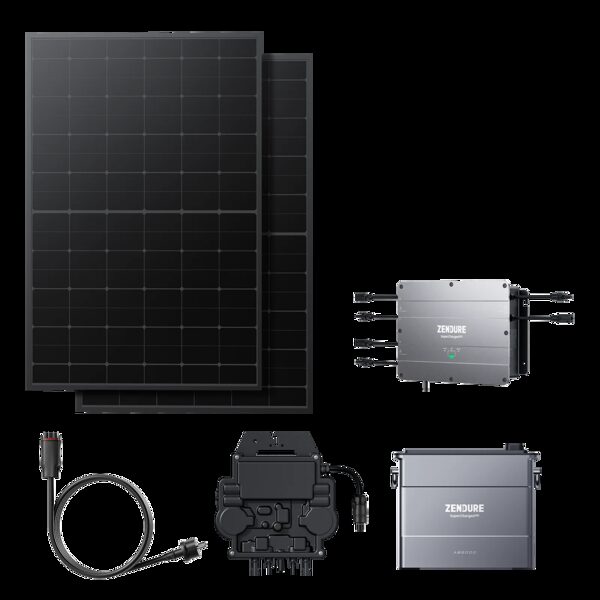
A compliant kit is a matched set, not a panel bought separately from an inverter. UKSOL states its Plug-In Solar Pro kits contain the solar module or modules, an ENA-compliant microinverter, the specified cables (4m AC cable and 2m DC cables) and a purpose-designed mounting solution18.
| Kit | Panels | Inverter | Mounting |
|---|---|---|---|
| UKSOL Plug-In Solar Pro | UKSOL module or modules | ENA-compliant microinverter | Purpose-designed mounting solution18 |
| InstaGen plug-in kit | Two 435W bifacial all-black panels | 800VA microinverter | Universal frame for gardens, balconies and walls, manually adjustable tilt1 |
| PowerXpress plug-in kit | 2 x 460W panels | Not stated | Adjustable bracket for walls, floors and balconies1 |
| PatioSun kits | UKSOL panels | Hoymiles microinverters | Not stated1 |
The governing document is the Plug-in Solar Device Interim Product Specification, which "covers both electrical design, British plug requirements, mounting systems and fire protection"24. All plug-in solar equipment supplied for use in the UK is required to comply with the specifications set out in that document24, and only devices compliant with the specification may be sold in the UK and plugged in under the amended regulations25. Home Energy Scotland advises making sure the specific model is on the list of devices that meet UK standards, checked via the ENA Connect Direct device register15.
Kits are sold at Argos online1 and are expected on the shelves of Lidl, Amazon, B&Q, Currys and Screwfix11. Major retailers worked with government on the rollout and kits are now available to buy in stores and online15. Plug-in solar panels are available to buy and use across Great Britain26.
Grid connection: G98, G99 and the type-test register
G98, previously called G83, is a UK engineering standard written by the Energy Networks Association, and notifying the network operator is an obligation under the Electricity, Safety, Quality and Continuity Regulations 200227. G98 is a simple connection procedure for fully type-tested installations under 16A per phase, installed on a fit-and-notify basis28, using Form A for installations at multiple premises and Form B for a single premise28. Above 16A per phase, or where the installation is not type-tested, G98 is not applicable and G99 should be used29. Northern Ireland Electricity Networks requires a compliance certificate with test results as part of a G99 fast-track application30.
The type-testing requirement is the practical filter. Under the G99 fast-track process, any generating units, including electricity storage, connected through it must use EREC G99 or G98 type-tested inverters, with G59 or G83 type-tested inverters permitted for units installed before the earlier standards were withdrawn31. The underlying European Network Code Requirements for Generators was incorporated into UK law32. Installer applications for domestic low-carbon technologies are made through the ENA's Connect Direct portal, which requires installation details33.
Installation: the socket is the weak point
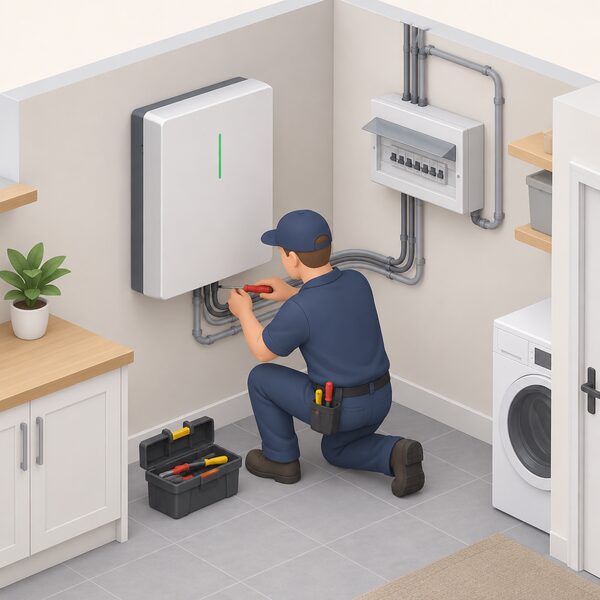
A compliant plug-in solar kit is designed for customer installation in accordance with its instructions, but UKSOL is explicit that "The socket itself must be suitable, correctly protected and professionally installed."18 That is the part a householder cannot verify by eye. An outdoor socket of unknown age, on an unknown circuit, with unknown protection, is being asked to carry generation back into the building.
For storage, there is no self-install route at all. Battery systems must be hard-wired by a qualified electrician3, and the installation standards that govern the work sit alongside BS 7671, the Wiring Regulations34. The pre-installation discipline that applies to other significant domestic loads gives the shape of it: under the IET Code of Practice for EV charging equipment, an installer must assess the adequacy of the supply capacity for the new load plus any existing load, assess the adequacy of the earthing, and notify the Distribution Network Operator once the equipment is installed35. Network operators expect contact before the work, not after36. Battery storage installations are also covered by added guidance within ECO4.
Where the legal line sits, and why
Before 27 August 2026, UK standards only permitted solar power generation that was permanently connected, meaning wired into the mains and not plugged into a socket1. The amendment created a narrow exception for a defined class of device. Electrical Safety First states that plug-in battery storage systems are "not permitted to be connected to an electrical installation connected to the electricity network (known as 'grid-tied')"2, and its consumer guidance advises against installing them in the home2.
The reasoning is visible in the legislation's own wording: a plug-in microgenerator must not be designed to import electricity from the consumer's installation in order to store it for later supply, beyond control or auxiliary functions the interim specification permits38. A socket-connected battery is by definition an importing device, on a circuit shared with other appliances, in a plug format that can be relocated without inspection.
Product risk reinforces it. Electrical Safety First's Battery Breakdown work identifies poor quality and substandard components, flawed design, physical abuse and improper charging or discharging as causes of thermal instability39. Those are precisely the failure modes an unsupervised consumer purchase is least protected against, and they are the subject of the wider home battery fire safety position.
Faults, monitoring and what a householder can check
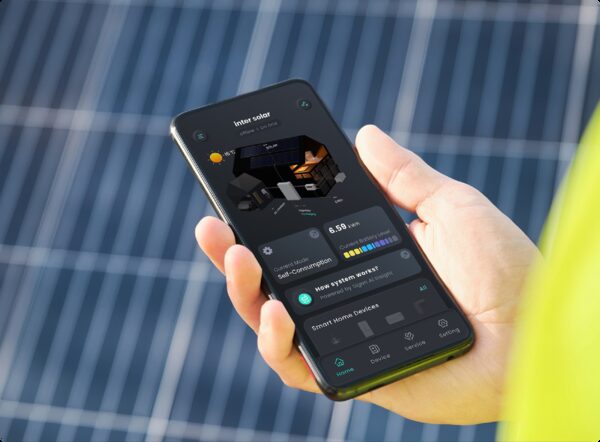
With plug-in solar, low or absent output has a short list of explanations before anything is broken: shading, tilt, time of day, and the anti-islanding shutdown that takes the microinverter offline whenever the grid supply fails18. Compatible UKSOL kits include app-based monitoring through the specified microinverter platform18, which is how a householder distinguishes a genuine fault from weather. That monitoring is a manufacturer's cloud service, and a dependency in its own right, as with any battery monitoring app.
For hard-wired storage, most battery storage systems monitor battery health and will alert when a replacement is needed21. A battery that stops charging is not always faulty: with a battery and no solar panels, charging stops when full and the battery discharges when the next cheap tariff period ends, automatically6. Using an electric vehicle as household storage is not generally available either, with bidirectional charging trialled in some places but not widely deployed6.
What it means for household independence
The plug-in route gives a renter or a flat-dweller a first stake in generating electricity, and that is not trivial. What it does not give is independence. An 800W device offsets part of a daytime load and nothing else; it stops entirely when the grid stops18; the saving figures attached to storage, £150 rising to £450 a year with a battery, describe hard-wired systems on full roofs4. Storage itself has bounded output: the National Energy System Operator notes that compared with pumped storage, the electricity batteries can deliver is much more limited40. The UK's total installed battery capacity is around six gigawatts41.
The dependencies that remain are the honest measure. The grid remains the supply for everything above the plug-in kit's ceiling. A supplier tariff sets whether stored or exported electricity is worth anything. A manufacturer's app carries the monitoring. And the one component that would most improve a plug-in household's position, storage, sits behind a legal boundary that the 2026 solar reform deliberately left in place. For households with the space and consent, a hard-wired system fitted by a qualified electrician remains the route, and the wider case is set out in home batteries and energy independence and the full guide.
Sources41 cited
- Plug-in solar panels reviewed, Which?, 2026-09-15
- Plug-in solar consumer guide, Electrical Safety First, 2026-08
- Plug-in solar advice, Centre for Sustainable Energy, 2026-09
- Plug-in solar briefing, POST, UK Parliament, 2026-06-25
- Plug-in solar regulations 2026, legislation.gov.uk, 2026-07-16
- Battery storage advice, Energy Saving Trust, 2026-08-19
- Future Homes Standard announcement, NAPIT, 2026-03-24
- Commons debate on plug-in solar, Hansard, 2026-03-16
- Britain continues to break clean power records, GOV.UK, 2026-05-28
- Plug-in battery statement, Electricity Storage Association, 2026-08-27
- Plug-in solar explained, Low Carbon Hub, 2026-07-09
- Plug-in solar panels guide, Uswitch, 2026-09-04
- UKSOL Plug-In Solar Pro reaches UK compliance, Solar Energy UK, 2026-08-20
- Generation and storage connections, Electricity North West, 2026-09-19
- What to know about plug-in solar panels, Home Energy Scotland, 2026-09
- Plug-in solar panels, Energy Saving Trust, 2026-09-17
- VAT on energy-saving materials, HMRC, 2026-09-17
- Plug-in solar FAQs, UKSOL, 2026-09-17
- Should you get solar panels?, Which?, 2024-07-03
- Battery storage advice, Centre for Sustainable Energy, 2025-10
- Battery storage for consumers, MCS, 2026-09-17
- Electrical energy storage systems, Flexi-Orb, 2025-04-22
- Smart Export Guarantee, Energy Saving Trust, 2026-05-20
- Plug-in solar consultation document, DESNZ, 2026-06-16
- Plug-in solar consultation, DESNZ, 2026-06-16
- Simple tips for a greener Easter, Home Energy Scotland, 2026-03
- Micro generation and storage connections, Electricity North West, 2026-09-19
- Micro generation connection procedure, Sell2Wales, 2026-06-15
- G98 single premises summary guide, Energy Networks Association, 2026-09-17
- G99 NI fast track applications, NIE Networks, 2026-09-19
- G99 fast track process, Electricity North West, 2026-09-19
- Connecting generation to the electricity networks, Energy Networks Association, 2026-09-17
- Connect Direct, Energy Networks Association, 2026-09-17
- EV charger regulations in England, NICEIC, 2026-08-19
- EV and heat pump FAQs, NIE Networks, 2026-09-19
- Charging at home, Electricity North West, 2026-09-19
- Plug-in solar panels vs rooftop systems, Which?, 2026-04-27
- Plug-in solar regulations, regulation 2, legislation.gov.uk, 2026
- Battery safety campaign, Electrical Safety First, 2026-09-17
- How does storage help us balance the grid, NESO, 2026-09-17
- Homes with batteries to cash in from free power offer, Solar Energy UK, 2026-04-14
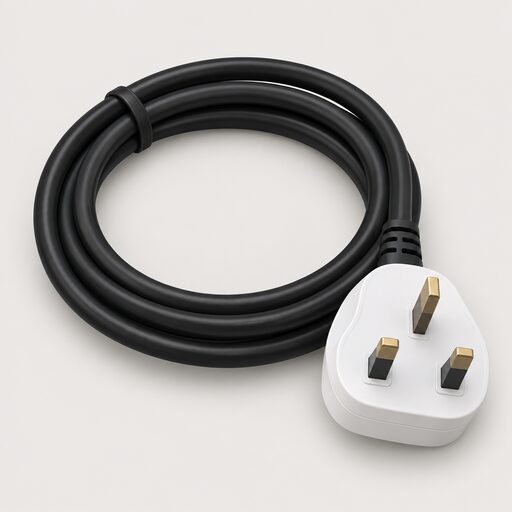 Plug-In Solar KitsCan you really plug solar panels into a normal wall socket in the UK, and is it legal now?
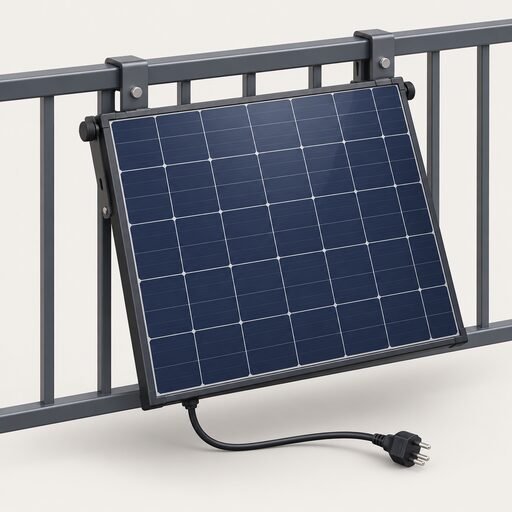 Balcony Solar SystemsCan you really plug solar panels into a normal socket, and what will it save you?
 Backup Power Safety RulesWho signs off a battery or backup circuit, and can you legally plug in a power station or a plug-in solar panel in the UK?
 Planning Permission in EnglandWhen a domestic battery or its enclosure falls within permitted development in England, when an application is needed, and how the position differs for outbuildings, listed buildings and conservation areas.
 Home Battery Install StatisticsHow many homes in the UK actually have a battery, and is that number growing quickly?
 Off-Grid Battery SystemsHow many days of power do you need when there is no sun?