
In this guide
MCS guidance on self-consumption and storage benefit sits at the design stage of a battery project, not at the end of it. The Microgeneration Certification Scheme requires installers to provide a design-stage prediction of system efficiency, not to verify actual performance, and MCS does not require remediation of systems that are underperforming relative to their design1. That single distinction explains most of what a householder needs to know about the numbers on a battery quote.
The reason the calculation matters is that a battery's value is almost entirely a self-consumption story. Great British Energy states that adding a battery to a solar installation increases self-consumption from 30 to 40% to 70 to 80%2. Everything an installer models, the battery capacity, the inverter, the tariff, the household load profile, exists to move a home along that range. The estimate is the evidence base for the purchase.
The installation itself is governed separately, by the battery installation standard. Approved Document L states that on-site electricity storage and battery systems connected to on-site electricity generation should be commissioned in accordance with the manufacturer's instructions and a commissioning procedure such as the commissioning requirements of the Microgeneration Certification Scheme's battery installation standard3. Warm Homes: Social Housing Fund rules go further and name MCS, PAS 63100 and PAS 2035 together as the standards a domestic battery must be installed to5.
What MGD 003 is and where it sits in the MCS standards framework
MCS is a certification scheme for microgeneration installation companies and products, and it aims to ensure consistent standards and provide confidence to consumers7. Its published roles include setting and maintaining technical standards for installations and products, certifying installers and products against those standards, issuing MCS certificates for completed eligible installations, and assisting certification bodies to review and address cases and consumer issues relating to installers or products8. MGD 003 is one of the guidance documents that sits under that standards umbrella, dealing specifically with self-consumption and storage benefit estimates.
The framework has several layers, and it helps to separate them. There are planning standards, such as MCS 020, which in Northern Ireland is defined as the product and installation standards for air source heat pumps specified in the Microgeneration Certification Scheme MCS 0209. In Scotland the same term is defined as the product and installation standards specified in the Microgeneration Certification Scheme MCS 020, Issue 1.310. There are installation standards, of which MIS 3012 is the battery one. And there is guidance on how estimates are produced and presented, which is where MGD 003 belongs.
The planning layer has real consequences. The MCS 020 Planning Standard is described as the gateway to securing grant funding, and as required for securing grant funding11. Where MCS standards approved by the Department for Energy Security and Net Zero have been updated, the relevant standards at the time of commissioning are used to assess eligibility12. That means the version of a standard in force on the day of commissioning, not the day of quotation, is the one that governs.
For a household, the practical point is that the estimate and the installation are governed by different documents with different purposes. A compliant estimate is not evidence that the installation will perform as modelled, and a compliant installation is not evidence that the estimate was sound.
Why self-consumption matters for battery benefit

Self-consumption is the share of generated electricity used on site rather than exported. Without storage, a solar array exports most of what it makes during the middle of the day, because the household is not there to use it. With storage, that generation is held and discharged later. The published range is wide: Great British Energy puts the increase at from 30 to 40% to 70 to 80%2.
That range is the whole financial case. A battery does not generate electricity; it moves it in time. Its benefit is the difference between the value of electricity exported and the value of electricity imported at the moment of use, multiplied by the volume shifted. Every input to the calculation, the array size, the battery capacity, the household's daily load, the tariff structure, changes the answer.
The calculation is also sensitive to things the installer cannot control. Domestic electricity consumption varies enormously between households of the same size and type, and the official indicator for domestic electricity consumption carries no confidence intervals, so the underlying data does not support a precise statement of what a typical home uses14. A modelled self-consumption figure is therefore a projection built on assumptions about behaviour, not a measurement.
"Great British Energy says adding a battery to a solar installation increases self-consumption from 30 to 40% to 70 to 80%"
For energy independence, this is the central mechanism. A home that raises self-consumption to the upper end of that range is buying less from a supplier and exporting less at a low price. It remains connected to the grid, and in most UK installations the grid remains the backup, but the volume of energy crossing the meter falls. The dependence that remains is on the network for import when the battery is empty and for export when it is full.
MIS 3012: the battery standard behind the calculation
MIS 3012 is the MCS battery installation standard, and it appears across the official documents as the commissioning route for domestic storage. Approved Document L, in both its England volume and the Welsh consultation version, states that on-site electricity storage and battery systems connected to on-site electricity generation should be commissioned in accordance with the manufacturer's instructions and a commissioning procedure such as the commissioning requirements of MIS 3012: The Battery Standard (Installation)3.
The Future Homes and Buildings Standards consultation response is careful about how firmly MIS 3012 is required. It states that the MIS standard has been cited as one way of meeting the commissioning requirements, with recognition that other methodologies may be suitable and that guidance should be flexible to account for evolving technology15. That is a softer position than a single mandated method, and it matters when an installer proposes an alternative commissioning route.
Where grant funding is involved, the standard is firmer. For domestic batteries to be eligible for the Warm Homes: Social Housing Fund, the product must be installed by an MCS certified installer, to the relevant MCS installation standard, MCS 30125. The same guidance requires UKCA or CE marking, which is required in the MCS Battery Installation Standard5.
The scale of activity under this standard is visible in the official statistics. In January 2026 there were 3,402 MCS certified domestic battery installations, of which 3,303 were in the sample, with a total sample capacity of 33,320 kWh6. For comparison, March 2024 saw 1,151 installations, 1,141 in the sample and 9,240 kWh of sample capacity, and February 2024 saw 1,202 installations, 1,192 in the sample and 9,670 kWh6. MCS certified installations of domestic retrofit electric batteries have been increasing6.
| Month | Installations | In sample | Sample capacity |
|---|---|---|---|
| February 2024 | 1,202 | 1,192 | 9,670 kWh |
| March 2024 | 1,151 | 1,141 | 9,240 kWh |
| January 2026 | 3,402 | 3,303 | 33,320 kWh |
The statistics cover retrofitting electric batteries into domestic properties in the United Kingdom, include domestic and existing installations, exclude commercial and newbuild properties, and exclude records where the Battery Nominal Storage Capacity was less than 1kWh or greater than 30kWh6. The capacity bands are chosen to cover distinct groupings: batteries approximately smaller than 6kWh, approximately larger than 11kWh, and a grouping in between6. Data are sourced from the MCS database6.
What installers must calculate at design stage
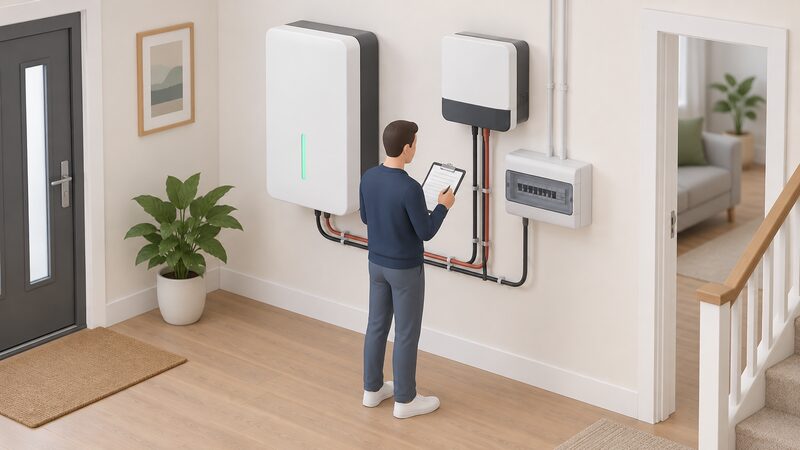
The design-stage duty is to produce a prediction. MCS requires installers to provide a design-stage prediction of system efficiency, not verify actual performance1. The estimate therefore has to be presented as a projection, with its assumptions visible, rather than as a guaranteed outcome.
Several other obligations attach to the installer at the same point. The installer is responsible for ensuring that the installation meets permitted development noise standards at the time of installation16. For grant-funded work, the installer must be certified by the Microgeneration Certification Scheme, a nationally recognised scheme17. Metering for payment must be fitted by an installer certified to MCS18. Where a Feed-in Tariff generator is installing energy storage or battery systems up to 50kW, an MCS installer is recommended, and the system installed in line with the MCS Battery Standard19. A Metering and Monitoring Service Package must be installed by an MCS certified installer under a signed agreement meeting specific requirements, with a continuing advice service18.
The calculation itself draws on the household's own consumption pattern, the array's modelled output, the battery's usable capacity and the tariff. Because the official consumption indicator carries no confidence intervals, the load side of the model rests on assumptions rather than measured population data14. Where a household has a smart meter with a year of half-hourly data, the estimate can be built on that; where it does not, the installer is modelling an archetype.
For independence, the design-stage calculation is where a household learns how much of its demand the system is expected to cover and how much will still be drawn from the grid. It is the document that sets expectations, and it is worth reading as a set of assumptions rather than a set of promises.
Design-stage prediction, not verified performance

The gap between prediction and performance is the most important thing to understand about an MCS performance estimate. MCS requires installers to provide a design-stage prediction of system efficiency, not verify actual performance, and MCS does not require remediation of systems that are underperforming relative to their design1. There is no mechanism in the standard that turns a shortfall against the modelled figure into an obligation to fix the system.
What MCS does operate is a checking regime. MCS undertakes its own checks on installations completed by MCS-certified installers, separate from Ofgem's audit programme, and may contact owners directly or arrange a visit21. Property owners contacted for those checks should aim to respond within seven days22. MCS may also contact a household for a short, routine verification on behalf of Ofgem, either by email or by phone23.
The consumer protection that MCS specifies is also bounded. MCS specifies handover documentation but not the quality of verbal explanation, household understanding, structured follow-up or ongoing support1. A household therefore gets a documented estimate and a handover pack, but the standard does not reach into how well any of it was explained.
This is where the independence question becomes concrete. A battery reduces reliance on a supplier for the energy it shifts, but the accuracy of the savings case rests on a model the household cannot audit and a standard that does not require the model to be corrected afterwards. The honest position is that the estimate is a planning tool, and the meter reading is the only performance evidence that counts.
The standards a domestic battery installation must meet
A domestic battery installation in the UK is governed by a stack of documents rather than a single rule. Warm Homes: Social Housing Fund guidance names MCS, PAS 63100 and PAS 2035 as the quality and installation standards a domestic battery must be installed in compliance with5. The same guidance requires the product to be installed by an MCS certified installer, to the relevant MCS installation standard, and requires UKCA or CE marking, which is required in the MCS Battery Installation Standard5.
Approved Document L adds the commissioning requirement: on-site electricity storage and battery systems connected to on-site electricity generation should be commissioned in accordance with both the manufacturer's instructions and a commissioning procedure such as the commissioning requirements of MIS 30123. The Future Homes consultation response records that MIS 3012 is cited as one way of meeting the commissioning requirements, with recognition that other methodologies may be suitable15.
| Document | What it covers | Where it applies |
|---|---|---|
| MIS 3012 | Battery installation and commissioning | Cited in Approved Document L and required for Warm Homes: Social Housing Fund batteries5 |
| PAS 63100 | Battery installation quality | Named alongside MIS 3012 in Warm Homes: Social Housing Fund rules5 |
| PAS 2035 | Retrofit project management | Named alongside MIS 3012 in Warm Homes: Social Housing Fund rules5 |
| MCS 020 | Planning standards for permitted development | Defined in Northern Ireland and Scottish legislation9 |
The standards also reach into grant eligibility. Where MCS standards approved by the Department for Energy Security and Net Zero have been updated, the relevant standards at the time of commissioning are used to assess eligibility12. The MCS 020 Planning Standard is described as the gateway to securing grant funding and as required for securing grant funding11.
For a household, the practical consequence is that the standard applying to the work is fixed at commissioning, not at quotation. A system designed under one version and commissioned under another is assessed against the later one. That is a reason to check the certificate date against the commissioning date, and to keep the handover documentation that records which standards were applied.
The redeveloped MCS Scheme and what changes for installers

MCS has redeveloped its installer scheme, which will be rolled out throughout 2026 and into early 202724. The redeveloped scheme is now rolling out across the MCS installer base25. The change that matters most to householders is the consumer code requirement: installers operating under the scheme are no longer required to hold a separate consumer code membership in order to deliver work under the Boiler Upgrade Scheme24.
That follows an earlier reform. MCS replaced the requirement for contractors to be members of a Chartered Trading Standards Institute approved consumer code with their own Customer Commitment26. The effect is to bring the consumer protection obligations inside the scheme rather than leaving them with an external code body.
The direction of travel is towards stronger financial protection and a contractual commitment to consumer protection law, with a single scheme rather than a scheme plus a separate code. For a household buying a battery, that means the protections attaching to the installer are being consolidated, and the deadline for every installer to be operating under the new rules is 31 March 202725.
There is a practical wrinkle for grant-funded work. Under the Boiler Upgrade Scheme, installers cannot use a temporary MCS certification number to create an account or apply for a voucher, and retrospective applications are allowed only after full certification, at the installer's risk27. A household should therefore expect the certification to be in place before the application, not promised for later.
What MCS certification means for consumer protection
MCS certifies, quality assures and provides consumer protection for microgeneration installations and installers, covering small-scale renewable electricity technologies such as solar photovoltaic panels, biomass, wind, heat pumps and heat products28. It is an independent certification scheme for microgeneration installation companies and products8. MCS aims to put consumer protection at the heart of the MCS Scheme29.
The certification covers both sides of a purchase. Installers are expected to use MCS certified products that have been designed, tested, and manufactured to industry-recognised standards25. The scheme's own description of its role includes certifying installers and products against those standards and issuing MCS certificates for completed eligible installations8.
On vulnerability, MCS sets out a detailed position. It recognises there is a scale of vulnerability and that each consumer is different, and that vulnerability can be permanent, transitory, or temporary, with circumstances assessed at the moment of interaction29. It commits to taking appropriate steps to consider the circumstance of any individual who is vulnerable or particularly susceptible to detriment or harm and therefore requires reasonable adjustments to the way in which it communicates and services their needs, and states that the welfare of every individual, whether consumer or staff member, is paramount29. Those who are vulnerable have the right to protection from abuse and to appropriate adjustments regardless of their gender, ethnicity, disability, sexuality, or beliefs29.
For independence, certification is a process guarantee rather than an outcome guarantee. It tells a household that the installer and product met a recognised standard at the point of certification, and it provides a route to escalate if the work falls short. It does not tell a household how much energy the system will actually shift, and it does not underwrite the savings figure in the estimate.
If something goes wrong: complaints and escalation

MCS is the contact for issues with the installation process, the installer, or the MCS certificate or product7. The process starts with the installer: contact them first, and allow reasonable time to respond, with 14 days described as a reasonable maximum time to expect a response30. Where a consumer code is involved, the installer should have been given at least 10 working days to resolve the matter before the code is contacted7.
If the complaint is not resolved, the MCS Administrator can be approached, and will advise how to make a complaint about the MCS installer31. Complaints can be raised by online form, email, post, phone or live chat, and MCS acknowledges a complaint within 5 working days30. MCS now manages complaints in-house25. During an investigation, MCS will speak to third parties on the consumer's behalf, carry out a technical review of the installation if needed, and work with the installer to reach a resolution30. Complaints from a third party acting on a household's behalf are accepted once verified with the household30.
To help, MCS needs details of what went wrong, photographic evidence, supporting documents, and a willingness to engage and allow installer access to remediate30. Where a complaint involves a vulnerable customer, any such complaint will be investigated fully and full co-operation will be given as appropriate where an investigation is conducted by a third party29.
The two-year window is the hard limit, and it runs from commissioning rather than from the date a problem becomes apparent. For a household, that is a reason to record the commissioning date and to raise concerns early rather than waiting to see whether performance improves. The complaint route addresses the installation and the installer; it does not reopen the design-stage estimate, because MCS does not require remediation of systems underperforming against their design1.
Sources31 cited
- Clean heat and fuel poverty report, Department for Energy Security and Net Zero, 2026-05
- Postnote: Residential energy storage, UK Parliament, 2026-06-25
- Approved Document L Volume 1 consultation version, Welsh Government, 2025-08
- Approved Document L Volume 1: Dwellings, Department for Levelling Up, Housing and Communities
- Warm Homes: Social Housing Fund wave 3 scheme guidance addendum, Department for Energy Security and Net Zero, 2026-06
- MCS domestic retrofit battery installations 2025 to 2026, Department for Energy Security and Net Zero, 2026-05-28
- Feed-in Tariffs: dispute resolution, Ofgem, 2026-09-17
- Boiler Upgrade Scheme, Ofgem, 2026-09-17
- Planning (General Permitted Development) Order (Northern Ireland) 2015, Schedule Part 2, legislation.gov.uk, 2026-09-17
- Scottish statutory instrument 2024/102, legislation.gov.uk, 2024-05-24
- Air source heat pump noise and permitted development rights in Wales: phase 1 report, Welsh Government, 2023-12-13
- Boiler Upgrade Scheme product eligibility, Ofgem, 2023-03-28
- Explanatory memorandum to the 2025 MCS planning standards instrument, legislation.gov.uk, 2025
- Domestic electricity consumption indicator, Office for National Statistics, 2026-09-20
- Future Homes and Buildings Standards consultation response, Department for Energy Security and Net Zero, 2026-03
- The Microgeneration Certification Scheme, Planning Portal, 2026
- Boiler Upgrade Scheme, Find government grants service, 2026-09-18
- Domestic RHI guide to metering, Ofgem, 2026
- Guidance for FIT generators V18, Ofgem, 2026-04-01
- FIT guidance for licensed electricity suppliers V17.1, Ofgem, 2024-09-06
- Boiler Upgrade Scheme guidance for property owners V5.1, Ofgem, 2026-07
- Boiler Upgrade Scheme guidance for installers V5, Ofgem, 2026-04-28
- BUS guidance for property owners V5 draft, Ofgem, 2026-03-25
- Boiler Upgrade Scheme guidance for installers V5.1, Ofgem, 2026-07-02
- How MCS is transforming consumer protection for renewables, MCS, 2026-09-10
- Amendments to the Boiler Upgrade Scheme: government response, Department for Energy Security and Net Zero, 2025-11
- Summary of updates to BUS guidance for installers V5, Ofgem, 2026-04
- ECO4 Flex and GBIS Flex information document, Ceredigion County Council, 2025-11
- Our approach to supporting customers, MCS, 2026-09-07
- What to do if things go wrong, MCS, 2026-09-07
- Solar panels, London Borough of Hammersmith and Fulham, 2026-09-17
 Self-ConsumptionHow much of the electricity from your own solar panels do you actually use, and how much goes to the grid?
 Solar and Energy IndependenceHow far domestic solar cuts dependence on suppliers and the grid, what self-consumption really looks like across the year, what a battery, diverter or EV adds, and the grid-outage limit of ordinary inverters.
 The Full Solar Panels GuideHow much do solar panels cost, and what could they save you each year?
 Energy Bills and IndependenceSolar panels can cut the part of your bill that goes up with every unit you use, but you still pay a daily standing charge just for being connected to the grid.
 Behind-the-Meter SystemsWhere does your meter sit, and what does that mean for the solar panels or battery you put in at home?
 Payback and SavingsHow long until a home battery pays for itself, and why do quoted payback times vary so much?