
In this guide
A home battery in the UK is installed to three documents that do different jobs. PAS 63100:2024, published by BSI on 20 March 2024, is the fire-safety and location specification for battery energy storage systems in dwellings1. BS 7671, the IET Wiring Regulations, is the electrical installation standard the wiring must satisfy2. MIS 3012, the MCS Battery Standard (Installation), is the scheme standard an MCS certified installer works to when the battery is connected to on-site generation3.
None of the three is an Act of Parliament. PAS 63100 is a fast-track standard, not law, and it becomes binding in practice through the routes that reference it. MCS scheme rules require domestic batteries to be installed in compliance with the latest version of the quality and installation standards, including MCS (MIS 3012), PAS 63100 and PAS 20353. The practical effect is that a household buying an MCS certified installation gets a system built to PAS 63100 whether or not the household has ever heard of it.
The standards divide cleanly. PAS 63100 governs where the battery may sit and how it is protected against fire. BS 7671 governs how it is wired. MIS 3012 governs how it is commissioned and by whom. A fourth document, PAS 2035, sits alongside them for retrofit work under grant schemes3.
The three standards that govern a home battery installation
The three documents answer three separate questions, and a compliant installation satisfies all of them.
PAS 63100:2024 is the specification for electrical installations providing protection against fire from battery energy storage systems for use in dwellings. Its intended users are suitably competent designers and installers of BESS that form part of electrical installations, for dwellings and similar simple electrical installations1. It covers the physical requirements for battery units and the installation location in respect of safety and external influences that affect fire safety1. It is a fast-track standard, which is BSI's route for a document produced quickly where the market needs one, and it carries the ICS code 13.220.01, Protection against fire in general1.
BS 7671 is the wiring standard. The Fitness for Human Habitation guidance for landlords in Wales states that the electrical wiring installation must meet the latest requirements of Institute of Engineering and Technology/British Standard (BS 7671)2. That is the baseline for any fixed electrical installation in a dwelling, and a battery is an addition to that installation rather than a separate system.
MIS 3012 is the MCS installation standard. Approved Document L, Volume 1, Dwellings, states that on-site electricity storage and battery systems connected to on-site electricity generation should be commissioned in accordance with both the manufacturer's instructions and a commissioning procedure such as the commissioning requirements of Microgeneration Certification Scheme's MIS 3012: The Battery Standard (Installation)5. The same requirement appears in the Welsh Government's consultation version of Approved Document L, Volume 16.
The three interact rather than compete. PAS 63100 sets the location and fire provisions, BS 7671 sets the wiring, and MIS 3012 sets the commissioning and the competence of the installer. A household that receives an MCS certificate has, in principle, evidence that all three were applied.
Fire safety: where a battery may and may not be installed
PAS 63100:2024 exists because a lithium-ion battery in a dwelling is a fire risk that has to be managed by placement as well as by product design. The standard's stated coverage is the installation location in respect of safety and external influences that affect fire safety, alongside the physical requirements for battery units1.
That phrasing matters. The standard does not simply say "install it here". It requires the designer to assess the location against safety and against external influences, which includes heat, water, impact and the routes by which a fire could spread or be fought. The location provisions are the reason the standard is cited in fire safety discussions at all.
Fire and rescue services give parallel advice for lithium-ion batteries in household devices, which is the closest official guidance to the domestic battery case. North Wales Fire and Rescue Service advises that a device should be charged in a room that has a working smoke alarm, which does not compromise the escape route, keeping the door closed while it is charging and away from any heat source7. It adds that items should be charged away from escape routes, never in a corridor or room that provides the only way out of the home, and the charger disconnected once charging is complete7.
"Charge items away from escape routes (never in a corridor or room that provides the only way out of your home) and disconnect the charger once charging is complete"
The escape route principle is the one that carries across to a fixed battery. A location that blocks or endangers the only way out of a dwelling is the location the guidance is written to avoid.
Outdoor installation: the preferred location and its clearances

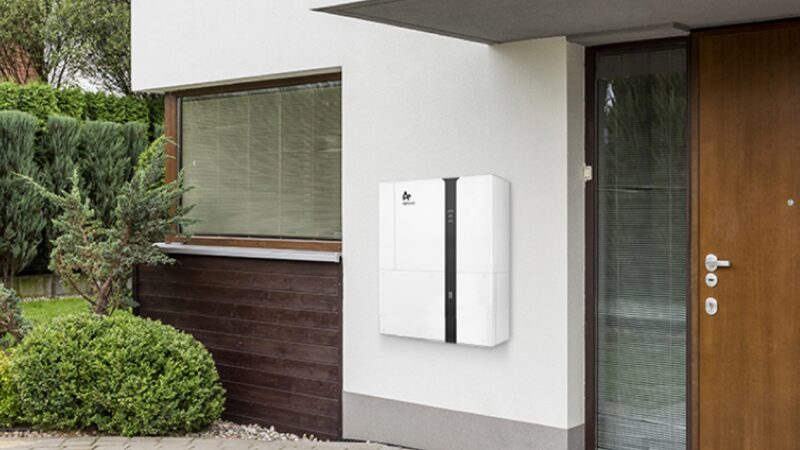
Energy Saving Trust states that a battery can be installed in garages, on external walls or utility rooms, depending on which one you choose8. Of those, the external wall is the location that removes the fire risk from the living space entirely, and it is the location most domestic installations use.
The clearances an outdoor battery must observe come from PAS 63100 itself, which sets the installation location in respect of safety and external influences that affect fire safety1. The standard is a paid document, so the exact figures are read from the standard rather than from a public summary.
Comparable standoff figures come from planning rather than from the battery standard, and they are worth knowing because they show the order of magnitude official documents work with. A Scottish Government consultation on permitted development rights proposed that solar canopies, battery storage and equipment housing for EV charging upstands should not apply within 5 metres of a road and 10 metres of the curtilage of a dwelling, with alternative limits of 5 metres from the curtilage of a dwelling and 2 metres from a road9. Those are planning distances, not fire clearances, and they are proposals rather than adopted rules.
Northern Ireland's permitted development schedule takes a different approach for wall-mounted electric vehicle outlets, requiring the outlet and casing to be within 2 metres of a road10. That is a siting rule for a different piece of equipment and does not govern a battery.
The practical point for a household is that an outdoor location is not simply "outside". Distance from doors, windows, combustible material and the escape route is what the location assessment is for, and the figures are set by the standard the installer works to.
Indoor installation: ventilation, fire separation and capacity limits
An indoor battery, in a garage or utility room, keeps the equipment out of the weather and close to the consumer unit. It also puts a fire risk inside the building envelope, which is why the location provisions bite hardest here.
PAS 63100:2024 covers the installation location in respect of safety and external influences that affect fire safety1. For an indoor location that means the room's construction, what else is stored or installed there, and how a fire in the battery would be detected and contained.
The building regulations give a useful parallel for how UK guidance treats appliances in confined or sleeping spaces. Approved Document J for Wales states that a gas fire, other space heater or gas water heater of up to 14kW (gross) heat input (12.7kW net) must not be installed in sleeping accommodation unless it is room sealed or equipped with a device designed to shut down the appliance before there is a build-up of a dangerous quantity of the products of combustion in the room concerned12. Regulation 30(2) of the Gas Safety (Installation and Use) Regulations 1998 sets the same threshold, requiring that a gas water heater of more than 14 kilowatt gross heat input in a room used or intended to be used as sleeping accommodation be room sealed13. The principle is that an appliance with a hazard inside it is separated from the room people sleep in.
Capacity limits for indoor installation follow from the location provisions rather than from a single national number. The MCS installation statistics give a sense of what is actually fitted: the sample excludes data where the Battery Nominal Storage Capacity was less than 1kWh or greater than 30kWh4. That is a statistical cut-off, not a regulatory ceiling, but it shows the band within which domestic installations sit.
BS 7671 and the new chapter on stationary secondary batteries
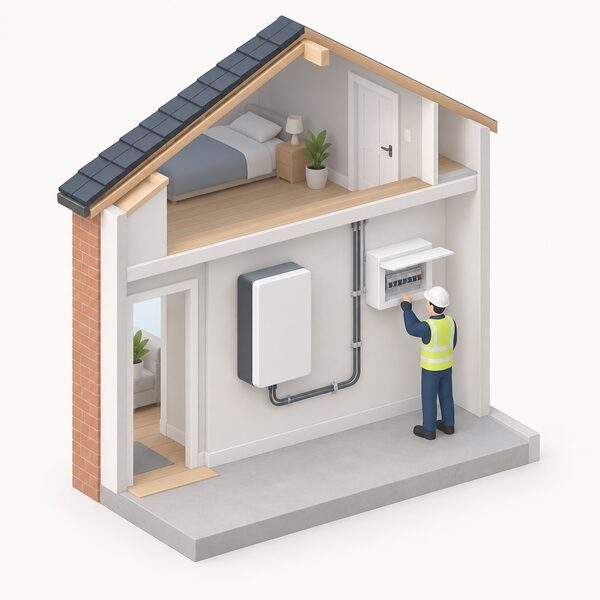
BS 7671 is the document that makes a battery part of the electrical installation rather than an appliance plugged into it. The Fitness for Human Habitation guidance for landlords in Wales requires that the electrical wiring installation meets the latest requirements of Institute of Engineering and Technology/British Standard (BS 7671)2.
The wiring regulations have been through several editions and amendments. The version cited in the fire literature review is BS 7671:2008+A3:2015, Requirements for Electrical Installations. IET Wiring Regulations15. The same review cites BS EN 60364-7-712, Low-voltage electrical installations. Part 7-712: Requirements for special installations or power systems, dated 2010, which is the international counterpart for special installations15.
The addition that matters for batteries is the chapter covering stationary secondary batteries, which brings energy storage into the body of the wiring regulations rather than leaving it to manufacturer instructions. The effect is that a battery installation is designed, tested and certified as part of the fixed wiring, with the same inspection and testing regime.
Approved Document S shows how the wiring standards interact with other documents when equipment is added to a dwelling. It states that where a building has only covered parking spaces it is exempt from installing charge points but needs cable routes, and that charge points installed voluntarily are outside section 6 guidance but must meet other relevant standards including electrical safety16. The pattern is consistent: one document sets the policy, and BS 7671 sets the electrical standard the work must meet.
For a household, the BS 7671 element is what an Electrical Installation Certificate or a Minor Electrical Installation Works Certificate records. A battery added to an existing installation should produce paperwork that names the standard.
MIS 3012: the MCS Battery Installation Standard for installers
MIS 3012 is the standard the installer works to, and it is the one that determines whether a household can access scheme benefits.
Approved Document L, Volume 1, Dwellings, requires that on-site electricity storage and battery systems connected to on-site electricity generation be commissioned in accordance with both the manufacturer's instructions and a commissioning procedure such as the commissioning requirements of Microgeneration Certification Scheme's MIS 3012: The Battery Standard (Installation)5. The Welsh Government's consultation version of the same document carries the identical requirement6.
The scheme rules make the standard a condition of funding. For domestic batteries to be eligible for the Warm Homes: Social Housing Fund scheme, the product must be installed by a MCS certified installer, to the relevant MCS installation standard (MCS 3012)3. The same guidance requires installation in compliance with the latest version of the quality and installation standards, including MCS (MIS 3012), PAS 63100 and PAS 20353.
MCS standards build on each other. The fire literature review notes that the installation standard (MIS 3002) calls up the MCS Guide to the installation of photovoltaic systems for technical content15. MIS 3012 sits in the same family, so an installer already working to MCS PV standards is working within a documented system rather than inventing a method.
The installer's own status is part of the requirement. Under the Green Homes Wales loan terms, the installer must be Registered, meaning registered with TrustMark and the relevant body for the relevant type of Eligible Measure, and must comply with relevant PAS certification, and must not be the borrower, a member of the borrower's household or immediate family17.
What the standards mean for householders and compliance
The standards are not written for householders, but they determine what a household receives and what it can rely on afterwards.
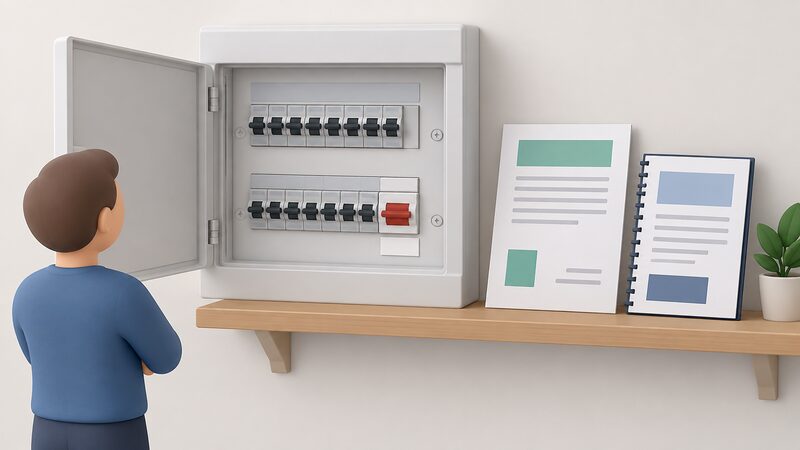
The first consequence is that compliance is documented rather than visible. A household gets an MCS certificate, an electrical installation certificate and a handover pack. Those documents are the evidence that PAS 63100, BS 7671 and MIS 3012 were applied, and they are what an insurer, a buyer or a grant scheme will ask for.
The second is that the standards are updated. PAS 63100:2024 is the current version, published 20 March 2024, and it is a fast-track standard, which means BSI can revise it as the evidence develops1. MIS 3012 is referenced as the latest version in scheme rules3. An installation built to an earlier version is not automatically non-compliant, but the version applied should be recorded.
The third is that the standards are not the only documents in play. Planning permission, grid connection notification and product safety regulation sit alongside them. The UK's new product safety framework consultation describes a fast-track Publicly Available Specification (PAS) addressing the technical requirements for battery systems used in e-bikes, e-scooters, and conversion kits18, which shows the PAS route being used for battery safety more widely.
The fourth is scale. MCS certified domestic battery installations ran at 3,402 in January 2026, with 3,303 in the capacity sample and 33,320 kWh of total capacity in that sample4. For comparison, January 2024 recorded 896 installations, 889 in the sample and 7,070 kWh4. The volume of installations is what makes a common standard necessary.
Where the standards leave a household's independence
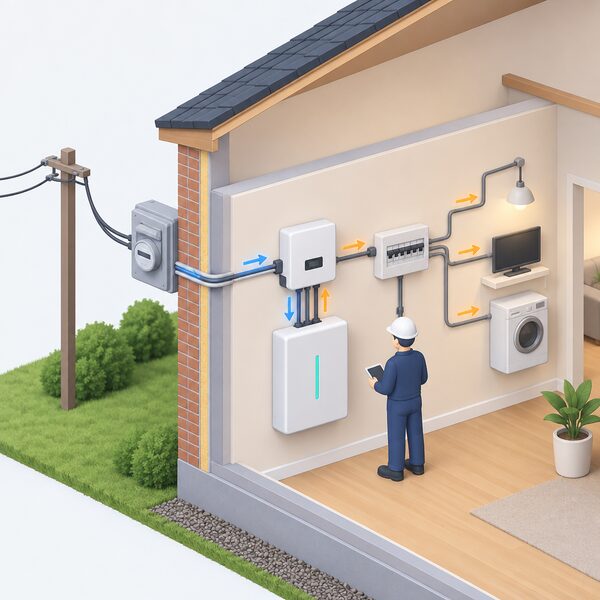
A battery installed to these standards does a specific job for a household's energy independence: it stores electricity the household generated or bought cheaply, and it releases it when the household needs it. The standards do not change that function, but they determine how safely and how verifiably it is delivered.
The dependence that remains is unchanged by any standard. The battery is connected to the grid, it is commissioned by an installer working to a scheme standard, and its behaviour is governed by an inverter and a battery management system that the household does not control. PAS 63100 governs location and fire safety, not autonomy1. BS 7671 governs wiring, not supply2. MIS 3012 governs commissioning, not operation5.
What the standards do give a household is a defensible installation. A system built to PAS 63100, wired to BS 7671 and commissioned to MIS 3012 has a documented basis, which matters when a warranty is claimed, a house is sold or an insurer asks a question. The standards are the reason a home battery is a fixed installation with paperwork rather than a large appliance in a cupboard.
Sources18 cited
- PAS 63100:2024 Electrical installations. Protection against fire of battery energy storage systems for use in dwellings. Specification, BSI, 20 March 2024
- Fitness for human habitation guidance for landlords, Welsh Government, 13 January 2022
- Warm Homes: Social Housing Fund wave 3 scheme guidance addendum, UK Government, June 2026
- MCS domestic retrofit battery installations 2025 to 2026, UK Government, 28 May 2026
- Approved Document L, Volume 1: Dwellings, UK Government, 2026
- Approved Document L, Volume 1: consultation version, Welsh Government, August 2025
- Lithium-ion batteries, North Wales Fire and Rescue Service, 2026
- Battery storage, Energy Saving Trust, 19 August 2026
- Scottish Government review of permitted development rights phase 2: consultation analysis, Scottish Government, 10 February 2023
- The Planning (General Permitted Development) Order (Northern Ireland) 2015, Schedules, legislation.gov.uk, 21 December 2020
- The Planning (General Permitted Development) Order (Northern Ireland) 2015, legislation.gov.uk, 4 July 2023
- Building regulations guidance Part J: heat producing appliances, Welsh Government, 2010
- The Gas Safety (Installation and Use) Regulations 1998, legislation.gov.uk, 1998
- Summary of updates to ECO4 delivery guidance and measures table, Ofgem, 7 August 2025
- Fire and solar PV systems: literature review, UK Government, 2015
- Approved Document S: frequently asked questions, UK Government, 17 April 2023
- Green Homes Wales loan standard terms and conditions, Development Bank of Wales, 17 September 2026
- The UK's new product safety framework, UK Government, 31 March 2026
 Home Battery Fire SafetyHow likely is a home battery to catch fire, and what keeps it safe if it does?
 DIY Home Battery BuildsBuilding your own home battery?
 Siting and LocationWhere can a home battery actually go?
 Electrical Safety RegulationElectrical work at home raises real questions about who can do it, what needs signing off, and what paperwork you should keep.
 Backup Power Safety RulesWho signs off a battery or backup circuit, and can you legally plug in a power station or a plug-in solar panel in the UK?
 Planning Permission in EnglandWhen a domestic battery or its enclosure falls within permitted development in England, when an application is needed, and how the position differs for outbuildings, listed buildings and conservation areas.