
In this answer
Short answer
MIS 3008 is the designation given to the Thermal Energy Storage Systems (TESS) Design and Installation Standard, the MCS document written to cover the design and installation of thermal stores including heat batteries1. It sits alongside the established MCS standards for other heating technologies, such as MIS 3005-D for heat pumps and MCS 008 for solid biomass fired heating systems2. For a household, the practical meaning is straightforward: MIS 3008 is the standard an installer will be working to when a heat battery is specified, and it is the certification route that determines whether the technology can be supported by public money.
The standard is not yet a settled, fully published document. MCS consulted on a Thermal Energy Storage System Standard in March 2025 and announced a pilot in September 2025, following nine months of work by a technical working group4. MCS has also stated it is planning to launch a pilot for a Thermal Energy Storage Systems Installation Standard and a System Performance Estimate Standard, which include heat batteries5. Until that work completes, a household looking at a heat battery is looking at a technology whose installation standard is still being finalised.
That matters because certification is the gatekeeper for grant funding in UK heating. The Microgeneration Certification Scheme has been a requirement for heat pump installations made under the Domestic Renewable Heat Incentive, the Green Homes Grant and the Clean Heat Grant6. A £2,500 grant for heat batteries will also be available once the legislation and appropriate product standards are in place, according to official guidance7. The standard and the subsidy are linked: no standard, no grant.
What MIS 3008 covers, and how it fits the MCS family
MCS standards are technology-specific. MIS 3005-D is the Heat Pump Standard covering design, and the current version is Issue 2.010. The MCS Heat Load Calculator operates under MIS 3005-D2. Solid biomass fired heating systems are certified under MCS 0083. Retrofit and packaged hybrid heating systems must be listed on the MCS product directory and fulfil the requirements set out in MIS 3005-D12. MIS 3008 is the equivalent instrument for thermal energy storage, and it is being developed with a companion System Performance Estimate Standard so that a predicted performance figure can be attached to an installation rather than left to the installer's judgement5.
The distinction between a design standard and a performance estimate standard is worth holding onto. A design standard governs how the system is sized, sited, connected and commissioned. A performance estimate standard governs what the household is told to expect from it. For heat batteries, where the technology is newer and the installed base smaller, the second document carries unusual weight: it is the mechanism by which a claim about annual output becomes a documented expectation rather than a marketing line.
Certification under an MCS standard is not a consumer guarantee in itself. It is a statement that the installation was carried out by a certified contractor working to a defined specification. The Microgeneration Certification Scheme's role as a funding requirement across three separate government schemes shows how that status has been used in practice6. MIS 3008 is being built to occupy the same position for thermal storage.

How a heat battery stores heat: phase change and non-phase change types
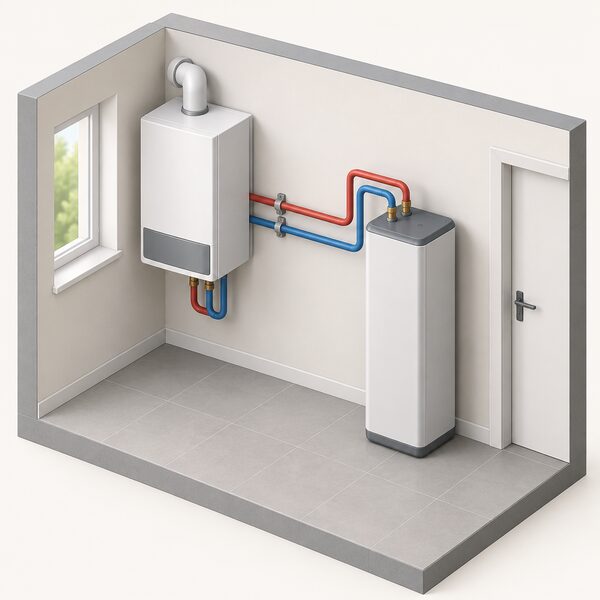
Heat batteries store energy as heat, supplied either by electricity from the grid or a household renewable source, or as surplus heat from a boiler, heat pump or another heating system13. Two broad types exist. One stores heat in a material that changes from a solid to a liquid and back, called phase change materials (PCM). The other stores heat in a material such as a ceramic where there is no phase change13.
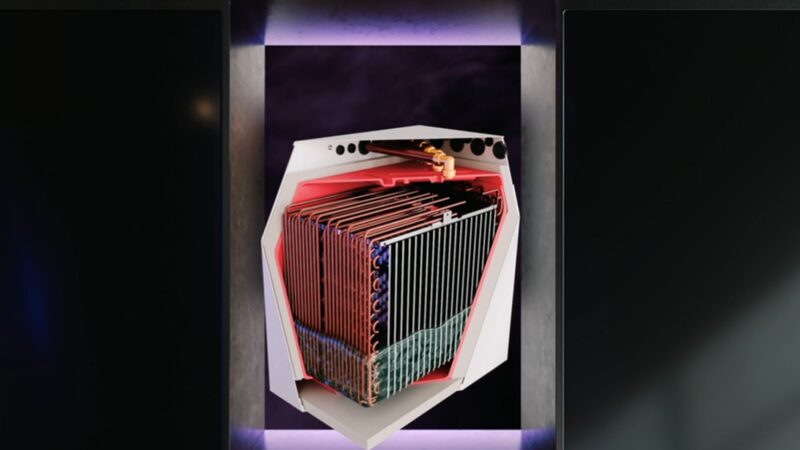
The phase change route is the one most often described in consumer guidance: spare heat or electricity is stored as heat by a material that changes from a solid to a liquid when it is absorbed, then back to a solid to release the heat14. The latent energy absorbed and released during that transition is what gives a compact vessel a useful capacity. The ceramic route relies on sensible heat, meaning the material simply gets hotter, and it typically needs more mass or volume for the same stored energy.
Heat batteries sit within a wider family of energy storage systems that includes battery storage and thermal storage13. They are distinct from electrical batteries in what they store and how they release it, and independent guidance notes that heat batteries may have a longer lifespan than electrical batteries13. That claim is stated as a possibility rather than a measured figure, and no verified service life for heat batteries appears in the available guidance. For a household, the honest position is that the storage medium is simpler and has no electrochemical degradation mechanism, but the pumps, controls and heat exchanger around it are still mechanical components with their own service life.
Grant eligibility: why certification is the gatekeeper for the £2,500 grant
The funding picture for heat batteries is set out in official guidance: a £2,500 grant for heat batteries will also be available once the legislation and appropriate product standards are in place7. That sentence contains both the amount and the condition. The money is committed in principle; the trigger is the legislation and the standards, which is where MIS 3008 sits.
What the Boiler Upgrade Scheme funds today is narrower. Independent guidance describes the scheme as covering the installing of a heat pump, biomass boiler or heat battery15, while the official installer-facing scheme rules list ground source heat pumps among the eligible technologies16. The biomass grant value is £5,000 from 28 April 20268. MCS has welcomed changes to the Boiler Upgrade Scheme, which indicates the scheme's scope is being actively revised17.
The certification infrastructure that would administer this already exists in outline. The MCS Certification Fund pays 75%, up to a maximum of £1,000, of the certification fees for MCS certification on heat pumps, which shows how the cost of becoming certified is itself subsidised to widen the installer base18. The Microgeneration Certification Scheme has been a requirement for heat pump installations under the Domestic Renewable Heat Incentive, the Green Homes Grant and the Clean Heat Grant6. A heat battery grant routed through the same machinery would follow a well-worn path.
For a household, the practical consequence is timing. A heat battery installed before the standard and the legislation are in place cannot be retroactively certified to a standard that did not exist at the time of installation. Households weighing a purchase against a future grant are weighing an unknown date against a known cost.
Cost and running costs: what the figures actually cover
The running cost comparison that matters most is against a heat pump. Independent guidance puts heat pumps at around £800 to £1,050 a year to run, describing them as one of the cheapest electric heating options8. Heat batteries have a maximum output of around 12,000 kWh a year, similar to the average UK home's heating demand8. The two figures are not directly comparable: one is an annual cost, the other an annual output ceiling, and the cost of running a heat battery depends on the price of the electricity put into it and whether that electricity is bought at peak rate or off-peak.
For context on the electric heating alternatives, infrared radiant panels are put at around £1,080 a year for a flat8. That is a running cost figure for a specific dwelling type, and it illustrates how much the answer depends on the property rather than the technology alone.
On capital cost, no published price for a heat battery appears in the available guidance. Prices are installer-quoted, and the figure will depend on the unit's capacity, the complexity of the connection to existing pipework and whether any cylinder or emitter work is needed alongside it. Households should expect a quotation rather than a list price.
Space and installation: up to four times smaller than a cylinder, no outdoor unit
The space argument is the strongest one for heat batteries in certain homes. Independent guidance describes them as most suitable for smaller homes that do not have space for an outdoor heat pump unit8. There is no condenser, no fan and no external footprint, which removes the planning and neighbour-consent questions that can stall a heat pump in a flat or a terrace.
The comparison with a cylinder is where the size claim comes from. Unvented cylinders usually take up less space than older systems and can be installed in lots of different areas of the home, giving more freedom in designing the space20. A heat battery is smaller again than an unvented cylinder of comparable stored energy, which is the basis for the claim that it can be up to four times smaller. Maker guidance states that a Thermino heat battery can replace a direct or indirect hot water cylinder21.
Installation connects to the existing wet central heating system through a heat exchanger, running at 55 to 60°C8. That temperature is the key compatibility fact. Heat pump records in the Product Characteristics Database provide values for 35°C, 45°C and 55°C22, and PCDB records provide efficiency values and maximum output for design flow temperatures of 35°C, 45°C, 55°C and 58°C, with 65°C for high temperature heat pumps23. A heat battery running at 55 to 60°C sits at or above the top of the standard heat pump range, which is why existing radiators and pipework are more often adequate without upsizing.
Where a heat battery falls short
The limits are as real as the benefits. A heat battery stores heat, not electricity, so it cannot run a household's lights, appliances or electronics during a power cut. It does not reduce dependence on the grid: the electricity or the surplus heat still has to come from somewhere, and in most homes that means a supplier and a meter. Where the input is a gas boiler, the household remains on gas.
The grant position is unresolved, and that is a financial limit rather than a technical one. A £2,500 grant for heat batteries will be available once the legislation and appropriate product standards are in place7, and until then the household carries the full cost. The VAT position compounds it: heat batteries are currently the only major heating technology that does not qualify for VAT relief9, and heating equipment not funded through an energy efficiency grant attracts 20% VAT19. The list of technologies that have benefited from relief includes insulation, central heating system controls, hot water system controls, solar panels, wind turbines, water turbines, ground source heat pumps, air source heat pumps, micro combined heat and power units and wood-fuelled boilers24. Heat batteries are not on it.
There is also a metering and measurement question. Where heat output is being measured for a scheme, meter class matters: Class 2 heat meters are likely to last longer than Class 3 heat meters, which may need to be replaced after 5 years25. That is a maintenance consideration for any installation where heat output is metered rather than estimated.
Finally, the standard itself is not finished. A household buying now is buying into a technology whose design and installation standard is in pilot, whose performance estimate standard is in development, and whose grant eligibility is conditional on both4. That is not a reason to avoid it, but it is the accurate description of where the technology sits.
The brands and products in the UK market
The maker facts available cover Sunamp's Thermino range. Maker guidance states that a Thermino heat battery can replace a direct or indirect hot water cylinder21. That is the scope claim the company makes for the product: it is positioned as a cylinder replacement rather than as a whole-house heating system in its own right.
For comparison, the unvented cylinder it would displace has its own documented characteristics. Unvented cylinders usually take up less space than older systems and can be installed in lots of different areas of the home, giving more freedom in designing the space20. A household comparing the two is comparing a stored hot water vessel against a thermal store that can also feed central heating.
On the heat pump side, the NIBE S1156-8 Heat Pump is described as suitable for both new builds and retrofit heating systems26. That is a maker product-page claim for that specific model, and it is included here because it is the kind of alternative a household weighing a heat battery against a heat pump would encounter. No ranking between technologies or products is offered, and none should be inferred.
What MIS 3008 means for a household's energy independence
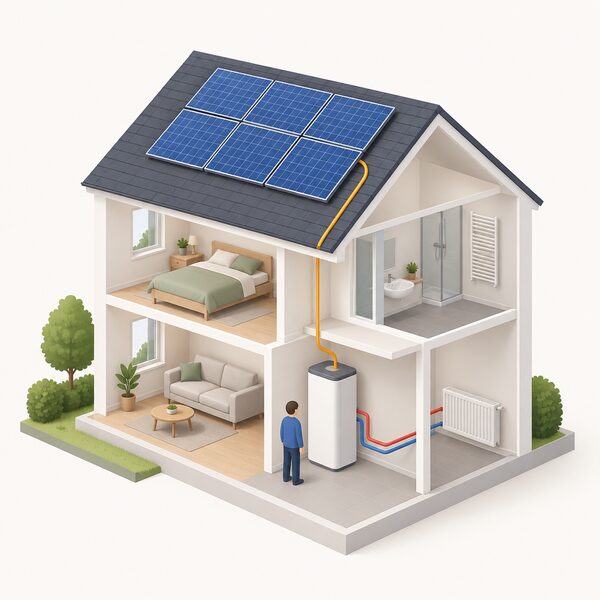
A heat battery shifts a household's heating demand in time. It takes electricity or surplus heat when it is available or cheap and releases it as heat when it is needed. That is a genuine form of independence from the timing of grid prices, and it is the same logic that drives off-peak electric heating more generally.
What it does not do is remove dependence on the grid, a supplier or a fuel. The input still arrives from outside the property in almost every case. Where the input is a household's own solar generation, the independence is greater; where it is a gas boiler's surplus heat, the household remains a gas customer. The technology changes when energy is used, not whether it is bought.
The certification question is the one to watch. MIS 3008 is the standard that will determine how heat batteries are designed and installed, and the £2,500 grant is conditional on it and on legislation7. A household tracking this technology is tracking a standard in pilot and a subsidy in waiting, and the two will arrive together or not at all.
Sources26 cited
- MCS announces pilot for new thermal energy storage systems installation standard, MCS Certified, 2025-09-15
- MCS Heat Load Calculator documentation, MCS Certified, 2026-09-17
- MCS microgeneration certification: where innovation meets sustainability, BSI Group, 2026-09-17
- Warm Homes: Social Housing Fund wave 3 scheme guidance addendum, GOV.UK, 2026-06
- MCS welcomes changes to Boiler Upgrade Scheme, MCS Certified, 2025-11-19
- Microgeneration Certification Scheme: heat pump installations and government schemes, UK Parliament, 2026-09-20
- Carbon Budget and Growth Delivery Plan: heat and buildings investor factsheet, GOV.UK, 2026-06-23
- Electric heating advice, Centre for Sustainable Energy, 2026-06
- No home left behind: how to support lower income homes in the heat transition, Association for Decentralised Energy, 2026-09-20
- Notice of standards: Boiler Upgrade Scheme regulations, approved standards, grant categories and grant levels, GOV.UK, 2026-07-21
- MCS microgeneration certification: where innovation meets sustainability, BSI Group, 2026-09-17
- Warm Homes: Social Housing Fund wave 3 scheme guidance, GOV.UK, 2026-07
- Storing energy, Energy Saving Trust, 2026-07-15
- Heating your home with renewable energy, Which?, 2025-09-22
- Grants and loans, Energy Saving Trust, 2026-02-19
- Boiler Upgrade Scheme: installers, Ofgem, 2026-09-17
- Boiler Upgrade Scheme guidance for installers V5, Ofgem, 2026-04-28
- Heat in buildings: progress report 2025, Scottish Government, 2025-10-02
- Tax on shopping: energy saving products, GOV.UK, 2026-09-17
- Unvented cylinder advantages, Joule UK, 2026-09-17
- Hot water cylinder vs Thermino: which hot water system is right for you?, Sunamp, 2025-09-18
- Low temperature heating, NCM Product Characteristics Database, 2026-09-17
- SAP 10.3 full specification, BRE Group, 2026-01-13
- VAT relief for energy-saving materials, legislation.gov.uk, 2026-09-17
- Domestic RHI: guide to metering, Ofgem, 2026
- NIBE S1156-8 heat pump, Quiet Mark, 2026-09-17
 Installation StandardsWhich rules must an installer follow when fitting a home battery?
 Heat Batteries with Heat PumpsCan a heat battery replace a hot water cylinder if you have no space for one?
 MCS ExplainedMCS is the quality mark for solar panels, heat pumps and other home renewables.
 Policy, Targets and Coming RulesHeat pumps are central to the government's plans for greener home heating.
 Appliance Standards and MarkingWhich marks should a boiler, heat pump or cylinder have before you buy, and what do they actually prove?
 Home Battery Fire SafetyHow likely is a home battery to catch fire, and what keeps it safe if it does?