In this guide
A gas boiler stops in a power cut even though the gas keeps flowing. Gas supplies and meters usually continue to work normally, but most boilers use electricity for pumps, fans and electronic controls, so the burner cannot run1. The same is true of heat pumps, electric storage heaters, broadband and cordless phones: all of them depend on a live electricity supply3.
That is the whole problem in one sentence. Heating in a UK home is a gas or heat pump appliance bolted to an electrical control system, and the electrical side fails first. A backup supply that carries the boiler circuit, or the heat pump's control and pump circuits, is what keeps heat in the house.
Why a boiler stops working in a power cut
The electrical demand of a modern boiler is small but not optional. A pump circulates water, a fan drives the flue, and a control board sequences ignition, modulation and safety checks. Remove the supply and the boiler shuts down, whatever the gas pressure at the meter. Network operators put it plainly: gas boilers and heating, electrical appliances and internet and landline connections will stop working in a power cut3. UK Power Networks' advice is the same, listing the gas boiler, heat pump, broadband and cordless home phone as equipment that will not work without electricity5.
Two things follow. First, the gas network is not the weak point. SGN states that if electricity goes off, gas supplies and meters will usually continue to work normally, and that a boiler may not work because most boilers use electricity2. Second, the failure is not a fault. It is the designed behaviour of an appliance that needs power to be safe.
There is a separate class of boiler shutdown that gets confused with power cuts, and it matters in winter. A condensing boiler produces acidic water that leaves through a condensate pipe, usually routed outside. In cold weather the water in that pipe can freeze, blocking it and causing the boiler to switch itself off9. Which? notes that a boiler that has stopped working in the cold is likely to have frozen condensate pipes, and that if the pipe gets blocked with ice, or anything else, the boiler will automatically shut down as a safety measure10. A boiler can also lock out, meaning the burner has shut itself down due to a fault or suspected fault11.
The distinction matters for a household's independence. A backup supply solves the electrical dependency. It does nothing for a frozen condensate pipe, a locked-out burner or a failed pump, and those are the faults most likely to leave a home cold in the same week as a cut.
What a portable power station is
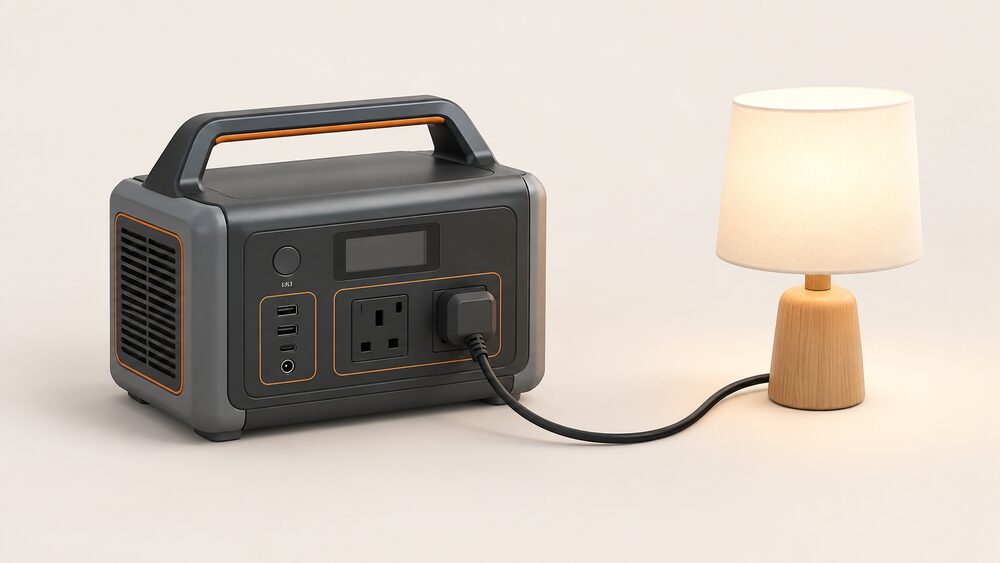
A portable power station is a battery in a box with an inverter, a charge controller and a set of output sockets. It stores direct current energy and delivers mains-shaped alternating current to whatever is plugged into it. It is not a generator: nothing burns, so there is no exhaust, no fuel and no flue.
The nearest familiar comparison is a power bank for a phone, scaled up. Power banks can hold enough power to charge a mobile several times and are worth having to hand4. A power station does the same job for mains appliances, within limits set by its inverter rating and its stored energy.
Two features separate one model from another, and both matter for heating. The first is continuous output, which decides whether an appliance will run at all. The second is surge capability, because anything with a motor or compressor draws a brief spike on start that is higher than its running load. A unit that carries a pump's running load may still trip on start-up.
There is also a control-board question. Boiler and heat pump electronics are sensitive to the shape of the alternating waveform a unit produces, and a modified sine wave output is not the same as the pure sine wave the grid supplies. No waveform specification is published for any named unit, so the safe statement is that waveform compatibility is a question for the equipment maker and the installer, not something to assume.
Can a portable power station keep your heating running?
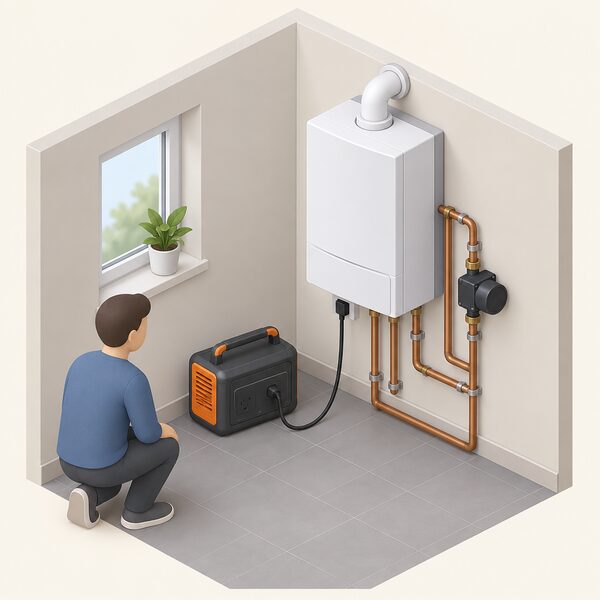
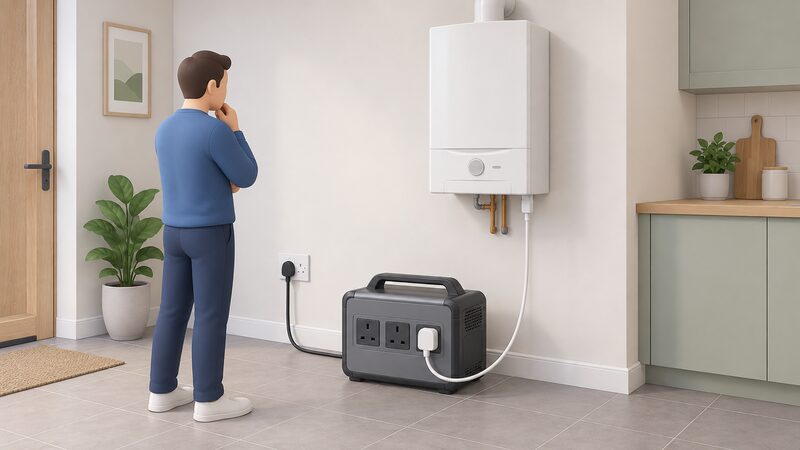
It can run an appliance that is plugged into it. Whether it can run the heating depends on how the heating is wired and how much power it draws.
The clearest case is a gas boiler on a plug-in supply, where the boiler and its pump sit on a single circuit that can be fed from the unit. The load is modest and the runtime is long. The harder cases are heat pumps and electric storage heaters. Citizens Advice states that if you use a heat pump or electric storage heaters, these will not work in a power cut4. NICEIC's guidance is broader: if your home or hot water is heated by a boiler or a heat pump, it will not work unless it is supported by backup power, because these are typically powered by electricity12.
That phrase, "unless it is supported by backup power", is the hinge. It does not say a portable unit will do it. It says the appliance needs a supply, and the supply has to be sized and connected correctly.
For a heat pump the electrical demand is far higher than a boiler's, because the compressor is the heating source rather than a pump circulating hot water from a flame. A portable unit sized for a boiler will not carry a heat pump's compressor, and no figures are published here for heat pump electrical input, so no runtime can be stated. What can be stated is the direction of travel: the larger the electrical heating load, the less a battery unit of any given size will do.
There is a support route that bypasses the sizing problem entirely for some households. SGN states that for customers on the Priority Services Register, including those who are elderly, disabled, chronically sick or have young children or other special needs, portable electric appliances are available for cooking and heating16. That is a network operator's provision, not a purchase, and it is worth knowing before spending money.
Sizing the unit: capacity, output and ports
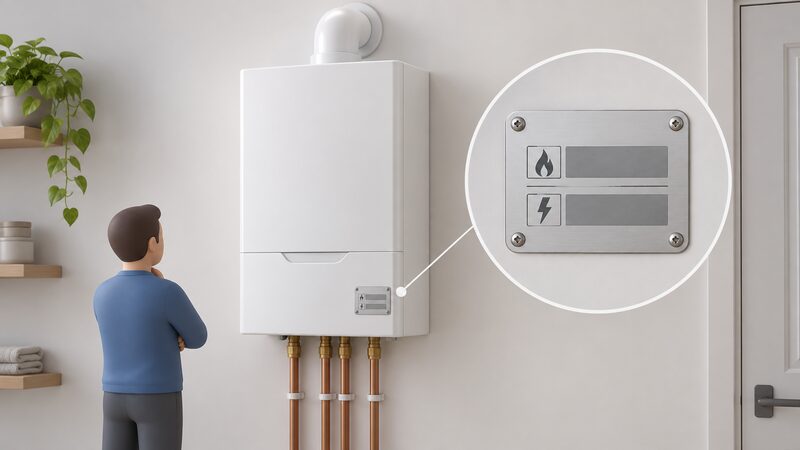
Sizing a backup supply for heating is a two-part sum: what the appliance draws while running, and what it draws in the first second. No wattage figures are published here for boilers, pumps, heat pumps or power stations, so the arithmetic has to be done from the appliance's own rating plate and the unit's own specification.
What is documented is the vocabulary and the sizing logic used elsewhere in heating. Boiler size, in the context of efficiency, is its heat output measured in kilowatts17. That is a thermal figure, not an electrical one, and the two are not interchangeable: a boiler's kilowatt rating describes heat delivered to water, while its electrical draw describes what a backup supply must cover. Confusing them is the most common sizing error.
For a household working out what a unit must carry, the practical questions are:
- Which circuits or appliances must stay on: the boiler and pump, the heating controls, the thermostat, the pump for a heat pump's circulation, or none of these.
- What each of those draws at start-up, not just in steady running.
- Whether the unit's continuous output exceeds the running load and its surge rating exceeds the start-up load.
- Whether the unit's output waveform suits the control board.
- How long the load must run, which sets the stored energy needed.
Heating controls themselves are a small but real load, and they are part of the system. BEAMA's guidance for dwellings with a hot water cylinder describes layouts using a two-port valve control or a three-port valve control, with a programmer, room thermostat and TRVs18. Each of those components needs power. A boiler interlock, which switches the boiler off when the heating and hot water thermostats have reached their set temperatures, is a control function rather than a load, but it depends on the same supply19.
For larger or off-grid properties, the sizing method used for biomass gives a sense of how heating loads are estimated in practice: calculate the volume to be heated in cubic metres and divide it by 34 for a reasonably well-insulated house to get an output in kW20. That is a thermal estimate and does not size a battery, but it shows the shape of the calculation a householder will meet.
Cost: what the backup is protecting
No published price is given here for any portable power station, so no price range can be stated. Prices for these units are quoted by the seller or the installer, and they vary with capacity, output and brand.
What is documented is the cost of the heating system the backup is protecting, which is the comparison that decides whether a backup purchase makes sense. A boiler service averages around £90 to £100, and Checkatrade's figure as of March 2026 is £100 including VAT8. If issues are found during a service, the additional repair bill could average £120 to £7508.
Set against that, the running cost of the alternative matters more than the purchase price. Portable electric heaters cost more to use than fixed heating, and Citizens Advice advises getting a broken heating system fixed as soon as possible so that portable electric heaters are not needed14. Uswitch makes the same point from the other direction: portable electric heaters are designed for small spaces and are not a substitute for an efficient central heating system13.
The energy cost of heating a home is also affected by how the heating is run, not only by what backs it up. According to the Energy Saving Trust, keeping your heating on all the time if you have a boiler will use more energy and cost you more money, and it is more energy efficient to have your boiler or heating come on when you need it21.
Safe to run indoors: no fumes, no ventilation, very quiet
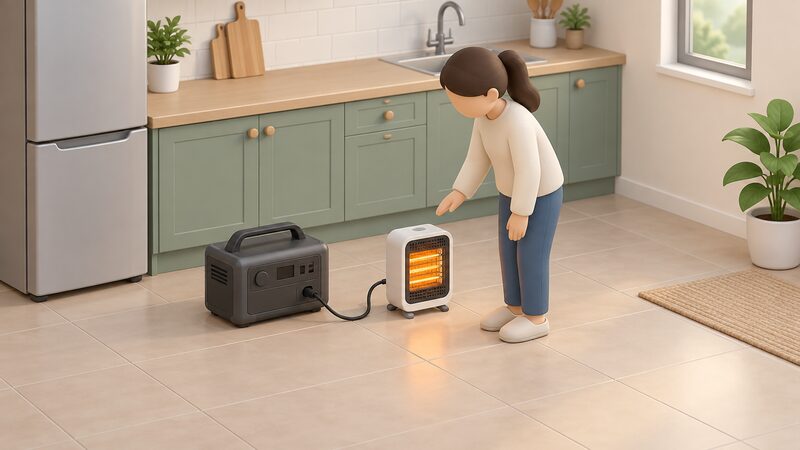
A battery unit has no combustion, so it produces no carbon monoxide and needs no flue. That is a genuine advantage over a petrol or diesel generator, which must never be run indoors. Carbon monoxide is a colourless, odourless gas produced by incomplete combustion, and incorrectly installed home boilers are one of the recognised exposure risks22.
The indoor safety question for a power station is therefore not about fumes. It is about the appliances the unit powers, and about the battery itself.
Portable electric heaters carry explicit rules. Never leave the heater unattended while in use or while you are asleep15. Cooking appliances carry their own: camping stoves should not be used indoors, and the guidance is to head outside to use them to boil water or cook small meals4. A power station makes those appliances possible indoors; it does not make them safe to leave running.
There is a second consideration that applies to any battery. Lithium battery safety, fire risk and recalls are a subject in their own right, and a unit that has been damaged, submerged or swollen is not a unit to keep using.
Recharging during and after an outage: mains, car or solar
Recharging is the constraint that decides whether a backup supply lasts an afternoon or a week. Three routes exist, and each has a condition attached.
Mains recharging depends on the grid returning. In a rota disconnection, different block letters are timetabled to be without power for typically around three hours once or twice a day6. Northern Ireland Networks gives the same figure for planned emergency power cuts7. Power might be switched off or reconnected around 30 minutes before or after the published time depending on nation6. That means a household on a rota usually has long windows between blocks in which to recharge from the mains, provided the unit is plugged in and the supply is genuinely back.
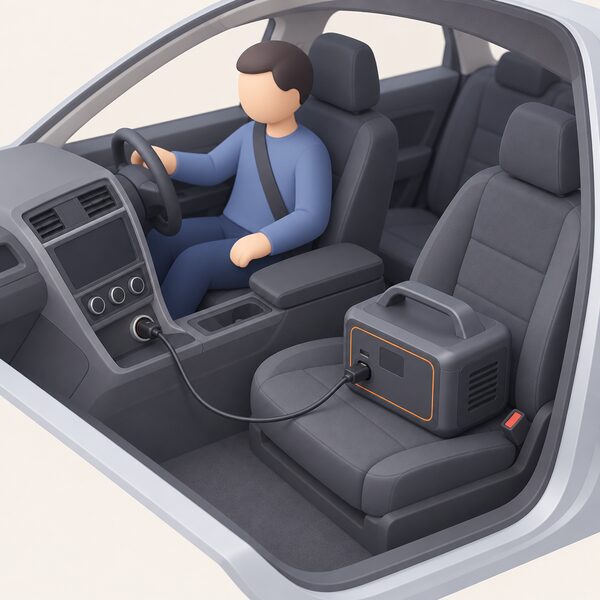
Car charging uses a vehicle's 12 volt socket or its own output, and depends on the unit supporting that input. Solar charging depends on panels, daylight and a charge controller, and it is the only route that does not depend on the grid or a vehicle. Neither route is documented here with figures for this equipment, so no recharge time can be stated.
There is a wider point about what a household can expect from the network in a long outage. Energy Networks Association guidance for care and assisted living providers describes uninterruptible power supplies as providing a few minutes of emergency battery backup if power fails, and notes that where a landline will not work during a power cut, the landline provider might offer a free solution such as a back-up battery unit, for a minimum of one hour, that would enable a call to the emergency services23. Those are short-duration provisions. They are not heating backup.
For households with medical or mobility needs, the same guidance notes that stairlifts often have backup batteries, that the expected battery life should be checked with the manufacturer, and that access to a ground floor exit, a telephone and heating should be ensured for around three hours7.
Home battery systems and storage inverter fault codes
A fixed home battery with a storage inverter is the other route to keeping heating alive, and it behaves differently from a portable unit. Energy Networks Association guidance states that in some cases these storage devices can provide back-up supplies for use in a power cut, but this is not always possible, and the installer should be asked24. That is the honest position: backup capability is a design decision made when the system is specified, not a feature every home battery has.
When a storage inverter does not deliver backup, it usually says so through a fault code. Growatt's support documentation sets out the common ones.
| Code | Meaning | Suggested check |
|---|---|---|
| Error 302, No AC Connection | The machine has no mains connection25 | Check whether the wiring between the mains and the machine is correct, and whether the wiring itself is reliable25 |
| Error 300 / 304, AC V Outrange / AC F Outrange | Mains voltage or frequency outside the rated range25 | Check whether the mains voltage or frequency exceeds the upper limit of the rated range or is lower than the lower limit25 |
| Error 500, BMS COM Fault | Battery-to-battery communication fails25 | Check whether the wiring between the energy storage machine and the battery is normal25 |
| Error 502 / 503, Bat Voltage Low / High | Battery voltage outside the set range25 | Solve the problem by setting the battery voltage range of the energy storage machine25 |
| Error 505, Battery reversed | Positive and negative terminals do not correspond to the terminals marked on the machine25 | Correct the terminal connections25 |
| Error 506, Battery Open | Communication is good in lithium battery mode but the battery is not connected25 | Check the battery connection25 |
| Warning 401 | The electricity meter is not connected25 | Check whether the meter is connected or whether communication between the meter and the machine is normal25 |
| Error 418 | The firmware programmed by the machine does not match25 | Firmware mismatch25 |
Two of these are worth reading closely in a power cut. Error 302 is what a system reports when the mains supply to it has gone, which is exactly what a power cut is. Error 500 is a communication failure between the machine and the battery, and in lithium battery mode the machine needs to communicate with the battery through the network cable25. A system that has lost its battery communication cannot be relied on to deliver backup, whatever its stored energy.
There is a safety dimension to fixed installations that does not apply to a plug-in unit. Consumer units contain residual current devices, which immediately switch off the electricity if they detect a fault and are designed to protect people from electric shocks and earth faults26. Any work to add a backup supply to a boiler circuit interacts with that protection, and it is not a do-it-yourself job.
What this means for a household's energy independence
Heating is the hardest load to make independent, and the reason is structural rather than technical. A gas boiler is a gas appliance with an electrical control system, so it depends on two networks at once. A heat pump depends on one network, electricity, but draws far more of it. Electric storage heaters depend on electricity and will not work in a power cut at all4.
A backup supply removes one dependency: the grid connection at the moment it fails. It does not remove the others. Gas still arrives through a pipe from a supplier. A heat pump still needs a supply large enough to run a compressor. A home battery still needs an installer to have configured backup capability, and a manufacturer's support line if a fault code appears. A portable power station still needs recharging, from the mains, a car or the sun.
The practical position for most households is a hierarchy. Keeping the boiler and its controls alive is achievable with a modest supply, because the electrical load is small. Keeping a heat pump alive is a much larger proposition. Keeping the house warm without either, using stored heat and layered clothing, is what the network operators' own guidance assumes, which is why their advice concentrates on food safety, warmth and communication rather than on powering the heating.

Sources26 cited
- Power cut advice, Powercut105, 2026
- Gas supply updates, SGN, 2026
- Storms and bad weather, Energy Networks Association, 2026
- What to do in a power cut, Which?, 2026
- Make a plan to be winter ready, UK Power Networks, 2026
- Power cuts, SGN, 2026
- Emergency power cuts, Electricity North West, 2026
- How much does a boiler service cost?, Uswitch, 2026
- My boiler isn't working, Northern Gas Networks, 2026
- How to thaw a frozen boiler condensate pipe, Which?, 2026
- Troubleshooting tips, OFTEC, 2026
- How to prepare for and stay safe during a power cut-a-power-cut), NICEIC, 2025
- Energy efficient heaters, Uswitch, 2026
- Make sure your home is energy efficient, Citizens Advice, 2026
- Portable heaters, Electrical Safety First, 2026
- Incident hub, SGN, 2026
- Electric boilers: what you need to know, Which?, 2025
- Part L 2022 heating controls guidance, BEAMA, 2022
- Boiler energy efficiency, Which?, 2025
- Biomass boilers, HIES Scheme, 2026
- Thermostats and heating controls, Energy Saving Trust, 2026
- Carbon monoxide: general information, UK Government, 2022
- Care and assisted living providers, Energy Networks Association, 2026
- Storage, Electricity North West, 2026
- Storage inverter FAQ, Growatt, 2026
- Consumer units and fuse boxes, NICEIC, 2025
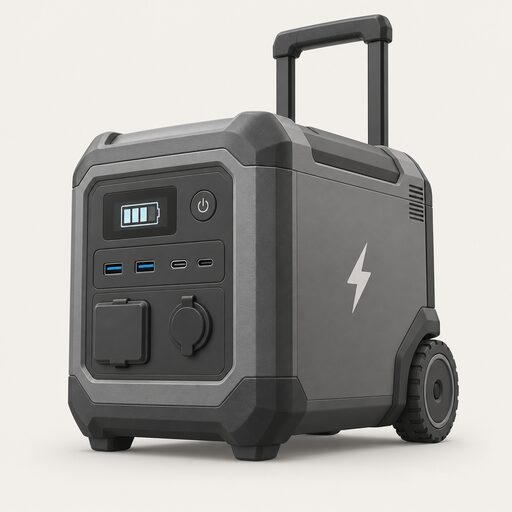 Portable Power StationsWhat can a portable power station actually keep going in a power cut, and for how long?
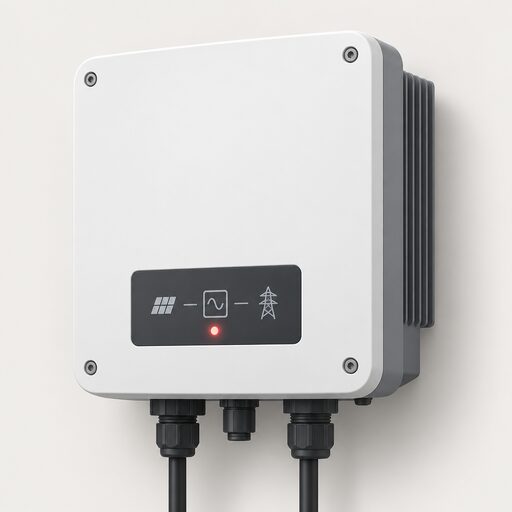 Islanding and Anti-IslandingWhy do solar panels switch off in a power cut, and can you keep the lights on anyway?
 The Full Backup Power GuideHow long do UK power cuts usually last, and what can keep your fridge, heating or phone going until the power comes back?
 Prepare a Home for a Power CutA household checklist for before, during and after an outage: what to keep charged and to hand, which appliances to switch off, how long food stays safe and what to do about medical equipment.
 UPS Sizing ExplainedWhat size uninterruptible power supply do you need, and how long will it keep your devices running in a power cut?
 Portable Generators for HomesWhat can a portable generator actually run in a power cut, and for how long?