
In this answer
Short answer
Sizing an inverter for a battery backup comes down to two numbers: the continuous power your essential loads draw, and the peak they demand for a few seconds when a motor or compressor starts. The inverter must cover the first continuously and the second briefly, and the battery bank behind it must be able to supply the current without its voltage collapsing.
The starting point is a load list. Add up the running watts of everything you want to keep on, then add around 15 to 20 per cent headroom for inverter losses, standby consumption and real-world variation1. Battery capacity in kilowatt hours is total device power in watts multiplied by run time in hours2. For planning, multiply battery energy by about 0.85 to 0.9 to get usable capacity, then divide by average load3.
Victron Energy, the Dutch manufacturer behind much of the UK's off-grid and backup equipment, states a 5 year warranty on its energy storage systems, upgradable to 10 years by an additional 10 per cent of the initial investment4. Its equipment is sold in the UK through specialist suppliers such as Wind & Sun5.
What an inverter does in a battery backup system
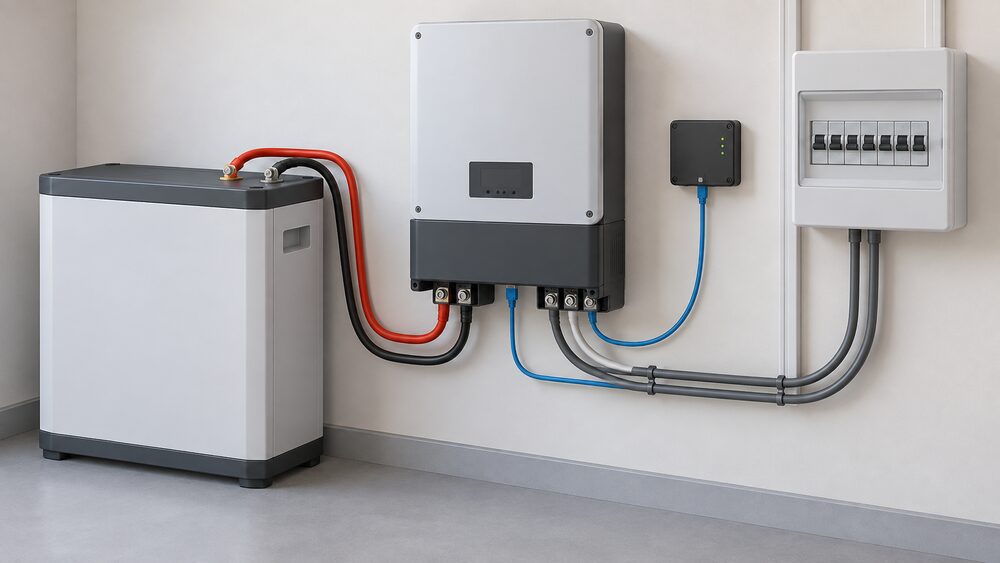
A battery inverter converts battery DC power to AC power for use by loads or the grid, and may also convert AC power to DC to charge the battery8. That dual role is what separates a backup inverter from a simple power supply: it sits between the bank and the house, shaping the current in both directions.
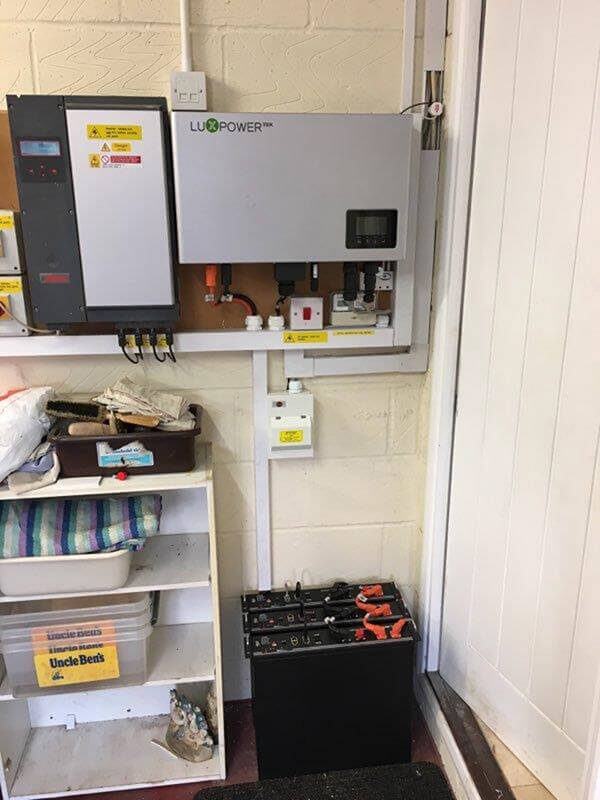
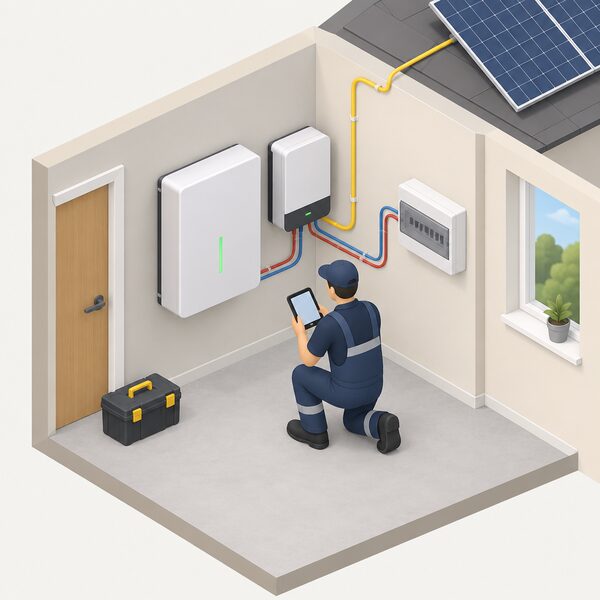
A backup-capable setup typically includes battery storage, a compatible hybrid inverter, control functions for safe off-grid switching, and a design that prioritises critical loads9. Backup design depends on the inverter, transfer equipment, battery capacity, household loads, and how the system is configured10. The inverter is therefore one component in a chain, and its rating has to match the rest of it.
In an energy storage inverter, a battery reserve function manages the battery's state of charge to ensure it remains within the desired range11. That reserve is what stops a backup system draining itself flat on ordinary self-consumption and then having nothing left when the grid fails. Some systems integrate the inverter and battery management in a single unit with backup capability built in12.
For a household, the inverter is the point at which stored DC energy becomes usable mains electricity. It is also the point of dependence: the inverter is a manufactured device with a warranty, a firmware stack and, in many designs, a communications link to a monitoring app or portal. Independence from the grid does not mean independence from the maker.
Sizing the inverter: matching continuous and peak power to your loads
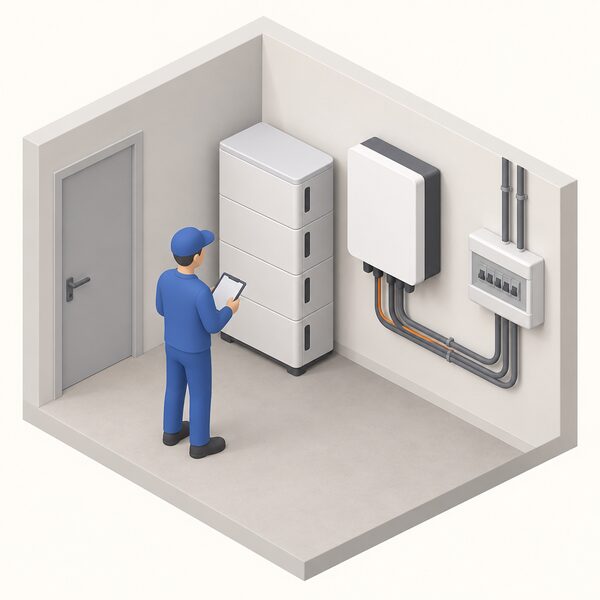
The continuous rating must cover the sum of the loads running at once. The peak rating must cover the surge when a fridge compressor, pump or motor starts. A Full Backup option is stated as covering both smaller single-phase and larger loads like electric cookers or heat pumps9, which shows the range a single inverter may be asked to serve.
Work from a written list. Battery capacity in kilowatt hours equals total device power in watts multiplied by run time in hours2. Add around 15 to 20 per cent headroom for inverter losses, standby consumption and real-world variation1. For planning, multiply battery energy by about 0.85 to 0.9, then divide by average load3. That gives the run time a given bank can support at a given draw.
Battery storage should then be sized with a usable capacity of approximately 1 to 1.5 times the daily PV output13. That rule links the bank to generation rather than to load, and the two approaches need reconciling: a bank sized for overnight self-consumption may be larger or smaller than one sized for a three-day outage.
| Sizing step | Figure | Source |
|---|---|---|
| Headroom for losses and standby | around 15 to 20% | 1 |
| Usable capacity factor | about 0.85 to 0.9 | 3 |
| Battery to daily PV output | 1 to 1.5 times | 13 |
| Capacity formula | total device power (W) × run time (h) | 2 |
AC-coupled battery storage can be scaled by adding multiple energy storage units or microinverters as needed, with battery storage and system output power both growing14. That matters for sizing: a modular design lets the inverter rating and the bank grow together rather than forcing one oversized choice at the outset.
Victron Energy: the Dutch maker behind many UK backup inverters
Victron Energy B.V. is named as the manufacturer on its own declarations and certificates15. The company states over 45 years of experience building backup and off-grid systems7, and separately describes itself as a family run business with over 50 years of experience4. The two figures appear in different documents and are not reconciled here.
Victron offers a wide range of advanced batteries designed for energy storage in both residential and professional applications, providing reliable power for solar, backup, and off-grid systems12. Its VE.Direct inverters use screw terminals for the battery connection and carry a VE.Direct communication port14. The MultiPlus range is described as a powerful true sine wave inverter and a sophisticated battery charger with adaptive charge technology11.
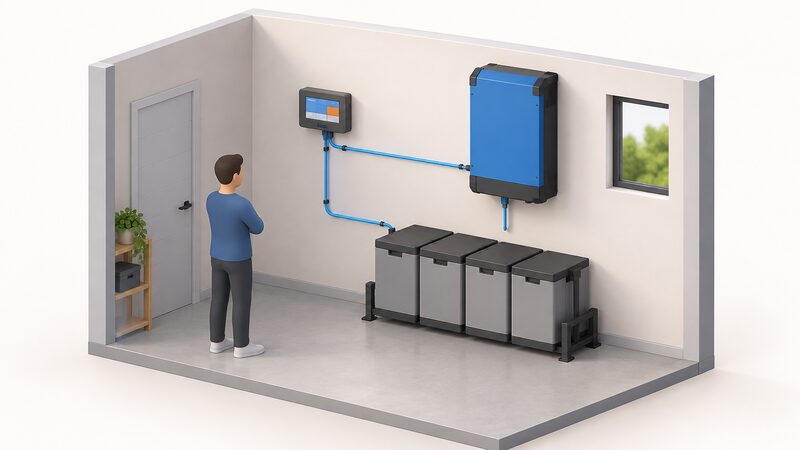
The company's off-grid range supports deep integration with third party managed battery brands via GX devices, and AC-PV inverters via a software assistant7. Managed batteries can be integrated through GX devices in minutes4. AC-PV inverters are supported directly after installing a software assistant, with strong collaboration with Fronius PV inverters4.
For a household, this matters in two directions. A Victron-based system can be assembled from a wide range of batteries and PV equipment rather than a single maker's catalogue, which supports independence from any one supplier. Against that, the system's intelligence sits in Victron's GX devices and firmware, so configuration, updates and fault-finding run through the maker's ecosystem and its dealer network.
Warranty: 5 years standard, upgradable to 10
Victron Energy states a 5 year warranty on its energy storage systems, and that the standard 5 year warranty is upgradable to 10 years by an additional 10 per cent of the initial investment4. The upgrade is a paid extension rather than an automatic entitlement, and the cost is expressed as a proportion of what was spent rather than a fixed sum.
Other warranty terms in the market vary widely, which is useful context when comparing. One hybrid inverter model carries a 5 year warranty with a 10 year option17. Independent guidance states that it is standard for inverters to have warranties for 10 years18, while the Energy Saving Trust says most inverters have warranties of five years as a minimum, which you can often extend by up to 15 years19. A separate installer source describes a 5 year defects guarantee extendable to 10, 15, 20 or 25 years at additional cost20.
Victron's battery ranges carry different terms from its inverters. The VRLA GEL battery range comes with a 2 year world-wide warranty, and the VRLA AGM range is compliant with both CE and UL specifications in ABS fireproof containers21.
"Our standard 5 year warranty is upgradable to 10 years by an additional 10% of the initial investment."
Buying and support in the UK
Victron equipment reaches UK households through distributors and specialist suppliers. Wind & Sun lists the brand within its battery charger collection5, and its Victron ESS package is described as suitable for use with any PV system and as an ideal self-consumption system to add battery storage to new or existing solar PV systems22. Prices for this class of equipment are installer-quoted rather than published as a single retail figure.
Victron Energy states that it offers full technical support in the UK23. That sits behind the dealer and installer network, which handles commissioning, GX configuration and battery integration. For a household, the practical support route is the UK supplier or installer who designed the system.
Three-phase solutions are available for larger properties. Victron and Sigenergy both offer genuine three-phase battery solutions which can be designed and installed for commercial or larger residential properties with a three-phase supply23. Most homes have a single-phase supply, so this applies mainly to larger or commercial premises.
The wider context is a grid-scale storage build-out: UK grid-scale battery storage power capacity reached 7.5 GW by the end of 202524, with a projection of 50 GW by 203525. That is grid infrastructure rather than household equipment, but it shapes the market for cells, inverters and installation labour that home systems draw on.
| Route | What it covers | Source |
|---|---|---|
| Specialist distributor | Equipment supply, brand range | 5 |
| ESS package supplier | Battery storage added to new or existing PV | 22 |
| Manufacturer | Full technical support in the UK | 23 |
| Three-phase installer | Commercial and larger residential properties | 23 |
Integrating batteries and solar PV with a Victron system
Victron systems support PV in parallel, AC-coupled PV, DC-coupled PV or a combination of all these options4. That flexibility is the main argument for the architecture: a household can add generation in the form it already has, rather than replacing it.
Managed batteries can be integrated through GX devices in minutes, and AC-PV inverters are supported directly after installing a software assistant4. The off-grid range extends this to deep integration with third party managed battery brands via GX devices and AC-PV inverters via a software assistant7. The Victron ESS battery storage add-on is stated as suitable for use with any PV system22.
Adding generation later is a normal path. The Energy Saving Trust advises considering battery storage if a solar system does not already have it, to store surplus electricity instead of exporting it26. It also notes that if you have battery storage, you can store excess electricity from wind turbines and solar panels to use later6.
The economics need stating plainly. Adding a battery to a solar panel system can increase bill savings, but often not enough to recover the cost of the battery within its expected lifetime, particularly where households already have access to a good export tariff26. A battery bought for backup resilience is a different proposition from one bought purely to shift cheap units, and the two cases should be assessed separately.
For independence, the picture is mixed. A Victron system with a managed battery and PV can run essential loads through a grid outage and store its own generation, which is real autonomy at the circuit level. What remains is dependence on the inverter's firmware, the GX device, the monitoring platform and the dealer who configured it, plus the battery maker's own management system.
Sources26 cited
- Best battery for solar panel buying guide, BLUETTI UK, 2026
- Backup battery for home guide, Jackery UK, 29 April 2026
- Best generator for home backup power UK, BLUETTI UK, 31 August 2026
- Self-Consumption and Energy Storage brochure, Victron Energy, February 2026
- Battery chargers collection, Wind & Sun, 20 September 2026
- Wind turbines advice, Energy Saving Trust, 20 May 2026
- Off-grid systems, Victron Energy, 2026
- Battery inverter definition, Tigo Energy, 2026
- Backup power function, Fronius, 17 September 2026
- DC-coupled vs AC-coupled vs hybrid storage, Hoymiles, 2 September 2026
- MultiPlus 500VA to 1600VA product page, Victron Energy, 2026
- Victron batteries, Victron Energy, 19 September 2026
- Batteries and 70 per cent self-supply, Spirit Energy, 2026
- VE.Direct inverter datasheet 250VA to 1600VA, Victron Energy, 17 September 2026
- IEC 60335 certificate for MultiPlus-II (GX) 4k5 and 6k5, Victron Energy, 12 November 2025
- UK PSTI statement of compliance, smallBMS NG, Victron Energy, 11 April 2025
- Deye warranty document v1.7, Deye, 17 September 2026
- How to choose a good solar installer, Low Carbon Hub, 20 October 2025
- Solar panels advice, Energy Saving Trust, 27 August 2026
- Solar PV: what to look for, Spirit Energy, 2026
- Gel and AGM batteries, Victron Energy, 19 September 2026
- Victron ESS package, Wind & Sun, 20 September 2026
- Battery storage economics and Victron storage, Spirit Energy, 2026
- Clean Flexibility Roadmap, July 2026 update, GOV.UK, December 2025
- Economic impact of solar and battery storage, Solar Energy UK, 2035
- Buying a house with solar panels, Energy Saving Trust, 13 August 2026
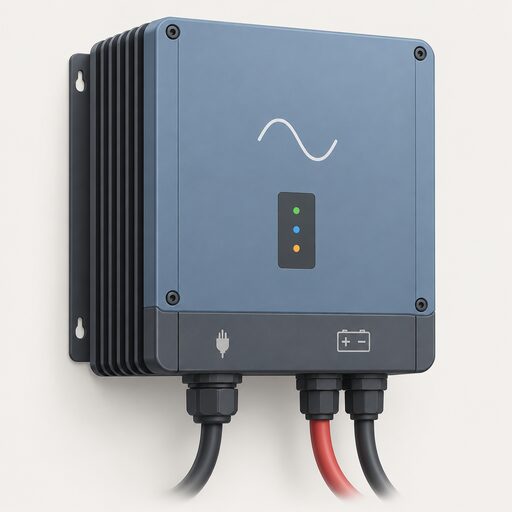 Inverters and Inverter-ChargersIf the power goes off, what actually keeps your fridge and boiler running?
 What Size Battery?How much electricity does your home use in a day, and how much of that falls in the hours when power is cheap or your solar panels are generating?
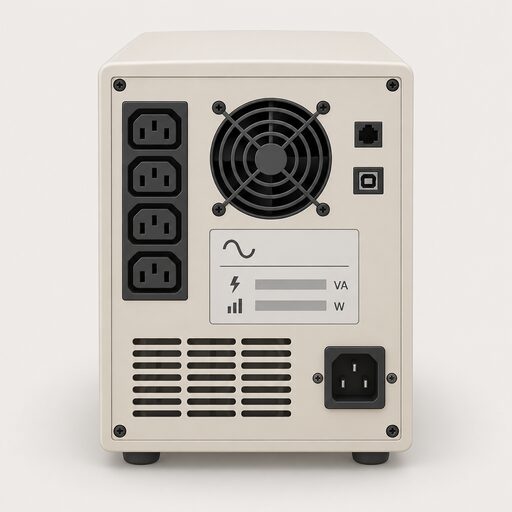 UPS Sizing ExplainedWhat size uninterruptible power supply do you need, and how long will it keep your devices running in a power cut?
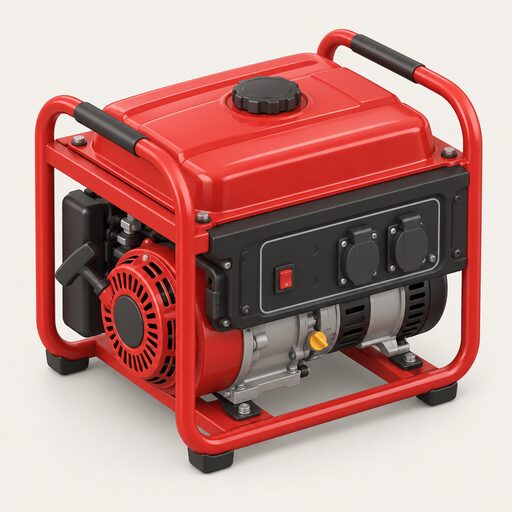 The Full Backup Power GuideHow long do UK power cuts usually last, and what can keep your fridge, heating or phone going until the power comes back?
 Maintaining Backup PowerWill your generator actually start when the power goes off?
 Backup Power and EPSWill your lights stay on when the power goes out?