
In this guide
Victron Energy is a Dutch manufacturer of inverters, inverter/chargers, solar charge controllers, battery management systems and monitoring devices, and it is one of the few brands a UK householder can buy as separate parts and assemble into a battery system rather than as a sealed appliance. The company describes itself as a family run business with over 50 years of experience, and its registered manufacturer address is De Paal 35, 1351 JG Almere, in the Netherlands1.
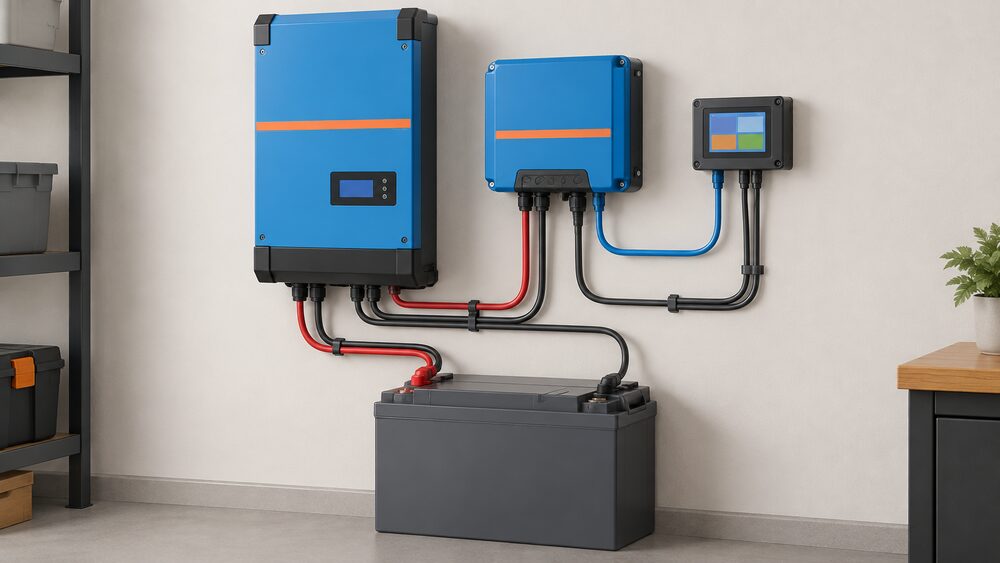
The equipment is not a home battery in the way a Powerwall or a GivEnergy unit is. Victron sells the conversion and control layer: the inverter that turns battery DC into mains AC, the charger that refills the battery, the MPPT controller that harvests solar, and the GX device that ties the parts together. The battery itself is usually bought separately, and Victron states that managed batteries can be integrated through its GX devices in minutes1.
That openness is the point and the complication. A Victron system can be built around third party batteries, third party solar inverters and a choice of grid or off-grid operation, which gives a household far more control over what it owns than a closed system does. It also means the household, or its installer, carries the design decisions. This page sets out what the maker publishes about the range, the prices that exist in the UK, the warranty terms and where the dependencies remain.
A Dutch family-run maker with over 50 years in the business
Victron Energy B.V. is named as the manufacturer on its own declarations and certificates, with the Almere address repeated across safety documentation for the MultiPlus-II, the Quattro and the Blue Smart charger ranges5. The company describes itself as a Dutch company that has been supplying off-grid and on-grid battery storage systems for automotive, marine, industrial and other uses for over 50 years3. One of its own off-grid pages puts the figure at over 45 years, so the two published statements differ by a few years; both describe a long-established business rather than a recent entrant2.
The trading history matters for a household because it speaks to whether spare parts, firmware and technical documentation will still exist in a decade. Victron publishes its certificates, declarations of conformity and compatibility lists openly, including a UK PSTI statement of compliance for its small BMS NG range, which is the kind of document a buyer rarely sees from a consumer battery brand8. The company began in the marine industry and now supplies marine, automotive, telecom, home and industrial applications both on and off grid9.
Its off-grid inverter/chargers are described by the company as having a reputation for technical innovation, reliability and quality9. That is the maker's own characterisation rather than an independent assessment, and it should be read as such. What is verifiable is the breadth of the certification record and the fact that the same inverter families appear across multiple national grid-compliance certificates, which indicates a product line built for many markets rather than one.
What Victron equipment covers: off-grid, backup, marine and home
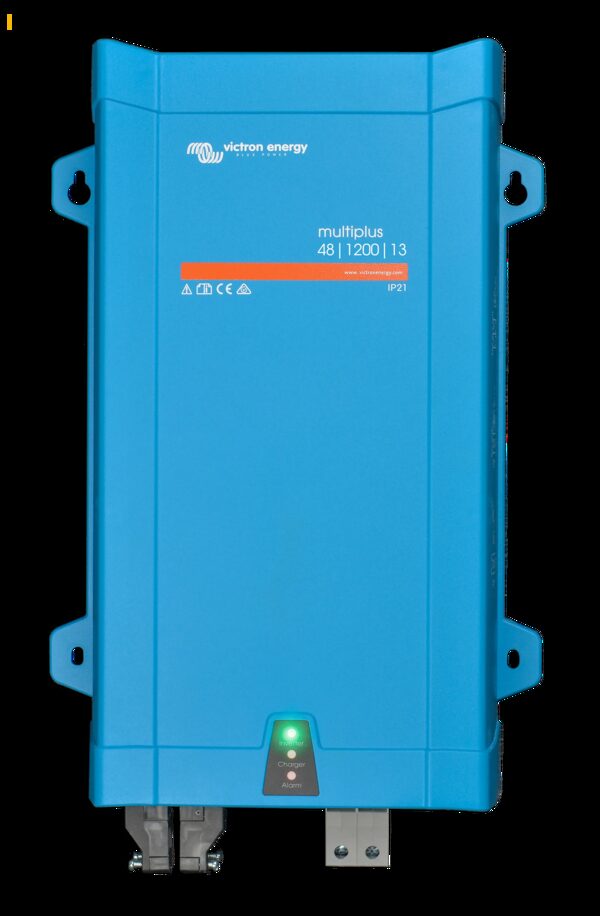
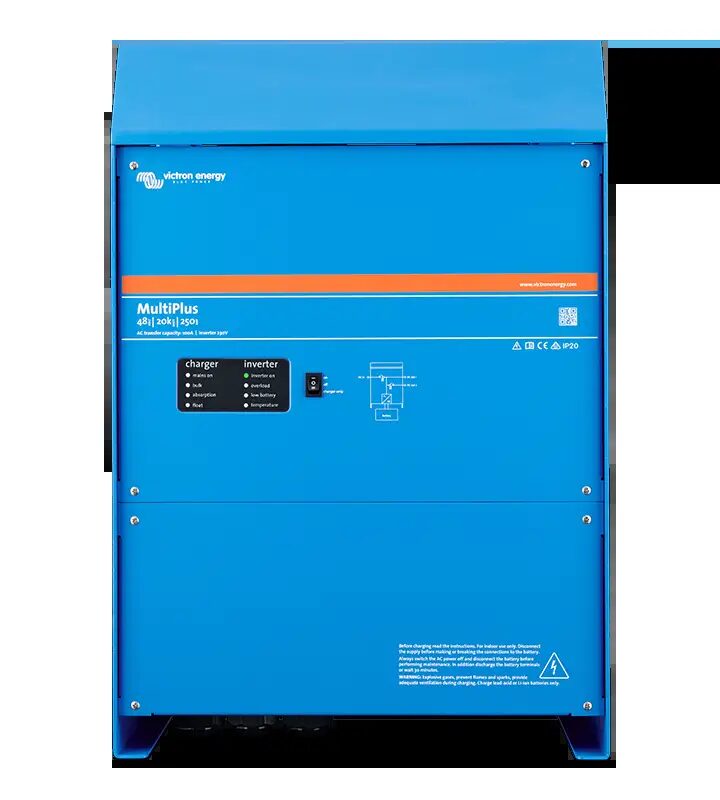
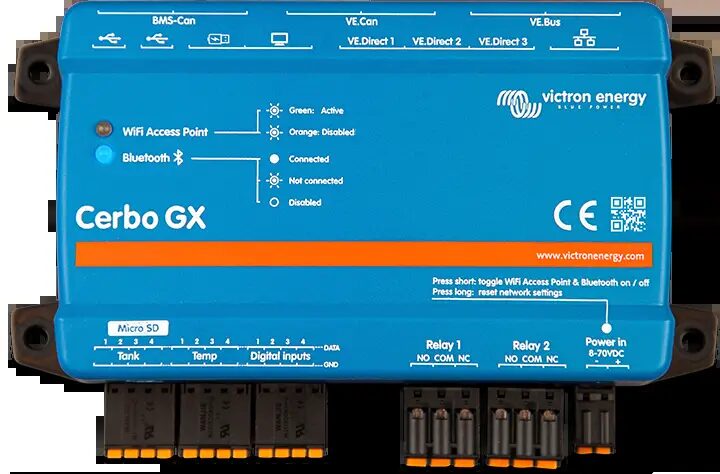
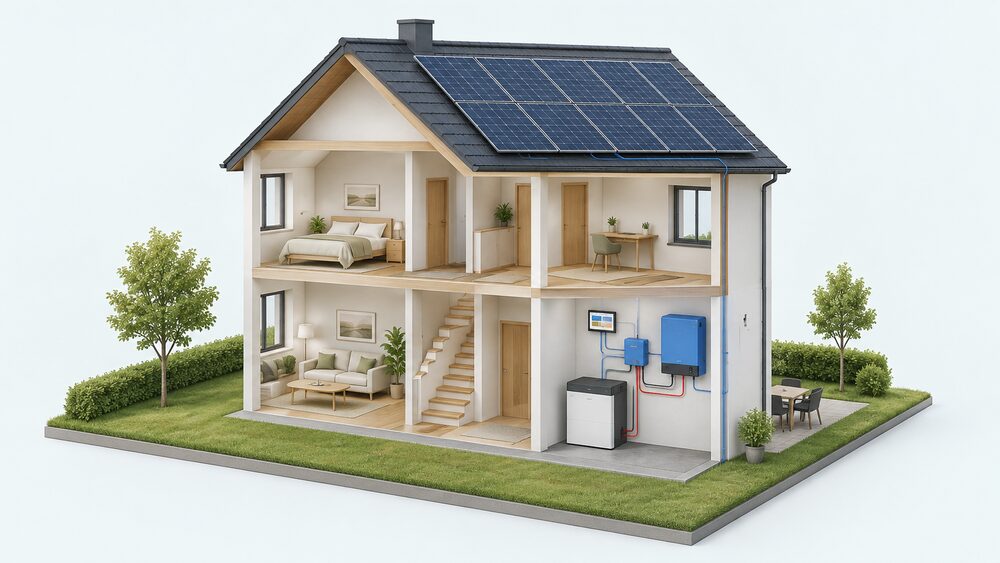
Victron's range spans several distinct jobs. The MultiPlus and MultiPlus-II inverter/chargers are the core of most systems, combining a mains inverter with a battery charger and a transfer switch. The Quattro does the same job with more than one AC input. The SmartSolar MPPT controllers handle solar. The GX devices, including the Cerbo GX, the Ekrano GX and the Cerbo-S GX, provide the monitoring and control layer. The EasySolar-II combines several of these in one enclosure.
The company's own compatibility documentation sets out what a Victron and Pylontech combination can be used for: off-grid, grid backup and energy storage systems for self-consumption10. Its off-grid market page describes system design options covering PV in parallel, AC-coupled PV, DC-coupled PV, or a combination of all of these1. That flexibility is unusual. Most domestic battery systems sold in the UK are AC-coupled or DC-coupled in one fixed way, and the household takes what it is given.
The EasySolar-II 48V 4k5 GX and 6k5 GX integrate a MultiPlus-II inverter/charger, a SmartSolar MPPT solar charge controller and a GX device with a 2 x 16 character display in a single unit11. For a small off-grid building, that removes a good deal of wiring and enclosure work. Victron describes the EasySolar as ideal for small off-grid systems with loads such as lighting, computers, chargers, electronic appliances and small power appliances12.
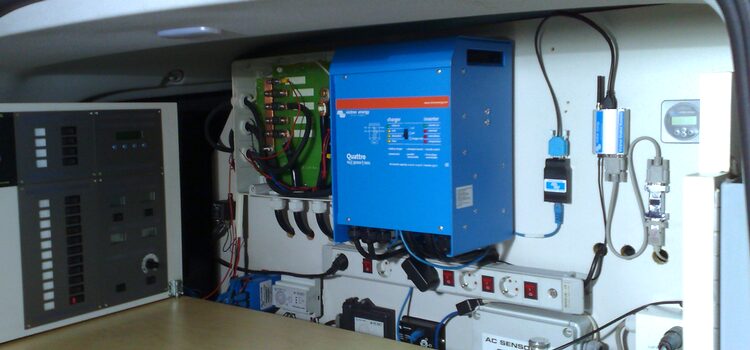
The same equipment appears in marine and vehicle applications, which is where much of the design heritage sits. The VE.Direct inverter range carries ECE R10-4 automotive approval, an IP21 protection category and a remote on/off facility, and the inverters are short circuit proof and protected against overheating13. A household buying Victron for a house is buying equipment that was also built to survive a boat.
Inverters and chargers: MultiPlus-II and what it costs in the UK
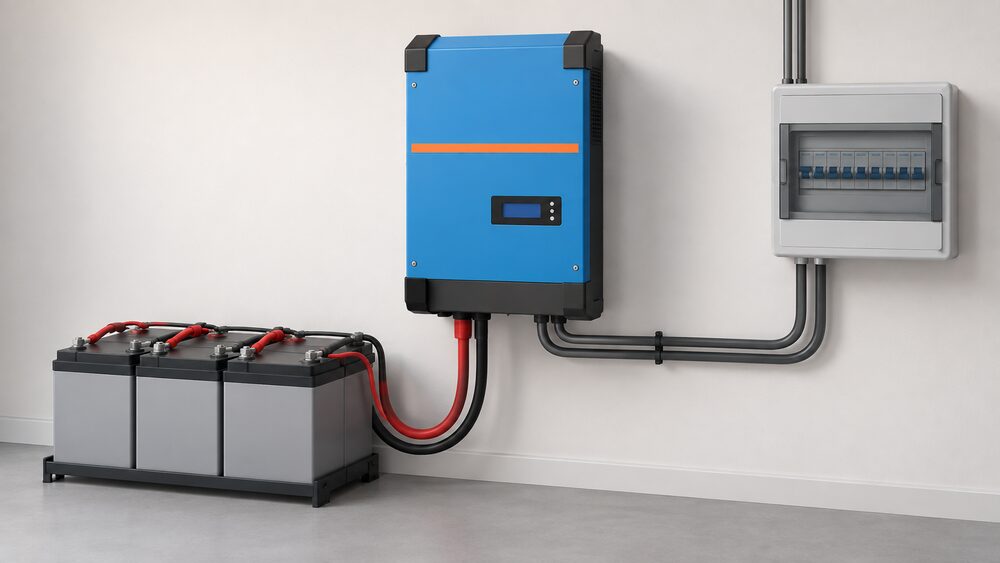
The MultiPlus-II is the model most UK householders will encounter. It is an inverter/charger with a transfer switch, so it can pass grid power through, charge the battery from the grid, and invert battery DC to mains AC when the grid is absent. The MultiPlus 3000VA to 5000VA range is listed as lithium ion battery compatible, with three phase capability and VE.Bus connectivity14.
Prices in the UK come from distributors rather than from Victron, and they are quoted both with and without VAT. The published figures for the MultiPlus-II 48/5000/70-50 and the MultiPlus-II 48/3000/35-32 are £623.20 and £485.60 respectively, both excluding tax4. Those are equipment prices for a single unit, not installed prices, and they exclude the battery, the mounting, the cabling, the protection devices and the labour.
For the MultiPlus-II 24/5000/120-50, one distributor figure is £1,125.90 plus VAT; another figure for the same model is £1,351.08 including VAT15. The two have not been reconciled, and the difference is larger than VAT alone would explain, so both should be read as indicative. A separate listing for a MultiPlus 24/3000/70-50 in its 120V variant gives £1,446.56 including VAT and £1,205.47 excluding VAT15.
| Model | Published price | VAT position | Source |
|---|---|---|---|
| MultiPlus-II 48/5000/70-50 | £623.20 | Excluding tax | 4 |
| MultiPlus-II 48/3000/35-32 | £485.60 | Excluding tax | 4 |
| MultiPlus-II 24/5000/120-50 | £1,125.90 | Plus VAT | 15 |
| MultiPlus-II 24/5000/120-50 | £1,351.08 | Including VAT | 15 |
| MultiPlus 24/3000/70-50 (120V variant) | £1,446.56 | Including VAT | 15 |
SmartSolar MPPT charge controllers: built for off-grid
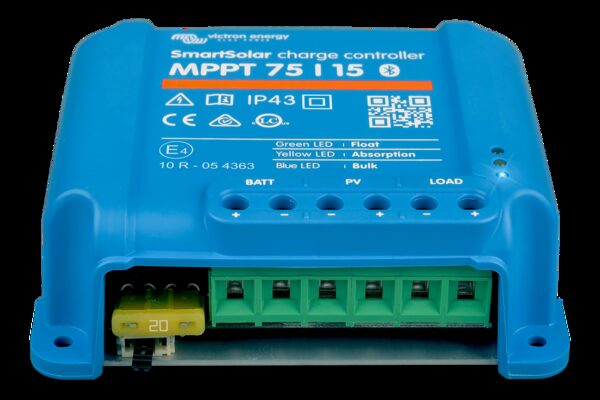
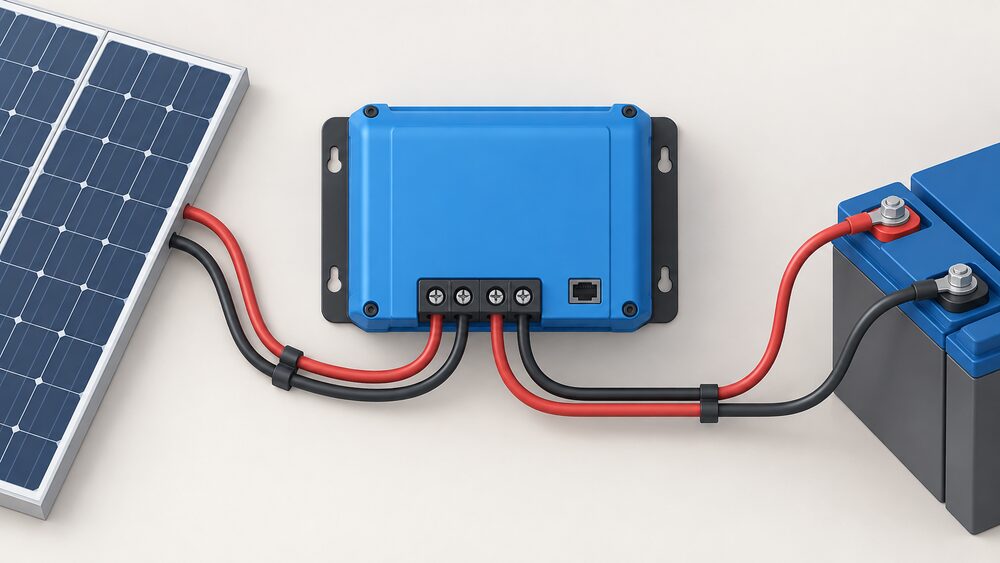
The SmartSolar range is Victron's solar charge controller line, described by the company as maximum power point tracking solar charger controllers9. The range runs from the small 75/10, 75/15, 100/15 and 100/20 units through the 100/30 and 100/50, up to the 150/35 and 150/45, the 150/60 to 250/70 models and the 150/70 to 250/100 VE.Can units16. The naming convention gives the maximum PV voltage first and the maximum charge current second. All of these models are listed as off-grid products, and the larger VE.Can units add a remote on/off two pole connector18.
The applications listed for these controllers are marine, off-grid systems, recreational vehicles and hybrid generators16. UK distributor listings classify the SmartSolar controllers as off-grid equipment, including the 100/30, the 150/35, the 150/45 and the 150/70 to 250/100 VE.Can models19. That classification is worth noting: these are controllers for systems that either have no grid connection or treat the grid as a backup, not for a standard grid-tied domestic solar installation where the panels connect to a string inverter.
The larger VE.Can models add a remote on/off facility on a two pole connector, which allows the controller to be switched from a signal rather than by hand19. The 100/30 uses screw terminals for its connections21. The SmartSolar 75/10, 75/15, 100/15 and 100/20 models report a 30-day performance history through the VictronConnect app, which connects to the system and delivers real-time data17.
The VE.Direct port on these controllers connects to a communication centre for access to VRM, Victron's remote management portal16. That is the route by which a solar array's output becomes visible alongside the rest of the system rather than sitting on its own.
Battery integration: managed batteries connect through GX devices
The integration story is the strongest part of the Victron proposition and the part most likely to matter to a householder who already owns a battery or wants to choose one. Victron states that managed batteries can be integrated through its GX devices in minutes, and that it has deep integration with third party managed battery brands1. AC-PV inverters are supported directly after installing a software assistant on the inverters, and the company notes a strong collaboration with Fronius PV inverters1.
The compatibility list confirms that all Multi, MultiPlus, MultiGrid and Quattro models are compatible when the appropriate model is used for the nominal battery voltage, and that a GX device is required, for example a Cerbo GX or a Venus GX10. That is a clear statement of the minimum architecture: an inverter/charger, a battery, and a communication centre.
Victron's own battery range is described as designed for energy storage in residential and professional applications, providing reliable power for solar, backup and off-grid systems22. The Lithium NG batteries can be connected in series, parallel, or a combination of both, and up to 25 batteries can be used in 48V battery banks23. The Lynx Smart BMS NG is designed specifically for those batteries and is compatible with Victron GX devices such as the Cerbo GX and with the VRM portal for real-time monitoring24. The VE.Bus BMS NG interfaces with and protects Victron Lithium NG batteries in systems that include a VE.Bus inverter/charger or VE.Bus inverter23.
Third-party batteries and AC-PV: how deep the integration goes
The depth of third party support is what separates Victron from most domestic battery brands. A household is not tied to one battery maker, and the inverter does not become obsolete when the battery does. The compatibility documentation covers managed lithium batteries, Victron connected products, solar irradiance and wind meters, auto start/stop generator control, marine multifunction displays, and resistive tank level and temperature inputs on the Ekrano GX25.
The Ekrano GX uses a quad-core processor to manage all connected Victron products and a large range of supported third party devices25. That processing capacity is what allows one device to coordinate solar, battery, generator and load rather than simply displaying them.
The EV Charging Station extends the same logic to vehicle charging. It can be fully integrated with and remotely controlled via a Victron Energy GX Device and VRM, and where solar sits within the Victron ecosystem it can be set up to allow excess energy from the sun to charge the vehicle directly26. That is a genuine energy independence feature: the car becomes a destination for surplus generation rather than a load drawn from the grid.
The ESS battery storage add-on is listed as suitable for use with any PV system, which is the clearest statement of the AC-coupled route4. A household with an existing solar installation and a feed-in or export arrangement can add Victron storage without replacing the panels or the existing inverter.
"Managed batteries can be integrated through our GX devices in minutes."
Warranty: 5 years standard, upgradable to 10 for an extra 10%
Victron's standard warranty is 5 years, and the company states that it is upgradable to 10 years by an additional 10% of the initial investment2. That is a paid extension priced as a percentage of what the household spends, so the cash cost scales with the size of the system rather than being a flat fee. Individual product pages confirm the 5 year term: the MultiPlus 3000VA to 5000VA range, the SmartSolar MPPT 150/35 and 150/45, and the SmartSolar MPPT 100/30 all list 5 years20.
The structure is different from the domestic battery warranties UK householders are used to, which typically guarantee a retained percentage of capacity over a number of years or a throughput in megawatt hours. Victron's published term is a period warranty on the equipment, with the extension bought rather than earned. A household comparing a Victron system against an all-in-one battery should compare the two warranty structures directly rather than the headline years alone; home battery warranties sets out how retained capacity and throughput terms work.
The 10 year extension is worth understanding as a commercial decision. Ten percent of the initial investment on a system costing several thousand pounds is a material sum, and it buys a longer period on the electronics rather than on the battery cells, which are usually a different manufacturer's product with their own terms. The battery warranty and the inverter warranty are separate documents.
UK availability and support: where to buy and what help you get
Victron is sold in the UK through specialist distributors rather than a single national retailer. Wind & Sun lists the EasySolar inverter/chargers with solar charge controller, the MultiPlus inverter/chargers in 3000VA and 5000VA sizes, the SmartSolar MPPT controllers across several current ratings, and the Ekrano GX, with downloads and documents available alongside the products19. Victron is described as offering full technical support in the UK3.
Installation is a separate matter from supply. Spirit Energy states that Victron and Sigenergy both offer genuine three-phase battery solutions, which it can design and install for commercial or larger residential properties with a three-phase supply28. That is a useful marker of where Victron systems sit in the UK market: they are common in three-phase properties and larger installations, where a single-phase domestic battery cannot provide backup across all three phases. Victron's own guidance notes that its systems are very good for three phase 400V grid connections, allowing back-up on all three phases, which is not within the capability of some competing products3.
For a household, the practical position is that a Victron system is specified rather than bought off a shelf. The parts are available, the documentation is public, and the technical support exists, but the design work falls to an installer or to the householder. Off-grid battery systems covers the wider design questions for properties with no mains connection, and battery backup power and EPS explains what keeps running during an outage.
Where the dependencies remain
A Victron system reduces dependence on a single manufacturer more than most home batteries do, because the battery, the inverter and the solar can come from different makers and be replaced independently. That is a real gain for a household that wants to own equipment it can maintain and extend.
The dependencies that remain are specific. The system still needs a battery, and if that battery is a managed lithium unit, its integration runs through a Victron GX device, so the communication layer is a single point that matters. Remote monitoring and control run through VRM, Victron's remote management portal, which means a broadband connection and the manufacturer's servers for anything done away from the property16. Local control at the device continues without that link, but the remote functions do not.
A grid-connected Victron system remains connected to the grid and to a supplier for the periods when the battery is empty and the solar is not producing. Off-grid operation removes that, at the cost of sizing the battery and the array for the worst week of the year rather than the average day. And the equipment itself is made by one company in the Netherlands, so the household depends on that company continuing to exist and to publish firmware, which its 50 year history and open documentation record make a reasonable but not guaranteed prospect1.
Sources28 cited
- Self-Consumption and Energy Storage Brochure, Victron Energy, 2026-02
- Off-Grid Market Page, Victron Energy, 2026
- Victron Storage Economics, Spirit Energy, 2026
- Victron ESS Package, Wind & Sun, 2026-09-20
- IEC 60335 Certificate, MultiPlus-II (GX) 4k5 and 6k5, Victron Energy
- IEC 62109 Certificate, Quattro 48V 5kVA to 10kVA, Victron Energy
- IEC 62477 Certificate, MultiPlus-II 48V 8kVA to 15kVA, Victron Energy
- UK PSTI Statement of Compliance, smallBMS NG, Victron Energy
- Victron Energy Distributor Page, Wind & Sun, 2026-09-20
- Pylontech Battery Compatibility, Victron Energy, 2026-09-17
- EasySolar-II 48V 4k5 and 6k5 GX Datasheet, Victron Energy, 2026-09-17
- Victron EasySolar Inverter/Chargers, Wind & Sun, 2026-09-20
- VE.Direct Inverter Datasheet 250VA to 1600VA, Victron Energy, 2026-09-17
- MultiPlus Inverter/Charger 3000VA to 5000VA, Wind & Sun, 2026-09-20
- Victron MultiPlus 24/3000/70-50 Inverter Charger, Orion Air Sales, 2026-09-17
- SmartSolar MPPT 100/30 and 100/50, Victron Energy, 2026-09-19
- SmartSolar MPPT 75/10, 75/15, 100/15 and 100/20, Victron Energy, 2026-09-19
- SmartSolar MPPT 250/85 and 250/100, Victron Energy, 2026-09-19
- SmartSolar MPPT 150/70 up to 250/100 VE.Can, Wind & Sun, 2026-09-20
- SmartSolar MPPT 150/35 and 150/45, Wind & Sun, 2026-09-20
- SmartSolar MPPT 100/30 and 100/50, Wind & Sun, 2026-09-20
- Victron Energy Batteries, Victron Energy, 2026-09-19
- VE.Bus BMS NG Datasheet, Victron Energy, 2026-09-17
- Lynx Smart BMS NG, Victron Energy, 2026-09-19
- Ekrano GX, Victron Energy, 2026-09-19
- EV Charging Station, Victron Energy, 2026-09-19
- Victron Ekrano GX, Wind & Sun, 2026-09-20
- Grid Backup Guidance, Spirit Energy, 2026
 Victron MultiPlus-II inverter-chargerThinking about a Victron MultiPlus-II for home backup?
 Victron EnergyCan you check your home battery and solar from your phone, and does it work if the internet goes down?
 Victron Energy Solar Charge Controllers and Off-Grid EquipmentWhich Victron controller suits your panels and battery when you put solar on a boat, cabin or off-grid home?