
In this comparison
A household weighing up Victron against Outback for an inverter charger is usually trying to answer one question: which of the two can be bought, supported and repaired in the UK, and what does the warranty actually cover. On the evidence available, the comparison is lopsided. Victron Energy is a Dutch family run business with over 50 years of experience in energy storage and self-consumption systems, and it states that it offers full technical support in the UK1. Its standard warranty is 5 years, upgradable to 10 years by an additional 10% of the initial investment1.
Outback Power appears in the site's own brand coverage as a maker of inverters for off-grid and backup systems, but the technical and commercial detail needed to set the two side by side, model ranges, warranty terms, UK stock and support arrangements, is not present in the sources behind this page. That gap is itself the finding, and it is stated plainly below rather than filled with assumption.
What the comparison covers, and what the evidence shows
This page compares two names a UK household is likely to meet when specifying an off-grid or backup inverter charger: Victron Energy and Outback Power. The comparison covers company background, warranty, how each integrates batteries and solar, UK availability and support, and the markets each serves. It does not cover price, because no published price exists for either brand's inverter chargers in the material behind this page, and inverter charger prices are installer quoted.
The evidence base is uneven, and that shapes the page. Victron publishes extensively: product pages, datasheets, compatibility lists, certificates and manuals, many dated through 2026. Outback Power is represented here only by a brand page describing it as a maker of inverters for off-grid and backup systems. There is no Outback warranty term, no model specification, no UK stock position and no support statement in the sources. A reader comparing the two should treat the Victron sections as documented and the Outback position as an open question to put to a supplier.
What the Victron material does show is a maker that treats integration as the product. Managed batteries can be integrated through its GX devices in minutes, and AC-PV inverters are supported directly after installing a software assistant on its inverters2. That is the substance of the comparison for most households: not the inverter alone, but whether the inverter charger will talk to the battery, the solar and the monitoring a home already has or plans to add.
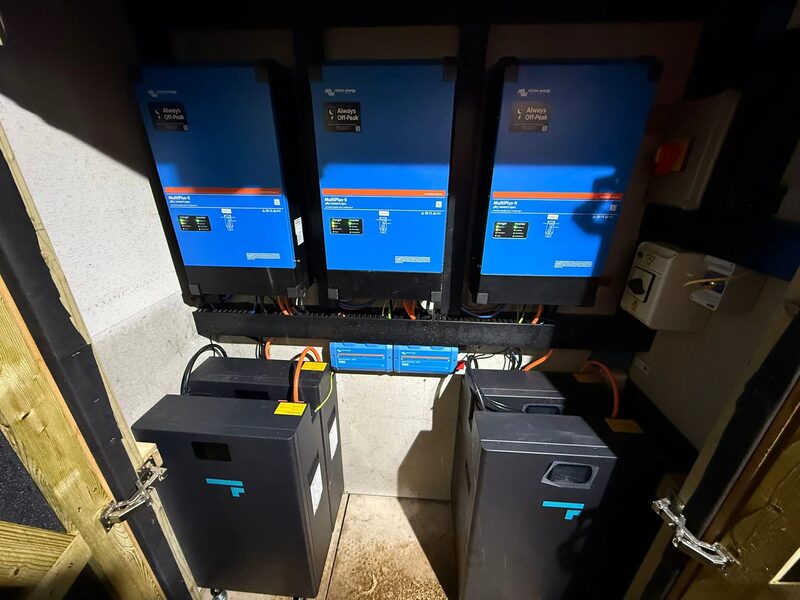
Victron Energy: a Dutch family run maker with over 50 years of experience
Victron Energy is a Dutch company, based in the Netherlands with representatives all over the world1. It describes itself as a family run business with over 50 years of experience, and says that experience is what it takes to build reliable energy storage and self-consumption systems2. One of its own off-grid pages gives the figure as over 45 years of experience in building backup and off-grid systems1. The two maker statements do not agree exactly, and both are the company's own account rather than an independent one, so the honest reading is that Victron has been trading for several decades, with the precise figure stated differently in different documents.
The company began in the marine industry and now offers products for marine, automotive, telecom, home and industrial applications, both on and off grid4. That spread matters to a household buyer for a practical reason: a maker selling into marine and telecom markets builds for vibration, salt air and unattended operation, and the same inverter charger families are then sold into home backup. Victron off-grid inverter chargers have a reputation for technical innovation, reliability and quality, according to the UK distributor that carries them5.
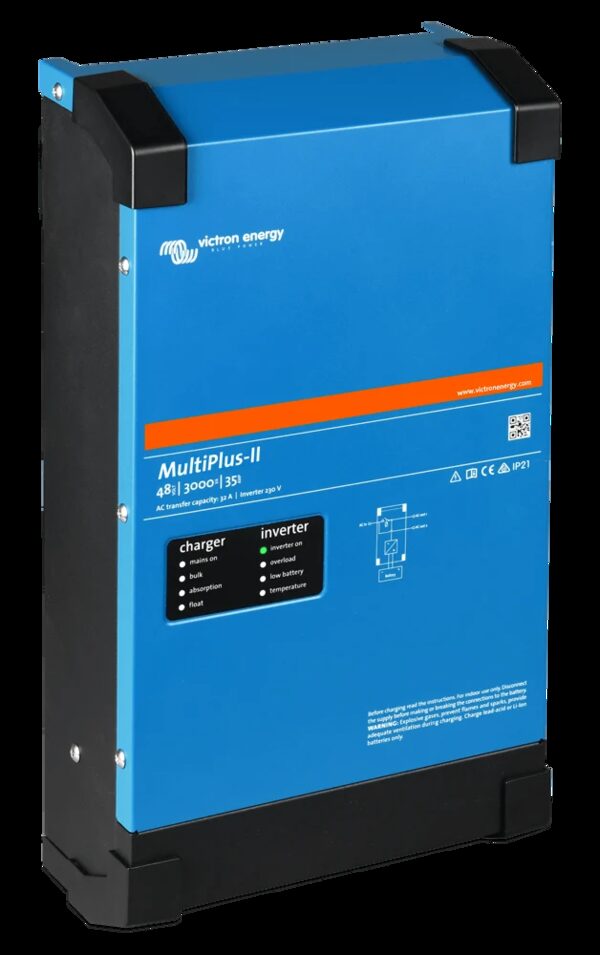
The product families a household will meet are the MultiPlus-II, described as a multifunctional inverter charger suited to professional marine, yachting, vehicle and land based off-grid applications, and the Quattro, a combined inverter and charger with a true sine wave inverter, adaptive charging and hybrid PowerAssist technology6. The Phoenix inverter range covers 3000VA to 5000VA in 12V, 24V and 48V versions8. The MultiPlus-II models covered by the maker's IEC 60335 certificate are declared by Victron Energy B.V.9.
Warranty: 5 years standard, upgradable to 10
Victron's standard warranty is 5 years, and the maker states that it is upgradable to 10 years by an additional 10% of the initial investment1. That is a paid extension priced as a percentage of what the system costs, so on a larger installation the upgrade costs more in cash than on a small one. It is a maker term, not a statutory minimum, and it is worth reading alongside the wider market: independent guidance on choosing a solar installer notes that it is standard for inverters to have warranties for 10 years3. On that benchmark, Victron's standard term is shorter than the market norm and the paid upgrade brings it into line.
The 5 year term is consistent across the Victron range in the UK listings. It appears on the SmartSolar charge controllers, the MPPT Control, the Phoenix Smart IP43 chargers, the Phoenix Smart inverters, the Skylla-TG battery chargers, the Blue Smart IP22 chargers and the VE.Can MPPT range10. A household specifying a whole system should expect the same term on each box rather than a longer one on the inverter and a shorter one elsewhere.
What the warranty does not do is remove the dependence on the supply chain. A warranty is only as useful as the route to a claim, which runs through the seller or installer who supplied the equipment. That is the same for any brand, and it is why the UK support position below matters as much as the term itself.
Battery and AC-PV integration through GX devices
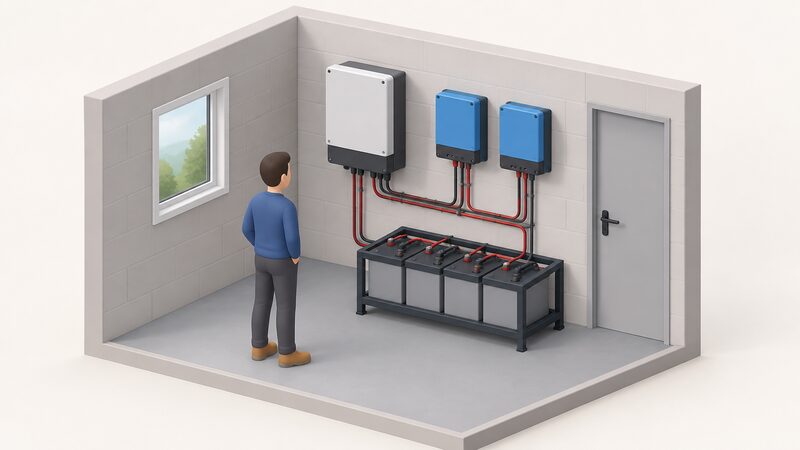
This is where Victron's design differs from a plain inverter charger. Managed batteries can be integrated through its GX devices in minutes, and AC-PV inverters are supported directly after installing a software assistant on the inverters, with strong collaboration with Fronius PV inverters2. In practice the GX device is the hub: it reads the battery management system, controls the inverter charger and presents the system to the household.
The EasySolar-II GX shows the approach in one box. It combines an MPPT solar charge controller, an inverter charger and a control hub with a display in one enclosure, and the 48V 4k5 and 6k5 versions integrate a MultiPlus-II inverter charger, a SmartSolar MPPT-Tr solar charge controller and a GX device with a 2 x 16 character display3. AC input and output connect through screw terminal blocks12. For a household that wants fewer separate boxes on the wall, that is the relevant model.
Compatibility is documented rather than assumed. All Multi, MultiPlus, MultiGrid and Quattro units are compatible with the listed managed batteries when the appropriate model is used for the nominal battery voltage, and all VE.Direct BlueSolar and SmartSolar MPPT chargers are compatible7. Old model VE.Can MPPTs from before 2019 are not supported7. The VE.Bus BMS V2 can disable VE.Direct and VE.Can solar chargers via a GX device, and allows control of the VE.Bus inverter charger from multiple devices including a Digital Multi Control, a VE.Bus Smart dongle or a GX device13.
| Component | Role in the system | Source |
|---|---|---|
| GX device | Integrates managed batteries and hosts the software assistant for AC-PV | 2 |
| EasySolar-II GX 48V 4k5 and 6k5 | MultiPlus-II inverter charger, SmartSolar MPPT-Tr controller and GX device in one enclosure | 3 |
| VE.Bus BMS V2 | Disables VE.Direct and VE.Can solar chargers via a GX device | 13 |
| Multi, MultiPlus, MultiGrid, Quattro | Compatible with listed managed batteries at the right nominal voltage | 7 |
| VE.Direct BlueSolar and SmartSolar MPPT | Compatible with the listed managed batteries | 7 |
UK availability and technical support
Victron states that it offers full technical support in the UK1. That is a maker statement, and it sits behind the distribution chain: the first call for a fault is normally the seller or installer, with the maker's support behind them. The maker's documentation is public and dated, including certificates for the MultiPlus-II range issued in 2025 and 2026, which is useful when an installer or a network operator asks for evidence of conformity9.
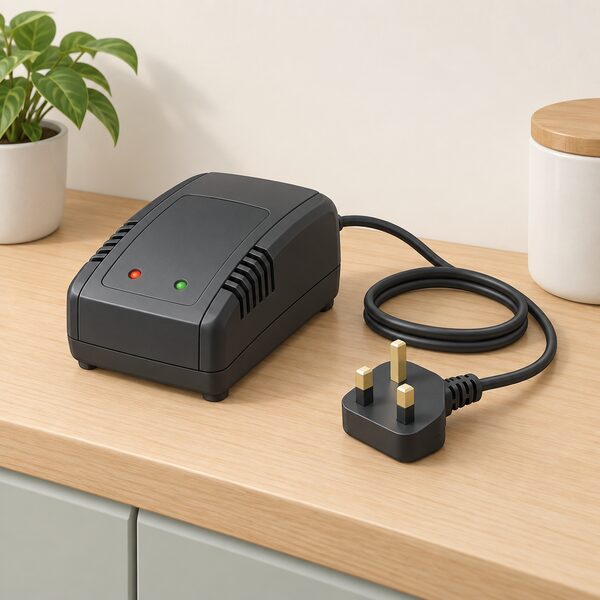
On availability, Victron equipment reaches UK households through specialist distributors and retailers. Wind & Sun lists Victron battery chargers, with the Blue Power IP22 charger from £103.81 and the Skylla-TG battery chargers from £508.8618. The Blue Smart IP22 charger is listed at £139.99 and comes with a UK plug20. Stock is not static: the Blue Smart IP65 Charger 12/5 230V shows as sold out on the same listings19. A household should treat availability as checked at the point of order.
Prices for inverter chargers themselves are not published in the material behind this page, so they are installer quoted. Where a distributor does publish a figure, it is a retail price for a charger or accessory rather than for an inverter charger, and it carries the VAT position stated on the listing.
Markets served: on-grid and off-grid, marine to home
Victron sells into marine, automotive, telecom, home and industrial applications, both on and off grid4. The split shows in the product listings. The SmartSolar charge controllers, the MPPT 100/30, the MPPT 150/35 and 150/45, the VE.Can MPPT range, the Phoenix Smart inverters, the Orion DC-DC converters and the Orion-Tr isolated converters are all listed as off grid10. The Phoenix Smart IP43 charger is listed as both on grid and off grid24. That mix is what allows one maker's kit to serve a boat, a remote off-grid property and a grid-connected home with battery storage.
The batteries follow the same pattern: Victron offers a range of advanced batteries designed for energy storage in residential and professional applications, providing reliable power for solar, backup and off-grid systems8. For a household, the practical consequence is that the same control and monitoring layer, VE.Direct and Bluetooth, runs across the range. The VE.Direct communication port appears on the VE.Direct inverters and on the SmartSolar controllers, and the Phoenix Smart inverters list Bluetooth and VE.Direct connectivity10. The MPPT Control works with all Victron MPPT charge controllers that use a VE.Direct communications port27.
The dependence that remains is worth stating. An off-grid inverter charger removes the reliance on a mains supply only to the extent the battery and the solar can carry the load; off-grid inverters depend on solar panels or battery storage alone, need battery management for operation, and need maintenance28. A Victron system in a grid-connected home still draws from the grid when the battery is low, and still depends on the maker for firmware, compatibility lists and spares. Independence here is a matter of degree, not a switch.
Where the comparison is thin: Outback in the available sources
The honest position is that this is not a like-for-like comparison on the evidence available. Outback Power is covered on this site as a maker of inverters for off-grid and backup systems, and that is the extent of what can be said from the sources behind this page. There is no Outback warranty term, no model specification, no UK stock listing and no support statement to set against Victron's 5 year term, its GX integration or its stated UK technical support1.
That does not mean Outback is unsuitable. It means a household cannot complete the comparison from published material alone, and should put specific questions to a supplier: the warranty term and who administers it, which managed batteries are supported, whether AC-coupled solar is accepted, what UK spares and support exist, and what the lead time is. Those are the same questions the Victron material answers directly, which is why the Victron side of this page is longer.
For a household whose priority is energy independence, the deciding factor is usually the integration layer rather than the inverter badge. A system that can read its own battery, accept an existing solar inverter and be monitored from a phone is one a household can operate and extend. A system that cannot is dependent on whoever installed it. On the evidence here, Victron documents that layer in detail; Outback's position is unverified in these sources.
Sources28 cited
- Off-grid systems, Victron Energy, 2026
- Self-Consumption and Energy Storage brochure, Victron Energy, February 2026
- EasySolar-II 48V 4k5 and 6k5 GX datasheet, Victron Energy, 17 September 2026
- Quattro inverter charger, Victron Energy, 19 September 2026
- Victron Energy brand page, Wind & Sun, 20 September 2026
- MultiPlus-II inverter charger, Wind & Sun, 20 September 2026
- Battery compatibility list, Victron Energy, 17 September 2026
- Victron batteries, Victron Energy, 19 September 2026
- IEC 60335 certificate for MultiPlus-II (GX) 4k5 and 6k5, Victron Energy, 12 November 2025
- SmartSolar charge controllers, Wind & Sun, 20 September 2026
- MPPT Control, Wind & Sun, 20 September 2026
- EasySolar-II GX, Wind & Sun, 20 September 2026
- VE.Bus BMS V2, Wind & Sun, 20 September 2026
- SmartSolar MPPT 100/30 and 100/50, Wind & Sun, 20 September 2026
- SmartSolar MPPT 150/35 and 150/45, Wind & Sun, 20 September 2026
- SmartSolar MPPT 150/70 up to 250/100 VE.Can, Wind & Sun, 20 September 2026
- Phoenix Smart inverters, Wind & Sun, 20 September 2026
- Victron battery chargers collection, Wind & Sun, 20 September 2026
- Skylla-TG battery chargers, Wind & Sun, 20 September 2026
- Blue Smart IP22 12V 30A charger, Fogstar, 19 September 2026
- Blue Smart IP22 12V 30A 3 output charger, Fogstar, 19 September 2026
- Orion DC-DC converters, high power non-isolated, Wind & Sun, 20 September 2026
- Orion-Tr DC-DC converters, isolated, Wind & Sun, 20 September 2026
- Phoenix Smart IP43 chargers, Wind & Sun, 20 September 2026
- VE.Direct inverter datasheet, 250VA to 1600VA, Victron Energy, 17 September 2026
- VE.Direct inverter datasheet, 250W to 1600W 230V, Victron Energy, 17 September 2026
- SmartSolar MPPT 150/45 up to 250/70, Wind & Sun, 20 September 2026
- Hybrid inverter vs off-grid inverter, LuxPowerTek, 24 July 2024
 Inverters and Inverter-ChargersIf the power goes off, what actually keeps your fridge and boiler running?
 Home EV Charger ManufacturersWhich home EV charger brands are worth considering, and how do you choose between them?
 Off-Grid Wind PowerHow much power can a small wind turbine actually make for a house, boat or caravan that is not on the grid?
 Solar and Energy IndependenceHow far domestic solar cuts dependence on suppliers and the grid, what self-consumption really looks like across the year, what a battery, diverter or EV adds, and the grid-outage limit of ordinary inverters.
 Off-Grid Battery SystemsHow many days of power do you need when there is no sun?
 Off-Grid System CostWhat does going off grid really cost, and what makes up most of that figure?