
In this answer
Short answer
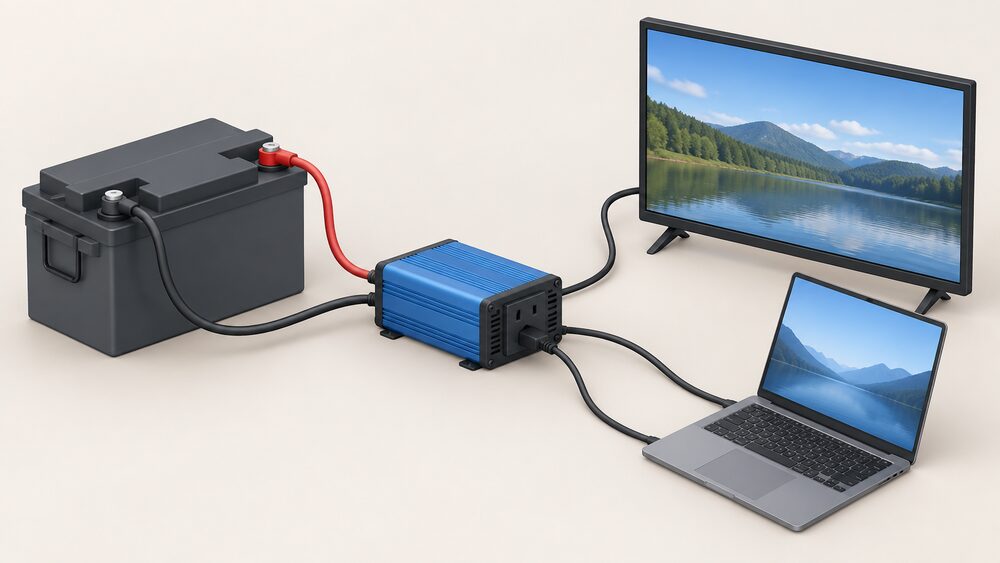
A 12V inverter takes the low voltage direct current from a battery and produces the 230V alternating current that a laptop charger or a television expects. That conversion is the whole point of the device: domestic equipment is built for mains voltage, and a leisure or automotive battery is not. The maker describes the range as allowing domestic equipment requiring 230V AC to run from leisure or automotive batteries1.
The loads involved are modest. Independent guidance puts a laptop at around 50W on average, against 140W for a desktop computer2, and gives an LCD TV as a 120W example appliance3. A maker sizing guide recommends a 300W to 500W pure sine wave inverter for TV use4. On those figures a laptop and a TV together sit well inside the smallest models in the Victron VE.Direct range, which starts at 250VA and runs to 1600VA5.
What that buys a household is a small measure of independence: a battery, an inverter and a screen or a laptop that keeps working when the mains does not. What it does not buy is autonomy from the grid, a supplier or a fuel chain. The battery still has to be charged from somewhere, and the inverter itself draws a standing load even with nothing plugged in.
What a 12V inverter actually does
An inverter converts direct current into alternating current. In a solar context the same device takes the low voltage DC output of the panels and turns it into the 230 volts needed in a home7. In a battery backup context the input is a battery rather than a panel array, but the job is identical: raise a low DC voltage to a mains-level AC waveform that equipment can use.
An inverter converts the DC electricity stored in a battery, or produced by solar panels, into the alternating current that household appliances use4. In a 12V system that means taking the battery's low voltage DC and producing a 230V AC supply of the kind a socket delivers4. Larger hybrid units in the same family add dual MPPT inputs for flexible PV array design and a built-in display showing real-time system status and power flow, so the household can see what is coming in and going out3.
That input window matters more than it looks. A 12V battery is not a fixed 12V: a charged lead acid or lithium pack sits above nominal, and a loaded one sags below it. The inverter has to hold a stable 230V output across that swing, and it shuts down rather than deep-discharging the battery when the input falls to the low threshold.
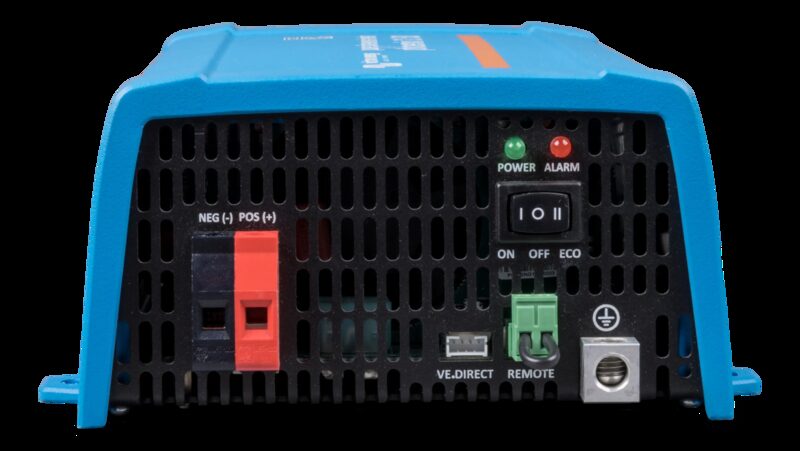
The range also carries a VE.Direct communication port, which gives a data link for monitoring and configuration5. Larger Victron equipment in the same family adds a built-in display showing battery, inverter and solar charger data8. For a household running a laptop and a television, the practical effect is that the inverter is a known quantity in a system rather than a black box.
Laptops and TVs: the low-power loads a small inverter is meant for
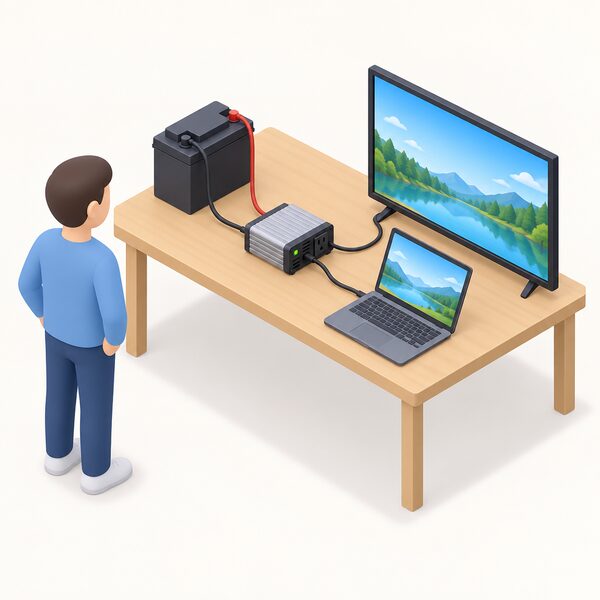
The two loads named in the question are exactly the class of equipment a small inverter is designed around. Independent guidance gives a laptop an average running draw of around 50W, compared with 140W for a desktop computer2. An LCD television is given as a 120W example appliance, alongside a desktop computer at 140W and a dehumidifier at 500W3. A separate independent guide notes that an energy-efficient 32-inch LCD will typically use half the power of a model with a 42-inch plasma screen9.
Those figures are planning values, not nameplate ratings. Screen size, brightness, panel technology and what the laptop is doing all move the number. The point for sizing is the order of magnitude: tens of watts, not hundreds.
The Victron VE.Direct range covers that comfortably. Continuous power at 25°C is offered at 250VA, 375VA, 500VA, 800VA, 1200VA and 1600VA across the 12/250, 12/375, 12/500, 12/800, 12/1200 and 12/1600 models5. The larger Inverter Compact models run from 1200VA up to 2000VA in 12V or 24V10.
There is a standing cost to running any inverter, and it is worth knowing before choosing the smallest unit. Victron's VE.Direct models offer an eco mode that drops the inverter into a low-consumption state when the connected load falls below a preset value, with a minimum load of 15W5. A laptop charger or a standby-mode television can sit below that threshold, so the inverter may keep cycling rather than supplying steadily. The larger Inverters Compact range starts at 1200VA and runs up to 2000VA in 12V or 24V, which is a different class of machine from the small units meant for a single low-power load6.
The range also has an eco mode that reduces consumption when the load falls below a preset value, with a minimum load of 15W5. A laptop or a television sits above that threshold, so eco mode will hold the inverter awake while either is running.
Choosing an inverter: the Victron range and the VE.Direct port
Sizing starts with the sum of the loads. A laptop at around 50W2 and an LCD TV at 120W3 come to roughly 170W, which is a plain addition of the two independent figures. A maker sizing guide recommends a 300W to 500W pure sine wave inverter for TV use4, which leaves headroom above that sum for start-up surges and for a second device.
The table below sets out the VE.Direct range as the maker publishes it.
| Model | Continuous power at 25°C | Zero-load power |
|---|---|---|
| 12/250 | 250VA | 4,2 / 5,2 / 7,9W |
| 12/375 | 375VA | 5,6 / 6,1 / 8,5W |
| 12/500 | 500VA | 6 / 6,5 / 9W |
| 12/800 | 800VA | 6,5 / 7 / 9,5W |
| 12/1200 | 1200VA | 10 / 11 / 12W |
| 12/1600 | 1600VA | 12W |
Across the range, the maker gives the input voltage range as "9,2 - 17 / 18,4 - 34,0 / 36,8 - 62,0V" and the DC low shutdown as 9,3 / 18,6 / 37,2V.
Source: Victron Energy VE.Direct inverter datasheet5.
The VE.Direct port is the feature that separates this range from a plain inverter. It provides a communication link for monitoring and configuration5, and it is the same protocol family used across the maker's smaller equipment. For a household that wants to know what the battery is doing, that link is the difference between guessing and reading a figure.
Above this range sit the Inverter Compact models, from 1200VA up to 2000VA in 12V or 24V10, and the EasyPlus, described as a powerful sine wave inverter11. The Sun Inverter takes the same idea to a different input, powering 230V AC equipment from leisure or automotive batteries12.
Does the waveform type matter for laptops and TVs?
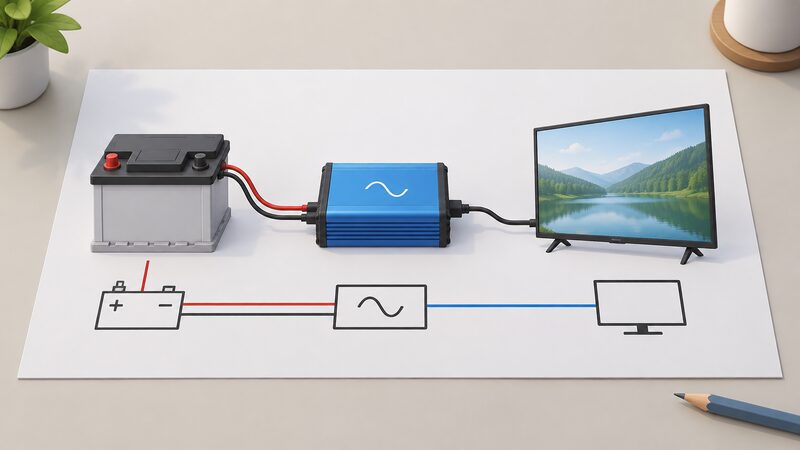
Waveform is a stated specification across this equipment, and the maker is explicit about why. The Inverter Compact is described as a pure sine wave inverter with a high efficiency10. The maker states that its Professional duty inverters safely power sensitive electronics thanks to the pure sine wave6. The EasyPlus is described as a powerful sine wave inverter11.
A pure sine wave output is the waveform type named for electronics of this class. The distinction matters because a laptop power supply and a television are both switch-mode devices that rectify and regulate the incoming AC. The maker's own framing ties pure sine wave output to sensitive electronics, and that is the specification to look for on a datasheet.
"Our Professional duty inverters safely power sensitive electronics thanks to the pure Sine Wave."
The range also carries environmental limits worth noting. Maximum humidity is 95% non-condensing5. That is a datasheet figure rather than a recommendation, but it sets the boundary for a garage, shed or outbuilding installation.
Warranty: 5 years standard, upgradable to 10 for an extra 10%
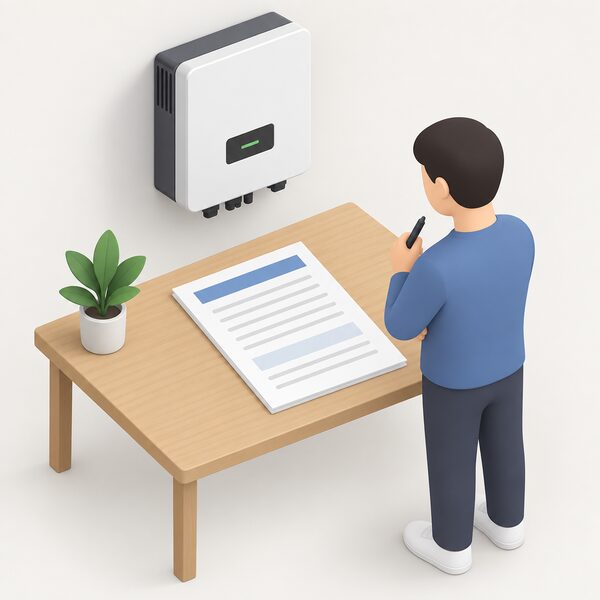
Victron Energy states a standard 5 year warranty, upgradable to 10 years by an additional 10% of the initial investment6. The Phoenix Smart Inverters are listed with a five year warranty13. The upgrade is priced as a percentage of what was spent rather than as a flat fee, so the cash cost scales with the size of the unit.
That structure is worth reading carefully. The standard term is five years, and the extension is an option purchased at the outset rather than a service plan added later. The maker's own wording ties the extension to the initial investment, which means the figure to work from is the purchase price of the inverter.
For comparison, other makers in the wider market publish similar structures. Deye lists several hybrid inverter models as 5 years with 10 years optional12, and other models in its range as 5 years or up to 10 years14, with one three-phase low voltage model listed at 5 years16. The pattern of a five year base term with a paid extension is common across the sector.
Victron Energy: a Dutch, family-run maker with over 50 years of experience
Victron Energy is a Dutch company17, and the maker describes itself as a family run business with over 50 years of experience in building energy storage and self-consumption systems6. Corporate documents name the manufacturer as Victron Energy B.V., De Paal 35, 1351 JG Almere, Netherlands16, and the same entity appears as manufacturer on other certificates and compliance statements in the range14.
That corporate identity matters for a buyer because it ties the warranty to a named legal entity in a named jurisdiction. The company appears as manufacturer on IEC 60335 certification for its chargers16, on IEC 60335 certification for MultiPlus-II models14, and on a UK product safety statement of compliance15. Certification of this kind is issued to the manufacturer, not to a reseller.
The off-grid market page sets out how the equipment integrates with the rest of a system. Managed batteries can be integrated through the maker's GX devices in minutes, and AC-PV inverters are supported directly after installing a software assistant6. The maker also reports strong collaboration with Fronius PV inverters6.
For a household, that integration is the difference between an inverter and a system. A laptop and a television are the loads; the battery, the charging source and the monitoring all sit around them, and the maker's own documentation describes how those parts connect.
Buying and support in the UK

Victron inverters reach UK households through distributors rather than direct sale, and published listing prices are the exception rather than the rule. One listed model, the VM-12/3000/120-16, is priced at £984.9813. For most other models in the range, prices are installer-quoted and depend on the wider system specified, so no range is given here.
The maker states that it offers full technical support in the UK17. Support runs through the maker and its UK distribution network, and the VE.Direct communication port on the inverter range provides the data link that fault diagnosis starts from5.
Availability of the wider range varies by model and by distributor stock. Where a model is not held, lead time is a distributor matter rather than a maker one. Prices for models not listed above are installer-quoted or distributor-quoted, and no range is given here for them.
For a household weighing a small inverter against other backup options, the comparison is worth making on load and runtime rather than on headline capacity. A 12V inverter running a laptop and a television is a narrow, low-power solution. It pairs naturally with a battery that is charged from the mains, from solar or from a vehicle, and it sits alongside the wider options covered in inverters and inverter-chargers and portable power stations.
The dependence that remains is straightforward. The inverter needs a charged battery, the battery needs a charging source, and the charging source is usually the grid or a fuel engine. A 12V inverter for a laptop and a TV reduces the consequence of a short outage. It does not remove the household from the supply chain behind it.
Sources17 cited
- Phoenix Inverter VE.Direct 250VA to 800VA, Victron Energy, 2026-09-19
- Energy saving tips for electronics, ivie, 2026-09-20
- Plug-in solar advice, Centre for Sustainable Energy, 2026-09
- What size inverter do I need?, Solax Power, 2026-05-13
- Inverter VE.Direct 250VA to 1600VA datasheet, Victron Energy, 2026-09-17
- Off-grid market page, Victron Energy, 2026
- Solar photovoltaic information, CAT, 2026-03-10
- Inverter RS 48/6000 230V Smart Solar, Victron Energy, 2026-09-19
- How much electricity does a TV use?, Uswitch, 2026-07-01
- Phoenix Inverter Compact, Victron Energy, 2026-09-19
- EasyPlus 12V 1600VA, Victron Energy, 2026-09-19
- Sun Inverter, Victron Energy, 2026-09-19
- Victron Phoenix Smart inverters, Wind and Sun, 2026-09-20
- IEC 60335 certificate, MultiPlus-II (GX) 4k5 and 6k5, Victron Energy, 2025-11-12
- UK PSTI statement of compliance, smallBMS NG, Victron Energy, 2025-04-11
- IEC 60335 certificate, Blue Smart IP67 Charger, Victron Energy, 2026-04-22
- Victron storage economics, Spirit Energy, 2026
 Inverters and Inverter-ChargersIf the power goes off, what actually keeps your fridge and boiler running?
 Portable Power StationsWhat can a portable power station actually keep going in a power cut, and for how long?
 Portable Power Station SizeHow big a portable power station does a home actually need, and how long will it keep things running in a power cut?
 Domestic Wind TurbinesCan a wind turbine really power a home, and is your site windy enough?
 UPS Sizing ExplainedWhat size uninterruptible power supply do you need, and how long will it keep your devices running in a power cut?
 Wind Turbine Output and SizingHow much electricity a home wind turbine makes depends far more on your wind than on its size.