
In this answer
Short answer
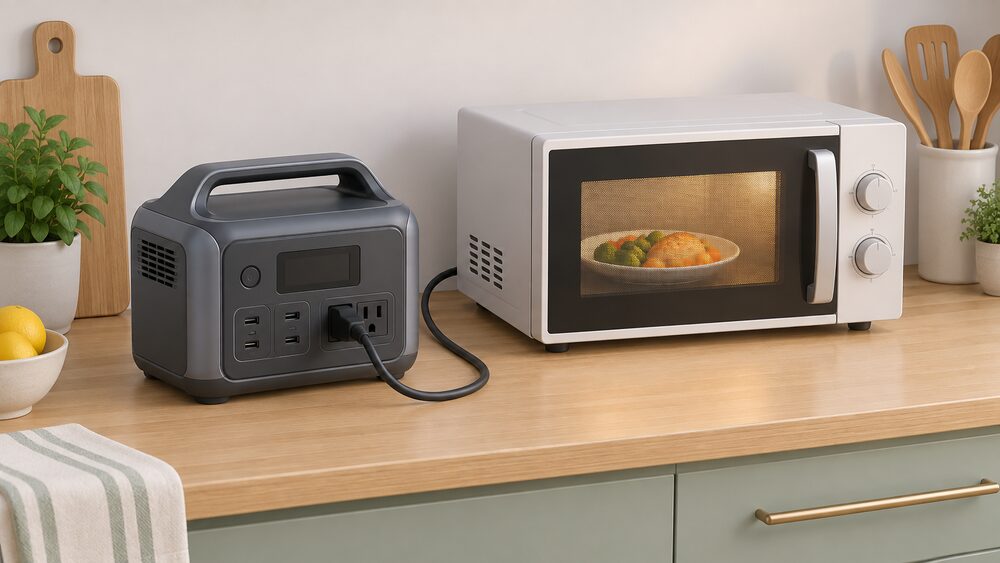
A portable power station can run a microwave, but the question is not whether it can start one. It is how long it will hold up, and whether the model in front of you is rated for the load. A microwave is commonly rated around 750W, and one independent guide gives a 750W figure for the appliance1. Sizing guidance for off-grid use puts a 3,000 to 5,000 watt generator as sufficient for basic off-grid appliances2, and medium generators of 3,000 to 5,000 watts are described as covering large appliances such as refrigerators, freezers, space heaters and sump pumps3.
The practical answer splits in two. A small station will run a microwave briefly, and makers publish those runtimes. Jackery lists 1.7 hours at 500W for the Solar Generator 1000 v2 and 3.2 hours at 500W for the 2000 v24. Anker SOLIX lists 1.5 hours for the C1000 on a microwave5. Jackery lists 0.8 hours for the Explorer 1000 v2 at 1160W6. Those figures are the maker's own, tested at stated wattages, and they move sharply with the load.
What a household gains is a cooking appliance that works without the grid, indoors, with no fuel and no exhaust. What remains is dependence on a charged battery, on a manufacturer's warranty, and on the grid or a solar panel to refill it.
What running a microwave actually demands from a power station
A microwave is a high-draw appliance for a short period, and that shape matters more than the total energy it uses. One independent guide gives a 750W rating for a microwave1, while maker product pages list 700W and 1160W examples for the same appliance type9.
The Energy Saving Trust notes that microwaves are generally more efficient than ovens at heating food up, as they only heat the food and not the air space inside1. That is the case for using one on a battery at all: the energy goes into the food rather than into warming an oven cavity.
What the station must supply is the running wattage plus whatever surge the appliance draws at start, sustained long enough to cook a meal. A station's inverter rating, not its capacity in watt hours, decides whether it will run the appliance at all. Capacity decides how many meals follow.
There is a second demand that is easy to miss. Households with medical devices, people with children and shift workers may need to consume electricity at peak times10, and a microwave is one of the loads that sits in that window. A station charged overnight can carry cooking into a peak period without drawing from the grid at the moment of highest demand.
"Microwaves are generally more efficient than ovens at heating food up, as they only heat the food and not the air space inside"
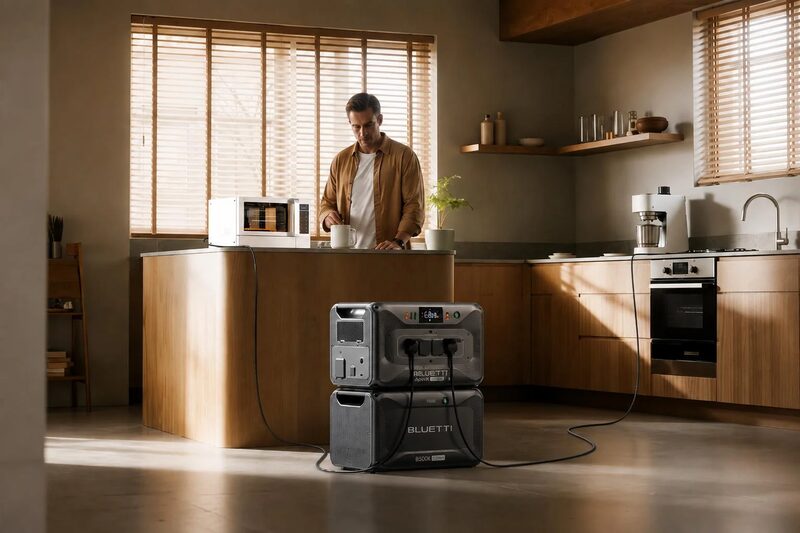
Output guidance: the 3,000 to 5,000 watt range for off-grid appliances
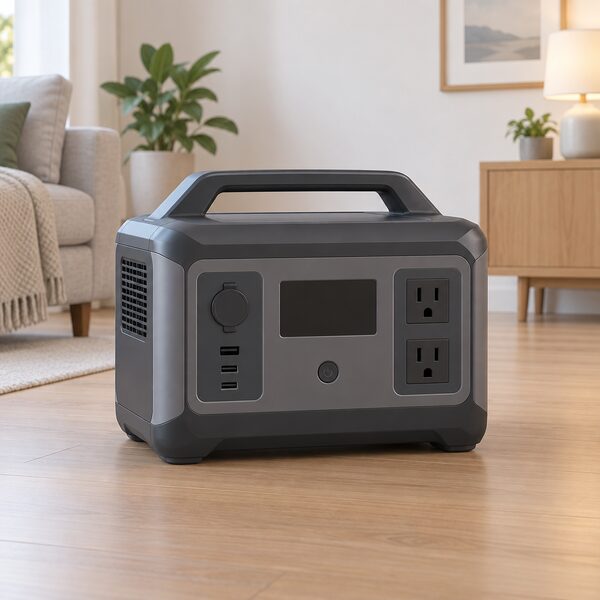
The sizing rule that recurs across maker guidance is a 3,000 to 5,000 watt generator for basic off-grid appliances2. Jackery states the same figure on its off-grid living page2 and again on its emergency generator guidance3. Medium generators of 3,000 to 5,000 watts are described as covering large appliances such as refrigerators, freezers, space heaters and sump pumps, for emergency power at a home or small business3.
That range is a generator figure, and it is wider than most portable power stations. It is best read as the ceiling a household should plan against when the microwave shares a circuit with other loads. A station rated below the top of that band may still run a microwave alone, but the margin for a second appliance at the same time narrows.
Capacity guidance sits alongside the output figure. Portable power stations of 2,500Wh and above are described as suiting heavier home backup and longer off-grid stays7. A station in that capacity class paired with a suitable inverter is the combination the guidance points to for repeated cooking.
| Guidance | Figure | Applies to |
|---|---|---|
| Off-grid generator sizing | 3,000 to 5,000 watts | Basic off-grid appliances2 |
| Medium generator class | 3,000 to 5,000 watts | Refrigerators, freezers, space heaters, sump pumps3 |
| Capacity for heavier backup | 2,500Wh and above | Home backup and longer off-grid stays7 |
| Microwave rating | 750W | Common UK appliance estimate1 |
For a household, the output figure is the one that decides whether the purchase works at all, and the capacity figure decides how long it works for. A station that meets the output test but sits at the bottom of the capacity band will cook one meal and need recharging.
Jackery, BLUETTI or Anker SOLIX: how the main brands compare
The three brands publish runtimes in different formats, which makes direct comparison harder than the numbers suggest. Jackery lists hours at a stated wattage for some models and hours for a stated appliance wattage for others. Anker SOLIX lists a single microwave runtime. BLUETTI's UK pages in this area cover winter storm backup and silent generator guidance rather than a microwave runtime table11.
| Model | Microwave runtime | Load stated | Source |
|---|---|---|---|
| Jackery Solar Generator 1000 v2 | 1.7 hours | 500W | 4 |
| Jackery Solar Generator 2000 v2 | 3.2 hours | 500W | 4 |
| Jackery Solar Generator 2000 Plus | 2.5 hours | 700W | 9 |
| Jackery Solar Generator 2000 Pro | 2.6 hours | 700W | 9 |
| Jackery Explorer 1000 v2 | 0.8 hours | 1160W | 6 |
| Anker SOLIX C1000 | 1.5 hours | Microwave | 5 |
The 2000 Plus and 2000 Pro pages also list other appliances at the same time, which shows how quickly a station's budget is spent: the 2000 Plus is listed at 1 hour for an electric oven at 1600W and 57 minutes for a heater at 1800W9. A microwave is a comparatively light load next to those.
Jackery's UK pages cover emergency generator guidance and uninterruptible power supply use3. Anker SOLIX publishes a UK C1000 page5. BLUETTI's UK site covers the AC300 and B300 power system8. None of these pages should be read as a ranking; they are the makers' own figures for their own products, tested under their own stated conditions.
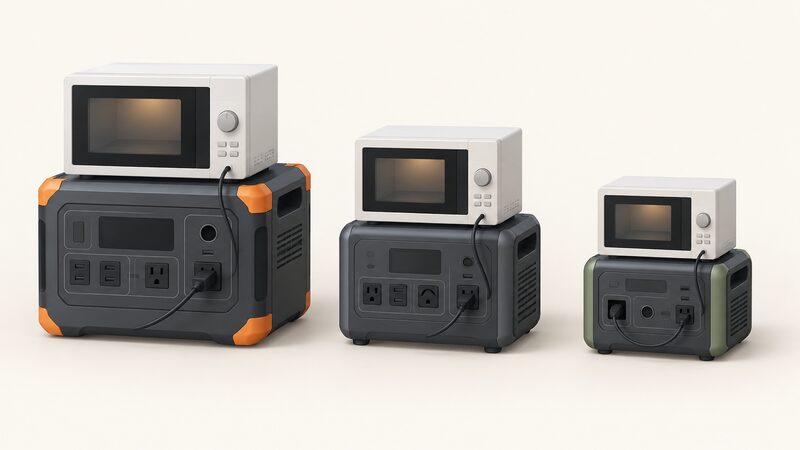
Battery chemistry and cycle life: why LiFePO4 and 3,000 cycles matter for repeated use
Repeated cooking loads a battery hard, and chemistry decides how many times it will take that. Many current LiFePO4 stations are rated for roughly 3,000 to 6,000 cycles before falling to about 80% of original capacity7. Lithium iron phosphate batteries are given as 4,000 to 6,000 cycles in one maker guidance12, and LiFePO4 chemistry is described as a strong choice for frequent use because it is designed for thousands of charge cycles and offers good thermal stability11.
The figures do not agree across documents. One maker guidance gives 4,000 to 6,000 cycles12 while another gives 4,000 to 10,000 cycles7, and a third gives 2,500 to 3,500 cycles against over 6,000 cycles elsewhere13. What is consistent is the shape of the claim: LiFePO4 is rated in thousands of cycles, not hundreds.
Service life is stated in years as well as cycles. One maker guidance gives a 10 to 12 year service life, 95% round-trip efficiency, and over 6,000 charge cycles before displaying significant degradation13. A separate case study example gives 6,000 cycles for an LFP battery12.
For a household, cycle life is the number that decides whether a station is a one-off purchase or a recurring cost. A station cycled daily on cooking and recharging will reach its rated cycles far sooner than one used for occasional outages. Thermal stability matters for indoor use, where the station sits in a kitchen rather than a garage.
Warranty, returns and price guarantees: what you get if it does not cope
Warranty terms are the maker's own statement, and they are narrower than buyers often assume. BLUETTI's product page for the AC300 and B300 power system states a 4 year warranty8. Anker's limited warranty for portable power stations excludes products that are damaged or modified, products operated with a damaged cord, plug or output cable, products that are disassembled, products cleaned with harmful chemicals or detergents, non-quality related issues after 30 days of purchase, products purchased from unauthorised resellers, products without sufficient proof of purchase, products that have been refunded, products with an expired warranty, lost or stolen products, damage from outside sources, damage from misuse, and purchases from illegitimate resources14.
That list matters for the microwave question directly. A station that will not run an appliance is not necessarily a faulty station, and a warranty that covers manufacturing defects does not cover a mismatch between the appliance and the inverter rating. The exclusion for non-quality related issues after 30 days of purchase is the clause that bears on a change of mind.
On the appliance side, the general safety position is that if there may be a problem with an appliance, it should be unplugged and the retailer, manufacturer or a qualified repair technician contacted as appropriate15. That is the route for a microwave that trips a station, rather than continued use.
Buying in the UK: delivery, financing and support
Availability changes quickly, and maker sites record it. Jackery has listed the Explorer 500, Explorer 300, Explorer 3000 Pro, Explorer 1000, Explorer 550, Explorer 240, Solar Generator 1000 Plus and Battery Pack 1000 Plus as sold out at various points, directing buyers to newer models such as the Explorer 600 v2, Explorer 240 v2, HomePower 3600 Plus, HomePower 3000, HomePower 1000 v2 and Explorer 1000 v26. Those notices are dated and site-specific, and a model sold out on one site may be available elsewhere.
No source here states a free shipping policy, a Klarna option, or a price guarantee for power stations. Prices are installer-quoted or shown at the point of sale, and no published figure for these units is given in the material behind this page. Delivery terms, payment options and returns are set by each seller and should be read on the product page at the time of purchase.
Support around power cuts sits with the network operators rather than the retailers. The 105 number is the route for reporting and checking a power cut16, and network operators publish energy saving advice for customers on their extra care registers17. For households that need electricity at particular times, including those with medical devices, the Priority Services Register is the relevant route, and it is covered in more detail on the Priority Services Register page.
Where a household is weighing a station against other options, the wider comparison sits on the portable power stations page, and sizing is covered on what size portable power station you need. Battery chemistry is developed further on portable power station batteries.
Where a station falls short of a generator
The 3,000 to 5,000 watt guidance is a generator figure, and most portable power stations sit below it. That gap is the honest limit of this approach. A station that runs a microwave for a stated number of hours at 500W is not the same as a station that runs a 750W microwave alongside other kitchen loads.
There is also a dependence that does not go away. A station needs recharging from the grid or from solar, and solar charging depends on daylight and panel siting. Guidance on making the most of solar panels covers the household side of that18. A pellet appliance, for comparison, requires electricity to operate19, so a household that has moved some heating to a fuel appliance may still need power for it.
The regulatory position on connecting generation to a home supply is separate and specific. A plug-in microgenerator is defined in legislation as intended for connection to a low voltage consumer's installation by means of a standard plug and socket20. That definition concerns generation, not a power station running a microwave, but it is the boundary a household should not cross by wiring a station into a ring main.
Smart plugs, often used alongside a station to control loads, require a smartphone and wi-fi connection to function and are primarily used to turn things on and off remotely, usually with no built-in LCD screen21. That is a dependence on a working network and a working phone, which is worth knowing before relying on one during an outage.
Sources21 cited
- Top five energy consuming home appliances, Energy Saving Trust, 2026
- Solar generator for off-grid living, Jackery, 2026
- Guide to emergency generators, Jackery, 2026
- Uninterruptible power supply, Jackery, 2026
- Anker SOLIX C1000 portable power station, Anker SOLIX, 2026
- Explorer 1000 v2 with accessories, Jackery, 2026
- Best portable power stations, BLUETTI UK, 2026
- AC300 and B300 power system, BLUETTI UK, 2026
- Home generator cost, Jackery, 2026
- Research briefing on electricity demand, UK Parliament, 2026
- Best silent generator UK, BLUETTI UK, 2026
- Are solar batteries worth it, Jackery, 2026
- Battery throughput life cycle, Solax Power, 2026
- Anker portable power station warranty policy, Anker, 2026
- Demand flexibility service: running appliances at cheaper times, Electrical Safety First, 2026
- Power cut 105, Powercut105, 2026
- Energy tips to help you save, Electricity North West, 2026
- Making the most of your solar PV panels, Centre for Sustainable Energy, 2026
- Wood, coal and smokeless fuel: which is right for your stove, HETAS, 2026
- The Electricity and Gas (Smart Meters) Regulations 2026, legislation.gov.uk, 2026
- Are energy monitors the best way to measure your power usage, Which?, 2026
 Portable Power Station SizeHow big a portable power station does a home actually need, and how long will it keep things running in a power cut?
 Portable Power StationsWhat can a portable power station actually keep going in a power cut, and for how long?
 UPS Sizing ExplainedWhat size uninterruptible power supply do you need, and how long will it keep your devices running in a power cut?
 Backup Power for HeatingWhy gas boilers, heat pumps and storage heaters stop in a power cut, what a portable power station can and cannot carry, how to size one, and what home battery systems do when the mains fails.
 Portable Power Station CostHow much does a portable power station cost in the UK, and what does the money actually buy?
 Domestic Wind TurbinesCan a wind turbine really power a home, and is your site windy enough?