
In this answer
Short answer
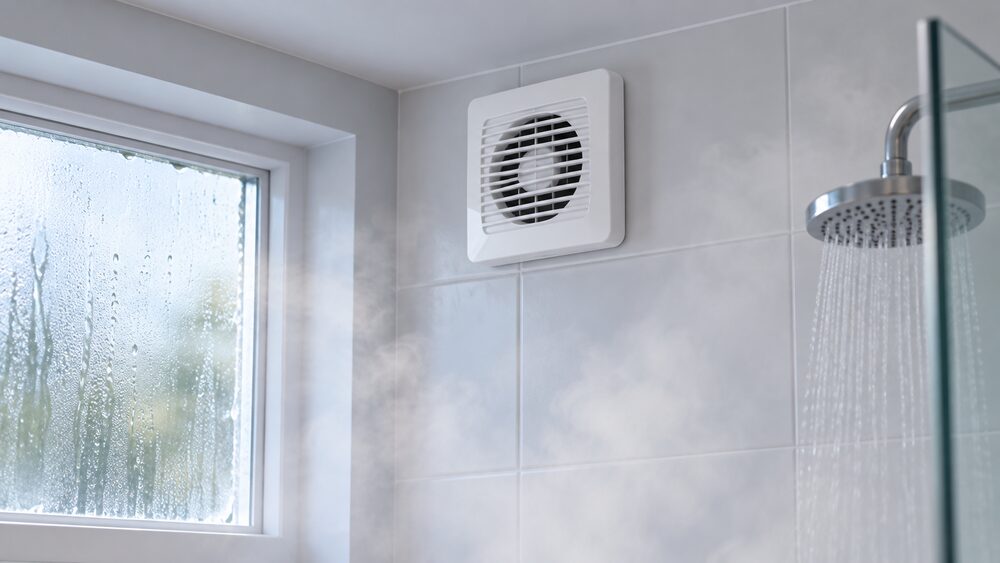
A bathroom extractor fan should run for at least 15 minutes after a shower or a bath, according to the Energy Saving Trust, which pairs that figure with the same run-on for a cooker extractor after cooking1. National Energy Action leaflets for the UK and for Northern Ireland put the figure slightly higher, advising that windows and extractor fans be left to run for about 20 minutes after to clear any steam2. The two figures are not in conflict so much as a floor and a working target: 15 minutes is the minimum, and 20 minutes is what the advice leaflets suggest in practice.
The reason the run-on matters is that the moisture does not leave the room when the shower stops. Water vapour stays in the air until it is either extracted or it condenses on the coldest surface it can find, which in a bathroom is usually the window, the external wall or the grout. Zehnder states that mechanical ventilation units can substantially reduce humidity within 15 to 30 minutes after a shower, which is the same window the run-on advice is built around4. A fan switched off at the moment the shower ends leaves that vapour indoors.
The cost of running on is small. Extractor fans typically use between 5 and 40 watts, and the Centre for Sustainable Energy puts a 20 watt extractor fan at about 1p per hour of use5. Power NI states that a standard bathroom fan running for 30 minutes a day would use around 15 kWh of electricity per year5. Fifteen minutes of overrun is a fraction of that daily half hour, so the moisture benefit is bought cheaply.
Why the run-on time matters for moisture and mould
Condensation and mould are the visible end of a moisture problem that starts with air that was never extracted. BEAMA's mould and condensation guidance sets out the health impacts of a build-up of condensation and mould in the home and gives three ventilation solutions: extractor fans, trickle vents and whole home ventilation systems9. The run-on period is the part of that system that deals with the moisture still in the air once the source has stopped.
The BESA's four steps to mould-free homes include installing extract fans in kitchens and bathrooms and giving occupants the usable means to ventilate the whole home, including bedrooms and trickle vents on windows10. That framing matters: an extract fan is one part of a ventilation strategy, not a substitute for ventilating the rest of the house. A bathroom fan that runs on properly clears the wet room, but the moisture that has already drifted into a landing or bedroom needs its own route out.
The mechanism is straightforward. Aereco describes humidity sensitive exhaust units opening quickly to evacuate excess moisture and eliminate the risk of condensation when relative humidity increases dangerously11. Zehnder notes that mechanical ventilation systems offer avoidance of moisture damage12. EnviroVent states that intermittent fans and other extractor fans are required to ventilate to atmosphere to remove the stale, moist air from the wet rooms within the property13. The run-on is what makes that removal complete rather than partial.
Where a household has no extractor fan at all, Which? advises considering having one installed and using it each time you shower or bathe14. The Centre for Sustainable Energy notes that in places where lots of moisture is produced, such as kitchens, bathrooms and utility rooms, extractor fans are required to remove the excess moisture, and that if there is no extractor fan, opening a window will help15. For a household's energy independence, a fan is a small, low-power device that runs on grid electricity, so it does not remove dependence on a supplier, but it protects the fabric of the home that insulation and glazing work is meant to preserve.
How run-on is controlled: timers, humidity sensors and overrun settings
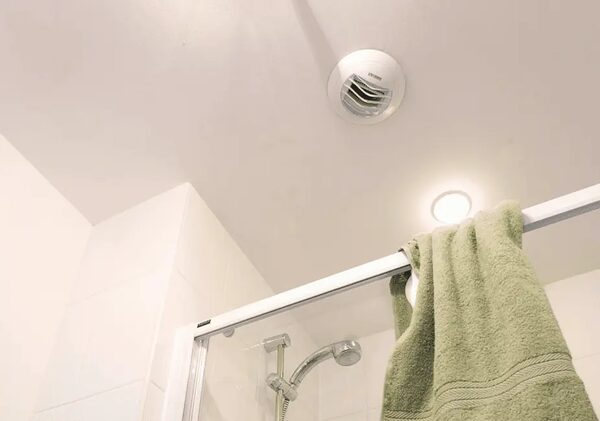
The run-on can be set by a timer, triggered by a humidity sensor, or left to the occupant. The Centre for Sustainable Energy describes intermittent extract ventilation as individual extractor fans in bathrooms, kitchens and utility rooms, usually controlled by a light switch, a timer or humidity sensor, and notes they are relatively cheap to install and reasonably effective but not always sufficient for very air-tight or damp-prone properties15. That last point is the limit of the technology: a fan sized and set for an ordinary bathroom may not keep pace with a sealed, heavily used one.
Timer control is the most direct answer to the run-on question. The Airflow iCONsmart 30 has an adjustable timer available from 2 to 45 minutes, and the same unit offers adjustable humidity control between 35 and 96 per cent room humidity16. Brookvent states that the Airstream ACE overrun timer can be set to suit occupant requirements from 1 to 100 minutes17. Those ranges show how much the right setting varies: a small, well-ventilated bathroom may clear in a few minutes, while a shower room with no window may need the top of the range.
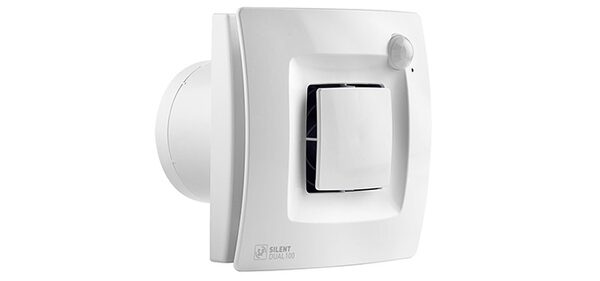
Humidity sensing hands the decision to the fan. EnviroVent describes its Silent Dual as an autonomous and intelligent extractor fan for bathrooms and WCs that automatically adjusts its performance according to the environment and ventilation requirements via two sensors, a presence detector and an adjustable humidity sensor13. Zehnder states that ventilation systems have integrated sensors that detect when humidity is too high and switch on automatically12. Vent-Axia notes that its PureAir Sense bathroom fan gives the choice to run continuously or intermittently18.
Control options across the market include a timer, humidity sensor, pullcord, PIR sensor, thermo-electric shutter and LED light, and the Profile 100 carries an adjustable over-run timer and an adjustable humidity sensor13. The Airflow iCONsmart 30 adds real-time data logging, silent hours, room refresh and delay start16. For a household, the practical question is whether the fan will run on without anyone remembering to leave it on, and a timer or humidity sensor answers that.
Where the 15-minute rule falls short: baths, small bathrooms and ventilation rates
The 15-minute figure is a behavioural rule, not a performance standard, and it assumes the fan is moving the right amount of air. The ventilation rate specified for a bathroom is 15 litres per second, a figure that appears in the Welsh Government's Approved Document F consultation, which states that a ventilation rate of 15 l/s is specified for removing moisture from bathrooms at a production rate of 400 g/h7. BEAMA's guidance for improving indoor air quality in existing homes gives the same 15 l/s for bathrooms and 30 l/s for utility rooms8.
The same Welsh consultation sets out the control requirement for an intermittent extract fan in a room with no openable window: controls which continue to operate the fan for a minimum of 15 minutes after the room is vacated7. That is the regulatory expression of the run-on rule, and it applies where there is no window to fall back on. Viessmann states that building regulations require a minimum fan extraction rate of 50 m³/hr, or 15 l/s, in a bathroom without an openable window19.
Where the rule falls short is in the gap between the specified rate and what a fan actually achieves. Brookvent notes that the local extractor fan which should be extracting at a rate of 15 l/s in a bathroom is often not effective20. A fan that is undersized, badly ducted or clogged will not clear the room in 15 minutes however long it runs. Viessmann makes the sizing point directly: buying a fan that is too small will not do the job efficiently, whereas a fan that is too big will only waste electricity19.
Baths are the other gap. The published advice does not separate a bath from a shower, and no source here sets a longer figure for a bath, but a bath releases moisture over a longer period and in greater quantity than a short shower. The Energy Saving Trust's 15 minutes and National Energy Action's 20 minutes are the figures available, and a household running a deep bath has no separate published number to work to1. The sensible reading is that the run-on should continue until the air is clear, which is what a humidity sensor does and a fixed timer approximates.
Balancing run time against energy use and noise
The energy case for running on is easy to make. The Centre for Sustainable Energy lists an extractor fan at 20 watts as costing about 1p per hour6. National Energy Action's Northern Ireland electrical items cost leaflet puts an extractor fan at less than a quarter of a penny per hour, with a rating of 5 to 10 watts21. Power NI gives the annual figure: a standard bathroom fan running 30 minutes a day would use around 15 kWh of electricity per year5. Sizing matters as much as run time: a fan that is too small will not do the job efficiently, while one that is too big wastes electricity16.
The noise question is separate and harder to generalise. Quiet Mark lists the Airflow iCONsmart 30 with a silent shutter and low energy consumption, and notes it complies with Building Regulations and is ductable for short runs16. The unit is described as ideal for toilets, en-suites, shower rooms and bathrooms16. Noise is a product characteristic rather than a run-time one, but it bears on whether a household actually leaves the fan running: a fan that is unpleasant to hear is more likely to be switched off early.
There is a safety point that sits alongside the run-time advice. Electrical Safety First warns against leaving a fan on overnight, advising that a fan be turned off before going to sleep and that working smoke alarms be ensured22. That warning is aimed at portable cooling fans rather than fixed bathroom extractors, but the principle of not running unattended electrical equipment overnight is worth separating from the bathroom run-on question, which concerns a short period after use rather than all night.
For a household's energy independence, the extractor fan is a small grid-dependent device with a large protective role. It draws a few watts, costs pennies a year, and guards the building fabric that insulation, glazing and draught-proofing work is designed to protect. The run-on period is the part of its operation that does the most work, and it is the part most easily defeated by switching the fan off too soon.
Sources22 cited
- Fixing damp and condensation, Energy Saving Trust, 2026-05-22
- Dealing with condensation and mould, National Energy Action, 2026-07-13
- Dealing with condensation and mould (Northern Ireland), National Energy Action, 2026-09-07
- Bathroom renovation, Zehnder, 2026-09-20
- Which appliances use the most electricity, Power NI, 2025-07-07
- How much electricity am I using, Centre for Sustainable Energy, 2026-07
- Building Regulations Part L and F review stage 2a, Approved Document F, Welsh Government, 2020-11
- Guidance for improving Indoor Air Quality in Existing Homes, BEAMA, 2023-06
- Mould and condensation infographic, BEAMA, 2026-09-19
- Four steps to mould-free homes, BESA, 2024-05-17
- Advantages of demand controlled ventilation, Aereco, 2026-06-11
- Mould, Zehnder, 2026-09-20
- Intermittent extract fans, EnviroVent, 2026-09-20
- How to stop condensation, Which?, 2026-05-26
- Ventilation, Centre for Sustainable Energy, 2025-07
- Airflow iCONsmart 30 extractor fan, Quiet Mark, 2026-09-17
- January sale 2024, Brookvent, 2024-01-05
- How do I choose my ventilation system, Vent-Axia, 2026
- Calculate extraction rate, Viessmann, 2022-03-24
- Retrofit ventilation solutions, Brookvent, 2026-09-20
- Electrical items cost (Northern Ireland), National Energy Action, 2025-04
- TikTok fan cooling hack warning that could risk electric shock, Electrical Safety First, 2026-09-19
 Maintaining Backup PowerWill your generator actually start when the power goes off?
 Exhaust Air Heat PumpsHow exhaust air heat pumps recover heat from air extracted by a home's ventilation system to provide heating, hot water and ventilation from one indoor appliance, and the capacity limits that follow from the ventilation rate.
 Radiators and Heat EmittersA radiator's real heat output depends on how hot the water inside it is compared with the room, so the figure in a catalogue often overstates what you will actually get.
 Electric FansHow electric fans cool people rather than rooms, what the main UK fan types (desk, pedestal, tower, ceiling and bladeless) draw in watts and cost per hour, where they fall short in a heatwave, how to use them safely, and how they fit alongside night ventilation and shading.
 Electric Heating CostsHow to work out what electric radiators, panel heaters, infrared and storage heaters cost to run per hour and per season.
 Manufacturer WarrantiesHow long does a boiler, heat pump or solar panel warranty actually last, and what do you have to do to keep it valid?